






 Request Consultation
Artificial intelligence is transforming clinical research by accelerating patient recruitment, protocol design, medical literature review, and regulatory documentation. This blog explores the leading companies developing AI-powered solutions for clinical trials, their latest innovations, competitive strategies, and how they are shaping the future of life sciences and drug development.
Introduction to AI-Powered Transformation in Clinical Trials and Medical Literature Review
AI has evolved into a base infrastructure in the life sciences, changing from experimental pilots to agent-driven workflows. Firms utilize intelligent agents and machine learning to optimize synthetic biology, simulate cell biology, and fast-track complex biological and chemical data processing to determine therapeutic candidates. AI is applied to operationalize precision medicine, using genetic profiles and predictive modeling to tailor treatments, thus streamlining hospital workflows and assisting in early disease detection.
Pharma AI solutions are assisting researchers in identifying disease-causing targets, like proteins or genes linked to an illness, with greater speed and accuracy. Advanced algorithms can analyze massive biological datasets, thus drastically reducing the time needed to search for viable treatment options. AI agents as well as predictive analytics streamline clinical trials by automating patient recruitment, enhancing site selection, and continuously monitoring trial progress. This shifts the bottleneck from discovery to translation and then evidence generation.
Open-source AI tools and data platforms, for instance, the Human Protein Atlas, enable academics to map complex cellular structures and interactions, thus uncovering novel biological units without man-made ontology limits.
Why AI Has Become Essential for Modern Clinical Research and Medical Evidence Generation
Traditional clinical research workflows are fundamentally restricted by siloed, paper-centric methodologies, high error rates, causing fragmented communication, and delayed trial timelines. These bottlenecks raise administrative burdens for staff, limit patient recruitment, and even increase the likelihood of missing data or non-compliance. Inconsistent coding, missing data, along with poor communication between different hospital and research databases, restrict the ability to reuse data or integrate advanced AI and predictive models. Strict geographic protocols and even a lack of decentralized tools contribute to poor enrollment rates and high participant dropout, thus severely delaying research completion.
The Growing Complexity of Clinical Trials Is Driving AI Adoption
Clinical trials have grown drastically in complexity, with an increase in the number of endpoints and a rise in overall data points collected in Phase III trials since 2005. This explosion of variables thus makes AI indispensable for trial execution, as manual tracking is no longer scalable or error-free. Decentralized trials capture digital endpoints remotely, which demands intelligent software to monitor compliance and even process streams of data without overwhelming trial participants.
The Explosion of Biomedical Literature Requires Intelligent Search and Analysis
Human reading speed cannot scale with worldwide knowledge production. Attempting a comprehensive manual review usually leaves researchers sifting via thousands of irrelevant papers, significantly decreasing the efficiency of finding actionable, evidence-driven results. Conference abstracts frequently contain preliminary data and are usually excluded from or complicate systematic reviews, thus muddying the synthesis process.
Rising Drug Development Costs Encourage AI-Based Research Optimization
AI optimizes the criteria for patient enrollment by examining real-world data and forecasting which patient cohorts will benefit most from the therapy. By broadening or tightening these parameters, AI assists in preventing misenrollment, minimizing protocol deviations, and expanding access to diverse populations. Further, AI tools transform unstructured study protocols into standardized digital artifacts, enabling sponsors to pre-populate budgets. Benchmarking systems quantify "patient burden"- how much a trial disrupts the individual's daily life- which helps teams improve visit schedules and reduce dropout rates before a single site is activated.
AI in Clinical Trials Market Size and Forecast 2026 to 2035
The global AI in clinical trials market is estimated at USD 2.60 billion in 2025 and is projected to grow from USD 3.32 billion in 2026 to approximately USD 25.52 billion by 2035, registering a CAGR of 25.66% during the forecast period from 2026 to 2035. The market's growth is primarily driven by the increasing need to accelerate drug development timelines while reducing overall clinical trial costs.
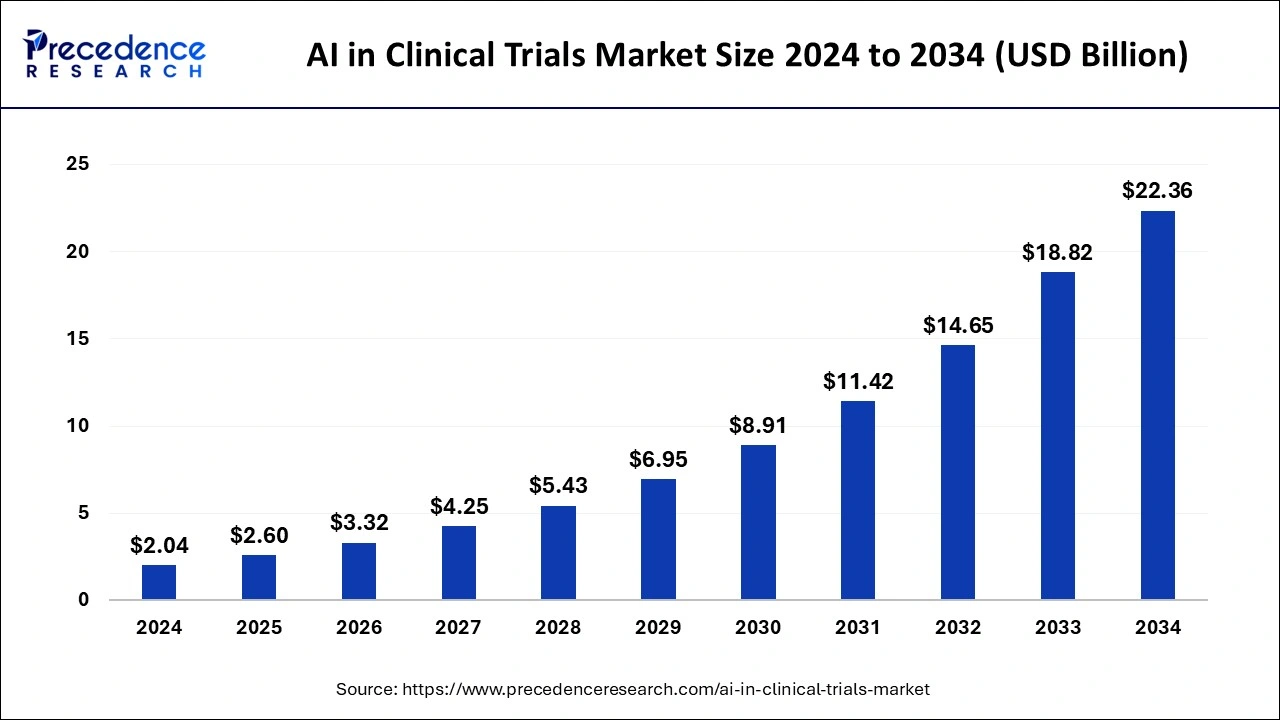
Get a Free Sample Report with Key Market Trends: https://www.precedenceresearch.com/sample/3743
Understanding AI Tools Used Across Clinical Trials and Medical Literature Review
Artificial Intelligence accelerates scientific research along with clinical development by transforming raw data into actionable medical insights, decreasing trial costs, and decreasing drug discovery timelines. AI applications span from initial laboratory discovery and trial design to patient enrollment and real-time clinical monitoring. AI utilizes mathematical models to build patient "digital twins," enabling researchers to digitally test patient responses to a drug, minimize safety risks, and even build external control arms. Further, wearables and continuous monitoring devices use AI to track patient vitals, sleep cycles, along with physical movements in real-time. This offers digital biomarkers that detect early adverse events or treatment responses.
AI for Clinical Trial Design and Protocol Optimization
AI revolutionizes clinical trials by integrating historical trial data, electronic health records (EHRs), along with real-world evidence (RWE). Through advanced machine learning (ML) and natural language processing (NLP), AI reduces human bias, predicts drug efficacy, and even accelerates the transition from drug discovery to regulatory approval. Furthermore, AI can generate synthetic patients to simulate control groups. This enables researchers to model how rare molecular subgroups respond to therapies, thus without the logistical burden of recruiting entirely new control cohorts.
AI-Powered Patient Recruitment and Site Selection Platforms
AI uses natural language processing to read unstructured clinical notes along with machine learning models to match structured EHR data against trial criteria. It forecasts enrollment by analyzing historical recruitment data and enhances diversity by identifying underrepresented populations and optimizing trial sites. Further, AI evaluates patient engagement and retention levels by assessing variables such as previous appointment adherence and travel distance, ensuring identified patients are thus likely to complete the trial protocol.
AI Solutions for Medical Literature Search and Evidence Synthesis
AI platforms accelerate systematic literature reviews combined with meta-analyses by automating tedious tasks. They scan massive databases, employ semantic algorithms to determine and merge duplicate records, and utilize machine learning to rank abstracts. Finally, they extract numerical study variables and format data, dramatically decreasing manual workloads. Paperguide automates end-to-end data extraction along with meta-analysis generation, while DistillerSR and Gatsbi Reviewer offer dedicated engines to compile structured data into quantitative synthesis.
AI for Regulatory Writing and Clinical Documentation
Specialized enterprise applications automate clinical along with regulatory documentation by synthesizing underlying trial data, statistical outputs, and templates. These AI platforms generate drafts for Clinical Study Reports (CSRs), Investigator Brochures (IBs), and even submission dossiers to improve consistency and compliance with FDA and EMA standards. For instance, Multiplier AI encompasses modules programmed to automatically generate eCTD-compliant dossier modules, IBs, along with patient narratives utilizing preclinical and clinical data summaries.
AI for Pharmacovigilance and Safety Signal Detection
AI continuously monitors global pharmacovigilance by utilizing natural language processing (NLP) and machine learning algorithms. Machine learning tools monitor announcements from authorities such as the FDA, EMA, and PMDA, updating compliance workflows and generating structured regulatory reports automatically. By establishing baselines along with comparing new signals against historically reported cases, AI can cut via noise and prioritize alerts based on severity. This reduces false positives, enabling pharmacovigilance experts to quickly focus on actionable insights.
Key Technologies Powering Next-Generation AI Platforms in Clinical Research
A synthesis of deep learning, autonomous AI agents, transformer architectures, and high-performance computing drives modern AI research platforms. Working together, these foundational technologies transform raw data into intelligent automation, predictive foresight, and even groundbreaking scientific insights. Moreover, deep learning and neural networks, considered the heart of AI platforms, are layered artificial networks. These models ingest vast volumes of raw information and autonomously uncover complex, hidden patterns without manual programming. Further, high-performance computing, the immense parallel processing demanded to train and run these advanced models, is powered by specialized hardware like GPUs.
Natural Language Processing for Scientific Literature Understanding
Natural language processing (NLP) allows AI systems to ingest and understand healthcare data by converting unstructured text into structured, actionable insights. Via advanced linguistic analysis, NLP bridges the gap between human medical narratives along with machine-readable data, unlocking critical information from complex clinical and scientific documentation. Moreover, NLP parses longitudinal clinical notes, laboratory results, and physician narratives within electronic health records (EHR) to understand patient progress over time. AI systems can automatically extract key metrics such as biomarker measurements and response to therapy, flagging variables which suggest treatment efficacy or complication risks.
Machine Learning Models for Clinical Trial Prediction
Machine learning predicts clinical trial outcomes by training on repositories such as TrialsBank. Algorithms process protocol text, past site performance, along with patient demographics through Neural Networks to calculate risk probabilities and timeline forecasts. Traditional forecasting assumes constant, linear recruitment. Clinical trial timeline thus, forecasting, PPD. ML utilizes time-series algorithms such as long short-term memory (LSTM) networks to model non-linear, regionally variable, and even seasonally affected accrual rates.
Large Language Models for Scientific Knowledge Discovery
Large language models and generative AI accelerate academic and scientific workflows by processing, synthesizing, and even formatting vast amounts of information. While powerful for drafting and exploration, they thus, fundamentally act as writing assistants and require strict human verification to avoid hallucinations or fabrication of citations. AI-driven discovery engines like ScholarAI and specialized literature assistants enable researchers to engage in conversational Q&A directly with databases of millions of scholarly papers. Generative AI condenses vast volumes of text by identifying central themes, methodology, and conclusions across multiple documents. Platforms such as Semantic Scholar provide quick-read summaries (TLDRs), while dedicated platforms such as SciSpace and Elicit help parse and synthesize entire libraries of peer-reviewed articles.
Knowledge Graphs and Biomedical Data Integration
Knowledge graphs (KGs) organize disparate biomedical data into human- and machine-readable networks, thus structuring facts as subject-predicate-object relationships. Diseases are associated with their underlying genetic mutations, dysregulated pathways, and even specific biomarkers that indicate progression or severity. By representing biology as a multi-dimensional web, KGs enable computational models to discover hidden, multi-step connections whih researchers cannot easily see manually.
Top Companies Developing AI Tools for Clinical Trials and Medical Literature Review
The healthcare AI ecosystem consists of four main groups such as established technology firms, specialized life science software manufacturers, AI-native startups, and healthcare analytics companies. Together, these stakeholders advance medical imaging, automate administration, improve clinical trials, and accelerate drug discovery. Legacy vendors such as Veeva, Medidata, and SAS, alongside newer specialized firms, provide the compliance-grade software backbones which integrate AI into drug discovery workflows and regulatory submissions. Companies such as Tempus use vast troves of multi-modal data to fuel predictive analytics and even power personalized medicines such as in oncology.
Microsoft
Microsoft’s healthcare AI ecosystem unifies data and clinical workflows via the Microsoft Cloud for healthcare, powered by highly scalable compute and even secure Azure AI capabilities. By deeply integrating with Electronic Health Record (EHR) systems along with advancing generative AI, Microsoft thus connects life sciences and clinical research ecosystems. Microsoft partners with major organizations to accelerate scientific research and drug development. Further, integrations between EHRs and clinical trial management systems, such as the collaboration with IgniteData and Memorial Sloan Kettering, automate data exchange, thus vastly reducing manual work and trial matching errors.
Google Cloud
Google’s healthcare AI solutions offer clinical-grade, multimodal AI programmed to alleviate administrative burdens and accelerate medical research. Through Vertex AI, healthcare providers can access advanced biomedical search capabilities, integrate domain-specific language models, and compliant APIs to synthesize complex patient data while managing strict HIPAA compliance.
Amazon Web Services (AWS)
AWS provides a suite of purpose-built AWS Health AI services programmed to accelerate and modernize clinical trials. By combining HIPAA-compliant cloud solutions and advanced machine learning infrastructure, alongside specialized NLP tools, life sciences organizations can streamline patient recruitment, improve protocol design, and securely manage clinical data at scale. Tools that offer zero-ETL integration with HealthLake, enabling analysts to query petabytes of clinical, diagnostic, and thus imaging data directly using standard SQL.
IQVIA
IQVIA provides an interconnected suite of life sciences and healthcare-grade AI solutions programmed to accelerate drug development and commercial success. Their capabilities span clinical trial management, real-world data evidence generation, predictive modeling, direct-to-patient recruitment, and tailored industry consulting. IQVIA utilizes advanced analytics to help companies assess study feasibility along with enrollment potential, optimize portfolios, and decrease costly delays. Thus, their Clinical Trial Planning Services assist with competitive landscape evaluations to keep trials on time and on budget.
Oracle Health
Oracle offers a unified, AI-driven healthcare ecosystem that seamlessly bridges clinical care and life sciences research. Their platforms decrease administrative friction, accelerate trial lifecycles, and even securely connect patients' Electronic Health Records (EHR) with clinical trial data for faster medical breakthroughs. Moreover, Oracle Health Clinical AI agent connects clinical, operational, and even financial data into a unified architecture, bringing AI-driven recommendations in real-time to the clinical trial or patient-care continuum.
Medidata Solutions
Medidata provides a unified, AI-powered platform engineered to streamline clinical trials across their entire lifecycle. The platform, offered as part of Dassault Systèmes, integrates data management, patient experiences, along with decentralized capabilities to decrease risk and accelerate study timelines. Proprietary Dataset, thus, an AI engine, is trained on the industry's largest proprietary dataset, leveraging data from over 38,000 trials and also 12 million patients. Synthetic Control Arm utilizes historical control patient data to accelerate trial timelines and decrease the number of active participants required in the control group. Medidata CTMS connects workflows, teams, along with data on a single trial management system to accelerate clinical trial planning and execution.
Veeva Systems
Veeva Systems is transforming life sciences along with regulated industries by embedding Vault AI natively into its single-source-of-truth Vault Platform. Instead of generic plug-ins, Veeva’s purpose-built AI agents function contextually within validated workflows.
Elsevier
Elsevier has integrated generative AI across its platforms to accelerate research, enhance clinical outcomes, and then streamline literature discovery. These AI-enhanced capabilities are built on a foundation of trusted, peer-reviewed content, along with prioritizing data privacy and research integrity.
SciVal & Reaxys platforms utilize machine learning and natural language processing to map disease-symptom relationships, conduct literature synthesis, alongside visualize research performance and emerging themes.
Clarivate
Clarivate leverages its massive, editorially curated data assets to provide AI-powered intelligence across scientific literature, intellectual property (IP), drug discovery, and academic research. It aims to support researchers along with organizations by accelerating breakthroughs, protecting innovations, and even driving data-driven decisions. Clarivate draws on information from over half a million clinical trials alongside biological databases to aid researchers in developing, protecting, and commercializing new therapeutics.
Semantic Scholar (AI2)
Semantic Scholar is a free, AI-powered search engine Semantic Scholar that tackles information overload by understanding paper context and even meaning rather than relying solely on exact keyword matching. The Semantic Reader is an augmented reading tool that offers in-line citation details, skimming highlights, and even contextual pop-ups without forcing users to navigate away from the document in Semantic Scholar.
Consensus
Consensus is an AI-powered search engine which scans over 200 million peer-reviewed academic papers to deliver evidence-based answers. By combining advanced semantic search with AI summarization, it thus accelerates evidence-based decision-making and saves researchers countless hours of manual literature review.
Elicit
Elicit is an AI-powered research assistant programmed to automate and accelerate scientific literature reviews, systematic reviews, and then evidence synthesis. The platform leverages advanced language models to synthesize large volumes of academic literature and fund complex research workflows. The platform features specialized AI "Research Agents" which take a defined research question and even autonomously execute comprehensive investigations. This involves identifying sub-questions, conducting searches, identifying research gaps, and compiling structured research landscapes.
Scite
Scite's Smart Citations revolutionize literature evaluation by categorizing citations as supporting, contrasting, or mentioning. By using deep learning, it determines citation context across billions of statements to offer direct sentence-level validation. This instantly shows if a paper's findings are challenged or backed by subsequent research. Scite’s Assistant as well as Reference Check tools ensure that literature reviews and manuscripts are grounded in verifiable, actively funded research rather than AI hallucinations.
TrialGPT and Emerging AI Startups
Artificial intelligence is transforming biomedical research, significantly cutting drug development timelines and costs. Startups now deploy foundation models, natural language processing (NLP), along with digital twins to automate clinical workflows, optimize trials, and even generate synthetic control data. To protect patient privacy and raise data diversity, AI creates "synthetic simulants" or digital twins that perfectly mirror the statistical properties of real patient populations.
- Mendel.ai employs advanced machine learning to normalize alongside reading complex biomedical data, significantly enhancing patient-to-trial matching and data extraction.
- Owkin offers an AI platform that integrates clinical data, pathology imaging, and genomics to drive actionable insights from disparate literature and even patient datasets.
- KerusCloud simulates realistic patient-level datasets to build external control arms (ECAs) and even test trial conditions without relying exclusively on expensive, time-consuming real-world enrollments.
- Plenful is a pharmacy-based platform applying AI to unstructured document processing, inventory planning, and even prior authorization workflows.
Comparative Analysis of Leading AI Companies in Clinical Research and Literature Review
Enterprise AI buyers face a fragmented market contributed by comprehensive ecosystems and specialized application vendors. The best fit depends heavily on the existing cloud infrastructure, governance needs, and even the technical maturity of your internal user base. For instance, Microsoft Azure AI Foundry is best for Microsoft-native enterprises. Integrates seamlessly with Copilot Studio, Microsoft 365, and the Azure OpenAI Service. Salesforce Agentforce & Data Cloud, the choice for CRM-native predictive forecasting, autonomous workflows, and customer-facing AI agents.
Comparison Based on Clinical Trial Capabilities
The clinical trial landscape is dominated by tech-forward contract research organizations (CROs) alongside dedicated eClinical platforms. These companies leverage AI and real-world data to accelerate timelines, optimize protocols, and allow decentralized, patient-centric trial models. Moreover, ICON plc specializes in end-to-end recruitment strategies by blending proprietary patient databases with targeted digital outreach. Parexel takes an intentional approach, utilizing digital tools to map seasonal and even regional variations in conditions for better recruitment and retention.
Comparison Based on Literature Review and Evidence Generation
AI literature review vendors vary significantly in their capabilities. Selecting the right platform demands evaluating how well their specific features, like literature search accuracy, citation analysis, and evidence extraction, work with your research requirements. For instance, Elicit excels in natural language querying, enabling researchers to search across over 138 million academic papers without needing precise keywords. Elicit Pro automates large-scale systematic literature reviews, thus supporting PRISMA-style workflows and large screening cohorts up to 40,000 papers. Scite is a best-in-class tool for citation analysis. Further, it highlights how many papers support, contrast, or merely mention a specific citation, thereby heavily reducing the risk of citation bias.
Comparison Based on AI Innovation and Market Position
Artificial Intelligence is shifting from isolated experiments to foundational, agentic business capabilities. Firms are investing heavily in localized data ecosystems, proprietary models, along with strategic alliances to accelerate time-to-market and offset rising integration costs. Innovation has shifted from basic chatbots to autonomous agents which take continuous action. Microsoft drove this narrative at its latest developer conference, thus moving from "Copilot to Autopilot" with new proprietary reasoning models.
Recent Innovations, Product Launches, Partnerships, and Acquisitions Shaping the Competitive Landscape
- Merck & Google Cloud formed a $1B, multiyear AI pact embedding Google Cloud's Gemini Enterprise across Merck's R&D, manufacturing, along with commercial operations to accelerate the delivery of medicines.
- Recursion & Exscientia are the two platforms officially merged, thus combining phenomic screening with automated precision chemistry into an end-to-end AI-discovery pipeline.
- Anthropic Launched Claude for Life Sciences and expanded its capabilities with the acquisition of drug-discovery startup Coefficient Bio for ~$400M, targeting to cut drug development time by 10x.
- The Salesforce Life Sciences Cloud integrated generative AI to unify patient data, streamline healthcare engagement, and improve clinical trial recruitment.
How Pharmaceutical Companies and CROs Are Selecting AI Platforms for Clinical Research
Selecting an AI vendor demands an enterprise-grade evaluation framework. Organizations must prioritize proven capabilities alongside verifiable evidence over marketing claims to mitigate operational and legal risks. The AI solution must integrate seamlessly with the existing tech stack, databases, and even core workflows via secure APIs, SDKs, or pre-built connectors. Model evaluation guarantees the vendor provides baseline testing results, confidence scores, and historical performance metrics on datasets specific to the use case, rather than generic public benchmarks.
Technical and Regulatory Evaluation Criteria
Organizations assess pre-implementation compliance via a structured, risk-based approach. They map regulatory requirements to specific software along with hardware controls, leveraging audits, cloud vendor qualifications, and formal Computer System Validation (CSV) or Computer Software Assurance (CSA) processes. Pre-implementation checks need established SOPs for managing changes to the system and thus documenting employee training to ensure staff is competent in using the system compliantly.
Business Factors Influencing Vendor Selection
Evaluating enterprise software demands balancing short-term costs and deployment speed with long-term adaptability. The right technology architecture must support the operational workflows without locking the business into rigid, expensive frameworks. Modern architectures provide various deployment approaches, including multi-tenant SaaS, single-tenant cloud, and hosted private clouds, each demanding a trade-off between vendor-managed upgrades and IT-controlled infrastructure. Scalable systems accept to business growth by managing increased transaction volumes and supporting new geographies or entities without destabilizing the core software framework.
Benefits AI Companies Are Delivering Across the Clinical Research Value Chain
AI accelerates the entire drug development and research pipeline. By automating labor-intensive workflows, organizations can decrease clinical trial timelines and decrease operational expenses, all while bringing life-saving treatments to market much faster. AI accelerates drug discovery from years to months and limits clinical trial setup, with predictive models forecasting trial results with accuracy. Natural Language Processing (NLP) enables researchers to instantly parse huge repositories of unstructured scientific literature and Electronic Health Records (EHR) to uncover vital insights without human oversight bias. AI streamlines document tracking, biosimulation, and even compliance reporting, ensuring data is standardized and audit-ready to secure regulatory approval.
Challenges and Limitations Facing AI Adoption in Clinical Trials and Literature Review
The widespread acceptance of artificial intelligence (AI) faces a complex bottleneck across technical, ethical, regulatory, and even operational dimensions. While the technology demonstrates unprecedented predictive and analytical capabilities, thus, moving AI from controlled laboratory environments to real-world integration remains restricted by fundamental vulnerabilities.
AI models inherit and amplify the socioeconomic, historical, or demographic biases present in their training data. This can result in systematic discrimination or flawed, unrepresentative results for minority groups when deployed globally.
Organizations must navigate a fractured, changing landscape of regional AI laws, like Europe’s AI Act, GDPR, and sector-specific rules. These frameworks usually feature ambiguous compliance thresholds, for instance, defining an adequate "right to explanation", thus creating legal risks for adopters.
Data Privacy, Security, and Regulatory Compliance
Protecting patient information fuels both strict regulatory compliances along with vital public trust. Without secure data practices, AI research systems risk severe legal penalties, for instance, under HIPAA or GDPR, and can compromise sensitive clinical data. Upholding data privacy safeguards AI-based research integrity while maintaining essential confidence in healthcare innovations. Many healthcare providers now choose to run AI locally within secure hospital environments. This strategy thus prevents sensitive patient data from being broadcast across open networks to train external, third-party AI systems.
AI Explainability and Scientific Validation
AI-generated insights demand strict validation before they can be utilized in research or regulatory submissions, as inaccurate or biased algorithms risk patient safety, data integrity, and compliance. Without rigorous verification, faulty AI outputs can invalidate research conclusions and contribute to severe regulatory rejections. Scientific integrity demands that computational processes yield consistent and verifiable results under identical conditions. Without reproducibility, regulators cannot confirm whether an AI system's output is scientifically reliable and merely a statistical anomaly.
Future Trends That Will Define the Next Generation of AI-Powered Clinical Research
Over the next decade, clinical research will change from siloed, reactive, and rigid trial designs to highly automated, patient-centric, and data-based ecosystems. This convergence of advanced technologies targets to drastically reduce drug development timelines, improve participant diversity, and allow truly tailored medical interventions. Computational replicas of biological systems will thus simulate complex physiological processes to predict individualized treatment responses. These are rapidly being accepted to create virtual control arms, reducing the demand for large human control groups and accelerating clinical trial phases.
By leveraging historical control datasets and real-world evidence, AI models can thus generate completely artificial, privacy-protected datasets that mirror real-world patient variability. This assists in overcoming recruitment bottlenecks and improving trial diversity.
Generative AI Will Become a Standard Research Assistant
AI copilots are revolutionizing research by automating repetitive cognitive work and reducing drafting time. They function under a human-in-the-loop paradigm, performing the heavy lifting while researchers maintain vital oversight, verify outputs, and enforce the methodological rigor required for publication and regulatory approval. AI can aid in planning by suggesting appropriate statistical tests based on offered data structures. It can also automate the generation of Python or R code for analysis and assist in identifying statistical outliers or evidence gaps, speeding up initial data processing.
Researchers must cross-reference AI-generated summaries and even citations against original, verified source databases. Thus, relying on unverified "hallucinations" or solely generated citations is a recognized risk in medical writing.
Real-Time Evidence Generation Will Transform Clinical Decision-Making
AI synthesizes vast, disparate healthcare datasets in real time. By using natural language processing (NLP) combined with machine learning, platforms continuously ingest Electronic Health Records (EHRs), biomedical literature, and registries. Moreover, AI models parse millions of published studies along with clinical trial updates to extract new findings, methodologies, and adverse events. They instantly cross-reference this against global databases to upgrade treatment guidelines. AI aggregates continuous streams of data from wearables and patient portals. Thus, it models these against historical records to create predictive digital biomarkers, mapping disease progression along with treatment efficacy in real-time.
AI Companies Are Redefining the Future of Clinical Trials and Medical Research
Artificial intelligence is fundamentally reshaping life sciences, compressing discovery along with trial execution timelines while unlocking vast datasets for research. Technology leaders, life science software providers, and then emerging AI startups are actively building the infrastructure to make these transformative capabilities standard across the industry. AI integrates and determines real-world data to evaluate how treatments perform in everyday patient populations, supporting post-market monitoring and also faster regulatory strategies. Generative biology tools and foundation models, such as NVIDIA BioNeMo, identify novel therapeutic targets, predict protein structures in hours, along with design completely new molecules in silico, drastically accelerating preclinical R&D.
About the Authors

Aditi Shivarkar
Aditi, Vice President at Precedence Research, brings over 15 years of expertise at the intersection of technology, innovation, and strategic market intelligence. A visionary leader, she excels in transforming complex data into actionable insights that empower businesses to thrive in dynamic markets. Her leadership combines analytical precision with forward-thinking strategy, driving measurable growth, competitive advantage, and lasting impact across industries.



Aman Singh
Aman Singh with over 13 years of progressive expertise at the intersection of technology, innovation, and strategic market intelligence, Aman Singh stands as a leading authority in global research and consulting. Renowned for his ability to decode complex technological transformations, he provides forward-looking insights that drive strategic decision-making. At Precedence Research, Aman leads a global team of analysts, fostering a culture of research excellence, analytical precision, and visionary thinking.

Piyush Pawar
Piyush Pawar brings over a decade of experience as Senior Manager, Sales & Business Growth, acting as the essential liaison between clients and our research authors. He translates sophisticated insights into practical strategies, ensuring client objectives are met with precision. Piyush’s expertise in market dynamics, relationship management, and strategic execution enables organizations to leverage intelligence effectively, achieving operational excellence, innovation, and sustained growth.