






 Request Consultation
Depth filtration is a highly effective purification technique that captures contaminants throughout the filter medium rather than just on the surface. It plays a vital role in improving efficiency, product quality, and process reliability across industries like biopharma, food processing, and water treatment.
Under the subtle operations of industrial purification, depth filtration functions as a concealed maze, leading the liquid through several layers in which contaminants are trapped, providing greater clarity to the solution.
The same kind of problem occurs in industrial use of liquids: removing unwanted particles is crucial without loss of the product’s integrity or slowing production in a way that could disrupt operations. Filtration is an indispensable yet frequently overlooked part of industries that seek to make processes safe and provide high-quality products, such as in pharmaceutical manufacturing, beverage clarification, and other industries.
Among the available methods, depth filtration has emerged as an excellent means to do so. Its ability to hold high particle loads without harming industrial efficiency is great indeed. Surface filtration systems capture impurities on their outer layer, but depth filtration retains particles over the entire depth of the filtering medium. This allows the possibility of building up considerable quantities of contaminants that are then blocked, for clarification and pre-filtration purposes.
This technology has evolved from an elementary separation technique to become integral in the complex manufacturing pipeline in recent years. Current applications of depth filtration include the synthesis and manufacture of biopharmaceuticals, food and beverage processing, and water purification, where process consistency in purity and processing reliability is critical.
Understanding Depth Filtration
Depth filtration consists of a porous medium whose purpose is not merely to allow particles to rest on the surface but to capture them in all sections of the material. They crawl through a complex meshwork of fibers or pores to be captured by mechanical interception, adsorption, and electrostatic forces. Frequently, the product of cellulose fibers, glass fibers, polypropylene, or composite media, depth filters can form a three-dimensional framework that is robust enough to allow large volumes of particulate matter.
There are typically three operating processes that pass through the filtration mechanism:
- Mechanical Retention: When they meet pore openings smaller than their physical size, larger particles become physically trapped.
- Adsorptive Capture: Some particles even have electrical charges that enable them to interact with the charged surfaces of the filtration medium, causing them to cling to those fiber strands.
- Tortuous Pathway Filtration: The convoluted routes within the filter's interior compel particles to traverse a complex labyrinthine path, thereby enhancing capture likelihood.
In-depth filtration media have a gradient pore architecture. In this case, the first layer consists of large pores to capture larger particles, while the next portions contain smaller pores to hold the finer impurities. Not only does this mitigate hasty clogging, but the overall filtration efficiency is dramatically improved by this design.
Types of Depth Filtration Systems
- Sheet Filters: These filters consist of flat sheets of fibrous material placed within filter housings. They are widely used in small applications.
- Lenticular Filters: Lenticular filters are made of stacked filter discs that constitute a sealed module, making it possible to have a large surface area and a compact size of filtration. That is why they are preferred in pharmaceutical manufacturing.
- Cartridge Depth Filters: Cartridge-type filters have cylindrical shapes and contain depth filtering media wrapped around a central core. Both water treatment and industrial filtration use them.
What is the Depth Filtration Market Size in 2026?
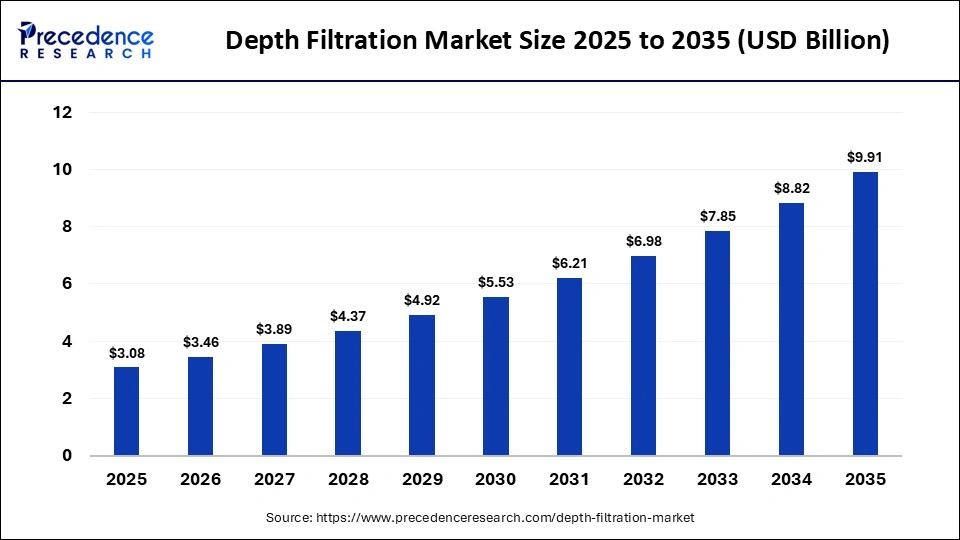
The global depth filtration market was valued at USD 3.08 billion in 2025 and is projected to grow from USD 3.46 billion in 2026 to approximately USD 9.91 billion by 2035, registering a CAGR of 12.40% during the forecast period from 2026 to 2035. Depth filtration plays a fundamental, though often underrecognized, role in modern bioprocessing by enabling high-clarity purification across pharmaceutical, food, and industrial applications, where the removal of fine contaminants is essential for operational efficiency.
Integration with Continuous Manufacturing Systems
With industries gradually upgrading to continuous manufacturing over conventional batch processing, filtration systems must adapt to the operational transformations occurring in this way. Such a transition has proven remarkably suitable for depth filtration. Ongoing process requires systems for filtration to operate without interruption over long periods of operation. Depth filter, modular cartridge units provide critical reliability by sustaining flow rates even amid variations in particle concentrations.
In integrated manufacturing lines, depth filtering is commonly used as a buffer stage, which mitigates fluctuations in feed streams preceding their receipt at a precision scale device, such as chromatography columns or membrane filters. This may seem like a minor function, but it is indeed pivotal: without such stabilization, continuous production systems would be much more vulnerable to unanticipated process interruptions.
Industrial Applications of Depth Filtration
- Biopharmaceutical Production: Depth filtration is a significant component of cell culture clarification in the biopharmaceutical field. In the manufacture of biologics, cells are grown in large bioreactors, which produce proteins, antibodies, or vaccines. When the cultivation process is done, the resulting mixture will typically contain cells, cellular debris, and various other contaminants that need to be removed before additional purifying steps can take place. Depth filters are often used for this because they effectively eliminate impurities while retaining essential biomolecules, such as monoclonal antibodies and recombinant proteins.
- Processing Food and Beverage: In the food and beverage sector, clarity and consistency are key elements. Depth filtration is widely used in a range of applications, such as beer and wine clarification, fruit juice purification, dairy processing, yeast elimination, and haze-forming particles. Depth filters enable high rates of particle extraction, yet retain flavor integrity and nutrients, which is why manufacturers prefer them.
- Water and Wastewater Treatment: Depth filtration is generally the process of removing suspended solids, organic materials, and particulate pollutants from water before its distribution or discharge into natural bodies in industrial and municipal water treatment facilities. It works particularly well where the amount of sediment in the water is high, turbidity level of the water tends to be greatly lowered, such that environmental conditions are maintained.
- Chemical and Industrial Processing: Lots of industrial manufacturing is done with liquid heavy with solid impurities. To maintain product purity for industries such as petrochemicals, paint coatings production, cosmetics manufacturing, and specialty chemicals fabrication, depth filtering is also necessary. For such industries, filtration models should be able to handle different particle sizes of mixed concentration in a non-blocking way. Therefore, depth filtration can be used with high efficiency, cost-effective in environments of such intensity.
Why Depth Filtration Matters in Industrial Processes
Filtration methods are usually assessed based on their performance, capacity, and budget to evaluate their efficiency. When the solids in fluid have a high level of suspended solids, for example, depth filtration is advantageous as existing membrane filters are rapidly obstructed.
Key benefits include:
- High Particle Retention: In contrast to conventional filters, which concentrate contaminants on an enclosed surface, depth filters spread the contaminants through the filter medium at the particle level. This enables them to retain much higher amounts of impurities before they reach their limit.
- Lower Operating Pressure: Generally operating at lower pressures, depth filtration systems utilize less energy, and mechanical strain is also lower on the equipment.
- Protection of Downstream Processes: In different production processes, depth filters serve as pre-filters that remove large particles before more complex phases, such as membrane filtration, operate.
- Scalability: With the addition of technology to industrial production plants, it becomes easy for these technologies to be easily expanded from laboratory operation to large-scale industrialization.
Trends Influencing the Adoption of Depth Filtration
- Growth of Biologics and Vaccines: With the rapid development of biologics (e.g., monoclonal antibodies, gene therapies, and vaccines), the demand for highly effective clarification technology has been significantly growing. In those operations, depth filtration is required for the removal of cells and particulates before purification.
- Heightened Demand for Food Safety: Consumers are increasingly seeking beverages and food products that are devoid of impurities while preserving their natural flavor profiles. This expectation is prompting food manufacturers to implement advanced filtration systems.
- Escalating Needs for Water Treatment: As the regulatory environment becomes more stringent and concerns over water problems mount, both in the industry and urban areas alike, there are huge outlays by enterprises to install the ability to purify water. Depth filtration is one of the initial pre-treatment steps of this process and plays an important role.
Emerging Innovations in Depth Filtration
- Single-Use Filtration Systems: Single-use filtration systems are taking off across the biopharmaceutical industry. These systems eliminate the need for cleaning validation, minimize the risk of contamination, and simplify the operations.
- Advanced Filter Media: An outstanding approach is to develop hybrid filter materials composed of cellulose fibers, synthetic polymers, and charged resins. This also promotes better particle retention abilities and increases throughput.
- Multi-Layer Gradient Filters: Newer filters use multi-layer media with progressively smaller pore sizes. The design improves the filtration efficiency and increases the filter lifetime.
- Sustainable Filtration Solutions: Environmentally friendly filter materials and recycling methods to mitigate what we dispose of through throwaway filtration systems are becoming the focus of more and more producers.
Challenges and Limitations
- Restricted Reusability: Many depth filters are designed for single use; operating costs are higher in large continuous operations.
- Waste Disposal and Management: Used filters should be properly disposed of, especially in pharmaceutical or chemical production settings where they might contain hazardous substances.
- Necessity for Process Optimization: Filtration efficiency is strongly influenced by process factors such as flow rate, pressure, and particle size distribution. A faulty design can lead to reduced performance or early clogging.
The Future of Depth Filtration
Substantial changes to the filtration system are expected to occur in the next decade. Pharmaceutical advances and increasing complexity of biologic treatments are pushing for filter systems to improve and yield higher efficiency, better product recovery rates, along with improved reliability throughout processes. Depth filtration will be one of the basic technologies of the next few decades as it’s developed to process significant amounts of particles without harming the delicate processes down the line.
Emerging technologies, such as real-time monitoring in smart filtration solutions, nanostructured filter materials, and automated process management, would contribute to the enhancement of the performance of depth filtration devices. In addition, a sustainability focus is anticipated to facilitate steps towards biodegradable filtering materials and waste minimization.
Expert Advise
According to Precedence Research, demand for depth filtration is rapidly emerging with stringent regulatory policies across several industrial sectors and innovations in depth filtration technology. With growing industry emphasis on sustainability, selecting filters with high-dirt-holding capacity and minimal waste generation is of prime importance, reducing operational costs. Depth filtration can significantly improve product quality, efficiency, and cost-effectiveness, promoting its widespread use. Moreover, the future of depth filtration is promising, driven by its integration with AI and ML technologies, introducing automation and enhancing filtration efficiency.
About the Authors

Aditi Shivarkar
Aditi, Vice President at Precedence Research, brings over 15 years of expertise at the intersection of technology, innovation, and strategic market intelligence. A visionary leader, she excels in transforming complex data into actionable insights that empower businesses to thrive in dynamic markets. Her leadership combines analytical precision with forward-thinking strategy, driving measurable growth, competitive advantage, and lasting impact across industries.



Aman Singh
Aman Singh with over 13 years of progressive expertise at the intersection of technology, innovation, and strategic market intelligence, Aman Singh stands as a leading authority in global research and consulting. Renowned for his ability to decode complex technological transformations, he provides forward-looking insights that drive strategic decision-making. At Precedence Research, Aman leads a global team of analysts, fostering a culture of research excellence, analytical precision, and visionary thinking.

Piyush Pawar
Piyush Pawar brings over a decade of experience as Senior Manager, Sales & Business Growth, acting as the essential liaison between clients and our research authors. He translates sophisticated insights into practical strategies, ensuring client objectives are met with precision. Piyush’s expertise in market dynamics, relationship management, and strategic execution enables organizations to leverage intelligence effectively, achieving operational excellence, innovation, and sustained growth.