



Depth Filtration Market Size, Companies, Share, Patient Volume, Treatment Adoption Rates, Pricing Analysis, Regulatory Landscape, Competitive Positioning, and Demand Forecast
Depth Filtration Market (By Media Material: Cellulose-based Depth Filter Media, Diatomaceous Earth Depth Filter Media, Perlite-based Depth Filter Media, Glass Fiber Depth Filter Media, Resin-Bonded Depth Filter Media; By Product Format: Cartridge Depth Filters, Capsule Depth Filters, Sheet Depth Filters, Module Depth Filters, Plate and Frame Depth Filtration Systems; By Application: Cell Culture Clarification, Harvest and Impurity Removal, Prefiltration Before Membrane Filtration, Water Purification, Food and Beverage Processing; By End User: Biopharmaceutical Companies, Contract Development and Manufacturing Organizations, Food and Beverage Companies , Academic and Research Institutes, Chemical and Specialty Materials Companies) - Global Industry Analysis, Size, Trends, Leading Companies, Regional Outlook, and Forecast 2026 to 2035
Source: https://www.precedenceresearch.com/depth-filtration-market
 Get a Sample
 Table Of Content


What is the Depth Filtration Market Size in 2026?
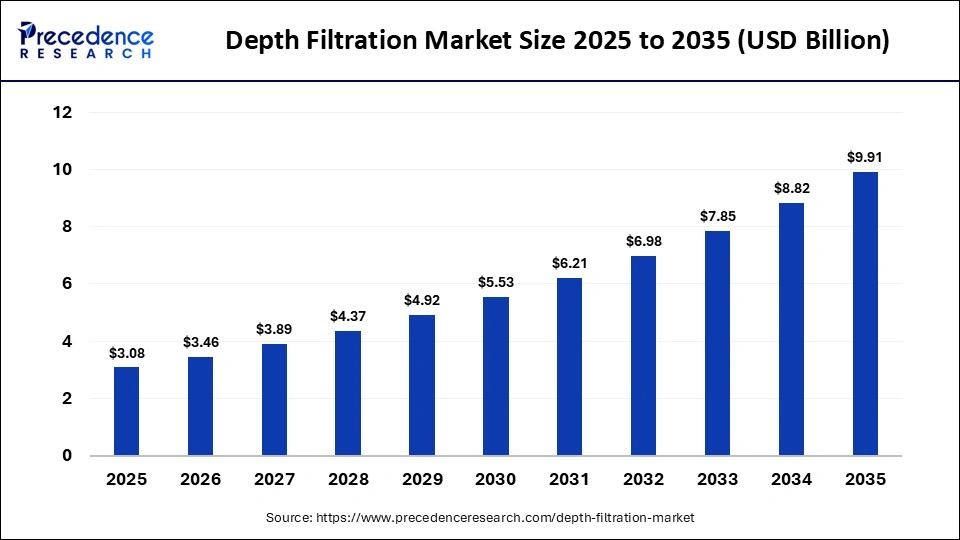
The global depth filtration market size was calculated at USD 3.08 billion in 2025 and is predicted to increase from USD 3.46 billion in 2026 to approximately USD 9.91 billion by 2035, expanding at a CAGR of 12.40% from 2026 to 2035. Depth filtration serves a fundamental, but not commonly identified, role in contemporary bioprocessing, providing high-clarity purification in the pharmaceutical, food, and industrial sectors where the removal of minute contaminants is required for operational efficiency.
Key Takeaways
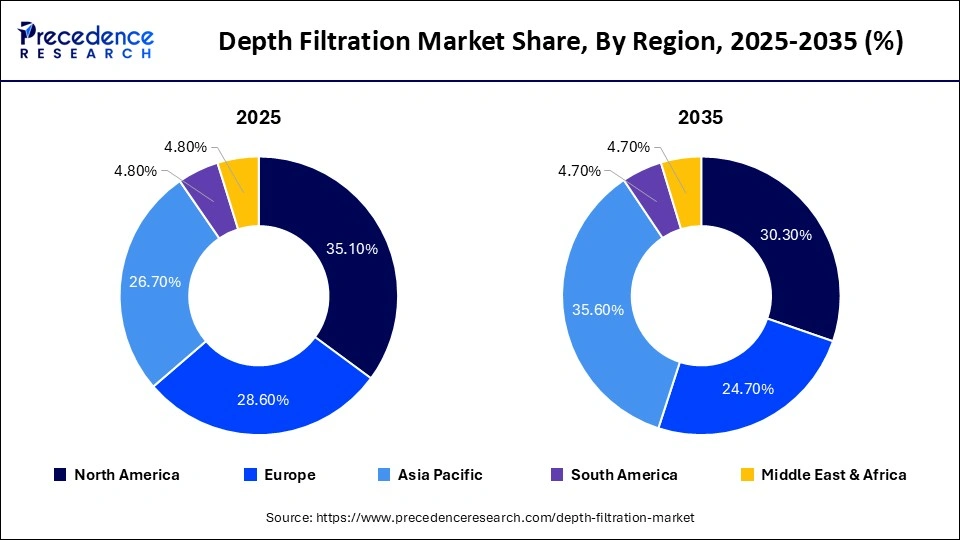
- North America held the largest revenue share of 35.10% in the market in 2025.
- Asia-Pacific is expected to grow at the fastest CAGR in the depth filtration market during the forecast period.
- By media material, the cellulose-based depth filter media segment accounted for a considerable revenue share of 31.70% in the market in 2025.
- By media material, the glass fiber depth filter media segment is expected to grow at the fastest CAGR of 14.10% in the market between 2026 and 2035.
- By product format, the cartridge depth filters segment held a dominant position in the market with a share of 27.80% in 2025.
- By product format, the capsule depth filters segment is expected to grow with the highest CAGR of 12.90% in the market during the studied years.
- By application, the cell culture clarification segment accounted for the highest revenue share of 28.40% in the market in 2025.
- By application, the harvest and impurity removal segment is expected to expand rapidly in the market with a CAGR of 12.70% in the coming years.
- By end user, the biopharmaceutical companies segment held a major revenue share of 37.80% in the market in 2025.
- By end user, the contract development and manufacturing organizations segment is expected to show the fastest growth with a CAGR of 12.80% over the forecast period.
What is the Depth Filtration Market?
The depth filtration industry comprises filtration media and systems that retain particles, cell debris, colloids, and contaminants throughout the thickness of a porous matrix rather than only on the surface. These products are used for clarification, prefiltration, impurity removal, and bioburden reduction across biopharmaceutical manufacturing, food and beverage processing, water treatment, and specialty chemicals. The market includes sheets, cartridges, capsules, discs, and modules supplied in single-use and reusable formats, along with related housings, accessories, and validation support.
Impact of AI on the Depth Filtration Market
Rather than changing the way filters are constructed, artificial intelligence (AI) is beginning to change the way filters are supervised and managed. AI-powered analytics in today's biomanufacturing environments analyze pressure trends, flow rates, and turbidity data to anticipate filter fouling well in advance of any production interruptions. By doing so, operators can replace or regenerate filters at optimal times and prevent expensive downtime and product losses.
AI also aids researchers in the development of processes by simulating filtration performance under different conditions to identify the most effective configurations. This results in a quieter transformation: filtration systems that work more reliably, improve process control, and significantly reduce trial-and-error experimentation.
Trends Influencing the Depth Filtration Market
- Growing Call for Biologics & Vaccine Development: New drug development on the rise, for example, monoclonal antibodies, vaccines, and gene treatments, has increased the use of depth filtration in bioprocess clarification. Newer generation technology includes advanced multilayer filter media, which is a mechanism for removing particles of different sizes and a high rate of throughput. This increases the soil holding capacity and reduces the number of filter replacements, allowing for consistent processing in high-volume industrial and pharmaceutical activity.
- Promotion By Automation & Intelligence Monitoring Tools: Contemporary systems for filtration are integrated with automated monitoring systems that provide real-time information on pressure levels, turbidity measurements, and flow rates. With the integration of this digital process, manufacturers can efficiently detect a source of filter fouling and continue to provide a satisfactory working performance during various complicated bioprocessing tasks.
- New Focus on Eco Filtration Equipment: Sustainability is increasingly an emerging but subtle trend shaping the strategy of filtration design. Manufacturers are exploring recyclable filters, biodegradable materials, and systems to help reduce energy consumption and minimize industrial waste, aligning filtration technologies with a company's overall agenda.
Market Scope
| Report Coverage | Details |
| Market Size in 2025 | USD 3.08 Billion |
| Market Size in 2026 | USD 3.46 Billion |
| Market Size by 2035 | USD 9.91 Billion |
| Market Growth Rate from 2026 to 2035 | CAGR of 12.40% |
| Dominating Region | North America |
| Fastest Growing Region | Asia Pacific |
| Base Year | 2025 |
| Forecast Period | 2026 to 2035 |
| Segments Covered | Media Material, Product Format, Application, End User, and Region |
| Regions Covered | North America, Europe, Asia-Pacific, Latin America, and Middle East & Africa |
Market Dynamics
Drivers
Increasing Pharmaceutical Manufacturing
Manufacturing in the pharmaceutical industry is considered to be quite pure, wherein even minor contaminants can cause a disruption of pharmaceutical products' stability or regulatory approval. Depth filtration, which is capable of removing cell debris, colloids, and suspended solids before the sterile filtration, proved reliable. It is necessary for the establishment of a system involving filtration technologies that will ensure a constant clarification of the process as regulatory agencies enforce even more stringent quality standards and organizations scale the production of biologics technologies.
Restraint
High Cost
While depth filtration is very efficient, the ongoing cost of replacing filters and maintenance of systems can be a major expense for manufacturers. Biologics production facilities with high throughput usually require a series of filtration steps; these additional operational costs can add up to higher operating costs. Pharmaceutical companies and research laboratories on a tighter production budget find it difficult to justify such expenditures.
Opportunity
Collaboration with CDMOs
There is a growing trend among pharmaceutical companies to outsource drug development and manufacturing tasks to contract development and manufacturing organizations (CDMOs). These entities are required to manage a variety of products plus different sizes of batch demands, leading to the need for adaptable filtration systems. This outsourcing shift is expected to put forward technologies connected with depth filtration, which can fit into modular manufacturing lines as well.
Segmental Insights
Media Material Insights
Which Media Material Segment Dominated the Depth Filtration Market?
The cellulose-based depth filter media segment held the largest revenue share of 31.70% in the market in 2025, due to its excellent dirt-holding capacity and economic performance in large-scale filtration applications. Cellulose matrices were widely used by biopharmaceutical producers as a material to filter cell debris and fine particles in the clarification phase. This multilayer mechanism enables efficient particle capture with sustained flow rates, which makes such filters highly advantageous for both processing conditions, upstream and downstream.
Depth Filtration Market Share, By Media Material, 2025-2035 (%)
| Media Material | 2025 | 2035 |
| Cellulose-Based Depth Filter Media | 31.70% | 25.40% |
| Diatomaceous Earth Depth Filter Media | 22.60% | 19.10% |
| Perlite-Based Depth Filter Media | 14.80% | 12.60% |
| Activated Carbon Depth Filter Media | 8.40% | 7.90% |
| Glass Fiber Depth Filter Media | 16.30% | 28.70% |
| Resin-bonded Depth Filter Media | 6.20% | 6.30% |
The glass fiber depth filter media segment is expected to show the fastest growth with a CAGR of 14.10% over the forecast period. Filters are known for superior particle retention and increased throughput compared to traditional materials, ideal for complex biologics and vaccine production. Manufacturers are increasingly experimenting with glass fiber matrices for applications that necessitate enhanced clarity and effective filtration solutions. The increasing number of pharmaceuticals currently in the industry, along with the imposition of stricter purification standards, has driven an increase in demand for advanced glass fiber depth filtering systems.
Product Format Insights
How the Cartridge Depth Filters Segment Dominated the Depth Filtration Market?
The cartridge depth filters segment accounted for the largest revenue share of 27.80% in the market in 2025, owing to its suitability for large-scale filtration in pharmaceutical and industrial processing environments. These filters are commonly used because they are compatible with existing filtration configurations, enabling reliable clarification throughout the production process. This enables high contaminant loading capacity and stable performance throughout various processing stages. Cartridge-based filtration systems became essential in the clarification of pharmaceutical manufacturing processes as the largest biomanufacturing plants further expanded their facilities.
Depth Filtration Market Share, By Product Format, 2025-2035 (%)
| Product Format | 2025 | 2035 |
| Cartridge Depth Filters | 27.80% | 24.10% |
| Capsule Depth Filters | 18.60% | 23.70% |
| Sheet Depth Filters | 21.40% % | 17.30% |
| Disc Depth Filters | 8.70% | 7.10% |
| Module Depth Filters | 14.90% | 18.60% |
| Plate and Frame Depth Filtration Systems | 8.60% | 9.20% |
The capsule depth filters segment is expected to gain the highest market share with a CAGR of 12.90% between 2026 and 2035, as pharmaceutical manufacturers move towards single-use technologies within modern bioprocessing situations. These filter units are so small that the cleaning protocols required are streamlined, and cross-contamination related to batch transitions is reduced. They are plug-and-play and work particularly well in research labs, pilot factories, and flexible manufacturing. As biopharmaceutical facilities concentrate on improving operational efficiency and guaranteeing sterility assurance, capsule-based depth filtration processes will, in turn, be more easily implemented in new biologics production facilities.
Application Insights
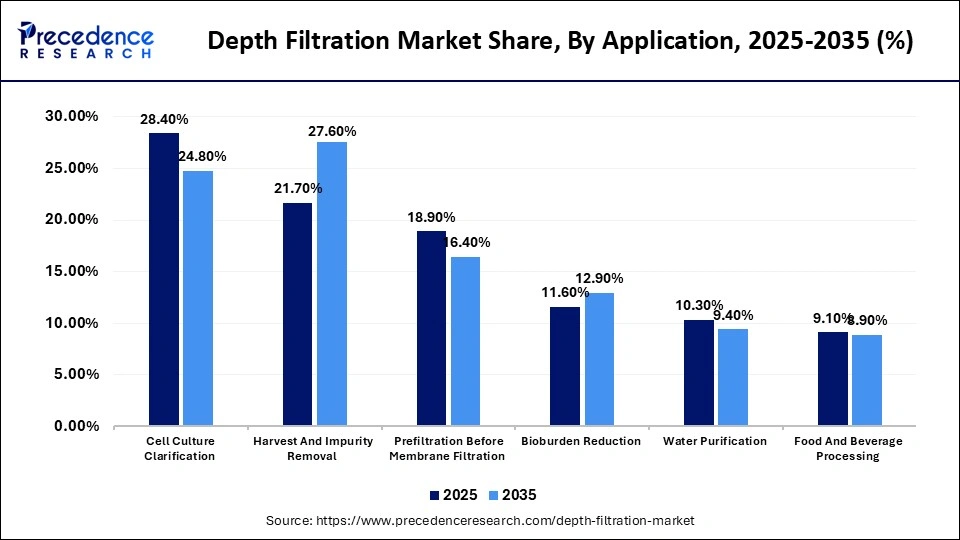
Depth Filtration Market Share, By Application, 2025-2035 (%)
| Application | 2025 | 2035 |
| Cell Culture Clarification | 28.40% | 24.80% |
| Harvest And Impurity Removal | 21.70% | 27.60% |
| Prefiltration Before Membrane Filtration | 18.90% | 16.40% |
| Bioburden Reduction | 11.60% | 12.90% |
| Water Purification | 10.30% | 9.40% |
| Food And Beverage Processing | 9.10% | 8.90% |
What Made the Cell Culture Clarification Segment Dominate the Depth Filtration Market?
The cell culture clarification segment contributed the biggest revenue share of 28.40% in the market in 2025. This was primarily related to depth filtration as one of the key steps in removing all cell debris and suspended particles generated in upstream bioprocessing. Biologics, particularly monoclonal antibodies and recombinant proteins, were heavily dependent on this clarification phase ahead of later purification steps.
Depth filters enable manufacturers to efficiently handle large volumes of cultures while ensuring product integrity remains intact. With the increase in worldwide production of biologics, adding depth filtration as a standard procedure in pharmaceutical production processes has become increasingly prevalent.
The harvest and impurity removal segment is expected to witness the fastest growth in the market with a CAGR of 12.70% over the forecast period, due to increasingly complex pharmaceutical processes. High-concentration cell cultures produce higher impurities, specifically proteins, lipids, and particulate residues that must be removed in high-efficiency ways. Depth filtration is an efficient way to manage these large contaminant loads, while keeping throughputs still high. As biologics progress, namely, vaccines and cell therapies, filtration technologies for the elimination of impurity will likely be of interest to bioprocess plants.
End User Insights
How the Biopharmaceutical Companies Segment Dominated the Depth Filtration Market?
The biopharmaceutical companies segment held the largest revenue share of 37.80% in the market in 2025, as they were among the largest users of depth filtration systems in biologics manufacturing. Such filtration technologies were significant for large pharmaceutical companies that required them for making sure product purity during the vaccine manufacturing process, for monoclonal antibody creation processes, and the plasma fractionation phase. Depth filtration was crucial for maintaining the sterile processing environment and removing particulates at early purification stages.
Depth Filtration Market Share, By End User, 2025-2035 (%)
| End User | 2025 | 2035 |
| Biopharmaceutical Companies | 37.80% | 33.60% |
| Contract Development and Manufacturing Organizations | 19.60% | 24.40% |
| Food And Beverage Companies | 13.70% | 11.60% |
| Water Treatment Facilities | 12.40% | 11.80% |
| Academic and Research Institutes | 7.10% | 7.80% |
| Chemical and Specialty Materials Companies | 9.40% | 10.80% |
The contract development and manufacturing organizations segment is expected to expand rapidly in the market with a CAGR of 12.80% in the coming years, supported by higher revenue generation as a result of the greater share of pharmaceutical companies that have outsourced the development and manufacturing of medicines. CDMOs provide flexible manufacturing facilities that can handle multiple products and batch sizes, leading to demands for adaptable filtration systems. These processes may be facilitated by depth filtration technologies, providing efficient clarification across different production methods.
Regional Insights
North America Depth Filtration Market Size and Growth 2026 to 2035
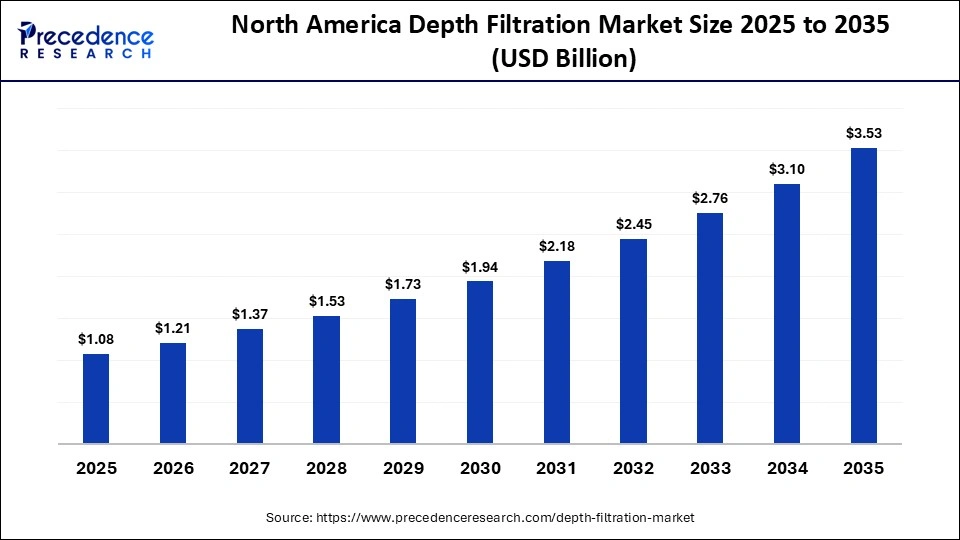
The North America depth filtration market size is estimated at USD 1.08 billion in 2025 and is projected to reach approximately USD 3.53 billion by 2035, with a 12.57% CAGR from 2026 to 2035.
Why North America Dominated the Depth Filtration Market?
North America held a major revenue share of the 35.10% market in 2025, driven by a strong biopharmaceutical manufacturing sector and investment in cutting-edge bioprocessing technology in the region. Pharmaceutical manufacturers frequently use depth filtration systems to ensure high clarity in vaccine and biologics development. Moreover, the presence of leading filtration technology providers and an established research environment has led to increased demand for solutions available in both large-scale and small-scale applications.
U.S. Depth Filtration Market Size and Growth 2026 to 2035
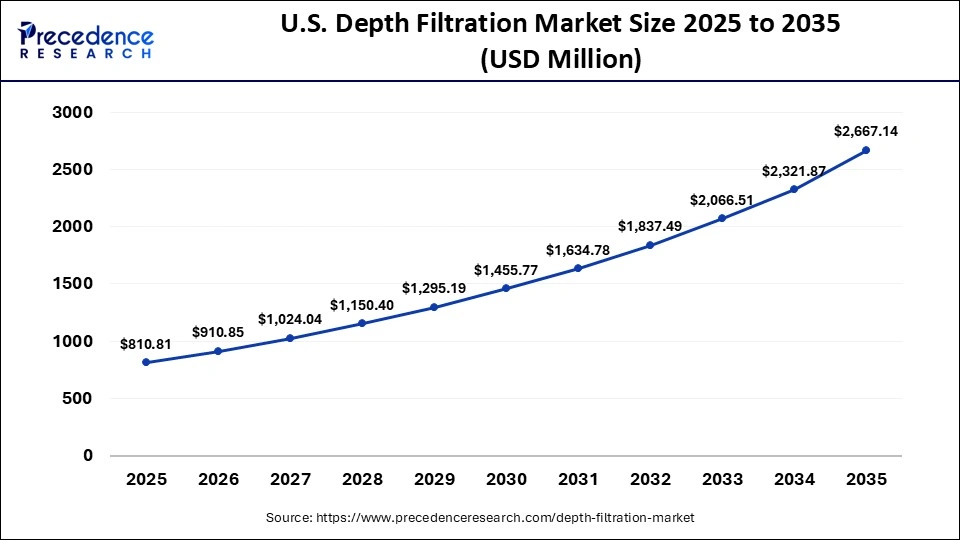
The U.S. depth filtration market size is calculated at USD 810.81 million in 2025 and is expected to reach nearly USD 2,667.14 million in 2035, accelerating at a strong CAGR of 12.65% between 2026 and 2035.
U.S. Market Trends
The U.S. dominated the North American market due to its established biotechnology ecosystem and strong pharmaceutical research. Biopharmaceutical companies and CDMOs used depth filtration systems extensively throughout biologics development and downstream processing stages. Ongoing technological improvements and significant R&D investments have resulted in strides toward more sophisticated filters. In addition, there was a growing need for reliable filtering systems in U.S.-based pharmaceutical production facilities, as regulatory changes in the production of sterile drugs have been strict.
Why is Asia-Pacific Experiencing the Fastest Growth in the Depth Filtration Market?
Asia-Pacific is expected to experience the fastest growth during the predicted timeframe. There is now increasing government funding and investment from private investors in the field of biotechnology research, vaccine development, and biosimilar development in this regard. This encourages the pharmaceutical industry to establish advanced filtration methods to maintain product purity and optimize processing efficiency. As global demand for biologics grows, wide adoption of depth filtration systems is expected to be strong, especially in new pharmaceutical production hubs throughout the Asia-Pacific.
China Market Trends
China is expected to be the fastest-growing country in the Asia-Pacific, due to its rapid expansion in biotechnology and pharmaceutical manufacturing capacity. Efforts from governments to promote domestic biologics production and vaccine development have induced companies to spend heavily on new bioprocessing infrastructure. Once there is a higher production capacity, more demand for appropriate clarification systems and technology for impurity removal will be required.
What are the Drivers of the European Depth Filtration Market?
Europe is expected to grow at a notable CAGR in the foreseeable future. The demand for sheet depth filters and disc depth filters has increased from the cosmetics industry in Germany, France, and Italy. The leading brands of depth filtration are investing rapidly in opening new production centers to expand their manufacturing volume. Moreover, numerous government policies for strengthening the food and beverage sector have accelerated the industry.
Germany Market Analysis
The German government has invested significantly in establishing new academic institutions, which in turn increases the demand for high-quality filtration systems. Companies such as Mann+Hummel, BRITA, and Freudenberg are launching a wide range of depth filters for different end-users. Moreover, the technological advancements in the chemical manufacturing units have further added to the industrial growth.
What is the Trend of the Depth Filtration Market in Latin America?
Latin America is considered to be a significantly growing area, due to the rise in the number of biopharmaceutical companies in Argentina, Venezuela, and Colombia. Also, the surging focus of governments on adopting wastewater management solutions further increases the demand for depth filtration systems. Some of the prominent companies are making significant investments to popularize their portfolio in this region.
Brazil Market Analysis
The demand for capsule depth filters has increased from the beer manufacturing brands to maintain purity and prevent contamination. The increasing adoption of depth filtration technologies by the biopharmaceutical companies in Brazil is an ongoing trend. Additionally, several CDMOs are partnering with OEMs to deploy their filtration systems in their production centers to enhance the drug production capabilities.
What are the Boosting Factors of the Depth Filtration Market in the Middle East and Africa?
The Middle East and Africa region is expected to grow at a considerable CAGR in the upcoming period. Oil and gas companies of the UAE, Saudi Arabia, and South Africa are integrating advanced filtration systems to produce high-quality fuels. Additionally, numerous government initiatives for strengthening the biopharma sector have increased the application of disc depth filters. The local filter manufacturers, such as Innovators Dubai and Aqua Care Water Filter UAE, are investing significantly to expand their businesses in this region.
UAE Market Trends
The municipalities are investing rapidly to use advanced filtration systems for delivering pure drinking water to the public working in the urban areas. In addition, the increasing proliferation of food and beverage brands has increased the demand for frame depth filtration systems. The government policies aimed at developing the healthcare sector further contribute to the market expansion.
Competitive Landscape
The depth filtration market is highly competitive due to the dominance of well-established companies and the proliferation of new entrants. Top companies operating in this sector include Sartorius, Danaher Corporation, Merck KGaA, 3M, and Parker Hannifin Corporation. These companies hold more than 50% of the overall market revenue by adopting numerous strategies, including product launches and acquisitions. Various startups, such as NovoFiltration, PureCell Technologies, and FiltraNova, are developing advanced filtration systems for biopharmaceutical companies to enhance their brand value globally.
Nowadays, prominent brands have started integrating advanced technologies such as AI and IoT in their filtration systems to enhance their operational efficiency. This industry has been facing significant problems due to stringent regulatory frameworks and clogging issues. Technological advancements in PFAS-free filtration and next-generation bio-clarification have enabled the leading companies to explore this field in the coming years.
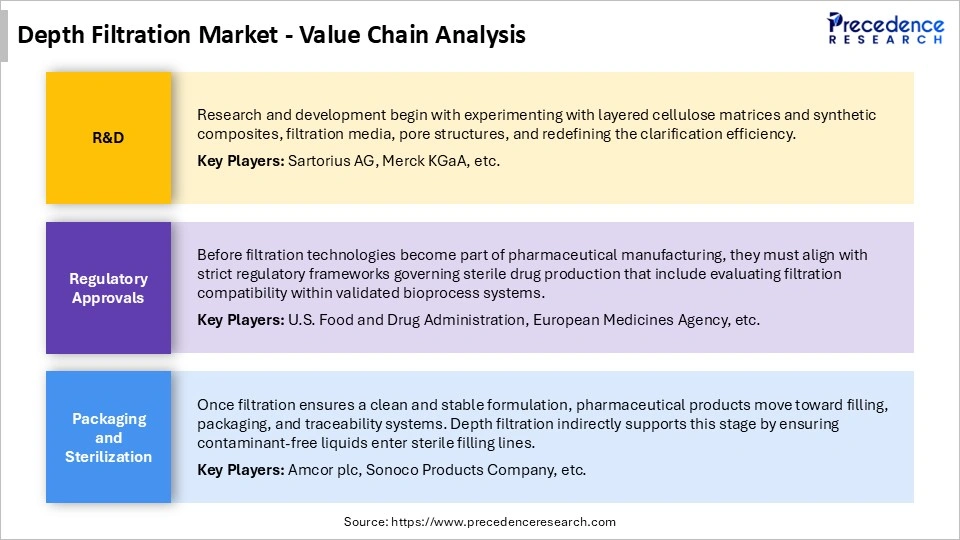
Depth Filtration Market Value Chain Analysis
Depth Filtration Market Companies
- Merck KGaA
- Sartorius AG
- Danaher Corporation
- Thermo Fisher Scientific Inc.
- 3M Company
- Repligen Corporation
- Parker Hannifin Corporation
- Eaton Corporation
- Meissner Filtration Products, Inc.
- Amazon Filters Ltd.
- Graver Technologies LLC
- Entegris, Inc.
- ErtelAlsop
- Filtrox AG
- Saint-Gobain Life Sciences
Recent Developments
- In June 2025, Sartorius AG developed Göttingen for filtration technologies of high necessity for bioprocessing. This upgrade of the treatment facility aims at meeting rising global requirements for filtration technologies associated with biologics and vaccine manufacturing, namely, depth filtration systems to be incorporated into downstream and upstream processing.
- In October 2024, Asahi Kasei Medical launched the Planova FG1, a next-generation virus removal filter featuring higher flux. The filter was developed to be used in manufacturing processes of biotherapeutic products, such as biopharmaceuticals and plasma derivatives, biosafety testing services, and biopharmaceutical CDMO operations.
Segments Covered in the Report
By Media Material
- Cellulose-based Depth Filter Media
- Diatomaceous Earth Depth Filter Media
- Perlite-based Depth Filter Media
- Activated Carbon Depth Filter Media
- Glass Fiber Depth Filter Media
- Resin-Bonded Depth Filter Media
By Product Format
- Cartridge Depth Filters
- Capsule Depth Filters
- Sheet Depth Filters
- Disc Depth Filters
- Module Depth Filters
- Plate and Frame Depth Filtration Systems
By Application
- Cell Culture Clarification
- Harvest and Impurity Removal
- Prefiltration Before Membrane Filtration
- Bioburden Reduction
- Water Purification
- Food and Beverage Processing
By End User
- Biopharmaceutical Companies
- Contract Development and Manufacturing Organizations
- Food and Beverage Companies
- Water Treatment Facilities
- Academic and Research Institutes
- Chemical and Specialty Materials Companies
By Region
- North America
- Latin America
- Europe
- Asia-pacific
- Middle and East Africa
For inquiries regarding discounts, bulk purchases, or customization requests, please contact us at sales@precedenceresearch.com
Frequently Asked Questions
Tags





Ask For Sample
No cookie-cutter, only authentic analysis – take the 1st step to become a Precedence Research client
 Get a Sample
.webp)



 sales@precedenceresearch.com
 Schedule a Meeting
