






 Request Consultation
RF power semiconductors amplify and switch high-frequency signals for wireless networks, defense systems, automotive radar, and consumer electronics, supporting next-gen connectivity and high-performance applications.
What are RF Power Semiconductors?
RF (radio frequency) power semiconductors are electronic components that can switch and amplify high-frequency signals, typically within the MHz to GHz frequency spectrum. These semiconductors are crucial in wireless communication, radar, broadcasting, and satellite systems. RF power semiconductors are made by manufacturing out of silicon, gallium nitride, or gallium arsenide, a material that is effective, linear, and thermally stable in high-power applications.
What is the RF Power Semiconductor Market Size in 2026?
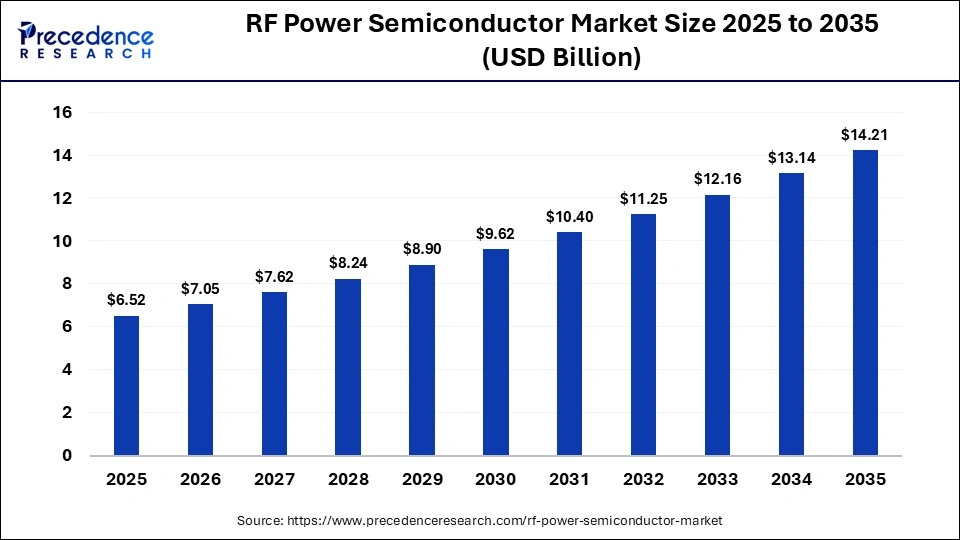
The global RF power semiconductor market size accounted for USD 6.52 billion in 2025 and is predicted to increase from USD 7.05 billion in 2026 to approximately USD 14.21 billion by 2035, expanding at a CAGR of 8.10% from 2026 to 2035.
Top Players Engaged in Manufacturing RF Power Semiconductors
|
Companies |
Offerings |
|
Qorvo Inc. was established in 2015, and it is based in Greensboro, North Carolina, the U.S., which designs and produces RF solutions, such as power amplifiers, filters, and mobile devices, infrastructure, and aerospace modules. |
RF modules, RF switches, and multi-band power amplifiers using GaN. |
|
Analog Devices Inc., a company that is based in Norwood, Massachusetts, the U.S., designs high-performance analog, mixed-signal, and RF solutions used in industrial, communications, and healthcare applications. |
RF power amplifiers, transceivers, and tunable RF components. |
|
Skyworks Solutions, Inc., is a manufacturer of RF front-end modules and semiconductor solutions that are aimed at mobile devices, automotive devices, and Internet of Things devices, and functions within the United States, specifically in Irvine, California. |
Amplifiers, attenuation, switches, as well as tunable RF devices. |
|
MACOM Technology Solutions is based in Lowell, Massachusetts, U.S., and is an international company that provides RF, microwave, and millimeter-wave semiconductor solutions. |
RF-amp power transistors, integrated modules, GaN, and GaAs. |
|
Infineon Technologies AG is a company based in Neubiberg, Germany, that manufactures various power semiconductors, RF components, and automotive electronics. |
RF modules, RF power MOSFETs, and GaN devices. |
|
NXP Semiconductors is an RF, analog, and power solutions-based company headquartered in Eindhoven, Netherlands, and operating in the automotive, communication, and IoT industries. |
RF transistors, power amplifiers, and GaN devices. |
Which RF Semiconductor Technologies are in High Demand?
The rapid evolution of wireless communication, defense systems, and connected devices is fueling strong demand for advanced RF semiconductor technologies. As industries transition toward 5G, IoT, and high-frequency applications, certain materials and technologies are emerging as clear front-runners.
- GaN (Gallium Nitride): Gallium Nitride (GaN)-based semiconductors are highly power-dense, thermally stable, and energy-efficient, making them ideal for applications such as 5G base stations, satellite communications, and defense radar systems. These RF devices support the development of compact, high-performance designs while minimizing energy loss and improving overall system reliability. As next-generation wireless technologies expand globally, GaN-based RF solutions are playing a critical role in enabling efficient and robust communication infrastructure.
- GaAs (Gallium Arsenide): Gallium Arsenide (GaAs) technology offers excellent performance at high frequencies along with low noise characteristics, making it ideal for RF applications. It is widely used in mobile handsets, aerospace systems, and satellite communications, where efficient signal amplification and reliable propagation are critical. Despite the emergence of newer materials, GaAs continues to play a vital role in advanced wireless systems due to its stability and high-performance capabilities.
- LDMOS (Laterally Diffused Metal Oxide Semiconductor): LDMOS transistors offer high power, excellent linearity, robust performance, and cost-effective amplification, making them well-suited for RF applications. They are widely used in cellular base stations and television transmitters, where efficient amplification and reliable signal transmission are essential. LDMOS technology enables large-scale wireless networks, such as mobile, satellite, and high-power communication systems, to operate with high efficiency and dependability.
Where are RF Power Semiconductors Used? Exploring Key Applications
RF power semiconductors find applications in industries such as telecommunication, defense, automotive, healthcare, and consumer electronics. They improve, switch, and manage high-frequency signals and enable connectivity, radar, auto vehicle sensors, medical and intelligent electronics, and drive innovation and performance in many sectors of the industry across the globe.
- Wireless Communication: RF semiconductors form the backbone of modern communication systems, powering mobile networks, Wi-Fi routers, 5G/6G base stations, and satellite systems. They enable high-speed, compact, and energy-efficient wireless connectivity for billions of users worldwide. With over three million 5G base stations deployed globally, particularly across the Asia-Pacific region, the demand for high-performance RF components continues to surge.
- Defense & Aerospace: RF semiconductors are utilized in radar systems, electronic warfare, military-grade satellite communications, and military-grade communications. These components deliver high power, precision, and reliability, allowing them to operate effectively in extreme and mission-critical environments. They are essential in enabling advanced surveillance, secure communication, and strategic defense operations worldwide.
- Healthcare: RF semiconductors are utilized in the healthcare sector to power medical imaging equipment and MRI equipment, as well as wireless patient monitoring equipment, and also the portable diagnostic equipment. Their high-frequency performance, compact size, and energy efficiency ensure accurate diagnostics and reliable real-time monitoring. This enhances patient care across hospitals, clinics, and even remote healthcare settings.
- Consumer Electronics: RF semiconductors are essential in smartphones, tablets, Wi-Fi routers, and smart home appliances. They enhance connectivity, improve data transmission speeds, and support seamless device performance. By enabling efficient signal processing in compact designs, RF components drive the development of high-performance and reliable everyday gadgets.
How Government Support and Industry Investment Drive the Growth of RF Power Semiconductors?
Government support and industry investment play a crucial role in accelerating the growth of RF power semiconductors by fostering innovation, infrastructure development, and large-scale adoption. Governments across major economies are investing heavily in 5G deployment, satellite communication, and defense modernization programs, which directly increase demand for high-performance RF components. At the same time, private sector investments from semiconductor companies and telecom operators are driving advancements in technologies such as GaN and GaAs, enabling more efficient, high-frequency, and reliable devices.
On September 21, 2024, discussions between Narendra Modi and Joe Biden led to the announcement of a joint India–U.S. initiative to establish India’s first national security-focused semiconductor manufacturing facility. This project aims to produce chips for military applications, telecommunications, and advanced electronics, strengthening India’s defense capabilities. It also marks a significant step in enhancing bilateral technological cooperation and advancing strategic semiconductor supply chain resilience between the two nations.
Core Factors Boosting RF Power Semiconductor Adoption
- 5G/6G Network Expansion: The rollout of 5G and emerging 6G networks is driving the demand for high-efficiency RF semiconductors. These components are critical for high-frequency amplification of compact signals in base stations, small cells, and network infrastructure, enabling faster data transmission, highly reliable connectivity, and widespread deployment of next-generation wireless communication systems. By supporting the backbone of advanced mobile networks, RF semiconductors are essential for meeting the growing global demand for high-speed, low-latency wireless services.
- Rise of IoT Devices: High-frequency RF semiconductors are essential for powering IoT devices, providing efficient wireless connectivity with low power consumption. Their integration into compact circuit boards allows the development of smaller, smarter devices that are both reliable and energy-efficient.
- Automotive Radar and Communication: The demand for high-power RF semiconductors is rising due to the rapid growth of autonomous vehicles, advanced driver-assistance systems (ADAS), and electric vehicle communication networks. These semiconductors support critical technologies such as radar, LiDAR, and V2X (vehicle-to-everything) communication, enabling real-time data transmission, enhanced vehicle safety, and automation. By powering these systems, RF semiconductors are helping to strengthen intelligent transportation networks and drive innovation in the expanding automotive and electric vehicle industry.
Key Challenges Hindering Widespread Adoption of RF Semiconductors
- High Production Costs: The manufacturing of advanced RF semiconductors, such as Gallium Nitride (GaN) and Gallium Arsenide (GaAs), requires specialized materials, precise fabrication processes, and meticulous assembly. These factors significantly increase production costs, creating a financial burden for manufacturers and influencing the size, cost, and availability of high-performance RF components.
- Thermal Management Issues: RF semiconductors generate a lot of heat that may affect performance and even reliability. Effective thermal management solutions, such as enhanced cooling techniques and optimized packaging, are essential to ensure stable operation, prevent overheating, and maintain resilience across applications in wireless communication, automotive, defense, and industrial systems.
- Supply Chain Complexity: The semiconductor industry faces challenges due to a limited number of global manufacturers, constrained raw material availability, and transportation issues. These supply chain complexities can lead to delays, increased costs, and production bottlenecks, ultimately affecting the timely delivery and availability of high-performance RF equipment across communication, defense, automotive, and industrial applications.
The Road Ahead for RF Power Semiconductor Technology
The industry holds significant potential for growth, driven by rising demand for energy-efficient, high-frequency components in 5G/6G networks, satellite communications, defense systems, and automotive applications. Advances in technologies like GaN, GaAs, and LDMOS are increasing power density, better linearity, and enabling smaller designs. Government investments in domestic semiconductor manufacturing, R&D, and production are strengthening the supply chain and fostering innovation. At the same time, the growing adoption of IoT devices, autonomous vehicles, and electric mobility is creating additional opportunities, positioning RF power semiconductors as critical components in the global electronics ecosystem.
Expert Opinion
According to Precedence Research, RF power semiconductors are becoming a critical growth driver in the global electronics and communication industries. The rapid deployment of 5G and upcoming 6G networks, expansion of IoT ecosystems, and increasing adoption of autonomous and electric vehicles are creating unprecedented demand for high-efficiency, compact, and high-performance RF components. Technologies such as GaN, GaAs, and LDMOS are enabling superior power density, linearity, and thermal stability, positioning companies that invest in these solutions to gain a significant competitive advantage.
However, businesses must navigate challenges including high production costs, complex thermal management, and constrained supply chains, which can impact profitability and scalability. Strategic investments in advanced R&D, local manufacturing capabilities, and diversified supplier networks are essential to mitigate these risks. Companies that successfully integrate these strategies are well-positioned to capitalize on the growing demand for RF semiconductors across telecom, defense, automotive, industrial, and consumer electronics sectors, making it a lucrative and strategically important segment.
Wrapping Up
RF power semiconductors are integral to communication, defense, automotive, and consumer electronics technologies. Their growth is being driven by the global rollout of 5G/6G networks, the expansion of IoT ecosystems, and the rising adoption of electric vehicles. While research, advanced fabrication, and manufacturing are advancing rapidly, challenges such as high production costs, thermal management, and supply chain constraints remain. Technologies like GaN, GaAs, and LDMOS are enabling compact, high-efficiency, and high-performance solutions. Moving forward, RF power semiconductors will be essential for powering the next generation of wireless, industrial, and aerospace applications, supporting enhanced connectivity, intelligent transportation, and robust defense systems worldwide.
About the Authors

Aditi Shivarkar
Aditi, Vice President at Precedence Research, brings over 15 years of expertise at the intersection of technology, innovation, and strategic market intelligence. A visionary leader, she excels in transforming complex data into actionable insights that empower businesses to thrive in dynamic markets. Her leadership combines analytical precision with forward-thinking strategy, driving measurable growth, competitive advantage, and lasting impact across industries.



Aman Singh
Aman Singh with over 13 years of progressive expertise at the intersection of technology, innovation, and strategic market intelligence, Aman Singh stands as a leading authority in global research and consulting. Renowned for his ability to decode complex technological transformations, he provides forward-looking insights that drive strategic decision-making. At Precedence Research, Aman leads a global team of analysts, fostering a culture of research excellence, analytical precision, and visionary thinking.

Piyush Pawar
Piyush Pawar brings over a decade of experience as Senior Manager, Sales & Business Growth, acting as the essential liaison between clients and our research authors. He translates sophisticated insights into practical strategies, ensuring client objectives are met with precision. Piyush’s expertise in market dynamics, relationship management, and strategic execution enables organizations to leverage intelligence effectively, achieving operational excellence, innovation, and sustained growth.