



Life Science Consumables Market Revenue, Leading Companies, Company Technology / Innovation, Diagnostic Testing Volume, Adoption Rates, Pricing Metrics, Supply Chain Performance, Competitive Positioning, and Industry Trends
Deepa Pandey, a Healthcare Industry Expert, highlights that the life science consumables market has reached USD 33.64 billion in 2026 and is on track to reach USD 54.4 billion by 2035, advancing at a CAGR of 5.49%. Key life science consumables market companies shaping the market include Promega Corporation, Roche Diagnostics while major growth segments span product type, application, technology, end user, region.
Source: https://www.precedenceresearch.com/life-science-consumables-market
 Get a Sample
 Table Of Content


What is the Life Science Consumables Market Size?
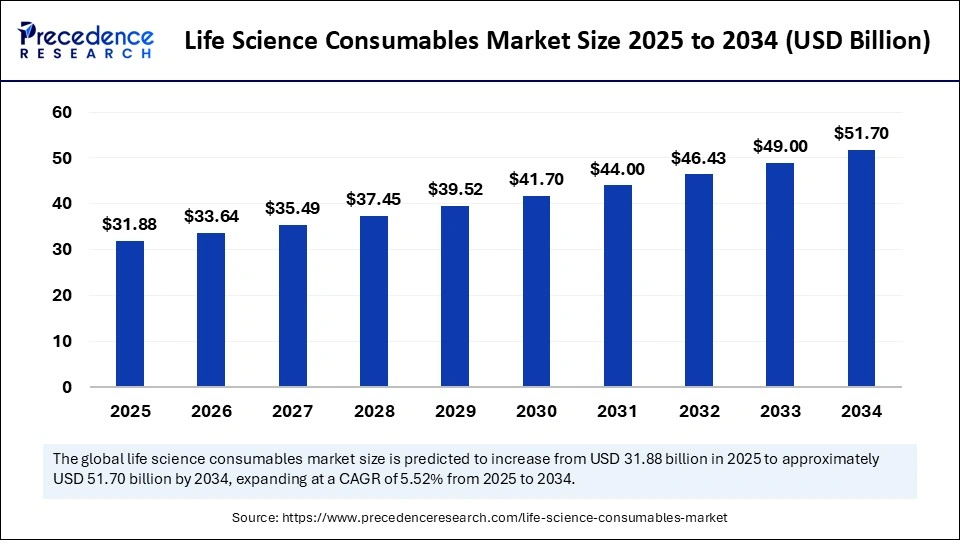
The global life science consumables market size is calculated at USD 31.88 billion in 2025 and is predicted to increase from USD 33.64 billion in 2026 to approximately USD 54.4 billion by 2035, expanding at a CAGR of 5.49% from 2026 to 2035. The market is expanding significantly owing to advancements in life science consumables enabled by cutting-edge technologies, laboratory automation, increased R&D to curb the growing incidence of chronic diseases, and strong government support for developing the healthcare sector.
Market Highlights
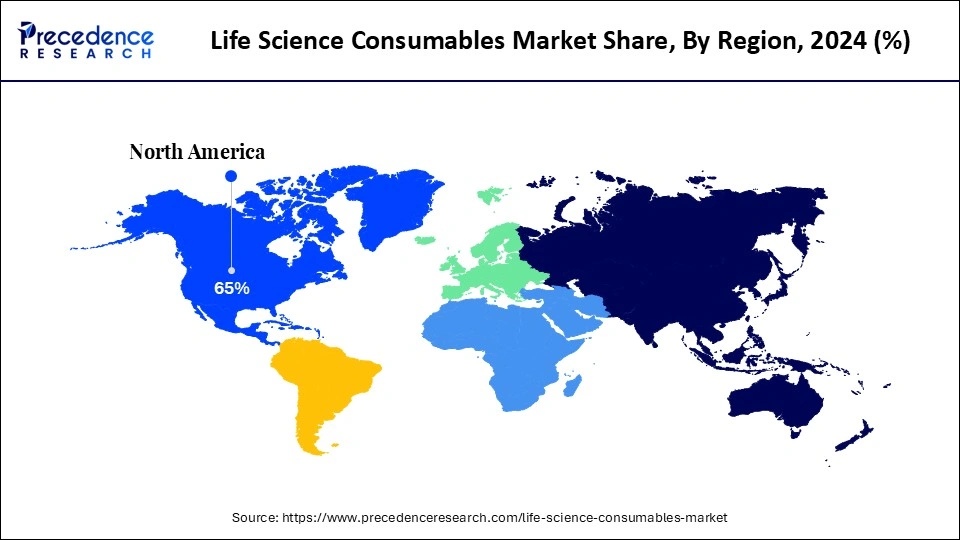
- North America held the largest market share of approximately 41.60% in 2025.
- The Asia Pacific is expected to grow the fastest CAGR from 2026 to 2035.
- By product type, the reagents and chemicals segment dominated the market in 2025.
- By product type, the kits & assays segment is expanding at the fastest CAGR from 2026 to 2035.
- By application, the molecular biology segment held the largest market share in 2025.
- By application, the cell biology segment is expected to witness the fastest CAGR during the foreseeable period.
- By technology, the cell culture technology segment held the biggest market share in 2025.
- By technology, the next-generation sequencing segment is expected to witness the fastest CAGR from 2026 to 2035.
- By end-user, the pharmaceutical & biotechnology companies segment captured the highest market share in 2025.
- By end-user, the clinical & diagnostics segment is expected to witness the fastest CAGR during the foreseeable period of 2026-2035.
Life Science Consumables Market Means
The life science consumables market comprises reusable and disposable materials used in life science laboratories for research and development and diagnostics. It includes various products, such as plasticware, glassware, reagents, filters, and microplates, that are crucial for experiments and analysis across sectors such as pharmaceuticals, biotechnology, and clinical diagnostics. These products are essential for workflows in cell culture, molecular biology, genomics, proteomics, and analytical chemistry, and they account for a significant portion of operational spending in research institutions.
This market covers single-use and reusable items that support scientific workflows. These consumables serve as the interface between experiments and their results, affecting accuracy and reproducibility. High-quality tubes, pipette tips, PCR plates, and chromatography consumables influence factors such as contamination control, reaction efficiency, and data consistency, making them indispensable to regulated laboratories that follow standards like GLP and ISO 17025. Major factors that support market growth include ongoing research and innovation, automation, and diagnostics. Increasing use of automated liquid handling systems, high-throughput sequencing, and point-of-care molecular platforms drives demand for compatible consumables designed for precision, sterility, and instrument integration.
AI Shifts in Life Science Consumables Market
The integration of artificial intelligence is revolutionizing the life science consumables market by improving operational efficiency, accelerating research and development, and enabling personalized medicine. Predictive maintenance can analyze sensor data from manufacturing equipment to identify potential causes of machine failures and reduce downtime, which significantly impacts an enterprises finances.
On the other hand, AI applications can accelerate the R&D process, thereby fueling demand for specialized consumables. This is achievable by analyzing vast genomic and proteomic datasets to find potential drug candidates and biomarkers. This data, fetched from automated systems, can further feed AI algorithms, creating ongoing feedback processes that enhance efficiency and precision.
Life Science Consumables Market Outlook
Industry growth overview
The market is expanding due to several factors, including increased R&D funding for pharma and biotech research, driven by the growing need for diagnostics and research on infectious diseases, genetic disorders, and chronic illnesses. Also, the integration of advanced technologies such as AI, next-generation sequencing, and high-throughput screening tools requires specialized consumables, fueling large-scale market growth.
Sustainability Trends
The market witnesses a sustainability trend that includes the use of biodegradable materials, focusing on the circular economy and ongoing regulatory support by the government to support recovery and recycling processes. A major push toward sustainability involves using materials such as polylactic acid, polyhydroxyalkanoates, and starch-based compounds for lab products and their packaging.
Startup Ecosystem
The startup ecosystem for the life science consumables market is vibrant due to the rise of deep technological transformations in the life science domain with AI integration. Many start-ups, like Opentrons, are focusing on developing solutions for niche problems, such as establishing automated labs and developing new treatment options for diseases. Also, innovators are developing novel diagnostic tests, such as rapid sepsis diagnostics, and new treatment options for diseases. They are further expanding eco-friendly options such as mushroom-based packaging and bioengineered fabrics.
Market Scope
| Report Coverage | Details |
| Market Size in 2025 | USD 31.88 Billion |
| Market Size in 2026 | USD 33.64 Billion |
| Market Size by 2035 | USD 54.4 Billion |
| Market Growth Rate from 2026 to 2035 | CAGR of 5.49% |
| Dominating Region | North America |
| Fastest Growing Region | Asia Pacific |
| Base Year | 2025 |
| Forecast Period | 2026 to 2035 |
| Segments Covered | Product Type, Application, Technology, By End User, and Region |
| Regions Covered | North America, Europe, Asia-Pacific, Latin America, and Middle East & Africa |
Life Science Consumables Market Segmental Insights
[[segment_insights]]
Regional Insights
How Big is the North America Life Science Consumables Market Size?
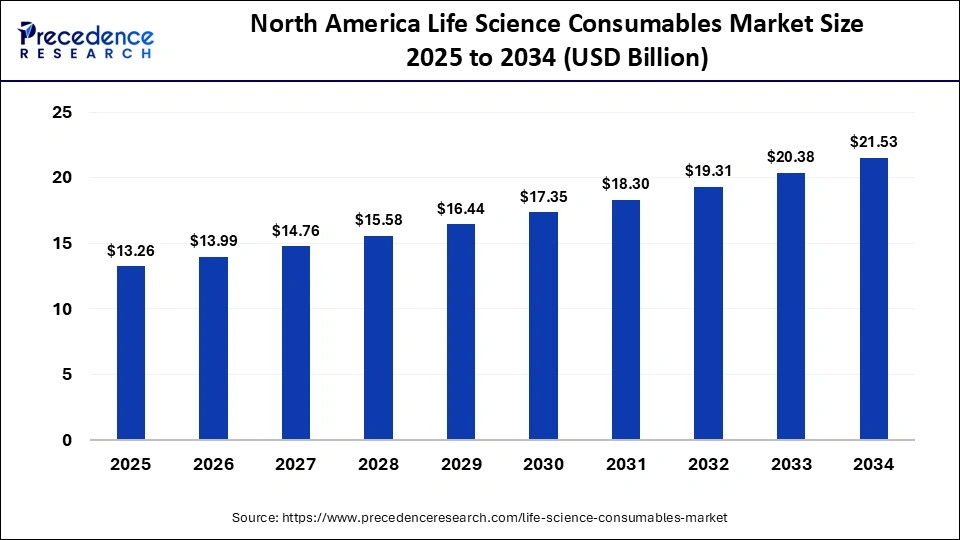
The North America life science consumables market size is estimated at USD 13.26 billion in 2025 and is projected to reach approximately USD 22.68 billion by 2035, with a 5.51% CAGR from 2026 to 2035.
What Factors Made North America a Dominant Region in the Life Science Consumables Market?
North America held approximately 40% market share in 2025. The region is dominant due to a couple of factors, such as government funding for research and increased healthcare spending, which foster advanced consumables and technologies. The region has a large number of actively working networks of cutting-edge academic institutions, hospitals and CROs that support the exponential growth of the life science consumables market. Leading research ecosystems such as those in Boston, San Francisco, North Carolina Research Triangle and Toronto drive continuous demand for sequencing kits, cell culture media, reagents and sterile disposables.
The presence of a well-developed and supportive regulatory environment, such as the FDA, further accelerates the approval of new products and technologies and helps increase demand for life science consumables. Federal agencies like the NIH and BARDA, along with private foundations and venture capital groups, also invest heavily in translational research, genomics, vaccine development and advanced therapeutic platforms, creating sustained consumption of high-quality laboratory consumables across the region.
What is the Size of the U.S. Life Science Consumables Market?
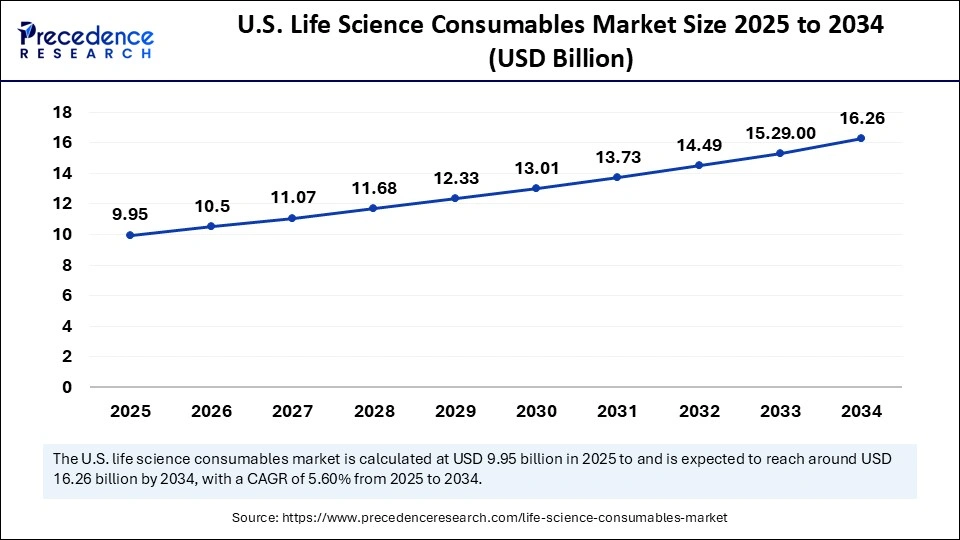
The U.S. life science consumables market size is calculated at USD 9.95 billion in 2025 and is expected to reach nearly USD 17.23 billion in 2035, accelerating at a strong CAGR of 5.64% between 2026 and 2035.
U.S. Life Science Consumables Market Analysis
The region is dominating the market due to significant government and private investment in R&D, strong support for advanced healthcare infrastructure, and the crucial role of personalized medicine and biopharmaceuticals. The U.S. receives ongoing funding from government agencies such as the National Science Foundation (NSF). Also, the active involvement of leading players such as Pfizer, Johnson & Johnson, and Merck is further fueling the regions growth.
How Is the Asia Pacific Life Science Consumables Market Expanding?
Asia Pacific is expected to witness the fastest CAGR during the foreseeable period of 2026-2035. The region is expanding due to a rapidly expanding healthcare infrastructure and supportive government initiatives that help establish research centers. The increasing number of chronic diseases, such as diabetes and hypertension, in the region encourages taking strong action against such diseases by monitoring their symptoms continuously.
The region leverages advantages such as low manufacturing costs and a large pool of skilled workers, further supporting its growth. Countries such as China, India, Japan, South Korea and Singapore are investing heavily in molecular diagnostics, sequencing laboratories, biomanufacturing parks and translational research hubs, which increases demand for reagents, assay kits and sterile consumables. National programs like Chinas Healthy China 2030, Indias National Biotechnology Development Strategy and Japans AMED-funded research networks continue to strengthen laboratory capacity.
China Life Science Consumables Market Analysis
The country is growing rapidly in the life science consumables market, driven by ongoing technological advancements and a large pool of talent and expertise developed annually by Chinese institutes, including those in the life sciences. Biomedical development has been identified as a strategic emerging initiative under policies such as Made in China 2025, and the 14th five-year plan supports local R&D and production.
Why Is Europe Seeing Notable Growth in the Life Science Consumables Market?
The European life science consumables market is rapidly growing owing to strong government support and policies for innovation in the life science sector, government-backed R&D progress, and increasing advancements in technology, such as AI and automation, integrated with the life science stream. The integration of AI into the life sciences has streamlined laboratory workflows, reduced errors, and enabled high-throughput analysis, leading to increased demand for advanced consumables. Additionally, the growing focus on preventive healthcare, along with diagnostics driven by a robust healthcare infrastructure, is a major driving factor.
Germany Life Science Consumables Market Analysis
The country is a major contributor to the markets growth as a leading economy in Europe, owing to the high-quality scientific research and infrastructure, strong pharmaceutical sector, along highly skilled workforce. The country benefits further from world-class universities and a well-established tradition of scientific excellence.
Why Is the Middle East & Africa Seeing Significant Growth in the Life Science Consumables Market?
The Middle East and Africa life science consumables market is growing rapidly as the region increasingly adopts advanced technologies such as genomics, AI-powered analytics and laboratory automation to enhance research and diagnostics. The increasing prevalence of diseases like cancer, CVD and diabetes requires strong support of advanced diagnostic tools and treatments, which drives the demand for life science consumables.
Countries such as the United Arab Emirates, Saudi Arabia, Qatar and South Africa are investing in molecular testing laboratories, precision medicine programs and national genomics initiatives that require sequencing kits, PCR reagents, extraction consumables and sterile disposables. Leading hospitals and research institutions across the Gulf region are also expanding automated laboratory systems and strengthening clinical research capabilities, which further accelerates procurement of high-quality consumables.
UAE Life Science Consumables Market Analysis
The countrys growth is attributed to a couple of leading factors like strategic government moves to curb the growing prevalence of chronic diseases under plans like the UAE Vision 2021-2031 and national innovation strategy. All these efforts are aimed at developing the UAE into a leading hub for scientific innovation in the life sciences sector.
Moreover, ongoing development of diagnostics centers, academic institutions and dedicated research parks like Dubai Science Park and Abu Dhabi Biotech Zone are further creating fertile ground for the growth of life science consumables market in the UAE.
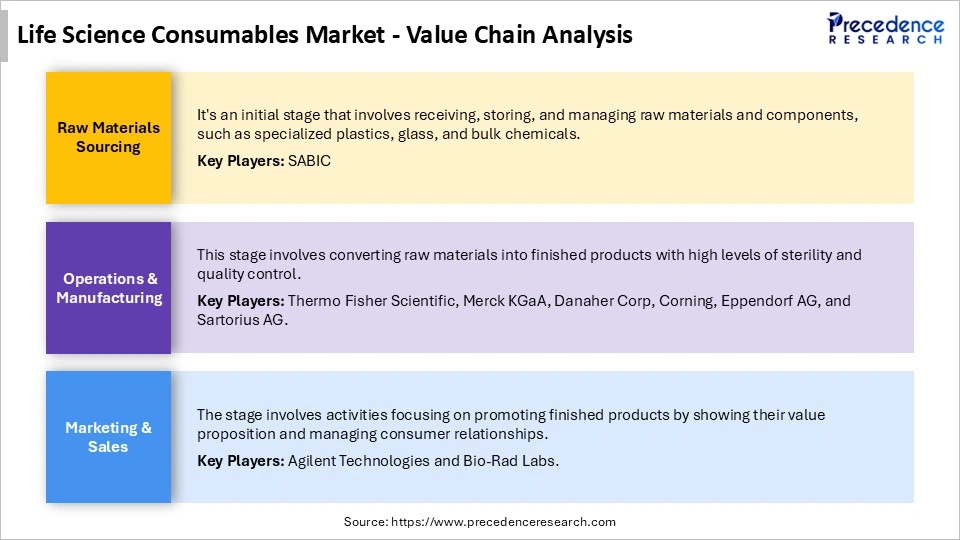
Life Science Consumables Market Value Chain
Life Science Consumables Market Companies
[[market_company]]
Recent Developments
- In October 2025, the leading life science platform with AI-driven capabilities, Labviva, launched new product name Smart Suppliers of the future to meet the strong consumer demand and fully digitize their catalogs further help lab equipment suppliers to expand their reach.(Source: https://www.labviva.com)
- In November 2025, Teva Pharmaceuticals Ltd introduced Teva Rise, which is a global innovation platform engineered to harness the strength of various disruptive technologies like AI, Industry 4.0, smart manufacturing, digital health and biotech, aiming to connect various startups and technology enterprises with business units of Teva Pharmaceuticals.(Source: https://www.tevapharm.com)
Life Science Consumables Market Segments Covered in the Report
[[segment_covered]]
For inquiries regarding discounts, bulk purchases, or customization requests, please contact us at sales@precedenceresearch.com
Frequently Asked Questions





Ask For Sample
No cookie-cutter, only authentic analysis – take the 1st step to become a Precedence Research client
 Get a Sample
.webp)



 sales@precedenceresearch.com
 Schedule a Meeting
