



Long-Term Care Software Market Trends, Companies, Revenue / Sales Performance, Subscriber Growth, Pricing Strategies, Cloud Adoption, Infrastructure Expansion, Competitive Landscape, and Industry Outlook
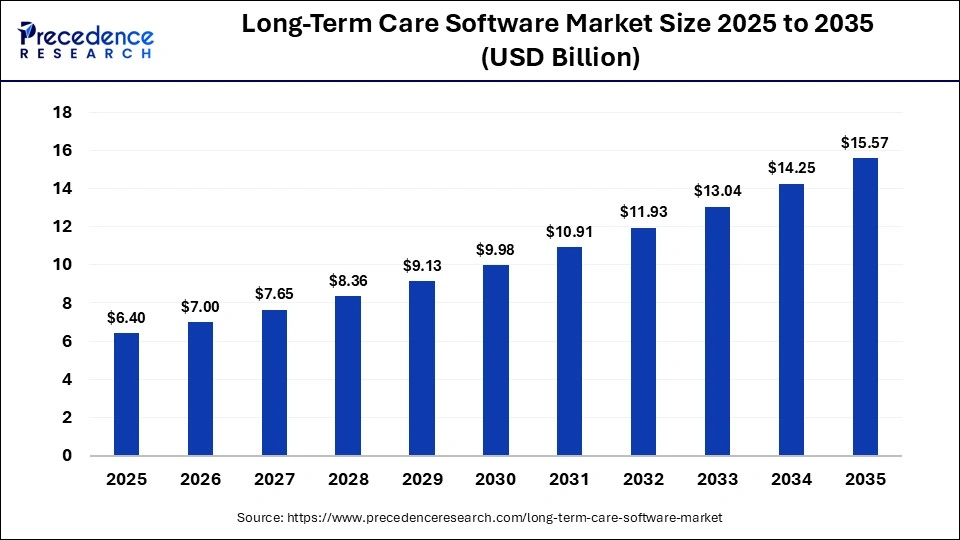
ICT industry specialist Shivani Zoting estimates the long-term care software market at USD 7.00 billion in 2026, with continued technology adoption expected to take the market to USD 15.57 billion by 2035 at a CAGR of 9.30%. Leading long-term care software market providers such as PointClickCare, MatrixCare, Netsmart Technologies, WellSky, Oracle Health are expanding their capabilities across segments including By Software Type, By Deployment Mode, By Facility Type, By Application.
Source: https://www.precedenceresearch.com/long-term-care-software-market
 Get a Sample
 Table Of Content


What is the Long-Term Care Software Market Size in 2026?
The global long term care software market size accounted for USD 6.40 billion in 2025 and is predicted to increase from USD 7.00 billion in 2026 to approximately USD 15.57 billion by 2035, expanding at a CAGR of 9.30% from 2026 to 2035. The long-term care software market is expanding rapidly due to increasing demand for efficient patient management, a rising aging population, and the need for digital healthcare solutions to improve care quality and operational efficiency.
Key Takeaways
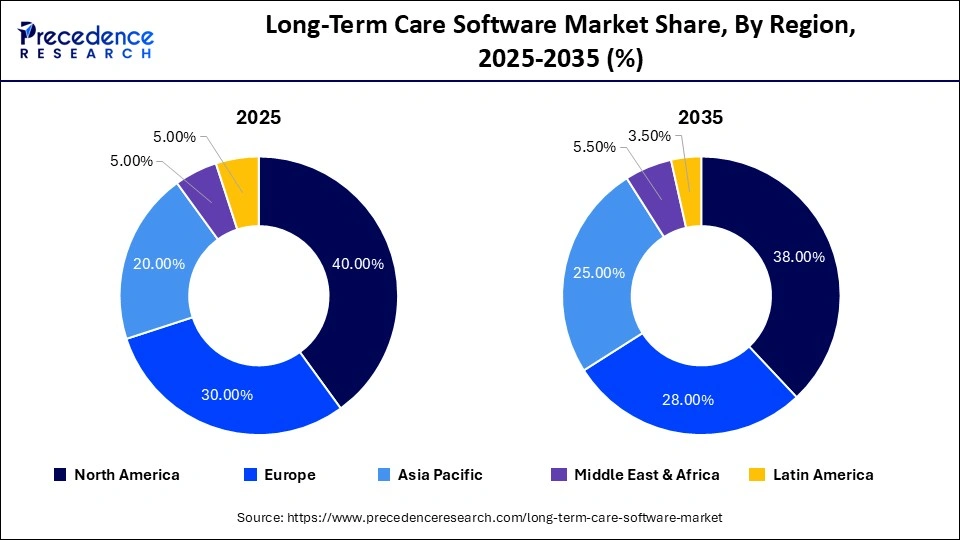
- North America led the long-term care software market with a 40% share in 2025.
- Asia Pacific is expected to grow at the fastest CAGR of 12.5% in the market during the forecast period.
- By software type, the electronic health records (EHR) for the long-term care segment led the market with a 30% share in 2025.
- By software type, the resident care & clinical management software segment is expected to grow at the fastest CAGR of 10.5% in the market during the forecast period.
- By deployment mode, the cloud-based solutions segment led the market with a 65% share in 2025.
- By deployment mode, the hybrid solutions segment is expected to grow at a significant CAGR of 9% in the market during the forecast period.
- By facility type, the nursing homes segment led the market with a 35% share in 2025.
- By facility type, the home healthcare agencies segment is expected to grow at the highest CAGR of 11.5% in the market during the forecast period.
- By application, the patient/resident health monitoring & documentation segment led the market with a 30% share in 2025.
- By application, the care coordination & workflow automation segment is expected to grow at the fastest CAGR of 11.5% in the market during the forecast period.
How is the Long-Term Care Software Market Evolving?
The market is expanding due to the growing need for effective patient management solutions and the growing aging population. Digital platforms are being used by long-term care facilities to ensure regulatory compliance, enhance care coordination, and streamline operations. The rising healthcare digitalization and investments in healthcare IT, especially in the U.S. and India, are also driving the market.
Firms like GE HealthCare are expanding their software capabilities through acquisitions and AI integration. This reflects a broader shift in the market where companies are focusing on digital platforms, interoperability, and data analytics to improve patient care, streamline operations, and support long-term care facilities with more efficient and scalable software systems.
Major Market Trends
- Rising adoption of cloud-based solutions: Healthcare providers are increasingly shifting to cloud platforms for better scalability, remote access, and cost efficiency.
- Integration of AI and analytics: Advanced AI tools are enabling predictive insights, improving patient care planning, and operational decision-making.
- Focus on interoperability: Software solutions are being designed to integrate seamlessly with electronic health records (EHR) and other healthcare systems.
- Growing demand for remote patient monitoring: The rise of telehealth and home-based care is driving adoption of software with real-time monitoring capabilities.
- Regulatory compliance and data security: Increasing healthcare regulations are pushing vendors to enhance data protection and compliance features.
- Mobile-friendly platforms: Care providers are adopting mobile-enabled software for on-the-go access to patient data and workflow management.
- Shift toward value-based care: Software solutions are evolving to support outcome-based care models and improve patient satisfaction.
- Expansion in emerging markets: Growing healthcare infrastructure and digital adoption in countries like India are creating new growth opportunities.
Market Scope
| Report Coverage | Details |
| Market Size in 2025 | USD 6.40 Billion |
| Market Size in 2026 | USD 7.00 Billion |
| Market Size by 2035 | USD 15.57 Billion |
| Market Growth Rate from 2026 to 2035 | CAGR of 9.30% |
| Dominating Region | North America |
| Fastest Growing Region | Asia Pacific |
| Base Year | 2025 |
| Forecast Period | 2026 to 2035 |
| Segments Covered | Software Type, Deployment Mode, Facility Type, Application, and Region |
| Regions Covered | North America, Europe, Asia-Pacific, Latin America, and Middle East & Africa |
Market Dynamics
Drivers
Need for Effective Patient Management Solutions
Healthcare facilities are increasingly adopting long-term care software, driven by an aging population and the rising need for efficient patient management. The demand to improve care coordination, streamline workflows, and reduce administrative burdens is accelerating digital transformation and boosting the need for long-term care software. In addition, the growing focus on improving patient outcomes and delivering high-quality care is encouraging providers to implement advanced software solutions.
Restraint
High Implementation Cost
The adoption of long-term care software is being hindered, particularly among small care providers, due to high implementation costs and concerns around data privacy and security. Operational challenges are further compounded by integration difficulties with existing legacy systems, which can limit seamless deployment. In addition, a lack of sufficient IT expertise within healthcare environments often restricts effective implementation and optimal use of these digital solutions.
Opportunity
Integration of AI and Cloud-Based Solutions
In regions such as India, the increasing integration of AI, telehealth, and cloud-based solutions is creating significant opportunities to enhance care delivery and expand healthcare services. Government initiatives and rising investments in digital health infrastructure are further supporting market growth by accelerating the adoption of advanced healthcare technologies. Additionally, the growing demand for remote and home-based care solutions is providing substantial opportunities for software providers, enabling them to expand their offerings and strengthen their presence in the digital health ecosystem.
Segment Insights
Software Type Insights
Long-Term Care Software Market Share, By Software Type, 2025-2035 (%)
| Software Type | 2025 | 2035 | CAGR (%) |
| Electronic Health Records (EHR) for Long-Term Care | 30.00% | 28.00% | 8.50% |
| Billing, Revenue Cycle & Claims Management Software | 20.00% | 19.00% | 8.00% |
| Resident Care & Clinical Management Software | 20.00% | 22.00% | 10.50% |
| Workforce & Staff Management Software | 15.00% | 16.00% | 10.00% |
| Medication Management Software | 15.00% | 15.00% | 9.00% |
The EHR for Long-Term Care Segment Held a 30% Market Share in 2025
The electronic health records (EHR) for long-term care segment dominated the long-term care software market with a major share of 30% in 2025. This dominance is driven by the need for stringent regulatory compliance, enhanced clinical decision-making, and the increasing demand for centralized patient data. EHR systems improve care coordination and ensure accurate documentation across facilities. In addition, integration with analytics and AI tools enables predictive care insights, while interoperability with other healthcare systems enhances the efficiency of data exchange.
The resident care & clinical management software segment held a 20% share of the market in 2025 and is expected to grow at the fastest CAGR of 10.5% in the coming years, driven by the growing need for integrated healthcare solutions that enhance patient outcomes and operational efficiency. The increasing adoption of personalized care planning and real-time patient monitoring also drive segmental growth. In addition, the expanding use of mobile health applications is enabling remote access to patient data, while automation features are reducing the manual workload of healthcare professionals, contributing to segmental growth.
The billing, revenue cycle & claims management software segment held a 20% market share in 2025 and is expected to grow at a 8% CAGR between 2026 and 2035. This growth is supported by the increasing need among long-term care facilities for more efficient reimbursement processes, reduced billing errors, and improved financial management. Furthermore, automation in claims processing is accelerating payment cycles, while compliance tools help providers adapt to evolving healthcare regulations.
Deployment Mode Insights
Long-Term Care Software Market Share, By Deployment Mode, 2025-2035 (%)
| Deployment Mode | 2025 | 2035 | CAGR (%) |
| Cloud-based Solutions | 65.00% | 70.00% | 12.50% |
| On-premise Solutions | 20.00% | 15.00% | 6.50% |
| Hybrid Solutions | 15.00% | 15.00% | 9.00% |
The Cloud-Based Solutions Segment Led the Market in 2025
The cloud-based solutions segment dominated the long-term care software market with the largest share of 65% in 2025 because of their cost-effectiveness, scalability, and capacity to offer remote access to medical data, facilitating improved coordination across various locations. Additionally, cloud platforms facilitate data backup and real-time updates, and improved cybersecurity measures are boosting provider confidence. Small and mid-sized facilities can now more easily access solutions thanks to the growing adoption of SaaS models.
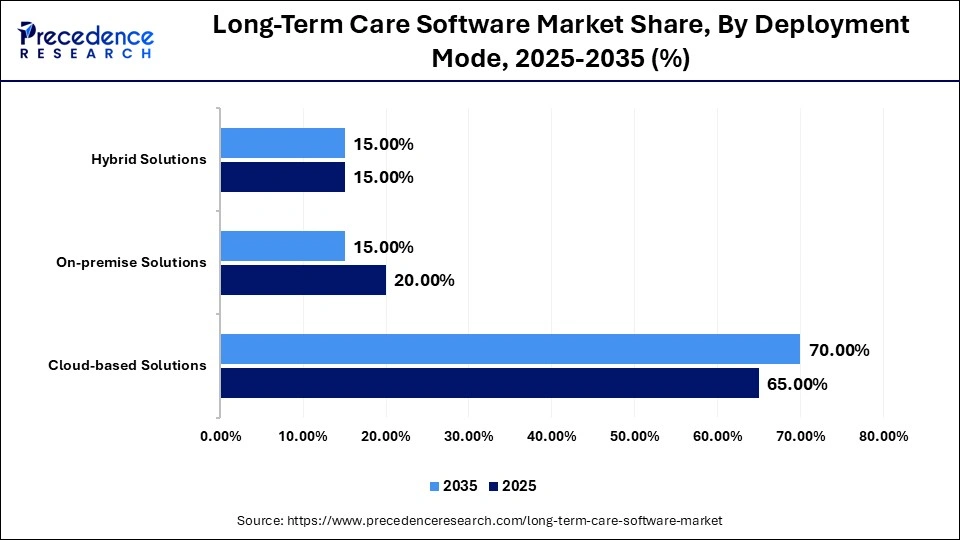
The hybrid solutions segment is expected to grow at a significant CAGR of 9% in the upcoming period, driven by the need for a well-rounded strategy that blends on-premise data control with cloud flexibility, particularly for companies with stringent data security regulations. Furthermore, hybrid models enable gradual digital transformation while providing customization according to particular organizational requirements. They also assist businesses in better managing sensitive data while utilizing the advantages of the cloud. Adoption of hybrid deployment strategies is being further encouraged by increased regulatory requirements.
The on-premise solutions segment held a 20% market share in 2025 and is expected to grow at a 6.5% CAGR over the forecast period since certain healthcare providers want total control over private patient information and adherence to internal IT and legal requirements. These solutions guarantee data storage in facility-controlled settings and offer more customization options. Large organizations, especially with well-established IT infrastructure, prefer on-premise solutions.
Facility Type Insights
The Nursing Homes Segment Held a 35% Share of the Market in 2025
The nursing homes segment dominated the long-term care software market with the largest share of 35% in 2025. This is mainly due to the need to manage high patient volumes, complicated care requirements, and regulatory compliance necessitates comprehensive software systems. Software adoption is being accelerated by an increase in patient admissions and the need for long-term care, while digital tools enhance staff productivity and care quality. Demand for cutting-edge solutions is also rising as patient safety and quality metrics gain more attention. Real-time care delivery in these facilities is being improved by the integration of monitoring technologies.
Long-Term Care Software Market Share, By Facility Type, 2025-2035 (%)
| Facility Type | 2025 | 2035 | CAGR (%) |
| Nursing Homes | 35.00% | 33.00% | 8.50% |
| Assisted Living Facilities | 25.00% | 24.00% | 9.00% |
| Home Healthcare Agencies | 20.00% | 23.00% | 11.50% |
| Hospice & Palliative Care Centers | 10.00% | 10.50% | 9.50% |
| Rehabilitation Centers | 10.00% | 9.50% | 8.00% |
The home healthcare agencies segment is expected to grow at a 11.5% CAGR in the coming years, driven by the need for remote patient monitoring systems, the growing aging population, and rising demand for in-home care services. Furthermore, telehealth integration is improving service delivery and promoting broader adoption due to its cost advantages over institutional care. Personalized care is becoming increasingly popular, which is helping the segment grow. Improvements in technology are also enhancing communication between caregivers and patients.
The assisted living facilities segment held a 25% market share in 2025 and is expected to grow at a 9% CAGR over the projection period, supported by the increasing use of digital tools to improve care coordination, resident engagement, and operational efficiency. The expanding elderly population continues to drive demand, while technology-driven solutions are enhancing resident safety and overall experience. Additionally, rising investments in smart facility management systems and digital platforms are streamlining both administrative and caregiving processes.
Application Insights
The Patient/Resident Health Monitoring & Documentation Segment Held a 30% Market Share in 2025
The patient/resident health monitoring & documentation segment dominated the long-term care software market with a share of 30% in 2025, as long-term care management requires accurate and ongoing health tracking. These solutions ensure adherence to healthcare regulations while also improving patient outcomes. Additionally, wearable device integration is improving monitoring capabilities, and real-time data tracking facilitates early intervention. Predictive healthcare outcomes are being further improved by the increased use of AI-driven insights. Adoption is also being aided by the increased focus on data-driven care.
Long-Term Care Software Market Share, By Application, 2025-2035 (%)
| Application | 2025 | 2035 | CAGR (%) |
| Patient/Resident Health Monitoring & Documentation | 30.00% | 28.00% | 9.00% |
| Care Coordination & Workflow Automation | 20.00% | 22.00% | 11.50% |
| Regulatory Compliance & Reporting | 20.00% | 19.00% | 8.50% |
| Financial & Billing Management | 15.00% | 16.00% | 9.50% |
| Staff Scheduling & Resource Optimization | 15.00% | 15.00% | 10.00% |
The care coordination & workflow automation segment is expected to grow at a 11.5% CAGR in the upcoming period. This growth is driven by the need to reduce administrative burdens and improve operational efficiency across care settings. Automation tools enhance communication among healthcare providers, streamline scheduling, and optimize task management. Integration with broader digital health ecosystems is further improving workflow efficiency, while increasing demand for operational transparency is accelerating adoption.
The regulatory compliance & reporting segment held a 20% market share in 2025, driven by stringent healthcare regulations requiring accurate and timely data reporting. These solutions enable providers to meet legal requirements through automated compliance tracking, reducing the risk of penalties. As regulatory frameworks become more complex, demand for such software continues to grow. Continuous updates and advanced reporting capabilities are helping organizations maintain adherence to evolving standards.
Region Insights
North America Long-Term Care Software Market Size and Growth 2026 to 2035
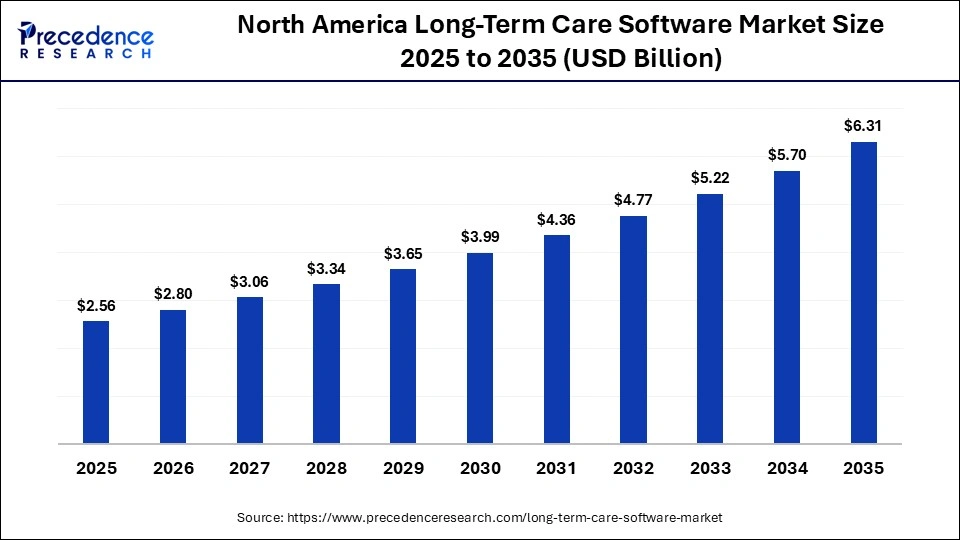
The North America long-term care software market size is estimated at USD 2.56 billion in 2025 and is projected to reach approximately USD 6.31 billion by 2035, with a 9.44% CAGR from 2026 to 2035.
Why Did North America Dominated the Long-Term Care Software Market in 2025?
North America dominated the long-term care software market with the largest share of 40% in 2025, driven by robust regulatory frameworks, high adoption rates of digital health technologies, and sophisticated healthcare infrastructure. Growth is further supported by ongoing investments in AI and cloud-based healthcare systems, and software adoption is encouraged by advantageous reimbursement policies. The market is also being strengthened by the existence of top healthcare IT firms. Innovations in the area are being further propelled by an increased emphasis on patient-centric care models.
U.S. Long-Term Care Software Market Size and Growth 2026 to 2035
The U.S. long-term care software market size is calculated at USD 1.92 billion in 2025 and is expected to reach nearly USD 4.67 billion in 2035, accelerating at a strong CAGR of 9.50% between 2026 and 2035.

U.S. Long-Term Care Software Market Trends
The U.S. leads the long-term care software market in North America due to its robust regulatory frameworks, high uptake of digital health technologies, and sophisticated healthcare infrastructure. The market is expanding due to the widespread use of EHR systems, favorable reimbursement regulations, and rising investments in AI-driven medical solutions. The market is also being strengthened by the existence of significant health IT firms and ongoing innovation in cloud-based platforms. The adoption of software in long-term care facilities is accelerated by an increasing emphasis on value-based care and patient outcomes.
How is the Opportunistic Rise of Asia Pacific in the Market?
Asia Pacific is expected to grow at the fastest CAGR of 12.5% throughout the forecast period, supported by growing healthcare infrastructure, an aging population, and a growing government emphasis on the transformation of digital healthcare. The region's market is expanding at an even faster rate thanks to increased investments in health tech and better access to care services. Growth is also being aided by increased knowledge of digital health solutions. The regions' healthcare delivery is improving due to the growing use of telemedicine and mobile health platforms.
India Long-Term Care Software Market Trends
India is emerging as a high-growth market for long-term care software supported by growing healthcare infrastructure and stepping up digitalization efforts. Adoption of software solutions is being driven by government initiatives supporting digital health, as well as growing awareness of managing care for the elderly. The market is expanding due to the aging population and the rising need for home healthcare services. Additionally, telemedicine's quick expansion and affordable cloud-based solutions are improving accessibility and care delivery nationwide.
Long-Term Care Software Market Companies
- PointClickCare
- MatrixCare
- Netsmart Technologies
- WellSky
- Oracle Health
- Epic Systems
- McKesson Corporation
- Veradigm
- AlayaCare
- ALIS
- Yardi Systems
- American HealthTech
- Eldermark
- Meditab
- Experience Care
- Optimus EMR
Recent Developments
- In April 2026, WellSky announced an expanded partnership with Google Cloud to integrate an AI-powered provider directory into its hospital discharge planning solutions. The integration is designed to reduce discharge delays by enhancing the accuracy and speed of finding post-acute care. The new technology leverages Google Cloud's Vertex AI to streamline the transition from hospital to home, reducing administrative burden.(Source: https://finance.yahoo.com)
- In March 2026, PointClickCare announced the launch of its next-generation EHR for Practice Groups. The platform integrates AI-driven workflows like Ambient Scribe to streamline senior care documentation. This update aims to enhance clinical certainty and reduce administrative burden for post-acute providers.(Source: https://www.prnewswire.com)
Segments Covered in the Report
By Software Type
- Electronic Health Records (EHR) for Long-Term Care
- Billing, Revenue Cycle & Claims Management Software
- Resident Care & Clinical Management Software
- Workforce & Staff Management Software
- Medication Management Software
By Deployment Mode
- Cloud-based Solutions
- On-premise Solutions
- Hybrid Solutions
By Facility Type
- Nursing Homes
- Assisted Living Facilities
- Home Healthcare Agencies
- Hospice & Palliative Care Centers
- Rehabilitation Centers
By Application
- Patient/Resident Health Monitoring & Documentation
- Care Coordination & Workflow Automation
- Regulatory Compliance & Reporting
- Financial & Billing Management
- Staff Scheduling & Resource Optimization
By Region
- North America
- Latin America
- Europe
- Asia-pacific
- Middle and East Africa
For inquiries regarding discounts, bulk purchases, or customization requests, please contact us at sales@precedenceresearch.com
Frequently Asked Questions





Ask For Sample
No cookie-cutter, only authentic analysis – take the 1st step to become a Precedence Research client
 Get a Sample




 sales@precedenceresearch.com
 Schedule a Meeting
