



Machine Vision Camera Market Trends, Companies, Revenue / Sales Performance, Manufacturing Yield, Fab Capacity, Export & Import Dynamics, Supply Chain Analysis, Competitive Landscape, and Growth Forecast
Machine Vision Camera Market (By Type: D Vision, 2D Vision, 3D Vision; By Product: PC-based Machine Vision System, Vision Controllers, Standalone Vision System, Vision Sensors and Image-based Barcode Readers, Others; By Application: Identification, Inspection, Gauging, Positioning, Others; By End User: Automotive, Healthcare, Manufacturing, Industrial, Others) - Global Industry Analysis, Size, Trends, Leading Companies, Regional Outlook, and Forecast 2026 to 2035
Source: https://www.precedenceresearch.com/machine-vision-camera-market
 Get a Sample
 Table Of Content


What is the Machine Vision Camera Market Size in 2026?
The global machine vision camera market size accounted for USD 52.50 billion in 2025 and is predicted to increase from USD 59.85 billion in 2026 to approximately USD 194.63 billion by 2035, expanding at a CAGR of 14.00% from 2026 to 2035. The machine vision camera market is experiencing rapid growth because of the integration of AI, advancements in 3D technology, and increasing demand for automation, extending into areas like surveillance, agriculture, and healthcare.

Key Takeaways
- North America dominated the market in 2025.
- Asia-Pacific is expected to grow at the fastest CAGR in the market during the forecast period.
- By type, the 2D vision segment led the global market in 2025.
- By type, the 3D vision segment is expected to expand rapidly in the machine vision camera market in the coming years.
- By product, the vision sensors and image-based barcode readers segment held a dominant position in the market in 2025.
- By product, the vision controllers segment is expected to grow with the highest CAGR in the market during the studied years.
- By application, the inspection segment accounted for the highest revenue share in the market in 2025.
- By application, the identification segment is expected to gain the highest share of the market between 2026 and 2035.
- By end user, the manufacturing segment held a major revenue share in the market in 2025.
- By end user, the automotive segment is expected to witness the fastest growth in the market over the forecast period.
What is the Machine Vision Camera Market?
A machine vision camera is an industrial camera designed for high-resolution imaging in automated inspection, measurement, and robotic guidance in manufacturing. These cameras feature high-speed image capture, global shutters, and interchangeable lenses for precise real-time analysis. These cameras are essential for inspection, quality control, robotics, and object recognition, focusing on image quality, consistency, and reliability. They also provide higher resolutions, faster frame rates, and reduced noise for detailed imaging.
In manufacturing, they are crucial for quality control, defect detection, dimension verification, assembly error identification, and compliance, thereby reducing waste and costs. In healthcare, they improve diagnostic accuracy and speed, reducing human error and aiding decision-making. Thus, machine vision cameras have revolutionized business operations, enhanced automation, accuracy, and efficiency across industries, enabling companies to streamline processes and improve quality control, helping gain a competitive edge.
What is the Role of AI in the Machine Vision Camera Market?
Artificial intelligence in machine vision cameras has revolutionized the industries using deep learning to analyze visual data and make quick decisions. This technology improves traditional vision systems by strengthening defect detection, object classification, and pattern recognition in challenging industrial environments. As machine vision outperforms human inspectors in speed and accuracy, detecting minute surface flaws, color variations, and assembly mistakes, it helps in reducing false positives and scrap rates.
The rise of machine vision has increased productivity, quality control, cost efficiency, and safety in manufacturing. AI also identifies defects and anomalies on production lines and helps to manage complex products better than humans. These cameras also recognize various objects in real-time for sorting and packing in robotics and logistics. Additionally, AI enables precise non-contact dimensional measurements and sorting in manufacturing, transforming cameras from simple image capture tools into sources of actionable intelligence for automation.
What are the Trends of the Machine Vision Camera Market?
- Advanced Imaging Technologies: Advanced Imaging Technologies (AIT) are crucial in the industry, transitioning from basic 2D imaging to real-time, high-precision analysis. As manufacturing and automation require efficiency, speed, and accuracy, AIT provides vital data such as depth, spectral, and polarization information in manufacturing. While 2D systems are cost-effective, 3D imaging is necessary for depth and spatial awareness tasks. Also, hyperspectral Imaging (HSI) helps in analyzing different spectral bands and detecting minor defects, while thermal Imaging detects heat patterns to ensure packaging integrity. Additionally, AI-enhanced cameras improve defect detection and accuracy, reducing false positives.
- Edge Computing and Smart Cameras: Edge computing and smart cameras are crucial in the sector as they shift data processing from centralized servers to real-time decision-making, reduce latency, and enhance privacy. The market is further driven by an increasing need for automation in non-industrial areas and quick, on-device analysis that avoids the bandwidth constraints of cloud systems. With Edge AI, smart cameras eliminate delays caused by sending data to a remote cloud server, which is vital for industrial uses like quality control, where immediate responses are required. Smart cameras also integrate lighting, optics, image capture, and processing into one unit. This simplifies deployment, maintenance, and compatibility with current automation systems, making them more efficient than traditional and bulky PC-based setups.
- AI and Automation Adoption: The use of AI and automation in the industry is crucial for enhancing accuracy, speed, and efficiency. By utilizing deep learning, these systems are able to handle complex and non-standard tasks. AI also helps in reducing false positives in quality control, while enabling quick defect detection, and helps in the reduction of operational costs. AI-powered automated systems process large volumes of visual data in real-time, while optimizing fast-moving production lines, thus catalyzing market growth further.
Market Scope
| Report Coverage | Details |
| Market Size in 2025 | USD 52.50 Billion |
| Market Size in 2026 | USD 59.85 Billion |
| Market Size by 2035 | USD 194.63 Billion |
| Market Growth Rate from 2026 to 2035 | CAGR of 14.00% |
| Dominating Region | North America |
| Fastest Growing Region | Asia Pacific |
| Base Year | 2025 |
| Forecast Period | 2026 to 2035 |
| Segments Covered | Type, Product, Application, End User, and Region |
| Regions Covered | North America, Europe, Asia-Pacific, Latin America, and Middle East & Africa |
Segmental Insights
Type Insights
Which Type Segment Dominated the Machine Vision Camera Market?
The 2D vision segment dominated the market in 2025, as it is essential due to its cost-effectiveness, speed, and reliability in inspecting, guiding, and identifying objects by their surface features such as contrast, color, and shape. It is widely used for barcode scanning, surface inspection, and basic robotic navigation in manufacturing.
2D vision systems are affordable and easier to implement, which makes them ideal for high-speed, high-volume production. They also effectively detect surface flaws such as scratches, dents, and color variations, which are vital in electronics and packaging. Additionally, 2D cameras integrate well with various software applications, offering a reliable plug-and-play automation solution in the long term.
The 3D vision segment is expected to be the fastest-growing over the studied period, as it is essential for providing depth, shape, and volumetric data, which helps robots to manage complex or reflective objects. It also outperforms 2D systems in precision, quality control, navigation, and logistics. It also allows for accurate measurements of volume, height, and surface shapes, helping in the detection of small defects.
Furthermore, these systems are less influenced by lighting and color variations, which enhances reliability in complex industrial settings. 3D cameras deliver micron-level accuracy for measuring and assembling intricate components, which is crucial in the automotive and electronics industries.
Product Insights
Which Product Segment Led the Machine Vision Camera Market?
The vision sensors and image-based barcode readers segment led the market in 2025 because of their flexibility, affordability, and ability to handle complex, high-speed tasks. It is driven by the need for 2D code reading, improved product traceability, and AI-powered inspections in industries such as automotive, logistics, and pharmaceuticals. They read codes in any direction, eliminating the requirement for exact product alignment on production lines.
They also offer better reliability and lower maintenance costs compared to laser scanners. Additionally, it integrates easily with IoT systems, while supporting key industrial protocols, and allows for easier smart camera installations. Thus, they are preferred for logistics sorting, automotive inspections, and food packaging, to provide fast and precise inspection and traceability.
The vision controllers segment is expected to expand rapidly in the market in the coming years, due to their ability to handle high-speed, multi-camera, and complex processing tasks in real-time. They also provide better cost-efficiency and high precision for robotics. They are flexible and easy for software updates, algorithm changes, and scalability for complex inspection or robotic tasks. Also, using one strong vision controller for several cameras is cheaper than equipping each camera with its own high-end processing capabilities, especially in large setups. Additionally, vision controllers are designed to withstand industrial conditions like dust, vibrations, and high temperatures, which ensures high reliability and consistent performance for quality assurance.
Application Insights
Why Did the Inspection Segment Dominate the Machine Vision Camera Market?
The inspection segment held a dominant position in the market in 2025, due to its need for automated and high-precision quality control in manufacturing. Inspection ensures that the product is consistent and minimizes waste, making it vital for industries like electronics, automotive, and pharmaceuticals. It automates real-time defect detection, which ensures compliance with regulations and reduces human error.
Also, advancements in AI, deep learning, and sensor technology lead to faster, advanced, and cost-effective inspection solutions. Additionally, apart from basic defect detection, these systems are used to validate barcodes/QR codes, inspect assemblies, and measure dimensions, broadening the market reach.
The identification segment is expected to show the fastest growth over the forecast period, driven by the need for fast, automated, and accurate identification, tracking, and inspection in manufacturing, e-commerce, and logistics. Key factors also include AI integration, rising quality assurance demands, and the need for product verification.
The growth of e-commerce and logistics increased the need for efficient order fulfillment and traceability. Also, advancements in sensor technology, such as CMOS, rapid image processing, and 3D imaging, enhance the identification, such as barcode scanning, OCR, and component recognition in industries including electronics, pharmaceuticals, and automotive.
End User Insights
How the Manufacturing Segment Dominated the Machine Vision Camera Market?
The manufacturing segment contributed the biggest market share in 2025, due to automated quality checks, quick defect identification, and better production efficiency in manufacturing. Quality assurance systems are needed for immediate defect detection for fast production lines, while ensuring consistent quality in electronics, automotive, and pharmaceuticals.
Machine vision cameras are highly used in robotic guidance, part tracking, and inventory control, which decreases dependence on manual inspections, reduces labor costs, reduces waste, and improves production output. Rapidly growing fields like semiconductor manufacturing, electric vehicle battery production, and electronics heavily rely on precise imaging to manage intricate, small components.
The automotive industry segment is expected to gain the highest market share between 2026 and 2035, as it requires speed and accuracy in vehicle assembly inspections and self-driving technologies. Vision systems are crucial in precise robotic guidance, such as welding, painting, and placing components. The increasing need for safety features like lane tracking, collision avoidance, and pedestrian detection boosts the use of AI-powered cameras in the automotive sector.
Regional Insights
Which Factors Drive the Machine Vision Camera Market in North America?
North America held a major revenue share of the market in 2025, due to its early adoption of industrial automation, strong manufacturing capabilities, and significant investments in AI and robotics. This leadership is further fueled by a high demand for advanced inspection in the automotive and electronics sectors, a concentration of major vendors, and robust R&D efforts.
The region's established automated production lines also require high-speed, 3D imaging technologies. Additionally, leading camera manufacturers and system integrators help shorten development times and speed up deployment. Swift investments in AI and edge computing enhance real-time decision-making and provide a competitive advantage to the industry.
U.S. Market Trends
The U.S. leads the market due to early automation adoption, strong R&D, and the presence of major companies. It is also driven by significant investments in AI, high-precision, and 3D imaging technologies. Machine vision is crucial for quality assurance and defect detection in industries like automotive, electronics, and semiconductors. Key sectors such as healthcare, logistics, and automotive increase the demand for these applications further. Major firms like Cognex, Teledyne, and National Instruments are based in the U.S. market, which is further supported by rising manufacturing and government initiatives.
How Will the Asia-Pacific Region Grow in the Machine Vision Camera Market?
Asia-Pacific is expected to host the fastest-growing market in the coming years, due to its large manufacturing base, rapid industrialization, and high automation. This growth is also driven by the need for precise quality control, robotic guidance, and AI inspection in the expanding electronics, automotive, and semiconductor sectors. As a global hub for production, the region needs advanced machine vision systems for quality assurance and defect detection. The market is further supported by strong government initiatives for smart manufacturing, which promote AI and machine vision technologies to enhance efficiency.
China Market Trends
China leads the regional market, supported by its robust manufacturing base, strong government initiatives, and rapid AI integration in various sectors. It is further boosted by cost-effectiveness and high-quality production, which enables quick scaling and reduces the technology gap with global leaders. Local firms have also swiftly adapted, offering cameras at lower prices, which results in a significant price-driven shift in the market. Furthermore, China's extensive manufacturing network necessitates automation to address rising labor costs and accelerate the adoption of vision-guided robotics.
What are the Advancements in the Machine Vision Camera Market in Europe?
Europe is expected to have significant market growth throughout the forecast years, as the industry is accelerating the implementation of industrial automation. Camera-to-vision machines are proving to be valuable components in various industries such as automotive, electronics, pharmaceutical, food and beverage, and packaging industries, and are being integrated to improve quality assurance, defect detection, and industrial production. Furthermore, with the development of the high-resolution camera, 3D imaging technologies, and edge computing, snow blower's work accuracy and ability of real-time inspection were constantly improving.
Germany Market Trends
Germany represents one of the leading markets for machine vision cameras in Europe due to its high industrialization level, high manufacturing competencies, and leading role in automation technologies. The use of machine vision systems for precision inspection, guidance of robots, quality assurance, and predictive maintenance is an emerging trend in German industries. Rising investments in AI-powered vision systems for production efficiency and quality control by automotive companies contribute significantly to the market's growth.
What are the Key Trends in the Machine Vision Camera Market in Latin America?
Latin America is expected to have significant growth in the market, due to the increased industrial automation and manufacturing in the region, and resulted smart production technology with the rising trend. The machine vision camera, which has become a kind of indispensable equipment for inspection, is widely used in quality inspection, packaging verification, reading of bar codes, and the monitoring of process equipment. In addition to travel and tourism, the automotive and food processing industries, pharmaceuticals, and electronics are key manufacturing industries.
Brazil Market Trends
Brazil is emerging as a major market for machine vision cameras in Latin America, with the growing use of industrial automation and investments in smart manufacturing technology. The increase in the demand for automated inspection systems and the integration of robotics is a significant factor driving market growth. Furthermore, as part of the adoption of Industry 4.0 and the shift towards digital manufacturing transformation, more companies are willing to invest in AI-powered imaging technology and intelligent automation systems.
How is the Middle East and Africa Region Growing in the Machine Vision Camera Market?
The Middle East and Africa are expected to have significant market growth in the upcoming years. Increasingly across the region, machine vision systems are being adopted to assist in the product quality, to automate the inspection process, and to increase operational efficiency. The manufacturing and oil & gas and, to a lesser extent, logistics and food processing sectors are growing significantly, with growth seen in the advanced imaging and inspection technology sector. Governments are also pouring considerable efforts into the implementation and development of smart factories, industrial diversification, and digital transformation projects.
Saudi Arabia Market Trends
Saudi Arabia is becoming a key market for machine vision cameras due to a surge in investments into smart manufacturing and the government's efforts to promote digital transformation outlined in Vision 2030. In the automotive, logistics, food processing, pharmaceuticals, oil and gas industries, machine vision systems are increasingly being used to add to automation, quality assurance, and operational efficiency. Rapid progress is also being made in market growth through government support of industrial diversification and advanced manufacturing.
Machine Vision Camera Market Supply Chain Analysis
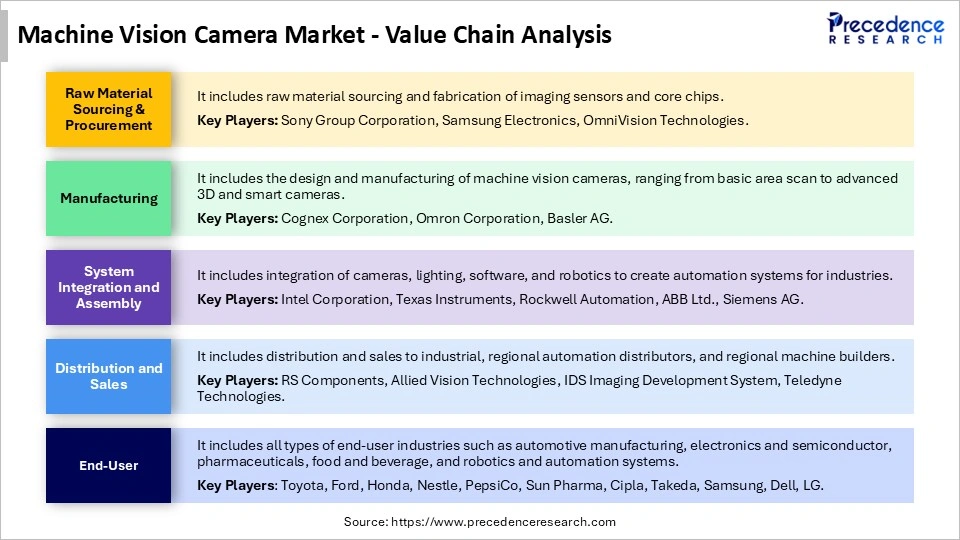
Machine Vision Camera Market Companies
- Cognex Corporation
- Keyence Corporation
- Teledyne Technologies Inc.
- Basler AG
- OMRON Corporation
- SICK AG
- Sony Group Corporation
- Allied Vision (TKH Group)
- Hikrobot
- Baumer Holding AG
- JAI A/S
- IDS Imaging Development Systems
- Datalogic S.p.A.
- Adimec Advanced Image Systems BV
Recent Developments
- In February 2026, Specim, a Konica Minolta subsidiary and leader in hyperspectral imaging, launched its FX19, a fast push hyperspectral camera operating in the NIR-SWIR spectrum of 1130–1920 nm. It offers improved performance and easy integration for industrial machine vision and advanced research, addressing the increasing demand for material identification and inspection in high-throughput environments.(Source: https://metrology.news)
- In September 2025, Keyence introduced its IM-X1000 Series, the newest addition to its Instant Measurement System range, for contemporary inspection requirements. It measures up to 5,000 dimensions in just one second with a single button press, boasting an ultra-wide stage, multisensor features, and the capability to automate intricate part programming.(Source: https://metrology.news)
Segments Covered in the Report
By Type
- D Vision
- 2D Vision
- 3D Vision
By Product
- PC-based Machine Vision System
- Vision Controllers
- Standalone Vision System
- Vision Sensors and Image-based Barcode Readers
- Others
By Application
- Identification
- Inspection
- Gauging
- Positioning
- Others
By End User
- Automotive
- Healthcare
- Manufacturing
- Industrial
- Others
By Region
- North America
- Europe
- Asia-Pacific
- Latin America
- Middle East & Africa
For inquiries regarding discounts, bulk purchases, or customization requests, please contact us at sales@precedenceresearch.com
Frequently Asked Questions





Ask For Sample
No cookie-cutter, only authentic analysis – take the 1st step to become a Precedence Research client
 Get a Sample




 sales@precedenceresearch.com
 Schedule a Meeting
