



Multi-Agent System (MAS) Platform Market Size, Share and Trends 2026 to 2035
Multi-Agent System (MAS) Platform Market (By Component: MAS Solutions/Platforms; By Component: MAS Solutions/Platforms, Professional Services (Integration/Consulting); By Deployment Mode: Cloud-Based, Hybrid/Edge Deployment; By Organization Size: Large Enterprises, Small and Medium Enterprises (SMEs); By Application: Workflow & Process Orchestration, Multi-Robot/Autonomous Systems Coordination, Predictive Analytics & Digital Twins, Others (Simulation, Fraud Detection); By Industry Vertical: BFSI (Banking, Financial Services, Insurance), Manufacturing & Automotive, IT & Telecommunications, Healthcare & Life Sciences, Retail & E-commerce, Others (Government, Energy)) - Global Industry Analysis, Size, Trends, Leading Companies, Regional Outlook, and Forecast 2026 to 2035
Source: https://www.precedenceresearch.com/multi-agent-system-platform-market
 Get a Sample
 Table Of Content


What is Multi-Agent System (MAS) Platform Market Size?
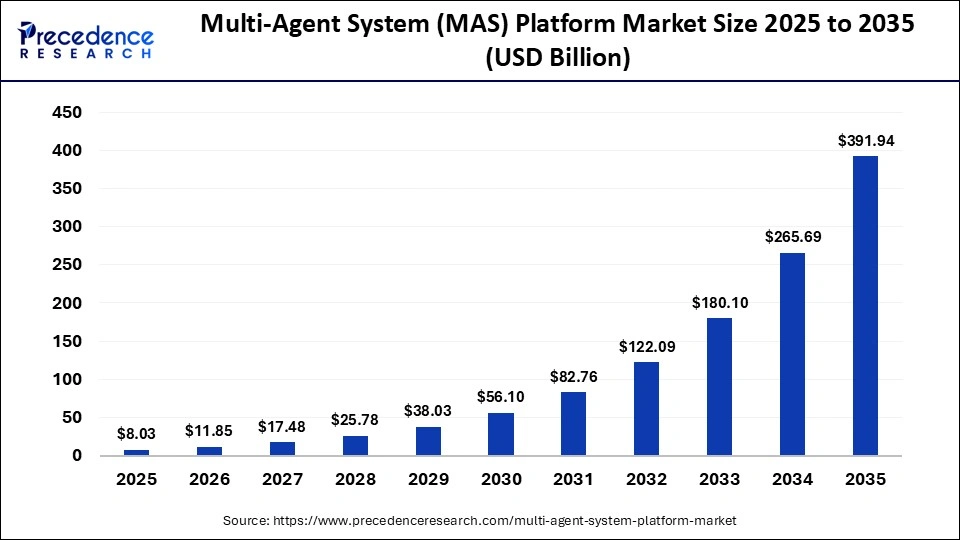
The global multi-agent system (MAS) platform market size was calculated at USD 8.03 billion in 2025 and is predicted to increase from USD 11.85 billion in 2026 to approximately USD 391.94 billion by 2035, expanding at a CAGR of 47.52% from 2026 to 2035. The market is growing steadily, driven by the rising demand for autonomous and intelligent systems, the growth of IoT and connected devices, cloud adoption, and scalability needs.
Market Highlights
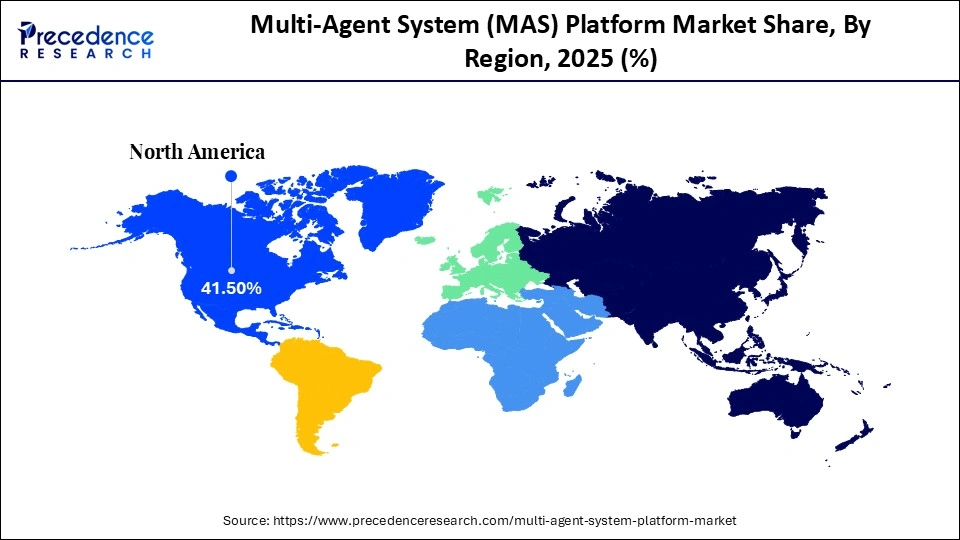
- North America led the multi-agent system (MAS) platform market with a share of approximately 41.5% in the global market in 2025.
- Asia Pacific is expected to expand at the highest CAGR in the market between 2026 and 2035.
- By component, the MAS solutions/platforms segment held a dominant revenue share of approximately 61.7% in the market in 2025.
- By component, the professional services (integration/consulting) segment is expected to grow at the highest CAGR between 2026 and 2035.
- By deployment mode, the cloud-based segment led the market with a market share of approximately 72.1% in 2025.
- By deployment mode, the hybrid/edge deployment segment is expected to expand at the fastest CAGR from 2026 to 2035.
- By organization size, the large enterprises segment held the largest revenue share of approximately 65.1% in the multi-agent system (MAS) platform market in 2025.
- By organization size, the small and medium enterprises (SMEs) segment is expected to grow at a solid CAGR between 2026 and 2035.
- By application, the workflow & process orchestration segment held a major revenue share of approximately 35.0% in the market in 2025.
- By application, the multi-robot/autonomous systems coordination segment is expected to grow at the highest CAGR between 2026 and 2035.
- By industry vertical, the BFSI (banking, financial services, insurance) segment contributed the biggest revenue share of approximately 21.0% in 2025.
- By industry vertical, the manufacturing & automotive segment is expected to grow at a solid CAGR between 2026 and 2035.
Why is the Multi-Agent System (MAS) Platform Market Gaining Momentum?
A multi-agent system (MAS) platform is a software framework that enables multiple intelligent and autonomous agents to interact, collaborate, and make decentralized decisions to achieve shared objectives. The market is gaining momentum as organizations increasingly require scalable, flexible, and self-adaptive systems to manage complex, real-time operations.
Rapid advancements in artificial intelligence, machine learning, IoT connectivity, and cloud computing have further accelerated adoption. Additionally, the shift toward Industry 4.0, autonomous automation, and distributed architectures across sectors such as manufacturing, healthcare, transportation, energy, and finance is driving strong demand for MAS platforms.
How Is AI Reshaping the Multi-Agent System (MAS) Platform Market?
Artificial intelligence integration can significantly enhance the MAS platform industry by enabling autonomous coordination, real-time decision-making, and complex workflow automation across sectors. By embedding advanced AI agents that understand, plan, and execute tasks collaboratively, platforms reduce manual oversight, accelerate operational efficiency, and improve the scalability and accuracy of services. AI also fosters interoperability between diverse systems, allowing intelligent orchestration, shared context, and adaptive problem-solving that traditional automation cannot achieve.
- In 2026, ServiceNow expanded the integration of Anthropic's Claude AI models into its Build Agent platform, empowering users to design workflows via natural language and automating enterprise software development and operations beyond simple task execution.
Multi-Agent System (MAS) Platform Market Trends
- Integration with Large Language Models and Advanced AI
One of the strongest trends in the MAS market is the integration of multi-agent systems with large language models (LLMs) and advanced AI architectures. By combining reasoning, planning, and domain-specific knowledge from LLMs with the coordination capabilities of MAS, platforms can handle far more complex tasks than traditional single-agent setups. This fusion enables agents to collaborate more intelligently, understand natural language, and adapt dynamically to evolving conditions in real-time use cases across sectors like customer service, automation, and decision support.
- Cloud and Edge Computing for Real-Time Distributed Intelligence
Another key trend driving MAS development is the adoption of cloud and edge computing architectures. Cloud infrastructure provides scalability, centralized data access, and easy deployment of agent ecosystems, while edge computing allows agents to operate and make decisions locally on devices with reduced latency. This hybrid approach ensures MAS platforms can support thousands of interacting agents in distributed environments, especially important in smart manufacturing, logistics, smart cities, and autonomous robotics by balancing performance, cost, and real-time responsiveness.
- Decentralized and Federated Intelligence
Decentralization is emerging as a core trend in multi-agent system (MAS) platform market, where agents coordinate without relying on a central controller. This federated or peer-to-peer architectural shift enhances resilience, scalability, and data privacy by enabling agents to learn and collaborate across nodes without transferring raw data. In federated learning and decentralized decision-making systems, MAS can support collaborative analytics, secure interactions, and cross-organizational workflows in sensitive domains such as healthcare and finance, aligning autonomy with governance and compliance needs.
- Enhanced Collaboration Protocols and Orchestration
MAS platforms are evolving from simple task routings toward advanced orchestration and agent collaboration protocols. Modern MAS frameworks allow specialized agents to communicate efficiently, sharing context, resolving conflicts, and coordinating workflows much like human teams. This trend reflects a growing realization that complex enterprise processes benefit from structured agent teams where orchestrators or coordination layers manage roles, dependencies, and state, improving reliability, adaptability, and performance in production environments.
- Explainability, Trust, and Governance
As MAS becomes more embedded in critical decision-making applications, explainability and governance are rising as strategic trends. Stakeholders increasingly demand transparent reasoning from autonomous agents, particularly in sectors like healthcare, finance, and government, where regulatory compliance and stakeholder trust are crucial. Trends toward Explainable AI (XAI) in MAS help ensure that autonomous decisions are interpretable, auditable, and aligned with ethical and legal standards, thereby making MAS platforms more viable for mainstream enterprise adoption.
- Sector-Specific Customization and Use Cases
MAS platforms are also seeing rapid growth due to vertical-specific solutions tailored to industry needs. In manufacturing, they orchestrate smart machinery and predictive maintenance; in logistics, they optimize routing and fleet management; in healthcare, they support diagnosis and resource allocation. This trend reflects a shift from generic MAS frameworks to customizable platform offerings that address distinct domain challenges with bespoke agents and workflows, accelerating deployment and business value in real-world operations.
Market Scope
| Report Coverage | Details |
| Market Size in 2025 | USD 8.03 Billion |
| Market Size in 2026 | USD 11.85 Billion |
| Market Size by 2035 | USD 391.94 Billion |
| Market Growth Rate from 2026 to 2035 | CAGR of 47.52% |
| Dominating Region | North America |
| Fastest Growing Region | Asia Pacific |
| Base Year | 2025 |
| Forecast Period | 2026 to 2035 |
| Segments Covered | By Component, Application, Deployment Mode, Organization Size, Industry Vertical, and Region |
| Regions Covered | North America, Europe, Asia-Pacific, Latin America, and Middle East & Africa |
Segmental Insights
Component Insights
Why the MAS Solutions/Platforms Segment Dominated the Market?
The MAS solutions/platforms segment dominated the global multi-agent system (MAS) platform market with a share of approximately 61.7%, because it offers scalable, interoperable orchestration layers that coordinate diverse autonomous agents, support real-time data processing, and simplify complex workflow automation. These platforms enable decentralized control, resilience, and adaptability across industries, reducing operational overhead and enhancing decision quality. Their flexibility, integration with cloud services, and ability to support rapid deployment attract enterprise adoption and investments in innovation.
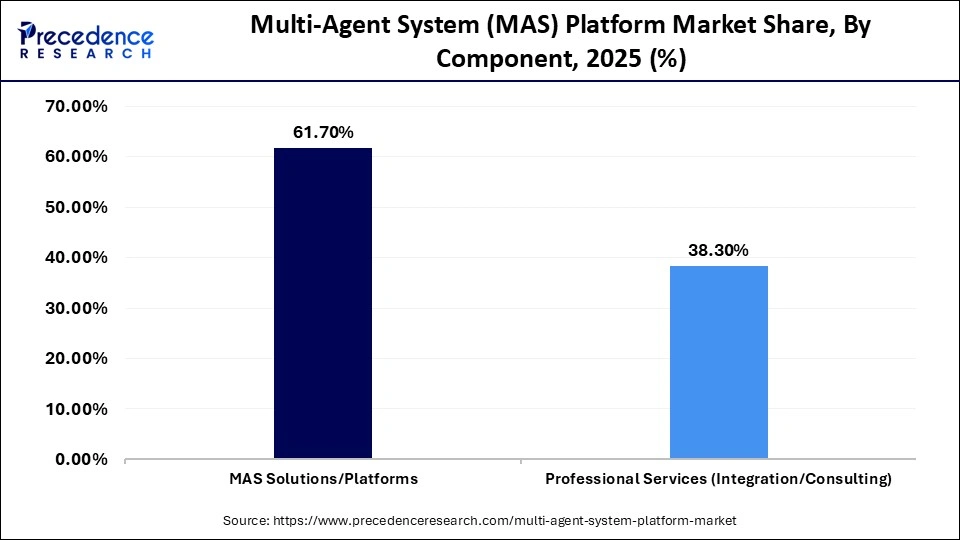
The professional services (integration/consulting) segment is expected to grow at the fastest CAGR in the market between 2026 and 2035, because businesses increasingly need expert consulting, integration, custom configuration, governance, and training to deploy complex MAS platforms effectively. As systems become more sophisticated, organizations lack internal expertise, driving demand for specialists to ensure seamless implementation, optimization, and compliance. This accelerates adoption and supports scalability across industries.
Deployment Mode Insights
How the Cloud-Based Segment Dominated the Market?
The cloud-based segment accounted for a considerable revenue share of approximately 72.1% in the multi-agent system (MAS) platform market in 2025, because cloud environments offer elastic scalability, flexible resource allocation, and lower infrastructure barriers, enabling MAS to quickly scale and coordinate many distributed agents without heavy upfront investment. Cloud platforms also support seamless integration, centralized management, real-time data sharing, and remote access, critical for dynamic workloads and geographically dispersed operations, making them the preferred deployment mode for MAS platforms.
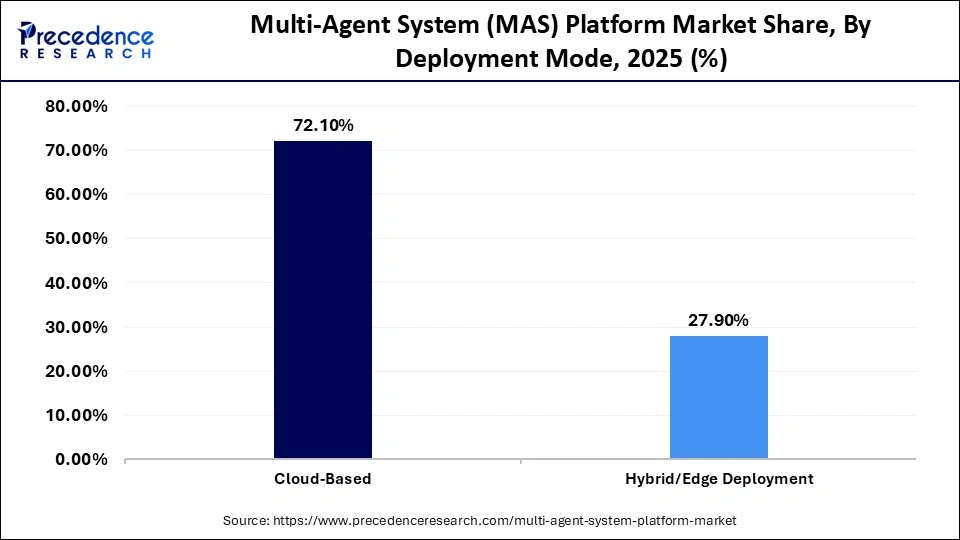
The hybrid/edge deployment segment is expected to grow with the highest CAGR in the market during the studied years, because combining cloud and edge computing lets MAS process data locally for real-time responsiveness, reduce latency and bandwidth use, and optimize resource allocation, while still leveraging the cloud for heavy computation and scalability. This flexibility meets demands for low-latency, efficient, and resilient agent coordination in distributed environments such as IoT, automation, and privacy-sensitive applications.
Organization Size Insights
Which Organization Size Segment Led the Market?
The large enterprises segment led the global market with a share of approximately 65.1% in the multi-agent system (MAS) platform market in 2025, because these organizations possess substantial financial resources, mature IT infrastructure, and deep technical expertise to implement and manage complex MAS platforms at scale. They face high operational complexity that benefits from coordinated agent orchestration and can justify strategic investments in customization, integration, and governance, enabling them to drive digital transformation and competitive advantage.
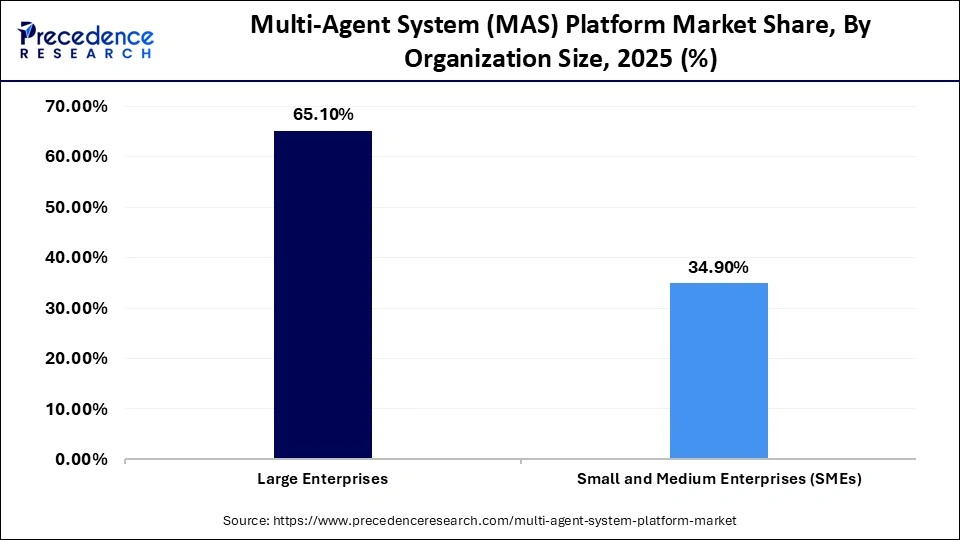
The small and medium enterprises (SMEs) segment is expected to expand rapidly in the market in the coming years, because SMEs increasingly adopt MAS platforms to boost efficiency, automate tasks, and remain competitive without heavy IT investments. Accessible, scalable solutions and demand for flexible, cost-effective automation drive rapid uptake as SMEs modernize operations and leverage intelligent coordination across business processes.
Application Insights
Which Application Segment Dominated the Market?
The workflow & process orchestration segment registered its dominance over the global multi-agent system (MAS) platform market with a share of approximately 35% in 2025, because MAS platforms excel at coordinating multiple autonomous agents across complex, dynamic tasks. They enable real-time decision-making, adaptive task allocation, and seamless integration across systems, reducing manual intervention. Their ability to manage distributed workflows, handle exceptions intelligently, and optimize end-to-end processes makes them widely adopted for orchestration use cases.
The multi-robot/autonomous systems coordination segment is expected to witness the fastest growth in the market over the forecast period, because expanding automation demands require intelligent, synchronized control of distributed robots and autonomous units. MAS platforms provide real-time collaboration, adaptive task allocation, and decentralized decision-making, improving efficiency, safety, and reliability across industries like logistics, manufacturing, and transportation.
Industry Vertical Insights
What Made BFSI (Banking, Financial Services, Insurance) the Dominant Segment in the Market?
The BFSI (banking, financial services, insurance) segment held the largest revenue share of approximately 21% in the multi-agent system (MAS) platform market in 2025, because financial institutions require highly coordinated, intelligent automation to manage complex operations, such as fraud detection, risk assessment, customer service, and regulatory compliance. MAS enhances real-time decision-making, streamlines transaction workflows, and personalizes interactions, helping banks and insurers improve efficiency, accuracy, and customer experience while maintaining robust security and operational resilience.
The manufacturing & automotive segment is expected to show the fastest growth over the forecast period, because industries increasingly rely on intelligent automation, real‑time coordination, and adaptive control across production lines, robotics, and supply chains. MAS improves efficiency, fault tolerance, and predictive maintenance, enabling dynamic task allocation and collaboration among machines, autonomous vehicles, and systems, meeting rising demand for smart, connected, and flexible manufacturing operations.
Regional Insights
How Big is the North America Multi-Agent System (MAS) Platform Market Size?
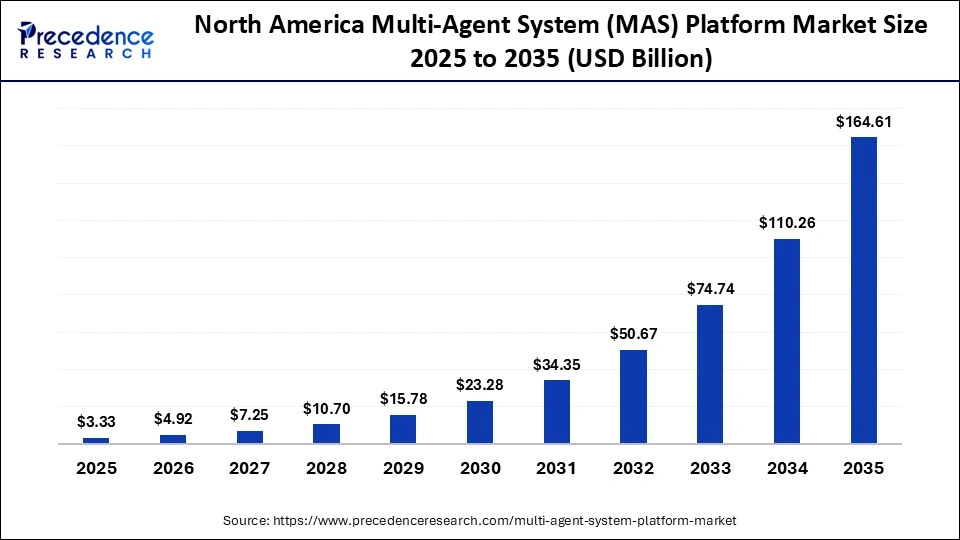
The North America multi-agent system (MAS) platform market size is estimated at USD 3.33 billion in 2025 and is projected to reach approximately USD 164.61 billion by 2035, with a 47.71% CAGR from 2026 to 2035.
Why North America Dominated the Multi-Agent System (MAS) Platform Market?
North America dominated the market with a share of approximately 41.5% in 2025, because it boasts advanced technological infrastructure, high R&D investment, and early enterprise adoption of AI and automation across key industries. A strong presence of innovation hubs, robust cloud and computing ecosystems, and proactive digital transformation strategies drives widespread deployment, while demand from sectors like finance, healthcare, and manufacturing accelerates growth. Furthermore, supportive regulatory and investment environments help maintain the region's leadership in intelligent, coordinated autonomous systems.
What is the Size of the U.S. Multi-Agent System (MAS) Platform Market?
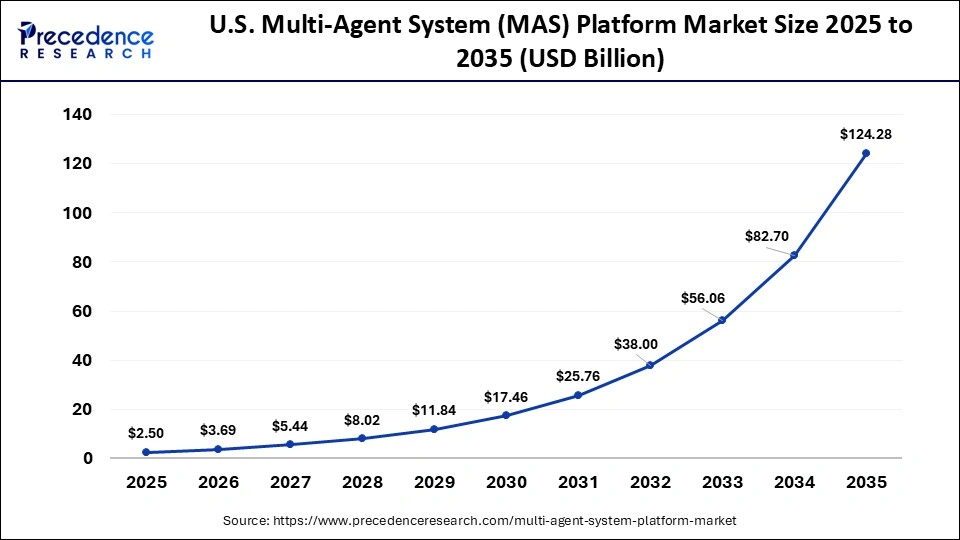
The U.S. multi-agent system (MAS) platform market size is calculated at USD 2.50 billion in 2025 and is expected to reach nearly USD 124.28 billion in 2035, accelerating at a strong CAGR of 47.79% between 2026 to 2035.
U.S. Multi-Agent System (MAS) Platform Market Trends
In the U.S., MAS platforms are advancing rapidly, with cloud‑based deployment still most used for scalability and integration. Trend growth includes agent orchestration for full workflow automation, interoperability standards, and specialized, collaborative agent swarms replacing single bots. Applications span enterprise operations, customer service automation, supply chain optimization, autonomous decision-making, and real‑time coordination across industries. The U.S. market is versatile, embracing both enterprise production use and innovative agent ecosystems beyond pilots, reflecting a shift toward agent-driven automation in business workflows.
How is Asia-Pacific Growing in the Multi-Agent System (MAS) Platform Market?
Asia-Pacific is expected to witness the fastest growth during the predicted timeframe, due to rapid technological adoption, government initiatives supporting AI and automation, and expanding digital infrastructure. Countries like China, India, Japan, and South Korea are increasingly implementing MAS platforms across manufacturing, logistics, and enterprise operations. Growing demand for intelligent, scalable automation and a rising skilled workforce further drive widespread deployment and innovation in the region.
China Multi-Agent System (MAS) Platform Market Trends
China holds a majority share in the region because it combines strong state support, vast AI research investment, and rapid commercialization of autonomous agent technology. Chinese companies are pushing MAS from theory into real use, with enterprise‑grade solutions handling complex, coordinated tasks across industries.
China's AI landscape has seen major innovations such as the upgrade of Alibaba's Qwen AI app to perform real‑world task execution and planning within its ecosystem, showcasing agent‑driven automation in consumer and enterprise services. Chinese initiatives also accelerate enterprise multi‑agent deployment frameworks that enhance coordination, efficiency, and autonomous decision‑making across business processes, reflecting a strategic focus on widespread agent adoption and innovation.
How Europe is Growing in the Multi-Agent System (MAS) Platform Market?
Europe is expected to experience lucrative growth during the forecast period. The strong industrial ecosystem and the rise in localized AI development increase the adoption of the MAS platform. The focus on deploying an agent network and the strong technological hub increases the use of the MAS platform. The growing automotive automation and the focus on managing multilingual business operations increase the use of the MAS platform, driving the overall market growth.
UK Market Trends
The UK is a major contributor to the market in the European region. The need for fraud detection and the focus on enhancing task accuracy increase the adoption of the MAS platform. The AI innovation hub and the shift to complex agentic AI systems increase the use of the MAS platform. The rise in automated guided vehicles helps with expansion. The growing MAS research drives the market growth.
Why Latin America is Growing in the Multi-Agent System (MAS) Platform Market?
Latin America is expected to grow notably in the coming years. The need for intelligent chatbots in the e-commerce industry and the focus on risk management in the banking sector increase the demand for the MAS platform. Heavy 5G connectivity investment and move towards edge nodes increases demand for the MAS platform. The expansion of agentic automation and the surging personalized marketing on platforms like e-commerce fuel the overall growth of the market.
Brazil Market Trends
Brazil is robustly expanding in the market. Growing business innovation and the focus on handling multi-step tasks increase the adoption of MAS platforms. The focus on data sovereignty and the huge investment in local AI infrastructure increase the development of the MAS platform. The increased utilization of the MAS platform in sectors such as agribusiness, banking, and e-commerce boosts the overall market growth.
Who are the major players in the global multi-agent system (MAS) platform market?
The major players in the multi-agent system (MAS) platform market include Microsoft Corporation, Google LLC (Alphabet), IBM Corporation, Amazon Web Services (AWS), SAP SE, Oracle Corporation, H2O.ai, DataRobot, RapidMiner, Databricks, Qualcomm, NVIDIA Corporation, Salesforce, Inc., Intel Corporation, SAS Institute
Recent Developments in the Multi-Agent System (MAS) Platform Market
- In January 2026, Teradata Corporation, a software company, unveiled AgentStack, an enterprise‑focused toolkit designed to operationalize MAS at scale across industry environments. The solution targets major barriers in deploying coordinated agent networks by enabling developers to integrate, manage, and monitor AI agent workflows in production without vendor lock-in, pushing multi‑agent orchestration deeper into real business applications.
- In January 2026, SpoonOS, revealed the launch of Web3‑based modular AI agent ecosystem, introducing a marketplace for developers and users to share and build modular AI agent skills on decentralized infrastructure. This marks a significant move toward open‑ended, collaborative multi‑agent development frameworks where autonomous components can be recombined to address diverse tasks in distributed environments. [Source: https://cryptorank.io]
- In November 2025, Google introduced Google Antigravity, an AI‑powered agent‑first integrated development environment that enables developers to orchestrate autonomous coding agents in parallel workflows. The system delivers verifiable artifacts and asynchronous task execution capabilities for software development, marking a major advancement in agent‑augmented programming environments. [Source: https://antigravity.google]
Segments Covered in the Report
By Component
- MAS Solutions/Platforms
- Professional Services (Integration/Consulting)
By Deployment Mode:
- Cloud-Based
- Hybrid/Edge Deployment
By Organization Size
- Large Enterprises
- Small and Medium Enterprises (SMEs)
By Application
- Workflow & Process Orchestration
- Multi-Robot/Autonomous Systems Coordination
- Predictive Analytics & Digital Twins
- Others (Simulation, Fraud Detection)
By Industry Vertical
- BFSI (Banking, Financial Services, Insurance)
- Manufacturing & Automotive
- IT & Telecommunications
- Healthcare & Life Sciences
- Retail & E-commerce
- Others (Government, Energy)
By Region
- North America
- Europe
- Asia-Pacific
- Latin America
- Middle East & Africa
For inquiries regarding discounts, bulk purchases, or customization requests, please contact us at sales@precedenceresearch.com
Frequently Asked Questions





Ask For Sample
No cookie-cutter, only authentic analysis – take the 1st step to become a Precedence Research client
 Get a Sample




 sales@precedenceresearch.com
 Schedule a Meeting
