



MXene Market Size, Companies, Share, Production Capacity, Raw Material Pricing, Export & Import Analysis, Manufacturing Cost, Competitive Positioning, and Demand Forecast
MXene Market (By Material Type: Ti-based, V-based, Nb-based, Mo-based; By Form: Multilayered, Delaminated, Quantum Dots; By Application: Energy Storage, EMI Shielding, Electronics, Environmental, Biomedical; By End-Use: Electronics, Energy, Automotive, Healthcare, Aerospace) - Global Industry Analysis, Size, Trends, Leading Companies, Regional Outlook, and Forecast 2026 to 2035
Source: https://www.precedenceresearch.com/mxene-market
 Get a Sample
 Table Of Content


What is MXene Market Sizein 2026?
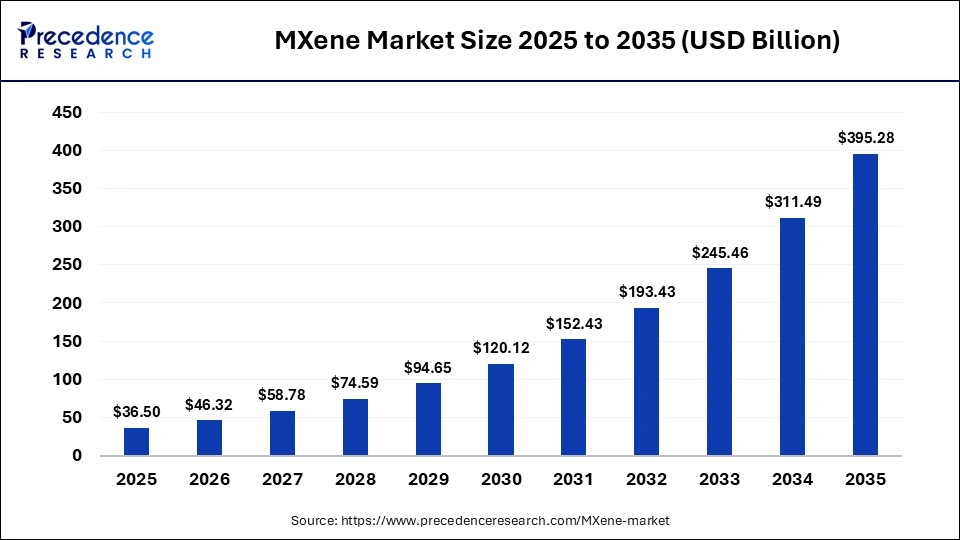
The global MXene market size was calculated at USD 36.50 billion in 2025 and is predicted to increase from USD 46.32 billion in 2026 to approximately USD 395.28 billion by 2035, expanding at a CAGR of 26.90% from 2026 to 2035. The market is driven by rising demand for advanced 2D nanomaterials in energy storage and the demand for next‑generation electronics.
Key Takeaways
- By region, Asia Pacific led the MXene market in 2025.
- By material type, the Ti-based segment led the market in 2025.
- By material type, the V-based segment is expected to grow at the fastest CAGR in the foreseen period.
- By form, the multilayered segment led the global market in 2025.
- By form, the quantum dots segment is observed to grow at a significant rate in the upcoming period.
- By application, the energy storage segment led the global market in 2025.
- By application, the EMI shielding segment is expected to grow at a rapid pace over the forecast period.
- By end-use, the electronics segment dominated the market in 2025.
- By end-use, the energy segment is expecetd to expand at the fastest rate in the foreseen period.
MXene Market Overview
MXene, a class of two-dimensional transition metal carbides, nitrides, and carbonitrides, has emerged as a highly versatile advanced material across multiple high-growth industries. Owing to its exceptional electrical conductivity, mechanical strength, and tunable surface properties, it is gaining strong traction in energy storage systems, biomedical applications, flexible electronics, environmental remediation, and AI-driven hardware technologies. As a next-generation nanomaterial, MXene is increasingly recognized as a significant breakthrough in materials science. A growing body of academic research, expanding industrial exploration, and rising funded initiatives are collectively accelerating the commercialization potential of MXene technology across the global market.
Impact of Artificial Intelligence on the MXene Market
The integration of Artificial Intelligence methodologies is transforming MXene research by addressing material complexity and enabling faster property prediction and application development. Machine learning models help identify optimal etching conditions, such as temperature and reaction time, to maximize yield and purity. Besides, an advanced approach combines Density Functional Theory (DFT) with Quantum Machine Learning (QML) to improve the accuracy of predicting MXene stability, bandgap tuning, and surface interactions. AI‑driven molecular simulations further support the design of MXene-polymer composites for applications such as wearable electronics and drug delivery systems. The convergence of AI‑driven modeling in MXene research is accelerating materials innovation and expanding the technological potential of next‑generation functional materials.
Mxene Market Trends
- The demand for Ti3C2Tx powder and slurries is rising as they increasingly disperse easily into polymer ink and formulations, signaling strong commercial adoption.
- Rising investment in biomedical applications of MXene reflects strong market momentum, driven by their favorable physiochemical properties, high electrical conductivity, and promising biocompatibility profile.
- Advances revealing topologically non‑trivial electronic behavior in MXene are strengthening their commercialization prospects in quantum computing and spintronics applications.
- The demand for MXene-based conductive films and sensors is growing with the rise of flexible displays, smart textiles, and miniaturized devices.
Investment is rising in sustainable, high-yield production methods, including eco-friendly etching techniques and scalable manufacturing processes.
Market Scope
| Report Coverage | Details |
| Market Size in 2025 | USD 36.50 Billion |
| Market Size in 2026 | USD 46.32 Billion |
| Market Size by 2035 | USD 395.28 Billion |
| Market Growth Rate from 2026 to 2035 | CAGR of 26.90% |
| Dominating Region | Asia Pacific |
| Base Year | 2025 |
| Forecast Period | 2026 to 2035 |
| Segments Covered | Material Type, Form, Application, End-Use, and region |
| Regions Covered | North America, Europe, Asia-Pacific, Latin America, and Middle East & Africa |
Segment Insights
Material Type Insights
How Does the Ti-Based Segment Dominate the MXene Market?
The Ti-based segment dominated the market with the largest share in 2025 due to the strong electrical conductivity, mechanical strength, and application versatility of Ti-based MXene. It is widely used in energy conversion applications such as solar cells, photocatalytic fuel production, hydrogen evolution through water splitting, and carbon dioxide reduction. In energy storage, Ti-based MXene supports Li-ion and next-generation batteries, supercapacitors, and hybrid systems due to their efficient charge transport and stability. Beyond energy, Ti-based MXene is applied in photocatalysis, drug delivery, neuroelectronic devices, photothermal cancer therapy, biosensors, and tissue engineering. Its broad application scope and high-performance properties reinforced the segment's dominance in the market.
The V based segment is projected to grow at the fastest rate in the upcoming period. This is due to its high popularity in electronic applications. V based MXene offers unique electronic properties, making it suitable for advanced technologies. Vanadium‑based carbide MXenes, depicted as V2CTx and V4C3Tx, demonstrate exceptional application prospects in energy storage, particularly in supercapacitors. Moreover, they are attracting significant interest from scientific researchers for innovation.
Form Insights
What Made Multilayered the Leading Segment in the Market?
The multilayered segment led the MXene market in 2025 due to its strong performance and wide application scope. Multilayered MXene has been used to develop mechanically robust conductive coatings that maintain performance under heavy stretching and bending, making it highly suitable for flexible and durable systems. Multilayer coatings can be deposited onto flexible polymer sheets, stretchable silicone, nylon, fiberglass, and silicon, which enhances their adaptability across different substrates and industrial uses. Additionally, a multilayered structure of MXene and silicon creates infrared sensors, ideal absorbers, and supports optical communication applications. The combination of mechanical strength, flexibility, and multifunctional capabilities has sustained the segment's dominant position in the market.
The quantum dots segment is expected to grow at a significant rate during the projection period, supported by their development as an efficient nanoscale platform for sustainable energy conversion. MXene quantum dots feature discrete electronic states and a high surface‑to‑volume ratio, while preserving the superior electrical conductivity and chemical tunability of their parent MXene materials. In addition, MXene quantum dots exhibit strong luminescent behavior, along with water solubility, good dispersibility, and biocompatibility, which broaden their application potential. Furthermore, they demonstrate catalytic performance comparable to noble metal catalysts without relying on rare earth elements. These attributes collectively position MXene quantum dots as a highly promising segment.
Application Insights
What Made Energy Storage the Dominant Segment in the Market?
The energy storage segment dominated the MXene market in 2025, driven by the high volume of battery production and the rigorous performance standards required for modern energy management. As renewable energy generation continues to expand, the need for reliable storage solutions has become increasingly critical. Governments and industries are investing in advanced materials such as MXenes to meet these evolving demands. Large-scale storage systems are increasingly specifying high-density digital platforms to ensure compliance with global standards and to meet consumer expectations for a reliable materials environment.
The EMI shielding segment is expected to grow at the fastest CAGR during the forecast period, driven by the rapid transition toward high-frequency communication systems and the increasing complexity of multifunctional electronic devices. The expansion of 5G networks and the Internet of Things has intensified the need to protect sensitive electronics from electromagnetic pollution. Moreover, electromagnetic interference (EMI) shielding materials are increasingly required to maintain device stability and performance. Adjustable EMI shielding properties have been achieved in solid-solution MXenes by mixing compositions with different elemental ratios, enabling application-specific performance tuning. Additionally, transfer matrix models effectively fit EMI shielding data for highly conductive MXene-based systems, further supporting technological optimization in this segment.
End-Use Insights
Why Did the Electronics Segment Lead the Market?
The electronics segment led the MXene market in 2025 due to the strong capability of MXene to support large-scale component manufacturing, consumer device platforms, and telecom communication networks, making it the material of choice for high-performance applications. Its extensive use across telecom networks, consumer electronics platforms, and manufacturing operations has significantly increased overall demand.
The high electrical conductivity and functionalized hydrophilic surface of MXenes enable their deployment in advanced applications such as flexible and wearable electronics. Large-scale operations in public infrastructure projects and mixed-use developments are further driving demand for advanced systems from material and technology providers. Additionally, the expansion of electric mobility, consumer electronics, and industrial systems is accelerating the adoption of two-dimensional transition metal carbides and nitrides within the electronics industry.
The energy segment is projected to expand at the highest CAGR in the coming years, driven by expanding applications in smart grid storage and renewable energy recovery systems. MXene provides a cost-effective alternative for advanced material integration in modern energy platforms. The emerging trend of the Internet of Things (IoT) and the miniaturization of electronics is increasing demand for small-scale energy storage devices. Additionally, transparency, conductive behavior, and color-changing properties make MXenes suitable for developing transparent electrochromic energy storage devices.
Regional Insights
Which Factors Contribute to Asia Pacific's Leading Position in the MXene Market?
Asia Pacific dominated the MXene market while holding a major share in 2025 and is projected to sustain its dominant position in the coming years. This is mainly due to massive investments in electronic component infrastructure and a well-established research ecosystem that supports advanced material innovation. A strong concentration of academic institutions actively engaged in MXene synthesis, combined with the presence of leading manufacturing hubs, particularly in Japan and South Korea, further strengthens the regional landscape. Continuous technological advancement and increasing investment in nanomaterials are accelerating overall market expansion across the region.
Japan accounts for a significant portion of global MXene investment, supported by its early adoption of nanotechnology and strong focus on green manufacturing, which is driving sustained growth.
China is currently leading the industrialization of MXenes by leveraging its comprehensive control over precursor materials and robust manufacturing capabilities, along with government-sponsored R&D initiatives. The country is also expected to hold the largest share of the regional market due to its strong nanomaterials manufacturing base and ongoing application development, with large-scale investment in energy storage further supporting demand. The Indian government's initiatives aimed at promoting innovation and renewable energy development are also contributing to market growth.
What Drives the Market within North America?
North America is projected to witness significant growth in the upcoming years, driven by rising demand for next-generation nanomaterials with advanced electrical, thermal, and mechanical properties. The region is expected to move toward large-scale commercialization of MXene across energy storage devices, wearable electronics, and environmental remediation technologies. Expanding electronics manufacturing activities have positioned EMI shielding as a critical application area, supported by the high electrical conductivity and layered structure of MXene, which enhances electromagnetic wave attenuation. Additionally, their high surface area and tunable chemical properties make MXene highly attractive for supercapacitors, lithium-ion batteries, and flexible electronics across the region.
The U.S. is projected to record significant demand for MXene, supported by increasing adoption in high-performance applications and the growing need for advanced materials in electronics, energy storage, and nanotechnology.
In Canada, MXenes are being widely studied and applied in energy storage solutions such as lithium-ion batteries, sodium-ion batteries, and supercapacitors. Environmental challenges in the country are further fueling demand for MXene-based water purification and pollutant removal systems, while pharmaceutical and healthcare researchers are increasingly investigating MXene for drug delivery, imaging, and biosensor applications.
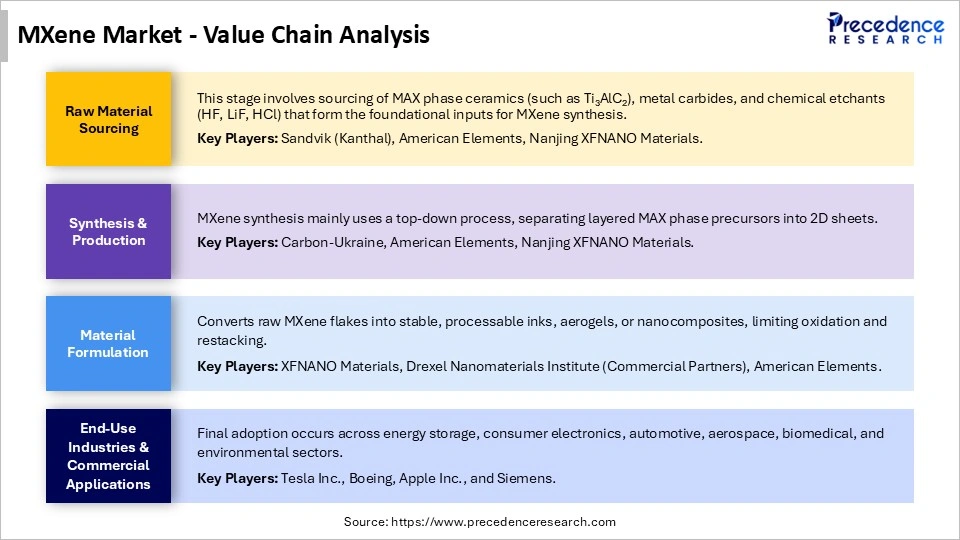
MXene Market Value Chain Analysis
Key Players Operating in the MXene Market
- American Elements (U.S.)
- Merck KGaA / Sigma-Aldrich (Germany)
- Alfa Chemistry (U.S.)
- Beijing Beike New Material Technology (China)
- Nanjing XFNANO Materials (China)
- Japan Material Technologies Corporation (JMTC) (Japan)
- ACS Material, LLC (U.S.)
- 2D Semiconductors, Inc. (U.S.)
- Carbon-Ukraine Ltd (Ukraine)
- Otto Chemie Pvt. Ltd. (U.S./India)
- SixCarbon Technology (Shenzhen) (China)
- Nanoshel LLC (U.S./UK)
- Nanograï¬ Nano Technology (Turkey)
- MSE Supplies LLC (U.S.)
- Beijing Zhongkeleiming Technology (China)
Recent Developments
- In 2026, researchers from the University of Chicago's Pritzker School of Molecular Engineering (UChicago PME), working with the University of Illinois Chicago and Vanderbilt University, introduced a groundbreaking method for synthesizing MXenes, advanced two-dimensional materials used in applications ranging from energy storage to electromagnetic shielding. Detailed in the journal Nature Synthesis, this new technique lowers production costs by at least two orders of magnitude and boosts product purity to 90%, a major improvement over the previous standard of around 60%. (Source: https://timestech.in)
- In 2025, Drexel University launched a three-year, 5 million multinational initiative to produce MXene nanomaterials. The project, undertaken in collaboration with Khalifa University in the United Arab Emirates, the University of Padua in Italy, and the Kyiv-based MXene manufacturer Carbon-Ukraine, aims to leverage this promising nanomaterial, first discovered at Drexel, to deliver clean drinking water to arid regions threatened by climate change and to enhance cell labeling and tracking technologies for biomedical analysis. (Source: https://drexel.edu)
- In 2025, researchers at Waseda University developed advanced MXene-coated lenses that protect the eyes from electromagnetic radiation while preserving moisture and exceptional optical clarity. This wearable innovation paves the way for safer, next-generation eyewear technologies in healthcare and beyond.
(Source: https://www.waseda.jp) - In 2025, ORSL, in partnership with IIT Bombay and IIT Kharagpur, secured a research grant under the DBT-BIRAC joint carbon capture and utilization program. This initiative makes ORSL the first Indian company to receive this prestigious funding in the CCU domain under the BioE3 Policy for High-Performance Bio‑Manufacturing. The project combines advanced biotechnology, algal engineering, and MXene-based photocatalysis to develop a near-zero-CO2-emission biogas platform. (Source: https://www.energetica-india.net)
Segments Covered in the Report
By Material Type
- Ti-based
- V-based
- Nb-based
- Mo-based
By Form
- Multilayered
- Delaminated
- Quantum Dots
By Application
- Energy Storage
- EMI Shielding
- Electronics
- Environmental
- Biomedical
By End-Use
- Electronics
- Energy
- Automotive
- Healthcare
- Aerospace
By Region
- North America
- Europe
- Asia-Pacific
- Latin America
- Middle East & Africa
For inquiries regarding discounts, bulk purchases, or customization requests, please contact us at sales@precedenceresearch.com
Frequently Asked Questions
Tags





Ask For Sample
No cookie-cutter, only authentic analysis – take the 1st step to become a Precedence Research client
 Get a Sample




 sales@precedenceresearch.com
 Schedule a Meeting
