



Night Vision Driver Monitoring System Market Size, Companies, Share, Vehicle Production Volume, Sales Performance, Export & Import Analysis, Technology Adoption, Competitive Positioning, and Demand Trends
Night Vision Driver Monitoring System Market (By Technology: Thermal Imaging Near-Infrared Technology, Visible Light Enhancement; By Component: Cameras, Displays, Processors, Software; By Vehicle Type: Passenger Vehicles, Commercial Vehicles, Motorcycles; By Application: Driver Monitoring, Pedestrian Detection, Animal Detection) - Global Industry Analysis, Size, Trends, Leading Companies, Regional Outlook, and Forecast 2026 to 2035
Source: https://www.precedenceresearch.com/night-vision-driver-monitoring-system-market
 Get a Sample
 Table Of Content


What is Night Vision Driver Monitoring System Market Size in 2026?
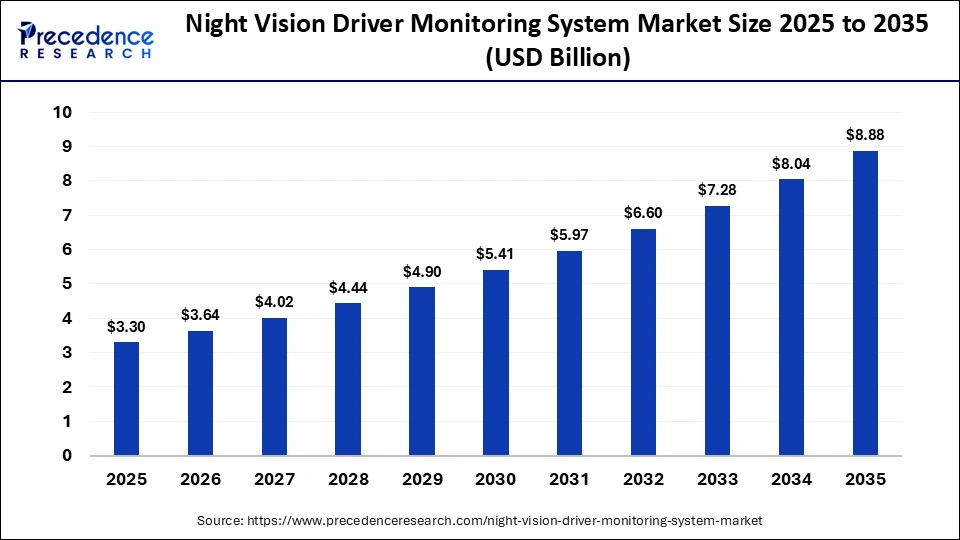
The global night vision driver monitoring system market size was calculated at USD 3.30 billion in 2025 and is predicted to increase from USD 3.64 billion in 2026 to approximately USD 8.88 billion by 2035, expanding at a CAGR of 10.40% from 2026 to 2035.The market is expanding rapidly because the focus of automotive safety is changing to intelligent and real-time in-cabin monitoring.
Key Takeaways
- North America dominated the global night vision driver monitoring system market in 2025.
- Asia-Pacific is expected to grow at the fastest CAGR in the market during the forecast period.
- By technology, the thermal imaging segment held a dominant position in the market in 2025.
- By technology, the near-infrared technology segment is expected to grow at the fastest CAGR in the market between 2026 and 2035.
- By component, the cameras segment led the global market in 2025.
- By component, the processors segment is expected to grow with the highest CAGR in the market during the studied years.
- By vehicle type, the passenger vehicles segment dominated the global market in 2025.
- By vehicle type, the commercial vehicles segment is expected to expand rapidly in the market in the coming years.
- By application, the driver monitoring segment held the largest market share in 2025.
- By application, the pedestrian detection segment is expected to expand rapidly in the market in the coming years.
Night Vision Monitoring: Enlightening the Road to Safer Mobility
The night vision driver monitoring system market is experiencing strong growth because of the increased use of advanced driver assistance systems (ADAS) and autonomous vehicle technologies. Carmakers are producing infrared cameras and sensor-driven surveillance systems to identify drowsiness, distraction, and inattention of the driver during dark conditions. The first to adopt these systems was in premium vehicle segments, but mid-range vehicles are also adopting them. Firm investments in companies like Bosch, Continental AG, and Denso Corporation are driving up the rate at which technology is penetrating the international markets.
How is AI Transforming Night Vision Driver Monitoring Systems?
Artificial intelligence (AI) transforms the night-vision DMS by allowing real-time face recognition, eye tracking, and behavior pattern analysis. AI-based algorithms allow additional differentiation between temporary glances and longer distractions, enhancing the accuracy of alerts and decreasing false alarms. Machine learning models evolve with the constant changes in the behavior of drivers, providing greater personalization and predictive safety interventions. Other companies, such as Smart Eye AB and Seeing Machines, are the first to develop AI-powered in-cabin sensing platforms in next-gen cars.
Night Vision Driver Monitoring System Market Trends
- Technological Advancements: Developments in near-infrared (NIR) cameras, 3D sensing, and thermal imaging are making the detection more accurate under low-light conditions. The system intelligence and data analytics capabilities are being enhanced with integration with biometric sensors and cloud connectivity.
- Emerging Markets: The increasing manufacturing of automobiles in emerging regions, such as Asia-Pacific and the Middle East and Africa is increasing the demand for safety-oriented automobile technologies. Market expansion is also being supported by the growing consumer awareness and the growth in sales of premium vehicles.
- Consumer Demand: Customers are focusing on safety, convenience, and smart cabin experiences. Growing apprehensions about driver fatigue, particularly on commercial flights and long-range flights, are speeding up adoption.
- Regulatory Support: The features of driver monitoring in new cars are being demanded by the government requirements of regions like the European Union. OEMs are being influenced by safety evaluation programs such as Euro NCAP to include advanced driver monitoring systems.
Market Scope
| Report Coverage | Details |
| Market Size in 2025 | USD 3.30 Billion |
| Market Size in 2026 | USD 3.64 Billion |
| Market Size by 2035 | USD 8.88 Billion |
| Market Growth Rate from 2026 to 2035 | CAGR of 10.40% |
| Dominating Region | North America |
| Fastest Growing Region | Asia Pacific |
| Base Year | 2025 |
| Forecast Period | 2026 to 2035 |
| Segments Covered | Technology, Component, Vehicle Type, Application, and region |
| Regions Covered | North America, Europe, Asia-Pacific, Latin America, and Middle East & Africa |
Segmental Insights
Technology Insights
Why Did the Thermal Imaging Segment Dominate the Market?
The thermal imaging segment dominated the night vision driver monitoring system market in 2025 because it has a higher ability to detect heat signatures, irrespective of the conditions of lighting. It guarantees high performance under full darkness, fog, and other unfavorable weather conditions. Automotive OEMs tend to use thermal systems in high-end and commercial vehicles where increased safety is very important. The technology is better at detecting fatigue of the driver and other hindrances by detecting contrasts in temperature. Its excellent accuracy and known aspect of being integrated in luxury cars boost the segment's growth.
The near-infrared technology segment is expected to show the fastest growth over the forecast period because of its low prices and small design of the system. NIR cameras reflect the face of the driver with the invisible light of infrared that allows tracking eyes and faces in low-light conditions. To strike a compromising equilibrium between performance and cost, automakers are embracing the use of NIR systems in mid-range cars. Reliability is increasing as sensors become more sensitive and AI-based tools enhance image processing. The rapid growth of the NIR systems is being driven by the scalability of the new technology to be used in mass-market vehicles.
Component Insights
What Made Cameras Segment Dominate the Night Vision Driver Monitoring System Market?
The cameras segment held the largest market share in 2025, since they are the heart of the sensing component of night vision monitoring systems. The infrared and thermal cameras can take high-resolution images, allowing accurate eye tracking, head location, and face orientation. Car manufacturers are laying emphasis on the use of multi-camera designs to increase accuracy and reduce blind spots. CMOS sensor technology has been continuously advancing to enhance the performance of low-light and to minimize the size of hardware.
The processors segment is expected to gain the highest market share between 2026 and 2035. Advanced processor systems can accelerate the speed of image signal processing for real-time tracking. They can be leveraged with advanced technologies, such as a convolutional neural network and SDRAM, enabling the lowest power consumption. They are designed in such a way that they can be compatible with multiple driver monitoring systems.
Vehicle Type Insights
How the Passenger Vehicles Segment Led the Market?
The passenger vehicles segment led the night vision driver monitoring system market in 2025, as they are produced in large quantities and are increasingly demanded to be equipped with sophisticated safety standards. Night vision DMS is being incorporated in ADAS packages by the luxury and mid-range car manufacturers. An increase in awareness about road safety and driver fatigue has increased uptake by owners of personal vehicles. In the new passenger models, integration is also facilitated by regulatory requirements in various areas.
The commercial vehicles segment is expected to witness the fastest growth in the market over the forecast period, due to the rising safety concerns with commercial vehicles. Government bodies launch policies related to fuel economy, targeting commercial fleets, as fuel economy is a significant factor in air pollution. Night vision DMS can analyze a driver's behavior and derive strategies to reduce fuel use. Moreover, DMS can significantly save exorbitant maintenance costs of commercial vehicles by monitoring driving safety.
Application Insights
Which Application Segment Dominated the Night Vision Driver Monitoring System Market?
The driver monitoring segment registered its dominance over the global market in 2025, driven by the need for fatigue, distraction, and drowsiness detection. These systems are based on real-time eye tracking, analysis of blink rate, and head movement. Rising road accident rates are being caused by careless driving, and OEMs are thus focusing on finding solutions to solve these issues by focusing on drivers. Combination with ADAS enables synchronized interventions like straightening the lane or emergency braking.
The pedestrian detection segment is expected to grow with the highest CAGR in the market during the studied years because of the rising urbanization and traffic density. Infrared and thermal systems are used to detect pedestrians during low visibility to minimize the chances of collision. The development of smart cities and self-driving cars is increasing the need for high-quality external sensing. Better image recognition algorithms help with detection despite the presence of many people in one place. The increasing safety consciousness among the consumer population and regulators is speeding up the move towards pedestrian-friendly systems.
Regional Insights
Why North America Dominated the Market?
North America held a major revenue share of the night vision driver monitoring system market in 2025, driven by the great usage of advanced technology in automotive safety. High demand for high-end cars with ADAS functionalities helps to grow the market. The fact that the major automotive technology providers are in the region and the ongoing investment in R&D enhances regional leadership. The use of government safety programs and insurance incentives also encourages integration of the system. Fleet operators in the companies are adopting driver monitoring to improve road safety. The region also enjoys the first-mover advantages of autonomous vehicle testing programs.
Country-Level Analysis
At the national scale, the U.S. leads the market in North America due to strict safety measures for vehicles and high sales of luxury vehicles. Canada is experiencing gradual growth based on the growing use of smart transportation systems. The presence of developed semiconductor and AI innovation agglomerations boosts technological advances in the region. Increased investment in the related vehicle infrastructure also increases demand. Night vision monitoring systems are added to the expansion of the production of electric vehicles.
How is Asia-Pacific Growing in the Night Vision Driver Monitoring System Market?
Asia-Pacific is expected to host the fastest-growing market in the coming years due to the increase in vehicle manufacturing and the growing middle-class population. The rapid urbanization and the rising road traffic accidents are driving demand for advanced safety systems. Most of the emerging economies are slowly rolling out tougher vehicle safety standards. Adoptions are rising at a faster rate through technological partnerships between international suppliers and local OEMs. Additional investments in electric and connected automobiles contribute to market growth.
Country-Level Analysis
China controls the regional production volumes and adoption of technological aspects at the country level. Japan has been a pioneer in innovation in cars and sensors. India is growing at a fast rate because of increased safety consciousness and regulatory trends. Increasing high-end car segments builds strength. Local car makers are also forming alliances with international technology suppliers.
Will Europe Grow in the Night Vision Driver Monitoring System Market?
Europe is expected to grow at a notable CAGR in the foreseeable future, driven by its stringent road safety laws and excellent automotive innovations. OEMs increasingly install driver monitoring systems in their new cars due to regulatory requirements. The penetration of high-cost vehicles is enhanced, and this will lead to early usage of thermal and infrared systems. Advanced safety solutions are also in favor of sustainability goals and smart mobility programs. The inter-relationship between automakers and technology suppliers helps make the system sophisticated. The growth of consumer safety awareness leads to a high market growth.
Country-Level Analysis
On the national level, Germany is the most innovative in the automotive industry and the production of premium vehicles. France and the UK are also growing in adoption, as there is good enforcement of regulation. High-end auto makers are incorporating sophisticated in-cabin spying capabilities. Road safety programs by the government promote deployment even faster. Night vision systems are demanded by investments in the testing of autonomous vehicles.
Night Vision Driver Monitoring System Market Value Chain Analysis
- Raw Material Sourcing: The foundation of any vehicle, including those equipped with Night Vision DMS, begins with the careful sourcing of high-quality raw materials.
Key Players: Sony Group Corporation and Omni Vision Technologies - Component Manufacturing: Once materials are sourced, they are transformed into various manufacturing processes. This stage includes the production of critical components like engines and transmissions.
Key Players: AISIN SEIKI Co. Ltd, Valeo - Vehicle Assembly and Integration: With components ready, the assembly phase begins. Skilled technicians bring together the engine, transmission, and DMS components to build the vehicle.
Key Players: Autoliv Inc and Continental AG - Testing and Quality Control: After assembly, each vehicle undergoes rigorous testing and quality control procedures. This step is vital for ensuring that the vehicle, particularly its safety features, including night vision systems, function correctly under real-world conditions.
Key Players: Autoliv Inc and Continental AG - Distribution to Dealers and OEMs: Post-testing, vehicles are prepared for distribution to dealers and original equipment manufacturers (OEMs).
Key Players: ZF Friedrichshafen AG and Magna International Inc. - Retail Sales and Financing: The final stage of the supply chain involves retail sales and financing options for consumers.
Key Players: Veoneer Inc and Hyundai Mobis
Night Vision Driver Monitoring System Market Companies
- AISIN SEIKI Co. Ltd.
- Valeo
- Veoneer Inc.
- OMRON Corporation
- Magna International Inc.
- DENSO CORPORATION
- ZF Friedrichshafen AG
- Aptiv
- Continental AG
- Autoliv Inc.
- Visteon Corporation
- Robert Bosch
- Continental
- Delphi Automotive
- Denso
- OMRON
- Valeo
- Aisin Seiki
- Magna International
- Visteon
Recent Developments
- In July 2025, Mobileye introduced its Driver Monitoring System, enhancing road safety by monitoring driver attention and alertness. The system leverages AI-powered computer vision and ADAS to detect drowsiness and distraction, providing real-time feedback. This innovation aimed to improve vehicle safety by ensuring drivers remained attentive while on the road.
- In May 2025, Omnivision launched the OX01N1B image sensor to make in-cabin automotive monitoring systems more cost-effective and energy efficient while improving performance. The sensor can capture high-quality images for applications, such as driver-awareness monitoring and night vision. (Source: https://www.allaboutcircuits.com)
Segments Covered in the Report
By Technology
- Thermal Imaging
- Near-Infrared Technology
- Visible Light Enhancement
By Component
- Cameras
- Displays
- Processors
- Software
By Vehicle Type
- Passenger Vehicles
- Commercial Vehicles
- Motorcycles
By Application
- Driver Monitoring
- Pedestrian Detection
- Animal Detection
By Region
- North America
- Asia Pacific
- Europe
- Latin America
- Middle East & Africa
For inquiries regarding discounts, bulk purchases, or customization requests, please contact us at sales@precedenceresearch.com
Frequently Asked Questions





Ask For Sample
No cookie-cutter, only authentic analysis – take the 1st step to become a Precedence Research client
 Get a Sample




 sales@precedenceresearch.com
 Schedule a Meeting
