



AI in Pharma Supply Chain Market Revenue to Attain USD 24.69 Bn by 2035
Published: 15 May 2026
Author: Precedence Research



AI in Pharma Supply Chain Market Revenue and Trends 2026 to 2035
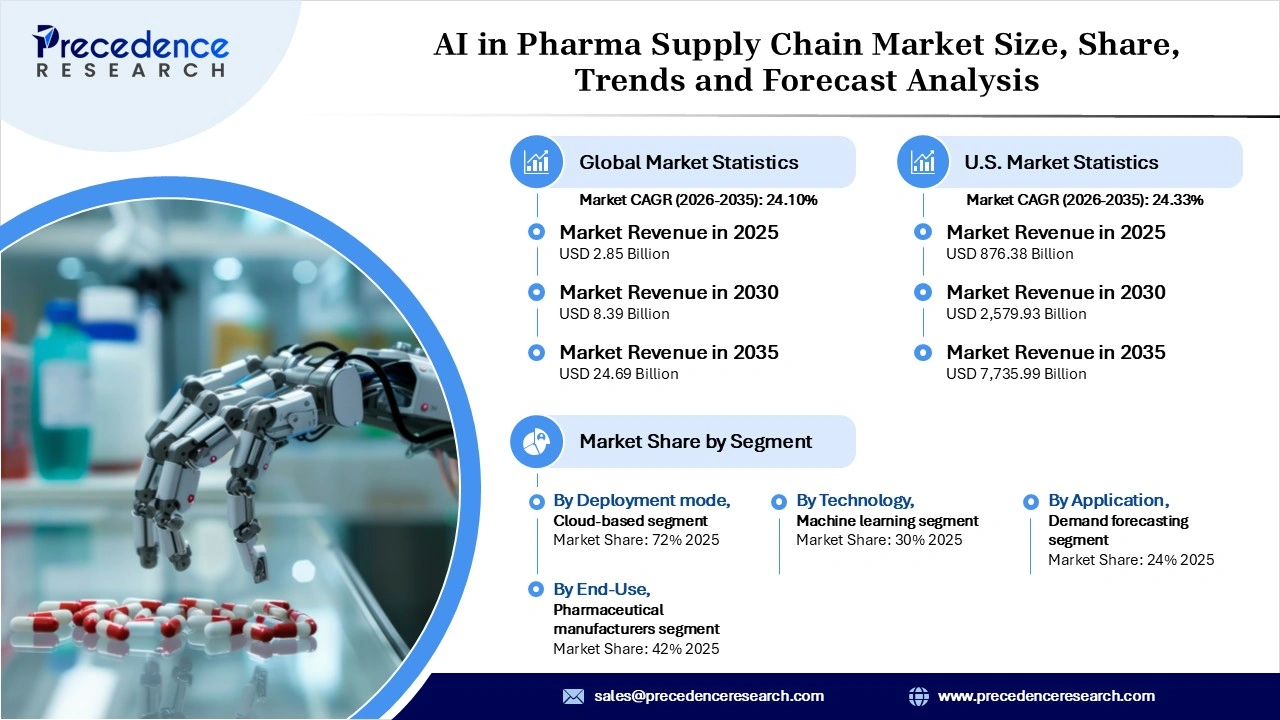
The global AI in pharma supply chain market revenue surpassed USD 2.85 billion in 2025 and is predicted to attain around USD 24.69 billion by 2035, growing at a CAGR of 24.10%. The market is growing rapidly due to rising demand for real-time inventory tracking, predictive analytics, cold chain monitoring, and improved drug distribution efficiency across global pharmaceutical networks.
Market at a Glance
The pharmaceutical industry is increasingly leveraging artificial intelligence (AI) to enhance demand forecasting, provide inventory optimization, manage logistics, and monitor the cold chain. In addition to the need to address drug shortages, AI solutions drive companies to attain operational excellence, resilient supply chains that can withstand disruption, and improve real-time decision-making while decreasing waste through automation and predictive analytics. Increased investments in digital transformation technologies, cloud-based platforms, and machine learning are further accelerating the development of AI applications within the pharmaceutical industry. Furthermore, new opportunities for growth for AI-enabled solutions in pharma supply chains exist as a result of regulatory compliance, detection of counterfeit drugs, and delivery of personalized medicines.
What Factors Drive the AI in Pharma Supply Chain Market?
- Increasing Use of Predictive Analytics in Supply Chain Management: Pharmaceutical organizations are utilizing AI to predict future needs, help maintain inventory levels, and decrease the amount of material that has a chance of going missing when looking at worldwide supply chains. AI can provide manufacturers with the means to better plan production capacity, decrease the amount of waste they generate during the production process, and deliver medicines when they are needed, particularly when the demand for health care changes on a regular basis and in times of emergency.
- Growing Need for Real-time Transparency and Automation of Supply Chain: AI technology supplies the ability to have real-time tracking capabilities associated with the shipment of pharmaceutical products from suppliers, to warehousing, and then through the entirety of the cold chain. Organizations are investing in automation-based supply chain systems to not only provide better visibility into the transactions that occur across their supply chains but also reduce errors with their operations, improve compliance with regulatory standards, and enhance the overall analytical capabilities utilized in decision-making.
Global Governments Push AI-Driven Transformation across Pharma Supply Chains
- In December 2025, India announced stronger adoption of generative AI in drug discovery and pharmaceutical manufacturing to improve research speed, optimize supply chains, and strengthen healthcare innovation through public-private collaboration.
- The European Union launched the €1.1 billion “Apply AI” initiative to accelerate AI adoption across healthcare and pharmaceutical sectors, supporting smarter manufacturing, predictive logistics, and faster development of advanced medical solutions.
- India has been discussing AI-driven modifications to enhance healthcare and pharmaceuticals by speeding up the adoption of AI to improve smarter manufacturing, predictive logistics, and faster development of innovative medical solutions.
- In May 2025, the U.S. launched the EQUIP-A-Pharma initiative to strengthen pharmaceutical manufacturing resilience using AI, advanced analytics, and predictive technologies to secure medicine supply chains and reduce disruption risks.
Market Segmentation Overview
- By deployment mode, the cloud-based segment dominated the AI in pharma supply chain market with a share of 72% in 2025 and is expected to grow at the fastest CAGR of 28.5% in the coming years because they offer a highly scalable infrastructure, lower operational costs, and immediate access to data, and increased usage of AI-powered analytics and remote monitoring within pharmaceutical operations.
- By deployment mode, the on-premise segment held the second-largest market share of 28% in 2025, with pharmaceutical companies wanting a greater level of data security, regulatory compliance, and control over sensitive manufacturing and supply chain data.
- By technology, the machine learning segment led the market with a share of 30% in 2025 and is expected to grow at the highest CAGR of 26.5% during the forecast period, as it enables pharmaceutical companies to enhance their ability to accurately forecast demand, reduce operational inefficiencies through automation of supply chain decision making, and improve their ability to perform real-time monitoring across logistic and production networks.
- By technology, the predictive analytics segment held the second-largest market share of 25% in 2025, as there is an increased demand for conducting risk assessments, optimizing inventory levels, forecasting demand, and making proactive decisions regarding inventory management within complex pharmaceutical supply chains.
- By application, the demand forecasting segment held the largest revenue share of 24% in the AI in pharma supply chain market in 2025, due to an increasing need for accurate production planning, reduced pharmaceutical shortages, optimized inventory levels, and efficient management of distribution networks within healthcare.
- By application, the cold chain monitoring segment held 12% of the market share in 2025 and is expected to expand rapidly with a CAGR of 27.5% over the studied period, owing to the expansion of biologics and vaccine distribution across diverse geographical locations. The increasing development of temperature-sensitive pharmaceutical products with the rising prevalence of infectious disorders also boosts the segment’s growth.
- By end-use, the pharmaceutical manufacturers segment dominated the market with a share of 42% in 2025 because they are adapting to use AI-based technologies in scheduling their production operations, ensuring compliance with regulations, coordinating logistics, and providing better visibility into the entire supply chain.
- By end-use, the biotechnology companies segment held the second-largest market share of 24% in 2025 and is expected to grow at the fastest CAGR of 28.5% during the forecast period because their investment into AI-related research continues to increase. Their investments in cold chain monitoring, optimizing supplies and efficiently handling complex biologics for distribution has also continued to increase.
Regional Analysis
North America held a major revenue share of 41% in the AI in pharma supply chain market in 2025, due to the presence of large pharmaceutical manufacturers, existing health care IT infrastructure, and a fast and widespread move toward incorporating automation into every aspect of a pharmaceutical supply chain. Many companies throughout the region are now implementing AI into aspects of their operations, such as inventory optimization, predictive demand forecasting, automating warehouse functions, and monitoring the temperature of drug shipments during transportation. The U.S. leads the market in North America due to substantial investments into the use of AI-enabled logistics, the use of digital twin technology, and real-time tracking systems in the distribution of pharmaceuticals throughout North America.
Asia-Pacific held 24% of the market share in 2025 and is expected to witness the fastest growth with a CAGR of 29.5% in the predicted timeframe because of the rapid increase in pharmaceutical production, digitalization of the health care industry, and the increasing amount of government support for smart manufacturing projects. Countries like China, India, Japan, and South Korea are all investing substantially in the development of their supply chains to utilize AI-based solutions to improve access to medicines and to optimize their logistics operations. The rapid growth of e-commerce for health care delivery and the increasing demand for effective cold chain management are additional factors propelling the growth of the market in this region.
AI in Pharma Supply Chain Market Coverage
| Report Attribute | Key Statistics |
| Market Revenue in 2025 | USD 2.85 Billion |
| Market Revenue by 2035 | USD 24.69 Billion |
| CAGR from 2026 to 2035 | 24.10% |
| Quantitative Units | Revenue in USD million/billion, Volume in units |
| Largest Market | North America |
| Base Year | 2025 |
| Regions Covered | North America, Europe, Asia-Pacific, Latin America, and the Middle East & Africa |
Top Companies in the AI in Pharma Supply Chain Market
Major companies involved in providing AI tools and services for pharma supply chain include IBM, SAP, Microsoft, Oracle, and Amazon Web Services. Google Cloud, Accenture, Deloitte, and TCS are other leading providers of AI tools. The fastest-growing startups include Logility, project44, and o9 solutions.
Segments Covered in the Report
By Component
- Software
- Services
By Deployment Mode
- Cloud-based
- On-premise
By Technology
- Machine Learning
- Predictive Analytics
- Natural Language Processing (NLP)
- Computer Vision
- Robotic Process Automation (RPA)
By Application
- Demand Forecasting
- Inventory Management
- Warehouse Automation
- Logistics Optimization
- Cold Chain Monitoring
- Risk & Compliance Management
By End-use
- Pharmaceutical Manufacturers
- Biotechnology Companies
- Contract Manufacturing Organizations (CMOs)
- Distributors & Logistics Providers
By Organization Size
- Large Enterprises
- Small & Medium Enterprises (SMEs)
By Region
- North America
- Latin America
- Europe
- Asia-pacific
- Middle and East Africa
Get this report to explore global market size, share, CAGR, and trends, featuring detailed segmental analysis and an insightful competitive landscape overview @ https://www.precedenceresearch.com/sample/8408
You can place an order or ask any questions. Please feel free to contact us at sales@precedenceresearch.com |+1 804 441 9344