



AI in Pharma Supply Chain Market Trends, Companies, Revenue / Sales Performance, Subscriber Growth, Pricing Strategies, Cloud Adoption, Infrastructure Expansion, Competitive Landscape, and Industry Outlook
AI in Pharma Supply Chain Market (By Deployment Mode: Cloud-based, On premises; By Technology: Machine Learning, Predictive Analytics, Natural Language Processing (NLP), Computer Vision, Robotic Process Automation (RPA); By Application: Demand Forecasting, Inventory Management, Warehouse Automation, Logistics Optimization, Cold Chain Monitoring, Risk & Compliance Management; By End-use: Pharmaceutical Manufacturers, Biotechnology Companies, Contract Manufacturing Organizations, Distributors & Logistics Providers) - Global Industry Analysis, Size, Trends, Leading Companies, Regional Outlook, and Forecast 2026 to 2035
Source: https://www.precedenceresearch.com/ai-in-pharma-supply-chain-market
 Get a Sample
 Table Of Content


What is the AI in Pharma Supply Chain Market Size in 2026?
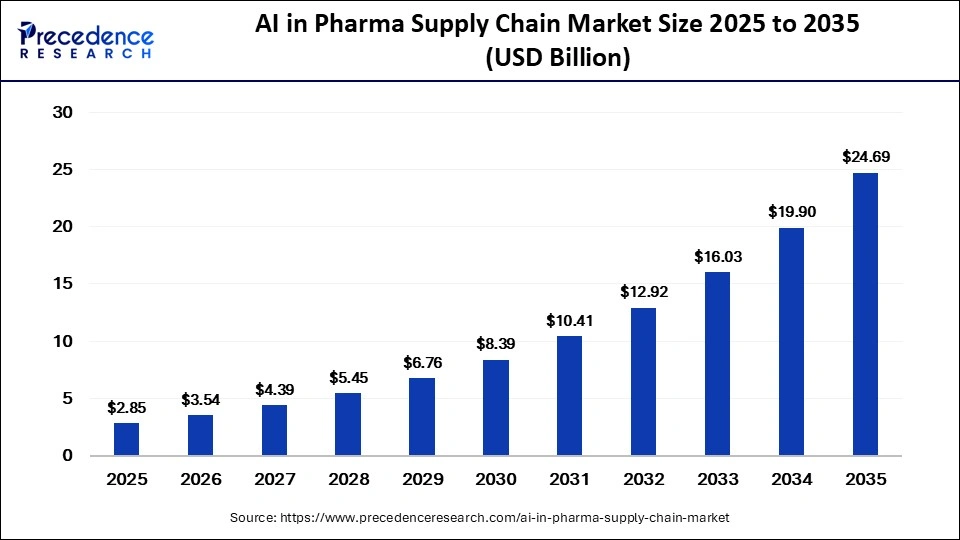
The global AI in pharma supply chain market size accounted for USD 2.85 billion in 2025 and is predicted to increase from USD 3.54 billion in 2026 to approximately USD 24.69 billion by 2035, expanding at a CAGR of 24.10% from 2026 to 2035. The market is largely driven by better demand forecasting, reduced stockouts of critical medications, and rapid expansion of AI/ML technologies in the pharmaceutical sector to speed up manufacturing.
Key Takeaways
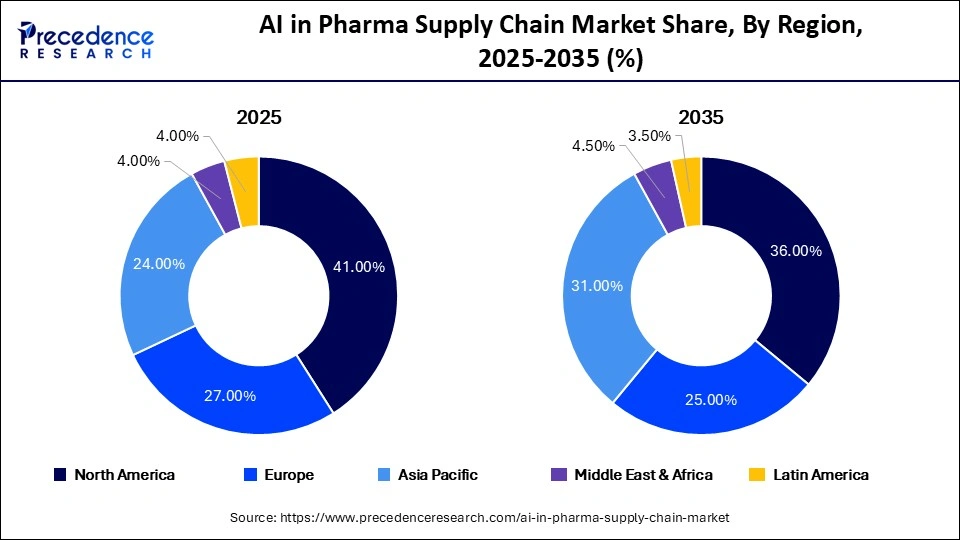
- North America held the largest AI in pharma supply chain market share of 41% in 2025.
- Asia-Pacific is expected to witness the fastest CAGR of 29.5% during the foreseeable period.
- By deployment mode, the cloud-based segment held the largest market share of 72% in 2025.
- By deployment mode, the on-premise segment held the second-largest market share of 28% in 2025 and is expected to grow at a CAGR of 11.5% during the foreseeable period.
- By technology, the machine learning segment held the largest market share of 30% in 2025.
- By technology, the predictive analytics segment held the second-largest AI in pharma supply chain market share of 25% in 2025 and is expected to grow at a CAGR of 23.5% during the forecast period.
- By application, the demand forecasting segment held the largest market share of 24% in 2025.
- By application, the inventory management segment held the second-largest market share of 22% in 2025 and is expected to grow at a CAGR of 23% in the coming years.
- By end-use, the pharmaceutical manufacturers segment held the largest market share of 42% in 2025.
- By end-use, the biotechnology companies segment held the second-largest market share of 24% in 2025 and is expected to grow at a CAGR of 28.5% over the studied period.
AI in Pharma Supply Chain Market Overview
The market deals with utilizing highly advanced technologies like machine learning, predictive analytics, and computer vision. The integration of AI with a pharma supply chain can offer proactive, automated, and highly intelligent networks instead of relying on manual processes and reactive approaches.
This transition shows self-healing supply chains that can detect barriers, disruptions, and optimize inventory in real-time, backed by precise data analysis to ensure proper delivery within the allotted time frame. The market is largely shifting from pilot projects to full-scale adoption of AI in supply chains, with leading pharma companies like AstraZeneca and Novartis that are leveraging AI for demand forecasting and precise inventory management.
AI in Pharma Supply Chain Market Trends
- The increasing adoption of intelligent agents that can independently reorder and manage inventory at supply chain levels is minimizing human negligence and accelerating the AI adoption in the pharma supply chain.
- AI can predict disruptions and suggest optimized transport routes for crucial and high-value biologic products.
- Many organizations are leveraging digital twins and making virtual replicas of supply chains to simulate potential barriers in the routes and test strategies that can reduce them effectively in a risk-free environment.
- The rapid integration of AI with blockchain technology in the pharma supply chain to ensure transparency in transactions and end-to-end traceability is further enhancing product quality and blocking counterfeit drugs.
Market Scope
| Report Coverage | Details |
| Market Size in 2025 | USD 2.85 Billion |
| Market Size in 2026 | USD 3.54 Billion |
| Market Size by 2035 | USD 24.69 Billion |
| Market Growth Rate from 2026 to 2035 | CAGR of 24.10% |
| Dominating Region | North America |
| Fastest Growing Region | Asia Pacific |
| Base Year | 2025 |
| Forecast Period | 2026 to 2035 |
| Segments Covered | Deployment Mode, Technology, Application, End-use, and Region |
| Regions Covered | North America, Europe, Asia-Pacific, Latin America, and Middle East & Africa |
Market Dynamics
Drivers
Growing Need for Demand Forecasting
The primary driver of the AI in pharma supply chain market is the increasing demand for precise forecasting and supply ratio to keep a balance between both amid price volatility and availability of crucial drugs, biologics, and vaccines that are newly launched. AI can allow early-warning systems that can flag possible shortages in advance by analyzing supplier capacity, regulatory results, and geopolitical threats that affect supply chains globally. AI minimizes forecasting errors by 20–35% by introducing real-time signals, which help support stock availability.
Restraint
Fragmented Data
The market is observing some critical barriers that hinder market expansion, including regulatory uncertainty, a skills gap to handle AI/ML technologies, and fragmented data as an input for AI systems. Many organizations are stressed because of siloed and broken data with missing information trapped in legacy infrastructure, making it harder to precisely train AI models. Also, the significant shortage of experts who can understand both AI technologies and the pharma sector closely is another market barrier.
Opportunity
Automated Logistics
The market is witnessing an opportunity to grow by converting supply chains from manual, reactive processes into highly precise and automated networks. AI agents can autonomously manage supply chain barriers like rerouting shipments in real-time due to traffic issues or bad weather conditions. Additionally, AI-driven sensors can detect changes in temperature in real time and prevent the loss of billions in annual medicine waste. AI supports customization and production of drugs in small batches, supporting in-time manufacturing and drug delivery.
Segmental Insights
Deployment Mode Insights
The Cloud-based Segment Held the Largest Market Share of 72% in 2025
The cloud-based segment dominated the AI in pharma supply chain market with the highest share of 72% in 2025 and is expected to grow at the fastest CAGR of 28.5% in the coming years, as it offers cost-effectiveness, real-time data integration, which is essential to handling complex global logistics, along with higher scalability. It allows predictive analytics and supports secure sharing of complex datasets among manufacturing, logistics providers, and regulatory bodies.
AI in Pharma Supply Chain Market Share, By Deployment Mode, 2025-2035 (%)
| Deployment Mode | 2025 | 2035 | CAGR (%) |
| Cloud-based | 72.00% | 85.00% | 28.50% |
| On-premise | 28.00% | 15.00% | 11.50% |
The on-premise segment held 28% of the market share in 2025 and is expected to grow at a CAGR of 11.5% during the foreseeable period. The segment is largely driven by the increasing demand for data security, regulatory compliance, and integration with existing manufacturing systems. On premises, deployment is ideal for data security and intellectual property protection.
Technology Insights
The Machine Learning Segment Held the Largest Market Share of 30% in 2025
The machine learning segment dominated the AI in pharma supply chain market with the highest share of 30% in 2025 and is expected to expand rapidly with a CAGR of 26.5% over the studied period due to its ability to analyze vast and complex datasets for predictive analytics and real-time risk management. ML algorithms excel at detecting patterns to optimize inventory and reduce stockouts, and improve cold chain logistics for sensitive products.
The predictive analytics segment held 25% of the market share in 2025 and is expected to grow at a CAGR of 23.5% during the foreseeable period of 2026-2035. The segment is growing as it directly addresses crucial industry challenges. It includes demand volatility, high inventory costs, and complex logistics, along with stock-out prevention.
AI in Pharma Supply Chain Market Share, By Technology, 2025-2035 (%)
| Technology | 2025 | 2035 | CAGR (%) |
| Machine Learning | 30.00% | 32.00% | 26.50% |
| Predictive Analytics | 25.00% | 24.00% | 23.50% |
| NLP | 15.00% | 14.00% | 21.00% |
| Computer Vision | 14.00% | 15.00% | 25.00% |
| RPA | 16.00% | 15.00% | 22.50% |
The NLP segment held a market share of 15% in 2025 and is expected to grow at a CAGR of 21% during the forecast period. The segment is growing due to its ability to process reports, notes, and trial documents with text-based prompts. NLP offers immediate and high-value applications like supplier risk management and automated procurement.
The computer vision segment held 14% of the market share in 2025 and is expected to grow at a CAGR of 25% during the foreseeable period. The segment is growing as it offers automated and real-time quality control with visual inspection, which is crucial to comply with strict regulatory mandates such as FDA and cGMP.
Application Insights
The Demand Forecasting Segment Held the Largest Market Share of 24% in 2025
The forecasting segment dominated the AI in pharma supply chain market with the highest market share of 24% in 2025, as it directly resolves high-stakes issues like stockouts of critical medications and expensive overstocking by using AI. It allows to analyze complex and real-time datasets and enables forecasting accuracy by up to 50% while boosting profitability.
The inventory management segment held 22% of the market share in 2025 and is expected to grow at a CAGR of 23% during the foreseeable period. The segment is growing as it resolves crucial challenges in financial and operational areas. It is essential for balancing high-value and time-sensitive stocks with unpredictable demand.
AI in Pharma Supply Chain Market Share, By Application, 2025-2035 (%)
| Application | 2025 | 2035 | CAGR (%) |
| Demand Forecasting | 24.00% | 25.00% | 25.50% |
| Inventory Management | 22.00% | 21.00% | 23.00% |
| Logistics Optimization | 18.00% | 19.00% | 25.00% |
| Warehouse Automation | 14.00% | 15.00% | 26.50% |
| Cold Chain Monitoring | 12.00% | 13.00% | 27.50% |
| Risk & Compliance Management | 10.00% | 7.00% | 20.50% |
The logistics optimization segment held a market share of 18% in 2025 and is expected to grow at a CAGR of 25% in the coming years. The segment is growing as AI-driven demand forecasting reduces overstocking and product expiration, along with route automation.
The warehouse automation segment held a market share of 14% in 2025 and is expected to grow at a CAGR of 26.5% during the foreseeable period of 2026-2035. The segment is growing as it directly impacts challenges like cold chain integrity, regulatory compliance, and labor-intensive handling of massive and complex inventories.
End-Use Insights
AI in Pharma Supply Chain Market Share, By End-use, 2025-2035 (%)
| End-use | 2025 | 2035 | CAGR (%) |
| Pharmaceutical Manufacturers | 42.00% | 40.00% | 23.50% |
| Biotechnology Companies | 24.00% | 27.00% | 28.50% |
| CMOs | 18.00% | 19.00% | 26.00% |
| Distributors & Logistics Providers | 16.00% | 14.00% | 21.50% |
The Pharmaceutical Manufacturers Segment Held the Largest Market Share of 42% in 2025
The pharmaceutical manufacturers segment dominated the AI in pharma supply chain market with the highest share of 42% in 2025, as pharma manufacturers are prioritizing AI to resolve critical issues like cold-chain failures, inventory mismanagement, and urgent regulatory compliance. Manufacturers are investing heavily in AI for predictive analytics and automated production.
The biotechnology companies segment held 24% of the market share in 2025 and is expected to grow at the highest CAGR of 28.5% during the foreseeable period. The segment is growing as the biotech companies hold huge datasets and significant capital necessary for deploying predictive analytics for optimizing complex R&D, clinical trials, and manufacturing processes. AI adoption minimizes R&D costs by up to 50% and accelerates the drug lifecycle.
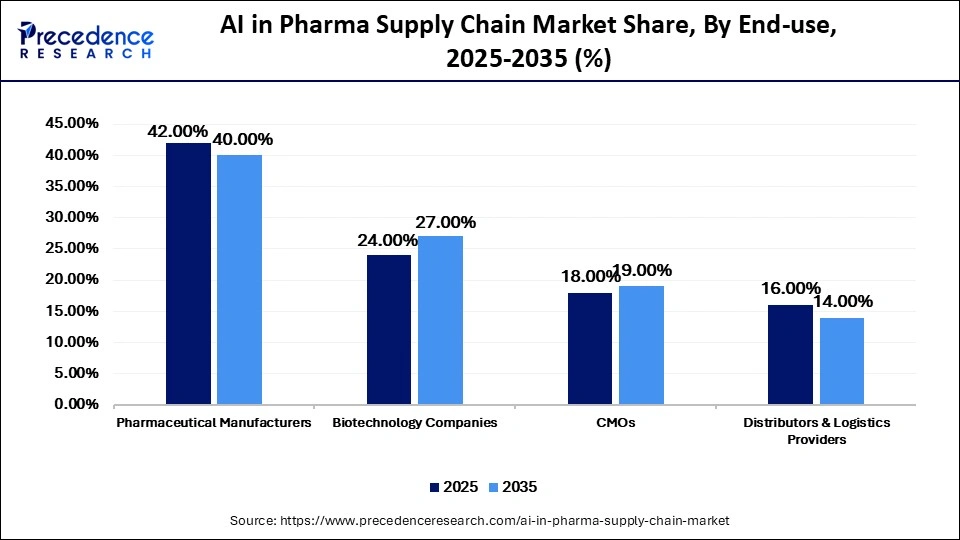
The CMOs segment held a market share of 18% in 2025 and is expected to grow at a CAGR of 26% in the predicted timeframe. The segment is expanding as they are the main hub for production, managing high-volume commercial manufacturing and complex logistics that benefit from AI-driven efficiency.
The distributors and logistics providers segment held a market share of 16% in 2025 and is expected to grow at a CAGR of 21.5% during the foreseeable period of 2026-2035. The segment is growing as it offers the highest and immediate ROI via critical optimizations like reducing inventory holding costs and transportation costs by a significant margin.
Regional Insights
North America AI in Pharma Supply Chain Market Size and Growth 2026 to 2035
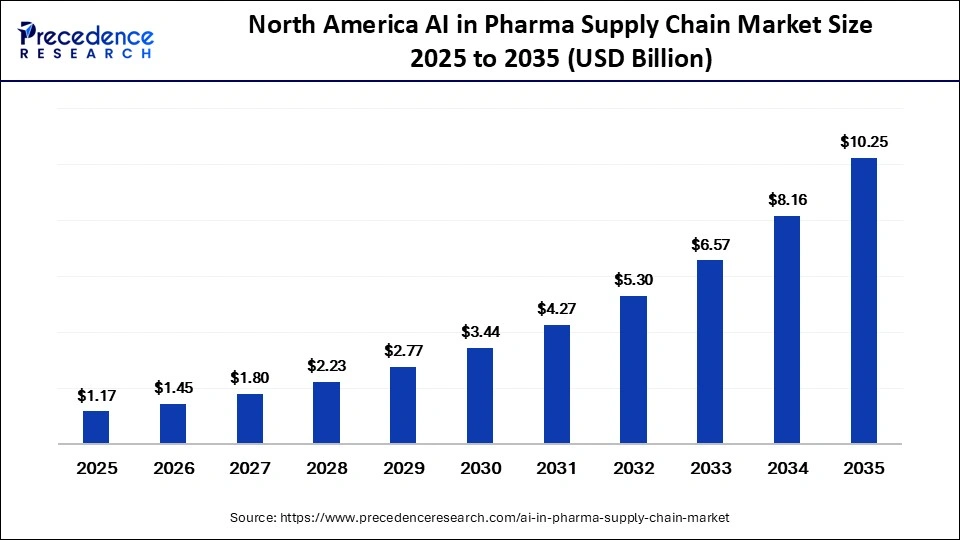
The North America AI in pharma supply chain market size is estimated at USD 1.17 billion in 2025 and is projected to reach approximately USD 10.25 billion by 2035, with a 24.24% CAGR from 2026 to 2035.
North America Held the Largest Market Share of 41% in 2025
North America held a major revenue share of 41% in the AI in pharma supply chain market in 2025, which is majorly driven by the combination of factors like high R&D investments, strong presence of leading biotech and pharma companies, and increasing adoption of AI to enhance efficiency in every sector. The region is witnessing rapid growth as a dense concentration of biotech and pharma tech giants are collaborating with AI tech firms to gain insights on demand forecasting and quality control.
U.S. AI in Pharma Supply Chain Market Size and Growth 2026 to 2035
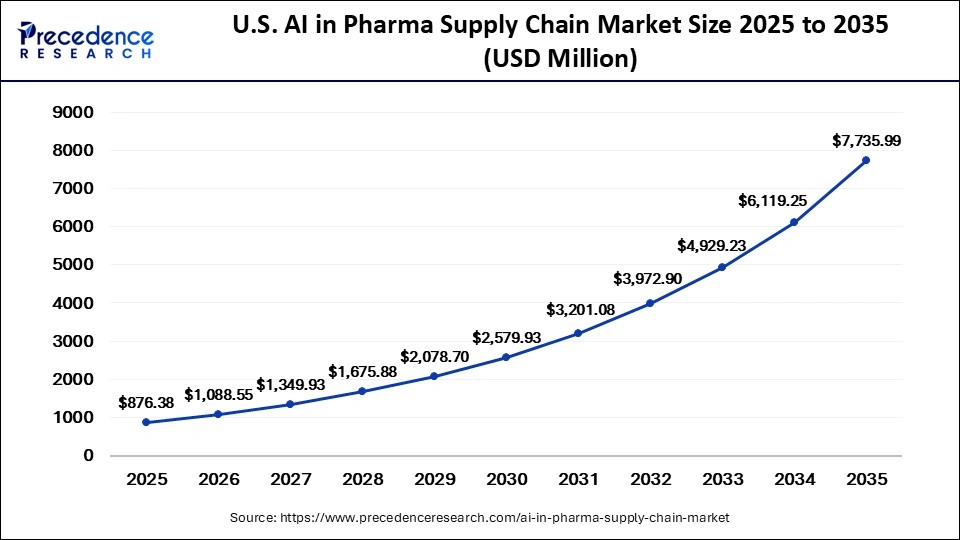
The U.S. AI in pharma supply chain market size is calculated at USD 876.38 million in 2025 and is expected to reach nearly USD 7,735.99 million in 2035, accelerating at a strong CAGR of 24.33% between 2026 and 2035.
U.S. Market Analysis
The U.S. is a leader in the market expansion in North America due to the proactive approach by the U.S. FDA for quality management and AI use in the pharma supply chain. Validating AI technology assisted in creating a favorable environment for implementation. The region is a frontier in the early deployment of AI-powered tools for supply chain resilience, minimizing stockouts, and enhancing manufacturing efficiency.
How is Asia-Pacific Growing in the AI in Pharma Supply Chain Market?
Asia-Pacific held 24% of the market share in 2025 and is expected to grow at the fastest CAGR of 29.5% over the studied years. The region is considered a central hub for pharma manufacturing, clinical research and AI-based analytics used in the pharma sector to reduce costs and enhance outputs. Strong policies backed by the government have further supported initiatives like ‘Made in China 2026' and provide significant financial incentives to adopt AI in logistics and healthcare. The region is increasingly adopting smart technologies like AI to solve logistics challenges and offer safe transportation of pharma products.
China Market Analysis
China has a strong hold on the production of key starting material and intermediate chemical compounds largely required in a critical area, establishing a strong foundation for the entire pharma manufacturing chain. A centralized hospital network, a huge population along with high-end AI-enabling imaging, offers vast datasets to train AI models precisely which is transforming drug discovery and diagnosis backed by AI models.
Which Factors Drive the AI in Pharma Supply Chain Market in Europe?
Europe held 27% of the market share in 2025 and is expected to grow at a CAGR of 22.8% during the projected period, due to high initial investment in the pharma sector, strong regulatory support for digital transformation and increasing demand for a resilient pharma supply chain. European firms are aggressively embracing AI to manage risks, enhance traceability and secure supply chains to reduce dependency on APIs from the Asia-Pacific region. Thus, European pharma companies are actively investing in AI-driven digital transformation to improve efficiency.
Germany Market Analysis
The region is significantly expanding due to its advanced industry 4.0 manufacturing expertise with stringent regulatory needs and rapid adoption of AI to manage complex, temperature-sensitive and high-value logistics. Moreover, the massive investment in digitalization production and high-tech cold chain integrity optimization supports the market growth in the region.
AI in Pharma Supply Chain Market Companies
- IBM
- SAP
- Oracle
- Microsoft
- Kinaxis
- Blue Yonder
- Infor
- Logility
- project44
- o9 Solutions
- Amazon Web Services
- Google Cloud
- Accenture
- Deloitte
- TCS
Recent Developments
- In February 2026, a leading marketer Sanofi shifted from AI experimentation to becoming a crucial and foundational part of their infrastructure. It supports R&D decisions and supply chain and manufacturing processes along with how to discover medicines.(Source: https://fortune.com)
- In December 2025, Fujitsu Ltd introduced the development of a multi-AI agent collaboration technology that allow secure partnership and better response to changing environment among AI agents in various companies, aiming to optimize secure pharma supply chains.(Source: https://www.biospectrumasia.com)
- In August 2025, Celsius Logistics, a cold chain solutions provider, introduced the launch of its specialized logistics arm, ‘Celsius+', which was developed to assist pharma clients. The company announced an investment of Rs 50 crore to create a fleet and support infrastructure, of which Rs 35 crore will be invested to deploy 100 new reefer vehicles.(Source: https://pharma.economictimes.indiatimes.com)
Segments Covered in the Report
By Deployment Mode
- Cloud-based
- On premises
By Technology
- Machine Learning
- Predictive Analytics
- Natural Language Processing (NLP)
- Computer Vision
- Robotic Process Automation (RPA)
By Application
- Demand Forecasting
- Inventory Management
- Warehouse Automation
- Logistics Optimization
- Cold Chain Monitoring
- Risk & Compliance Management
By End-use
- Pharmaceutical Manufacturers
- Biotechnology Companies
- Contract Manufacturing Organizations (CMOs)
- Distributors & Logistics Providers
By Region
- North America
- Latin America
- Europe
- Asia-pacific
- Middle and East Africa
For inquiries regarding discounts, bulk purchases, or customization requests, please contact us at sales@precedenceresearch.com
Frequently Asked Questions





Ask For Sample
No cookie-cutter, only authentic analysis – take the 1st step to become a Precedence Research client
 Get a Sample




 sales@precedenceresearch.com
 Schedule a Meeting
