



AI in Product Lifecycle Management Market Revenue to Attain USD 75.72 Bn by 2035
Published: 03 Jun 2026
Author: Precedence Research



AI in Product Lifecycle Management Market Revenue and Trends 2026 to 2035
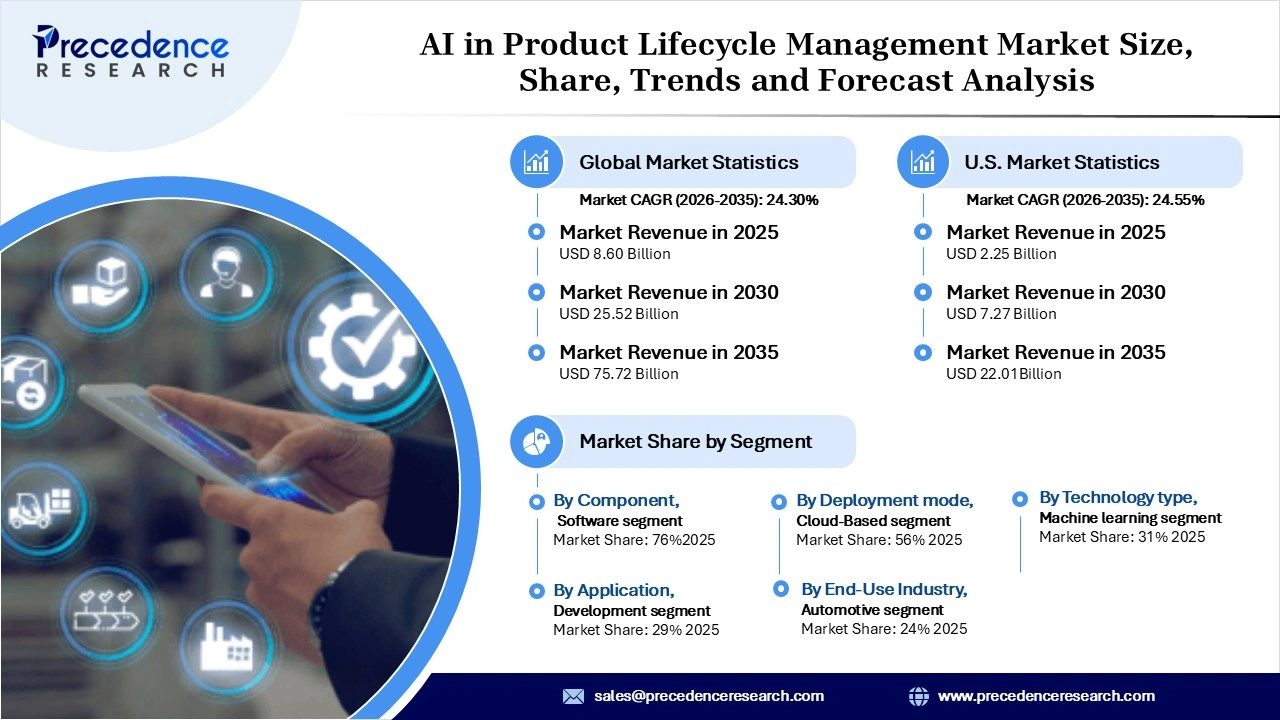
The global AI in product lifecycle management market revenue surpassed USD 8.60 billion in 2025 and is predicted to attain around USD 75.72 billion by 2035, growing at a CAGR of 24.30%. The market is driven by the necessity to speed up innovation cycles and improve decision-making during the designing, manufacturing, and servicing processes using technologies such as predictive analytics, generative design, and quality control automation.
Market Overview
The AI in product lifecycle management market comprises various AI technologies embedded into PLM platforms and processes across the entire product lifecycle, from ideation and design to manufacturing, maintenance, and end-of-life disposal. Key use cases include generative design for optimizing part geometries, predictive analytics for risk and demand forecasting, and computer vision for quality control and inspection processes.
The market also includes native AI-enabled PLM platforms, plug-in AI solutions for legacy PLM systems, and third-party AI software integrated into PLM workflows. These solutions are widely adopted across industries such as automotive, aerospace, industrial machinery, electronics, consumer goods, and medical devices, where AI enhances efficiency, innovation, and product quality throughout the lifecycle.
What are the Major Trends in the Market?
AI-Driven Document Review and Change Management Engine for PLM
The latest trend in the market is the usage of AI engines incorporated into PLM systems to facilitate automated document reviews and change management processes. The engines are capable of automatically categorizing engineering change requests, extracting important information from unstructured data, and routing them for review by the relevant stakeholders. This helps in improving compliance tracking and enhancing engineering productivity. In 2025, PTC introduced Arena AI Engine, which is an AI-driven document review and change management assistant incorporated in its Arena PLM system, making it capable of automatically classifying engineering changes.
Adoption of AI-Driven Data Platforms
There is an increasing trend toward the adoption of AI data platforms in manufacturing companies as a means to consolidate their information into a centralized location. This move sees manufacturers moving from their existing PLM and ERP solutions to adopt new technology that allows for the consolidation of unstructured information, such as drawings, quality documentation, and designs, in an efficient manner. In 2026, CADDi launched an AI manufacturing data platform case study involving Tier-1 automotive supplier, Neaton Auto Products Manufacturing (NAPM). With over 140,000 documents loaded into CADDi’s AI data platform, NAPM engineers were able to reduce drawing searches by around 40% to 70%, thanks to the AI solution, which consolidated information from PLM, ERP, and handwritten notes.
Government Policies Pave the Way for Manufacturing Revolution
Governments across the globe are formulating strategies to propel their respective economies towards growth through manufacturing and industrial use of AI technology that can transform the entire product life cycle. Governments are encouraging businesses to integrate AI in their design, production, and management systems through a well-curated roadmap, financial aid, and supportive regulations. In 2026, the Chinese government’s Ministry of Industry and Information Technology and seven other government agencies issued the implementation plan for the “AI + Manufacturing” Special Action Initiative dated December 25, 2025. This initiative targets the integration of AI into the product development and manufacturing process and is targeting 500 applications, 1000 industrial AI agents, and a leading global AI-manufacturing industry by 2027.
Market Segmentation Overview
- By component, the software segment led the AI in product lifecycle management market with a 76% share in 2025. This is mainly due to its ability to offer the fundamental elements of AI, such as generative design engines, predictive analytics models, and natural language processing in change management, making conventional PLM systems smarter and fully automated.
- By component, the services segment is expected to expand at the highest CAGR of 27.1% during the forecast period, as implementing AI-based PLM systems entails the need for expertise in the areas of consulting, implementation, migration, and training employees, none of which are usually available internally for most industrial companies.
- By technology, the machine learning segment dominated the AI in product lifecycle management market with a 31% share in 2025, since it is the technology that gives the predictive power, like predicting demand, finding defects, and optimizing designs, which has been extensively adopted to develop AI-based PLM systems.
- By technology, the generative AI segment is expected to grow at the highest CAGR of 37.2% from 2026 to 2035. This is because it allows for advanced capabilities, including automatic design creation, natural language creation of technical manuals, and change management assistants, thereby saving time and resources in the development phase.
- By application, the product design & development segment led the AI in product lifecycle management market with a 29% share in 2025, owing to the fact that there is a high usage of AI technologies across industries in generative design, simulation optimization, and design rule checks, providing instant and tangible results, and saving time and costs.
- By application, the product portfolio management segment is expected to expand at the highest CAGR of 28.1% during the forecast period because AI makes it possible for companies to analyze the market trends, profits, and resource utilization associated with various products.
- By end-use industry, the industrial manufacturing segment led the market with a 26% share in 2025, since the industry includes many different types of complicated products ranging from heavy machinery to consumer items, wherein the use of AI-driven PLM solutions helps to improve designs and shorten the time-to-market.
- By end-use industry, the electronics & semiconductor segment is expected to grow at the fastest CAGR of 29.4% from 2026 to 2035 because of the need to speed up its chip design processes, handle growing product complexity, and increase production yield rates.
Regional Analysis
North America led the AI in product lifecycle management market with a 38% share in 2025. This is because of the early and extensive use of cloud-based PLM systems, a mature manufacturing base across the automobile, aerospace, and heavy machinery industries, and substantial venture capital investments made by the local governments in startups developing AI-powered engineering applications. The U.S. dominated the market in North America owing to the significant presence of leading PLM players such as PTC, Aras, and Autodesk, and the fast-paced deployment of generative AI for design and change management. Canada witnessed notable market growth due to industry digitization efforts by the Canadian government and the increasing application of AI-enabled PLM technologies in the aerospace and clean technology industries.
Asia Pacific is expected to expand at the highest CAGR of 29.6% during the forecast period, owing to the fast pace of digitalization of manufacturing processes, stringent government mandates for the adoption of AI technology, and the development of the cloud and smart factories. China led the market in Asia Pacific due to the implementation of the “AI + Manufacturing” strategy and state-funded digital transformation programs for state-owned enterprises. India is a significant contributor to the market because of the PLI schemes for electronics and automobile manufacturing, the IndiaAI initiative, and the increasing number of engineering and PLM software users.
AI in Product Lifecycle Management Market Coverage
| Report Attribute | Key Statistics |
| Market Revenue in 2025 | USD 8.60 Billion |
| Market Revenue by 2035 | USD 75.72 Billion |
| CAGR from 2026 to 2035 | 24.30% |
| Quantitative Units | Revenue in USD million/billion, Volume in units |
| Largest Market | North America |
| Base Year | 2025 |
| Regions Covered | North America, Europe, Asia-Pacific, Latin America, and the Middle East & Africa |
Top Companies in the AI in Product Lifecycle Management Market
Siemens Digital Industries Software, PTC, Dassault Systemes, and Autodesk are some of the key players that specialize in AI-based PLM systems that feature AI for generative design, predictive maintenance, and simulation-based product development. SAP, Oracle, and IBM provide AI-based PLM systems that have an increased focus on integrating the PLM systems with the supply chain and meeting regulatory norms. Aras, Hexagon AB, and Accelrys BIOVIA focus on AI capabilities within the PLM systems to manage product configurations, quality management, and material informatics. Altair Engineering, ANSYS, and Bentley Systems concentrate on AI-based simulations, topology optimization, and digital twins in PLM systems.
Segments Covered in the Report
By Component
- Software
- Services
By Deployment Mode
- Cloud-based
- On-premises
- Hybrid
By Technology
- Machine Learning
- Generative AI
- Natural Language Processing (NLP)
- Computer Vision
- Predictive Analytics
By Application
- Product Design & Development
- Digital Twin & Simulation
- Predictive Maintenance
- Supply Chain Optimization
- Quality Management
- Product Portfolio Managment
By End-use Industry
- Automotive
- Aerospace & Defense
- Industrial Manufacturing
- Healthcare & Medical Devices
- Consumer Goods
- Electronics & Semiconductor
- Others
By Region
- North America
- Latin America
- Europe
- Asia-pacific
- Middle and East Africa
Get this report to explore global market size, share, CAGR, and trends, featuring detailed segmental analysis and an insightful competitive landscape overview @ https://www.precedenceresearch.com/sample/8440
You can place an order or ask any questions. Please feel free to contact us at sales@precedenceresearch.com |+1 804 441 9344