



AI in Product Lifecycle Management Market Trends, Companies, Revenue / Sales Performance, Subscriber Growth, Pricing Strategies, Cloud Adoption, Infrastructure Expansion, Competitive Landscape, and Industry Outlook
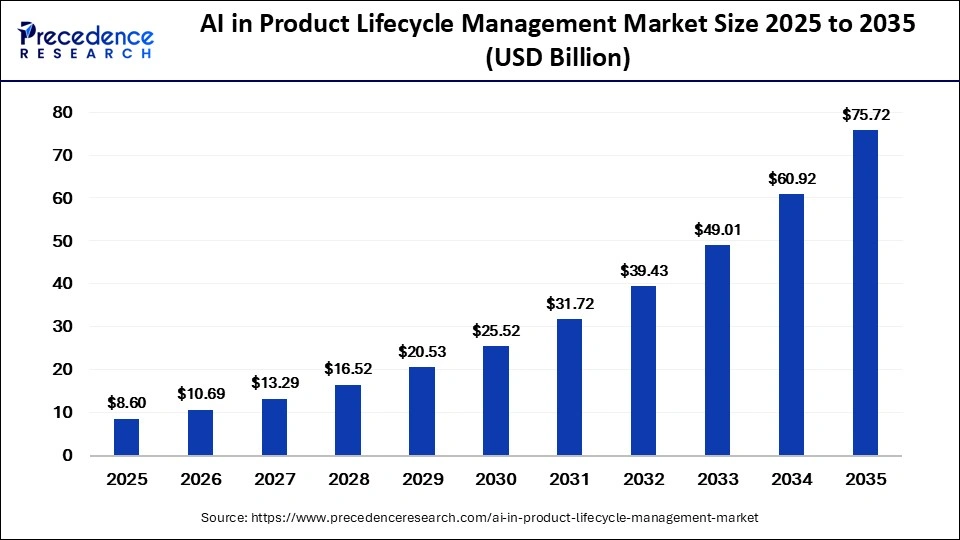
ICT industry specialist Shivani Zoting estimates the AI in product lifecycle management market at USD 10.69 billion in 2026, with continued technology adoption expected to take the market to USD 75.72 billion by 2035 at a CAGR of 24.30%. Leading AI in product lifecycle management market providers such as Siemens Digital Industries Software, PTC, Dassault Systèmes, Autodesk are expanding their capabilities across segments including By Component, By Deployment Mode, By Technology, By Application, By End-Use Industry.
Source: https://www.precedenceresearch.com/ai-in-product-lifecycle-management-market
 Get a Sample
 Table Of Content


What is the AI in Product Lifecycle Management Market Size in 2026?
The global AI in product lifecycle management market size accounted for USD 8.60 billion in 2025 and is predicted to increase from USD 10.69 billion in 2026 to approximately USD 75.72 billion by 2035, expanding at a CAGR of 24.30% from 2026 to 2035. The market is driven by the rising adoption of AI PLM software, the growth of Industry 4.0, and digital transformation across industries.
Key Takeaways
- North America led the AI in product lifecycle management market in 2025 with a 38% share.
- Asia Pacific is expected to grow at the fastest CAGR of 29.6% between 2026 and 2035.
- By component, the software segment led the market with a 76% share in 2025.
- By component, the services segment is expected to grow at the fastest CAGR of 27.1% in the upcoming period.
- By deployment mode, the cloud-based segment held the largest market share of 56% in 2025 and is expected to grow at the fastest CAGR of 28.6% in the coming years.
- By technology type, the machine learning segment accounted for the highest revenue share of 31% in 2025.
- By technology, the generative AI segment is expected to expand at the fastest CAGR of 37.2% in the foreseeable period.
- By application, the product design & development segment held a major market share of 29% in 2025.
- By application, the product portfolio management segment is observed to grow at the fastest CAGR of 28.1% throughout the forecast period.
- By end-use industry, the automotive segment held a 24% share of the market in 2024.
- By end-use industry, the electronics & semiconductor segment is expected to grow at the fastest CAGR of 29.4% during the projection period.
Market Overview
Product lifecycle management (PLM) is a strategic approach that allows developers to manage product lifecycles from the initial concept and design through procurement and production service and eventual disposal. AI in PLM is a multi-faceted role that spans engineering, design, and marketing strategy to create products that serve customer needs and sustain market relevance. Teams can use it to analyze complex datasets, automate labor-intensive processes, and derive insights that improve decision-making. It can also be of assistance for preventative measures and planning. AI-powered PLM can greatly enhance productivity in enterprises when moving from traditional methods.
AI in Product Lifecycle Management Market Trends
- Integration of Generative AI for Product Design and Development: Generative AI is increasingly being used to automate product design, create multiple design alternatives, and optimize engineering processes. This helps organizations reduce development cycles, improve innovation, and accelerate time-to-market for new products.
- Expansion of Predictive Analytics and Digital Twin Technologies: AI-powered predictive analytics is enabling manufacturers to forecast product performance, identify potential failures, and optimize lifecycle decisions. The growing adoption of digital twins allows companies to simulate real-world product behavior, improving design accuracy and operational efficiency.
- Increased Adoption of AI-Driven Collaboration and Knowledge Management: Organizations are leveraging AI to enhance collaboration across engineering, manufacturing, supply chain, and service teams by centralizing and analyzing product data. AI-powered knowledge management systems improve information accessibility, support faster decision-making, and reduce inefficiencies throughout the product lifecycle.
- Growing Use of AI for Quality Management and Compliance Monitoring: AI solutions are helping companies detect quality issues earlier through automated inspections, anomaly detection, and real-time monitoring. They also streamline regulatory compliance by continuously tracking product requirements, documentation, and industry standards.
Market Scope
| Report Coverage | Details |
| Market Size in 2025 | USD 8.60 Billion |
| Market Size in 2026 | USD 10.69 Billion |
| Market Size by 2035 | USD 75.72 Billion |
| Market Growth Rate from 2026 to 2035 | CAGR of 24.30% |
| Dominating Region | North America |
| Fastest Growing Region | Asia Pacific |
| Base Year | 2025 |
| Forecast Period | 2026 to 2035 |
| Segments Covered | Component, Deployment Mode, Technology, Application, End-Use Industry, and Region |
| Regions Covered | North America, Europe, Asia-Pacific, Latin America, and Middle East & Africa |
Market Dynamics
Drivers
Technological Innovations Accelerating the Adoption of AI PLM
The growth of the AI in product lifecycle management market is driven by increasing adoption of advanced technologies such as AI, IoT, and smart manufacturing solutions, along with the expansion of Industry 4.0 initiatives. Growing deployment of AI across operational workflows and accelerating digital transformation efforts are encouraging organizations to integrate intelligent PLM solutions. Additionally, the widespread adoption of cloud-based PLM platforms is enabling seamless collaboration among globally distributed engineering teams, further supporting market growth.
Restraint
Impact of Poor Data Quality and High Computing Requirements
A key challenge in the AI in product lifecycle management market is the prevalence of unstructured and inconsistent data from sources such as CAD files, engineering documents, and legacy systems, which can limit the accuracy of AI-driven insights and automation. Furthermore, AI-powered simulations, predictive analytics, and digital modeling require significant computing resources, advanced infrastructure, and high-quality data, resulting in substantial implementation costs that may hinder adoption among cost-sensitive organizations.
Opportunity
Emergence of Multimodal and Agentic AI in AI PLM
The integration of multimodal AI presents a significant opportunity for the AI in product lifecycle management market by enabling the analysis of diverse data formats, including text, images, videos, and 3D models, within a unified platform. In addition, the emergence of agentic AI is transforming PLM systems from passive decision-support tools into proactive systems capable of autonomous reasoning, optimization, and decision-making, thereby enhancing product innovation and lifecycle management efficiency.
Segment Insights
Component Insights
AI in Product Lifecycle Management Market Share, By Component, 2025-2035 (%)
| Component | 2025 | 2035 | CAGR (%) |
| Software | 76.00% | 72.00% | 23.4% |
| Services | 24.00% | 28.00% | 27.1% |
Software Segment Dominated With 76% of the Market Share in 2025
The software segment generated approximately USD 6.54 billion in 2025 and is projected to reach nearly USD 54.52 billion by 2035, growing at a CAGR of 23.4% during the forecast period. The software segment dominated the AI in product lifecycle management market with the highest share of 76% in 2025, driven by the growing deployment of AI-enabled PLM platforms that serve as the core foundation for managing product data and lifecycle processes. Rising demand for predictive product intelligence, expansion of digital engineering workflows, and increasing adoption of cloud-native PLM solutions have further strengthened the reliance on advanced software platforms. Additionally, the growing integration of PLM software with broader enterprise applications has enhanced connectivity and efficiency, reinforcing its dominant position in the market.
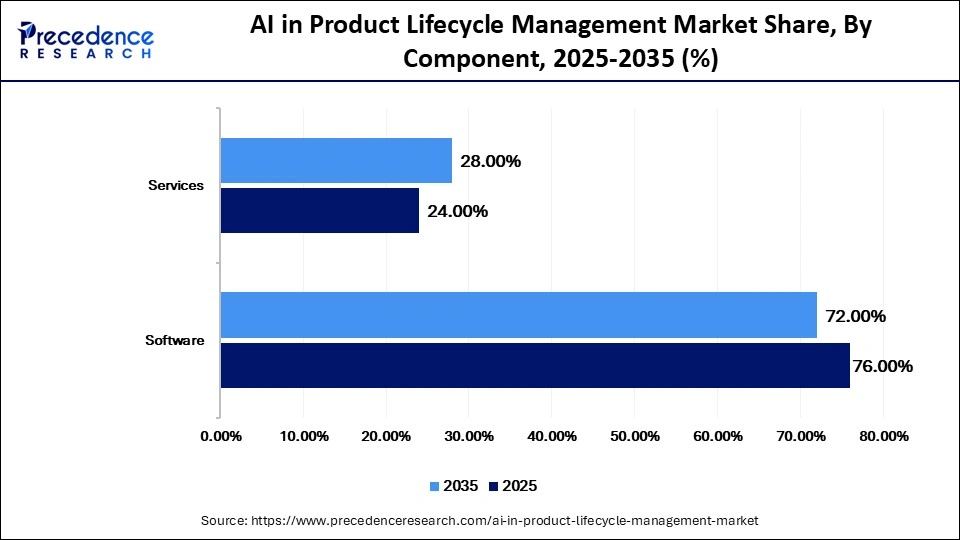
The services segment accounted for approximately USD 2.06 billion in 2025 and is projected to reach nearly USD 21.20 billion by 2035, growing at the fastest CAGR of 27.1% during the forecast period, and the segment accounted for nearly 24% market share in 2025. This is mainly due to the rising demand for implementation support as enterprises adopt increasingly advanced PLM solutions. Increasing AI integration complexity is also driving organizations to rely on consulting and managed services to ensure smooth deployment and system interoperability. Additionally, the expansion of enterprise digital transformation projects, along with the need for continuous optimization and training, is further accelerating the demand for specialized PLM services.
Deployment Mode Insights
AI in Product Lifecycle Management Market Share, By Deployment Mode, 2025-2035 (%)
| Deployment Mode | 2025 | 2035 | CAGR (%) |
| Cloud-based | 56.00% | 65.00% | 28.6% |
| On-premises | 25.00% | 14.00% | 13.8% |
| Hybrid | 19.00% | 21.00% | 24.9% |
The Cloud-Based Segment Held the Largest Market Share of 56% in 2025
The cloud-based segment generated approximately USD 4.82 billion in 2025 and is projected to reach nearly USD 49.22 billion by 2035, growing at the fastest CAGR of 28.6% during the forecast period. The cloud-based segment led the AI in product lifecycle management market while holding the largest share of 56% in 2025. This is mainly due to the increasing adoption of SaaS-based PLM platforms, rising demand for remote collaboration, and the ability of cloud solutions to provide anytime, anywhere access to product data without the burden of maintaining on-premises infrastructure. Additionally, the rapid development of cloud-native AI applications and scalable computing resources is further accelerating the adoption of cloud-based PLM solutions across industries.
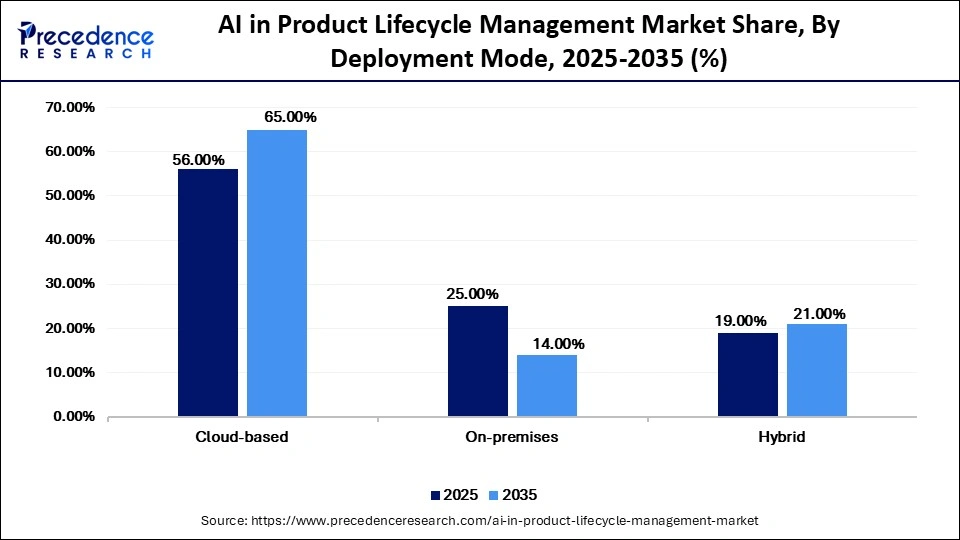
The on-premises segment accounted for approximately USD 2.15 billion in 2025 and is projected to reach nearly USD 10.60 billion by 2035, growing at a CAGR of 13.8% during the forecast period, and segment held a market share of nearly 25% in 2025. owing to the increasing adoption among highly regulated industries that require greater control over data, infrastructure, and compliance requirements. Additionally, on-premises PLM solutions offer extensive customization capabilities and enhanced data security, making them a preferred choice for organizations handling sensitive product and operational information.
The hybrid segment generated approximately USD 1.63 billion in 2025 and is projected to reach nearly USD 15.90 billion by 2035, growing at a CAGR of 24.9% during the forecast period. The hybrid segment held approximately 19% share of the market in 2025. The segment's growth is driven by the increasing adoption of multi-cloud and hybrid IT strategies, which enable organizations to balance flexibility, performance, and regulatory compliance. Hybrid PLM deployments allow enterprises to maintain control over sensitive data and data sovereignty requirements while leveraging cloud resources for scalability and cost optimization, further supporting market expansion.
Technology Insights
AI in Product Lifecycle Management Market Share, By Technology, 2025-2035 (%)
| Technology | 2025 | 2035 | CAGR (%) |
| Machine Learning | 31.00% | 27.00% | 21.8% |
| Generative AI | 16.00% | 28.00% | 37.2% |
| Natural Language Processing (NLP) | 18.00% | 17.00% | 22.6% |
| Computer Vision | 14.00% | 13.00% | 21.9% |
| Predictive Analytics | 21.00% | 15.00% | 20.8% |
What Made Machine Learning the Dominant Segment in the Market in 2025?
The machine learning segment generated approximately USD 2.67 billion in 2025 and is projected to reach nearly USD 20.44 billion by 2035, growing at a CAGR of 21.8% during the forecast period. The machine learning segment dominated the AI in product lifecycle management market, holding a major share of 31% in 2025. The segment's leadership is driven by the growing use of predictive engineering, manufacturing analytics, and product performance forecasting across industries. Machine learning enables more effective change management, reduces operational errors, enhances data integrity, and supports data-driven decision-making throughout the product lifecycle, contributing to its dominant market position.
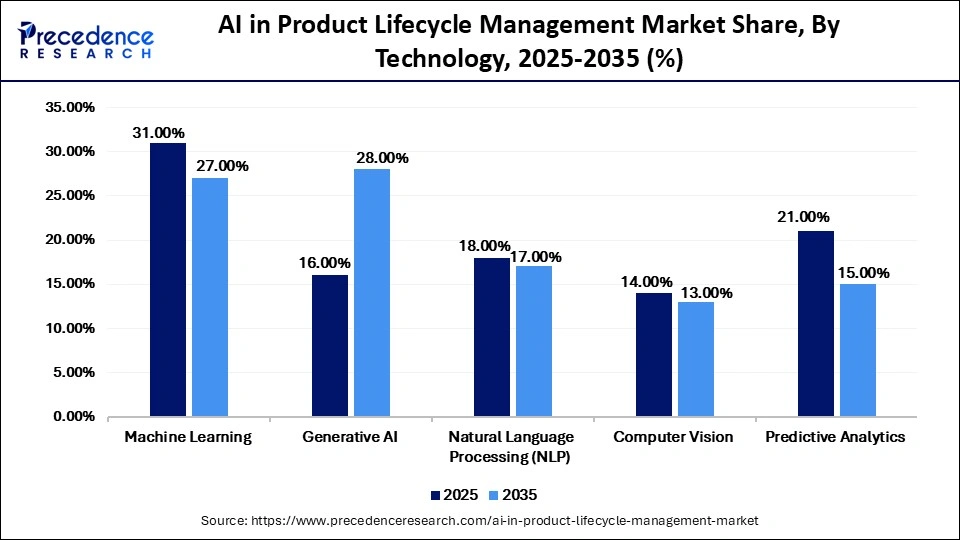
The generative AI segment accounted for approximately USD 1.38 billion in 2025 and is projected to reach nearly USD 21.20 billion by 2035, growing at the fastest CAGR of 37.2% during the forecast period. The generative AI segment accounted for around 16% of the market share in 2025, due to the rapid adoption of AI-assisted product design, engineering automation, and rapid concept generation capabilities. By enabling users to generate designs, specifications, documentation, and other product-related content from natural language prompts, generative AI is accelerating innovation cycles and improving product development efficiency.
The natural language processing (NLP) segment generated approximately USD 1.55 billion in 2025 and is projected to reach nearly USD 12.87 billion by 2035, growing at a CAGR of 22.6% during the forecast period. The natural language processing (NLP) segment held an 18% share of the AI in product lifecycle management market in 2025, driven by the increasing automation of engineering documentation, knowledge management, and product information workflows. NLP enhances intelligent search, improves collaboration across enterprise teams, and enables organizations to extract actionable insights from large volumes of unstructured product and engineering data.
Application Insights
The Product Design & Development Segment Led the Market With a 29% Share in 2025
The product design & development segment generated approximately USD 2.49 billion in 2025 and is projected to reach nearly USD 21.20 billion by 2035, growing at a CAGR of 23.1% during the forecast period. The product design & development segment dominated the AI in product lifecycle management market by holding a major share of 29% in 2025, driven by the increasing demand for faster product innovation and the growing adoption of AI-assisted design tools that streamline development processes. The expansion of collaborative engineering platforms further enhanced cross-functional teamwork, enabling organizations to improve design accuracy and efficiency. Additionally, rising product complexity management requirements and the need for improved time-to-market efficiency drove companies to leverage AI-powered solutions, strengthening the segment's market leadership.
AI in Product Lifecycle Management Market Share, By Application, 2025-2035 (%)
| Application | 2025 | 2035 | CAGR (%) |
| Product Design & Development | 29.00% | 28.00% | 23.1% |
| Digital Twin & Simulation | 22.00% | 24.00% | 27.8% |
| Predictive Maintenance | 16.00% | 15.00% | 22.9% |
| Supply Chain Optimization | 13.00% | 12.00% | 21.5% |
| Quality Management | 12.00% | 11.00% | 22.4% |
| Product Portfolio Management | 8.00% | 10.00% | 28.1% |
The digital twin & simulation segment accounted for approximately USD 1.89 billion in 2025 and is projected to reach nearly USD 18.17 billion by 2035, growing at a CAGR of 27.8% during the forecast period. The digital twin & simulation segment held about 22% market share in 2025, fueled by the rising adoption of virtual product testing, predictive modeling, and Industry 4.0 initiatives that require real-time monitoring and simulation capabilities. Digital twins enable organizations to create virtual replicas of physical products and processes, improving design validation, operational performance, and lifecycle management while supporting the expansion of connected product ecosystems.
The product portfolio management segment generated approximately USD 688 million in 2025 and is projected to reach nearly USD 7.57 billion by 2035, growing at the fastest CAGR of 28.1% during the forecast period. The product portfolio management segment held the market share of 8% in 2025, driven by the rising demand for strategic product planning and the growing need for market-driven innovation. Organizations are increasingly adopting AI-powered portfolio analytics and advanced product profitability assessment tools to evaluate product performance, optimize investments, and align offerings with changing market demands. Additionally, enhanced decision-making capabilities enabled by AI help businesses prioritize high-value opportunities, improve resource allocation, and strengthen overall portfolio management effectiveness.
End-Use Industry Insights
The Automotive Segment Led the Market With a 24% Share in 2025
The automotive segment generated approximately USD 2.06 billion in 2025 and is projected to reach nearly USD 16.66 billion by 2035, growing at a CAGR of 23.2% during the forecast period. The automotive segment led the AI in product lifecycle management market with a 24% share in 2025, owing to the increasing development of electric vehicles and the growing focus on autonomous vehicle innovation, both of which require advanced design, simulation, and lifecycle management capabilities. Rising investments in digital engineering and the expansion of smart manufacturing systems further accelerated the adoption of AI-driven PLM solutions across the industry. Additionally, the demand for faster product development cycles encouraged automotive manufacturers to leverage AI to streamline processes, improve collaboration, and bring new products to market more efficiently.
AI in Product Lifecycle Management Market Share, By End-Use Industry, 2025-2035 (%)
| End-Use Industry | 2025 | 2035 | CAGR (%) |
| Automotive | 24.00% | 22.00% | 23.2% |
| Aerospace & Defense | 16.00% | 15.00% | 22.0% |
| Industrial Manufacturing | 26.00% | 25.00% | 24.7% |
| Healthcare & Medical Devices | 10.00% | 11.00% | 27.2% |
| Consumer Goods | 9.00% | 10.00% | 24.8% |
| Electronics & Semiconductor | 11.00% | 13.00% | 29.4% |
| Others | 4.00% | 4.00% | 20.5% |
The aerospace & defense segment accounted for approximately USD 1.38 billion in 2025 and is projected to reach nearly USD 11.36 billion by 2035, growing at a CAGR of 22% during the forecast period. The aerospace & defense segment held nearly 16% share of the market in 2025, driven by the increasing complexity of aerospace systems. The aerospace & defense industry heavily utilizes artificial intelligence capabilities to reduce development cycles, improve traceability and compliance, and facilitate more efficient sustainment driven by data. There is also a rise in the implementation of digital twins, which supports the adoption of AI product lifecycle management.
The electronics & semiconductor segment generated approximately USD 946 million in 2025 and is projected to reach nearly USD 9.84 billion by 2035, growing at the fastest CAGR of 29.4% during the forecast period. The electronics & semiconductor segment held about 11% market share in 2025, fueled by the rising complexity of semiconductor design, which requires advanced tools to manage intricate development processes and ensure product quality. The growing demand for AI-driven engineering tools, coupled with the expansion of advanced electronics manufacturing, is accelerating the adoption of AI-powered PLM solutions across the industry.
Regional Insights
North America AI in Product Lifecycle Management Market Size and Growth 2026 to 2035
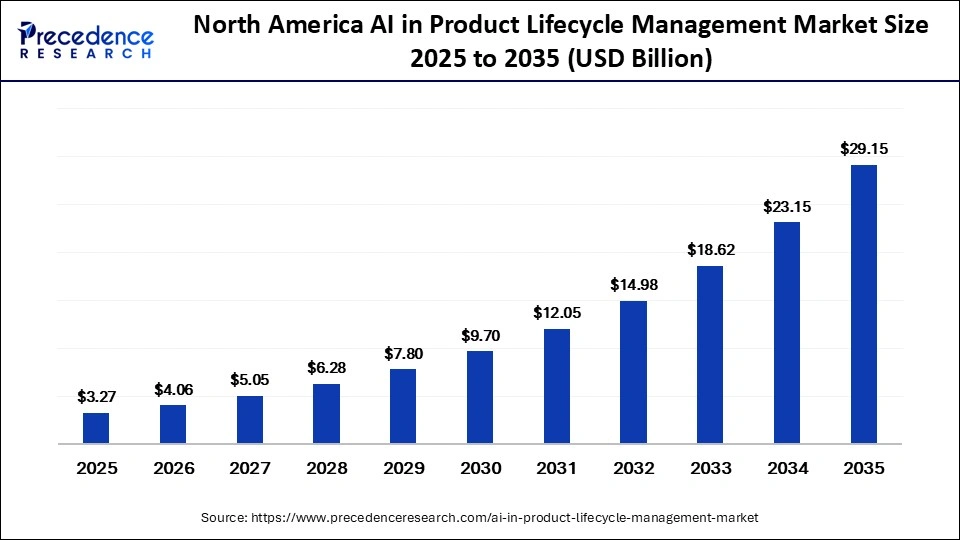
The North America AI in product lifecycle management market size was exhibited at USD 3.27 billion in 2025 and is projected to be worth around USD 29.15 billion by 2035, growing at a CAGR of 24.45% from 2026 to 2035.
North America: The Dominant Region
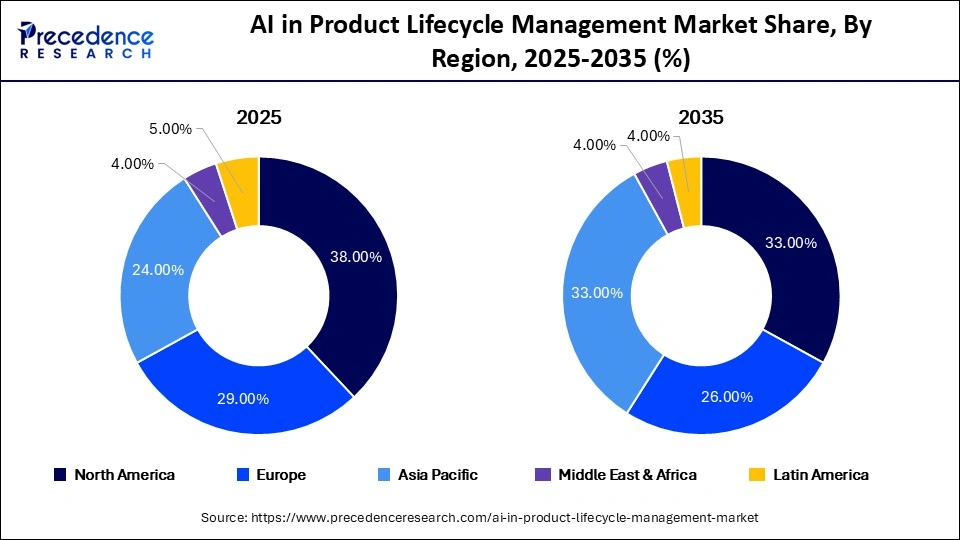
North America dominated the AI in product lifecycle management market while holding a 38% share in 2025. The region's dominance is attributed to the early adoption of AI across various industries. There is a strong presence of PLM software vendors, contributing to the regional market growth. Furthermore, federal procurement policies that promote digital-thread maturity, alongside the FDA's anticipated release of the Computer Software Assurance guidance in 2026, are establishing essential compliance standards.
U.S. AI in Product Lifecycle Management Market Size and Growth 2026 to 2035
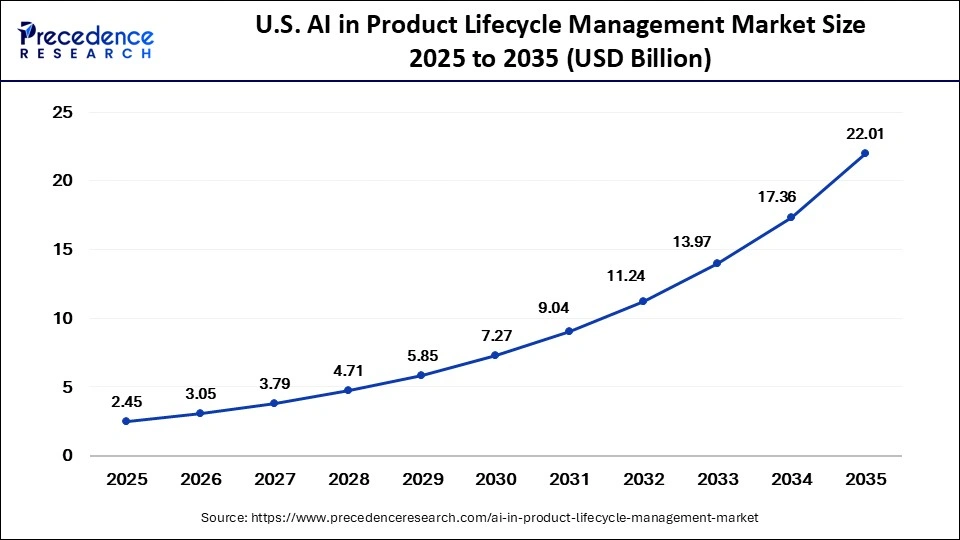
The U.S. AI in product lifecycle management market size was evaluated at USD 2.45 billion in 2025 and is projected to reach around USD 22.01 billion by 2035, growing at a CAGR of 24.55% from 2026 to 2035.
U.S. Market Analysis
The U.S. is a major contributor to the North American AI in product lifecycle management market, owing to the presence of many of the world's largest manufacturing, automotive, and technology companies and their adoption of AI PLM software systems. This concentration is driving demand for AI-powered PLM solutions that enhance innovation, compliance, and operational efficiency.
Europe: The Second-Largest Market
Europe is the second-largest market, holding a share of 29% in 2025. The region is expected to grow at a CAGR of 22.8% in the coming years, driven by the rising adoption of advanced technologies like AI and ML and robust regulatory frameworks aimed at maintaining quality with AI PLM across various industries. Additionally, initiatives like the Digital Product Passport and Ecodesign regulations are seamlessly integrating lifecycle assessments into design processes, further promoting market growth.
UK Market Analysis
The UK is experiencing substantial growth due to rapid technological advancements, evolving regulatory landscapes, and changing customer expectations. As digital transformation accelerates across manufacturing, aerospace, automotive, and consumer goods sectors, market leaders must prepare for significant shifts that could redefine competitive dynamics in the coming years.
Asia Pacific: The Fastest-Growing Region
Asia Pacific held about 24% share of the AI in product lifecycle management market in 2025 and is projected to expand at the fastest CAGR of 29.6% during the forecast period. The region's growth is mainly driven by rapid industrialization and the integration of digitalization across all industries. The rising adoption of autonomous vehicles, coupled with AI PLM integration, is further propelling the market. Additionally, increasing investments in AI and cloud technologies are supporting regional market growth.
China Market Analysis
China is leading the market in Asia Pacific, bolstered by a surge in industrial activity and digitalization efforts. In recent years, the region has seen a significant increase in manufacturing facilities, evolving from basic commodity production to innovative manufacturing hubs that drive the demand for AI and ML solutions.
How is the Opportunistic Rise of the Middle East & Africa in the Market?
The Middle East & Africa held a 4% share of the AI in product lifecycle management market in 2025 and is projected to expand at a CAGR of 22% in the coming years. This is mainly due to the growing industrial diversification strategies. The expansion of industrial infrastructure and the increasing adoption of AI-based analytics are key factors in this growth. Moreover, ambitious economic diversification and industrialization programs across key regional economies are supporting market development.
UAE Market Analysis
The UAE is poised for significant growth within the Middle East and Africa, owing to rapid digital transformation initiatives and strong government support for advanced technologies as part of broader diversification and Industry 4.0 strategies. Increasing adoption of smart manufacturing, cloud-based engineering solutions, and AI-driven innovation across key industries such as manufacturing, aerospace, and energy is further accelerating market expansion.
What Drives the Latin American Market?
Latin America held a 5% market share in 2025 and is projected to expand at a CAGR of 21.7% in the coming years, supported by the modernization of manufacturing operations and the increasing adoption of cloud software. This region is undergoing progressive digital transformation, with export-oriented automotive and electronics manufacturing sectors driving further adoption.
Brazil Market Analysis
Brazil is witnessing growth in the AI in product lifecycle management market due to rising demand for AI PLM solutions in the automotive, aerospace, and industrial sectors. As product complexity increases, the need for digital lifecycle management solutions becomes more critical, prompting mid-sized manufacturers in the area to invest in modern PLM platforms.
Competitive Landscape
The global AI in product lifecycle management market is moderately consolidated, with a mix of established PLM providers and emerging AI-focused technology firms competing for market share. Key players are primarily focused on integrating AI, machine learning, and predictive analytics into existing PLM platforms to enhance product design, simulation, and lifecycle optimization capabilities. Strategic partnerships, cloud-based solution expansion, acquisitions of niche AI startups, and continuous platform upgrades are commonly used to strengthen technological capabilities and expand global reach.
To stay ahead of the competition, key players must focus on deepening AI integration across the entire product lifecycle, from ideation to end-of-life management, while improving interoperability with enterprise systems such as ERP and MES. They should also prioritize industry-specific solutions, especially for high-growth sectors like automotive, electronics, and aerospace, where product complexity is increasing rapidly. Additionally, investing in real-time data analytics, scalable cloud infrastructures, and user-friendly collaborative platforms will be critical to maintaining long-term competitive advantage.
AI in Product Lifecycle Management Market Companies
- Siemens Digital Industries Software
- PTC
- Dassault Systèmes
- Autodesk
- SAP
- Oracle
- Aras
- IBM
- Hexagon AB
- Altair Engineering
- Ansys
- Bentley Systems
- AVEVA
- Centric Software
- Accelrys BIOVIA
Recent Developments
- In February 2026, Flinn introduced AI-driven software that automates regulatory and quality workflows in medtech, enabling manufacturers to manage compliance more efficiently, reduce administrative burdens, and accelerate innovation throughout the medical product lifecycle.(Source: https://tech.eu)
- In April 2026, PTC introduced Windchill AI Assistant, a new artificial intelligence (AI) feature within its Windchill product lifecycle management (PLM) solution. By embedding generative AI through a natural language chat interface, the assistant helps users more easily locate, interpret, and work with critical product data stored in the platform, cutting search time and boosting overall team productivity.(Source: https://www.prnewswire.com)
Segments Covered in the Report
By Component
- Software
- Services
By Deployment Mode
- Cloud-based
- On-premises
- Hybrid
By Technology
- Machine Learning
- Generative AI
- Natural Language Processing (NLP)
- Computer Vision
- Predictive Analytics
By Application
- Product Design & Development
- Digital Twin & Simulation
- Predictive Maintenance
- Supply Chain Optimization
- Quality Management
- Product Portfolio Managment
By End-use Industry
- Automotive
- Aerospace & Defense
- Industrial Manufacturing
- Healthcare & Medical Devices
- Consumer Goods
- Electronics & Semiconductor
- Others
By Region
- North America
- Latin America
- Europe
- Asia-pacific
- Middle and East Africa
For inquiries regarding discounts, bulk purchases, or customization requests, please contact us at sales@precedenceresearch.com
Frequently Asked Questions





Ask For Sample
No cookie-cutter, only authentic analysis – take the 1st step to become a Precedence Research client
 Get a Sample




 sales@precedenceresearch.com
 Schedule a Meeting
