



Cognitive Assessment and Brain Health Market Revenue to Attain USD 28.69 Bn by 2035
Published: 25 Jun 2026
Author: Precedence Research



Cognitive Assessment and Brain Health Market Revenue and Trends 2026 to 2035
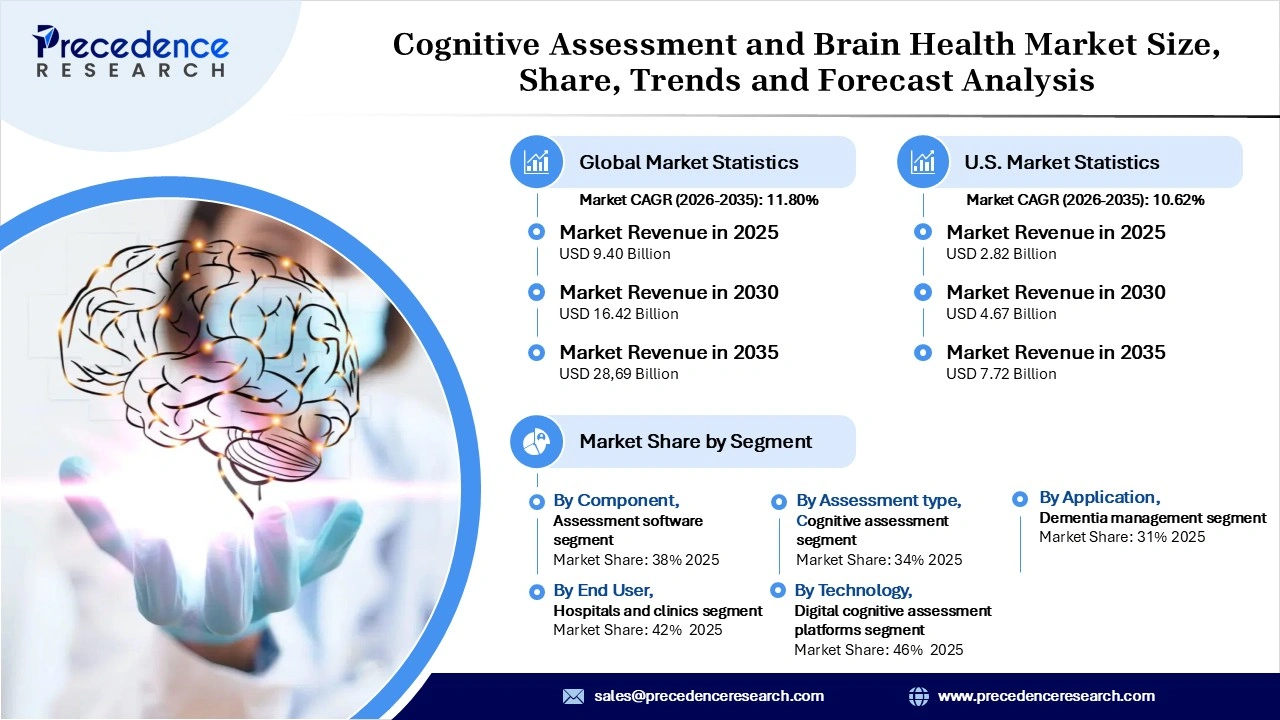
The global cognitive assessment and brain health market revenue reached USD 9.40 billion in 2025 and is predicted to attain around USD 28.69 billion by 2035 with a CAGR of 11.80%. The market is driven by the aging population worldwide, an increase in incidences of dementia and mild cognitive impairment, growing use of digital cognitive testing methods, and the rising adoption of AI-driven diagnosis.
Mapping Mental Fitness: Measurement and Maintenance of Cognitive Abilities
The cognitive assessment and brain health market consists of various products, services, and technology solutions employed for assessing, monitoring, and improving cognitive abilities throughout ones life cycle. Such tools involve traditional pen and paper neuropsychological tests, computer-based cognitive assessment solutions, digital biomarkers based on smartphone and wearable technologies, and brain training applications.
This market encompasses clinical diagnostics of neurological conditions such as dementia and mild cognitive impairment, diagnosis of concussion and stroke, monitoring of cognitive performance at work, and in the field of consumer wellness. AI-driven data analytics and remote monitoring platforms are used for better diagnosis and treatment. This market has been adopted by hospitals, general practitioners, long-term care facilities, pharmaceutical companies conducting clinical trials, employers, and individuals themselves.
Virtual Reality Platforms Facilitate Fast and Automated Cognitive Testing
The market is evolving from manual, paper-based tests to engaging digital solutions. Today, there are virtual reality systems that automate the process of cognitive testing by simulating everyday situations, thereby making cognitive testing interesting and adaptable. Virtual reality systems are less time-consuming, less biased than conventional systems, and are widely available for screening in primary care practices. In 2025, SingHealth Polyclinics and FXMedia introduced the CAVIRE-2, which is an immersive virtual reality system that performs a test of 6 basic cognitive abilities (memory, attention, language skills, perceptual-motor skills, social cognition, and executive functions).
Digital Platforms and AI Solutions Enhance Cognitive Screening
The cognitive assessment and brain health market is undergoing a broad adoption of digital solutions and AI tools, facilitating scalable and easily available screening processes outside the clinical environment. Major studies and practical implementation cases are confirming the efficiency of cognitive testing via smartphone applications. This adoption is driven by a strong need to detect diseases such as dementia and Alzheimer’s as early as possible, as well as the need for proactive brain health monitoring. In 2025, Intuition Brain Health Study results were announced on the platform, Nature Medicine. The study was conducted by Biogen and Apply and included 23,004 participants residing in the U.S. Cambridge Cognition’s CANTAB solutions were utilized for the core cognitive assessments. The results confirmed the ability to carry out large-scale remote cognitive assessment via smartphone and smartwatch.
Government Efforts for Early Screening for Cognitive Problems
Governments across the world have introduced various initiatives that would help incorporate regular cognitive screenings into primary care. Such initiatives contribute to the decrease in the delayed diagnosis of mild cognitive impairment and Alzheimer’s disease. Governments have introduced consistent screening programs, optimal referral pathways, and the use of electronic health records (EHRs) to monitor patient results. The American Medical Group Association (AMGA) introduced a Brain Health in Primary Care Quality Improvement Project in 2025, with the support of a grant provided through December 2026. The project is intended to shorten the time taken to diagnose mild cognitive impairment and Alzheimer’s disease in 4 health systems in the U.S., in 9 states, and more than 100,000 patients above the age of 65 years.
Cambridge Cognition and Ivory Team Up to Debut in India’s Cognitive Testing Market
In 2026, Cambridge Cognition joined forces with Ivory to launch its CANTAB Pathway digital cognitive tests throughout India. India has a total population of 1.47 billion, and 138 million people are 60 years old or older, with 34 million suffering from mild or severe cognitive impairment. This partnership will help satisfy the need for cognitive tests in a market where 90% of cognitive impairment is undiagnosed.
Market Segmentation Overview
- By component, the assessment software segment led the cognitive assessment and brain health market with 38% share in 2025, because it provides unprecedented scale, standardization, and automation of pen and paper or physician-administered assessments, thereby facilitating quick, scalable, and affordable cognitive assessments. This segment can be seamlessly integrated with AI-powered analytics solutions and electronic health records (EHRs).
- By component, the brain training solutions segment is expected to expand at the highest CAGR of 13.5% during the forecast period, since it caters to the increasing demands of consumers for brain improvement outside of clinical assessments through gamified applications that can be done anytime using their smartphones. Such platforms are often equipped with AI-powered adaptive algorithms that provide personalization.
- By assessment type, the cognitive assessment segment dominated the market with 34% share in 2025, due to the fact that it is the most reliable and proven approach for the detection of mild cognitive impairment, dementia, and other neuropsychological disorders using a set of standardized tests. This segment provides quantitative and repeatable results on various functions, such as memory, attention, executive function, and language.
- By assessment type, the memory assessment segment is expected to grow at the fastest CAGR of 12.7% from 2026 to 2035, because memory impairment is the first and most obvious sign of Alzheimer’s disease and other types of dementia, and, therefore, gets significant focus for clinical trials and screening procedures. It allows continuous and inexpensive evaluation both in clinical environments and at patients’ homes.
- By application, the Alzheimer’s disease and dementia management segment led the cognitive assessment and brain health market with 31% share in 2025, since it affects a significant number of people, which drives the need for a reliable and reproducible method to assess the cognitive status of patients. This segment has become essential for clinical trials due to the development of disease-modifying drugs for Alzheimer’s disease.
- By application, the clinical research segment is expected to expand at the highest CAGR of 13.7% during the forecast period, due to the increasing need for clinical trials as a result of the growing pipeline of disease-modifying drugs for the treatment of various neurological disorders. The trend towards decentralized and hybrid clinical trials necessitates remote cognitive assessments.
- By end user, the hospitals and clinics segment dominated the market with 42% share in 2025, because it has multidisciplinary staff (neurologists, geriatricians, psychiatrists, neuropsychologists) which is capable of conducting and interpreting the results of standardized tests of cognition. Hospitals and clinics have the largest number of referrals from general practitioners for the treatment of various neurological diseases.
- By end user, the homecare settings segment is expected to grow at the fastest CAGR of 15% from 2026 to 2035, due to the increased desire among the aging population to stay at home during the course of long-term treatments, which is facilitated by the development of remote monitoring technologies, digital cognitive tests, and telemedicine applications.
- By technology, the digital cognitive assessment platforms segment led the market with 46% share in 2025, since it provides exceptional scalability, standardization, and automation features. This segment has proven to be highly efficient at conducting quick, affordable, and accurate cognition screening within big groups of patients. The integration of AI analytics, EHRs, and cloud-based data storage ensures that real-time digital biomarkers are provided through longitudinal data monitoring.
- By technology, the AI-based cognitive analytics segment is expected to expand at the highest CAGR of 17.2% during the forecast period, because it turns raw data from cognition tests into usable information via recognizing complex patterns, making predictions about disease progression, and finding early signs of diseases. This technology can constantly learn through huge databases to increase accuracy, automate the process of diagnostics, and support clinical decisions.
Regional Analysis
North America led the cognitive assessment and brain health market with 40% share in 2025, since it has an extensive healthcare system, a high prevalence of Alzheimer’s and dementia diseases, and an inclination towards adopting health technologies driven by AI and digital technologies. The U.S. dominated the market in North America because of the presence of a large number of clinical trials for drug discovery and treatment of brain-related illnesses, and significant funding by the National Institutes of Health (NIH) for brain health research. Canada is a significant contributor to the market owing to its publicly funded healthcare system, government-endorsed dementia strategies and brain health programs, and the significant presence of academic research organizations involved in digital biomarker validation.
Asia-Pacific is expected to grow at the fastest CAGR of 14.5% from 2026 to 2035, because it has the largest and aging population, which results in growth in the prevalence of dementia, thereby necessitating cognitive assessment solutions that are affordable and can be implemented on a large scale. China led the market in Asia-Pacific due to its rapidly aging population, extensive investments in terms of digital health and diagnostics with the aid of AI technology, as well as fast-growing infrastructure for conducting clinical trials of drugs related to various neurological diseases. India witnessed notable market growth owing to its large and underserved aging population, growing awareness of cognitive health, and the presence of digital health companies providing cost-effective cognitive assessments.
Europe held the second-largest market share of 28% in 2025, due to the presence of a well-developed healthcare sector, high incidences of dementia, active government investment into digital health and brain research, and favorable regulations supporting standardized cognitive assessments. Germany dominated the market owing to its mature pharmaceutical and clinical research ecosystem, where trials for the treatment of neurodegenerative diseases involve highly stringent standards for cognitive endpoints, and the presence of a statutory health system favoring digital health technologies for dementia testing. The UK is a significant contributor to the market because of the significant emphasis made by the National Health Service (NHS) on early identification of dementia and the extensive use of digital cognitive assessment tools.
Cognitive Assessment and Brain Health Market Coverage
| Report Attribute | Key Statistics |
| Market Revenue in 2025 | USD 9.40 Billion |
| Market Revenue by 2035 | USD 28.69 Billion |
| CAGR from 2026 to 2035 | 11.80% |
| Quantitative Units | Revenue in USD million/billion, Volume in units |
| Largest Market | North America |
| Base Year | 2025 |
| Regions Covered | North America, Europe, Asia-Pacific, Latin America, and the Middle East & Africa |
Top Companies in the Cognitive Assessment and Brain Health Market
Cogstate, Cambridge Cognition, CNS Vital Signs, and Creyos are some of the key players that provide computerized cognitive assessment batteries. Pearson is an educational publisher that offers standardized cognitive and neuropsychological tests such as the WAIS and WISC for clinical and educational evaluations. BrainCheck, Neurotrack, and Altoida provide digital cognitive screening services focused on the early diagnosis of mild cognitive impairment and Alzheimer’s disease. Posit Science and Lumos Labs focus on brain training and cognitive enhancement solutions. BrainScope, EMOTIV, and Muse specialize in providing brain assessment equipment.
Segments Covered in This Report
By Component
- Assessment Software
- Assessment Services
- Brain Monitoring Devices
- Brain Training Solutions
By Assessment Type
- Cognitive Assessment
- Neuropsychological Assessment
- Memory Assessment
- Attention and Executive Function Assessment
- Others
By Application
- Alzheimer's Disease and Dementia Management
- Traumatic Brain Injury (TBI) Assessment
- Mental Health Assessment
- Academic and Educational Assessment
- Clinical Research
- Others
By End User
- Hospitals and Clinics
- Academic and Research Institutes
- Pharmaceutical and Biotechnology Companies
- Homecare Settings
- Others
By Technology
- Digital Cognitive Assessment Platforms
- AI-Based Cognitive Analytics
- Neuroimaging-Based Assessment
- Wearable Brain Monitoring Technologies
By Region
- North America
- Latin America
- Europe
- Asia-pacific
- Middle and East Africa
Get this report to explore global market size, share, CAGR, and trends, featuring detailed segmental analysis and an insightful competitive landscape overview @ https://www.precedenceresearch.com/sample/8519
You can place an order or ask any questions. Please feel free to contact us at sales@precedenceresearch.com |+1 804 441 9344