



Computational Medicine and Drug Discovery Software Market Revenue to Attain USD 60.52 Bn by 2035
Published: 08 May 2026
Author: Precedence Research



Computational Medicine and Drug Discovery Software Market Revenue and Trends 2026 to 2035
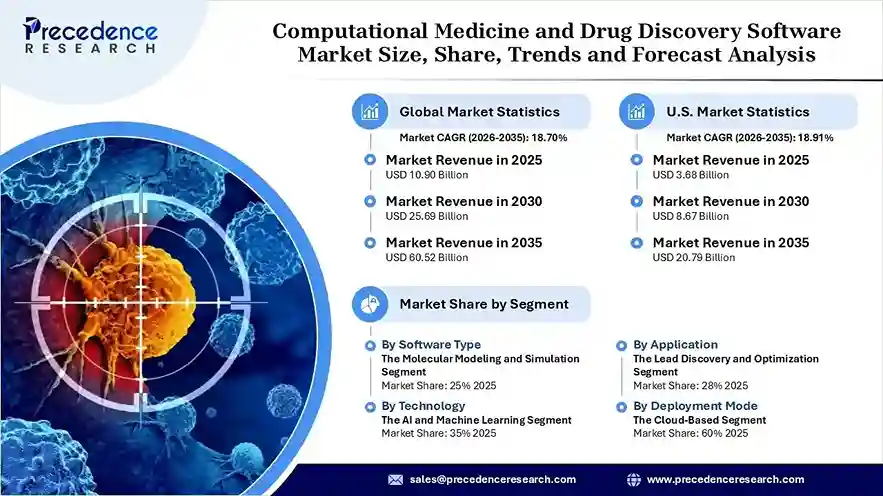
The global computational medicine and drug discovery software market revenue reached USD 10.90 billion in 2025 and is predicted to attain around USD 60.52 billion by 2035 with a CAGR of 18.70%. The market is driven by the huge amount of information generated by the biotech sector, which includes genomics, proteomics, and high-throughput screening data, and the increasing need to shorten the time required for developing a drug.
Market Overview
The computational medicine & drug discovery software market involves the use of computer programs and systems to analyze biological data, understand the pathology behind diseases, predicting drug-target interactions, and simulate outcomes. The technologies used involve target discovery software for the discovery of disease-causing genes and proteins, and in silico virtual screening software for testing thousands of drug-like compounds.
The market serves pharmaceutical and biotechnology firms, universities and research centers, contract research organizations (CROs), and government agencies across various fields such as oncology, neurology, metabolic disorders, and genetics. This market facilitates antibody discovery, cheminformatics, bioinformatics, and systems biology. Overall, the objective is to compress the drug development timeline.
What Drives the Growth of the Market?
Usage of Generative AI Models for Drug Target Discovery
The computational medicine & drug discovery software market is driven by the rising usage of generative AI platforms that design new small molecules for specific drug target parameters as opposed to using existing chemical libraries. The generative AI models enable the identification of more drug targets and the use of these drug targets in different treatment approaches, such as degraders, molecular glues, and antibody-drug conjugate payloads. In 2026, Variational AI launched the fourth version of its generative AI platform, Enki 4, which increased the number of drug targets from 592 to 760 and included degraders, PROTACs, molecular glue, and novel antibody-drug conjugate payloads.
Adoption of Physics-Based AI for Virtual Screening
There is a rapid adoption of a hybrid approach involving deep learning and physics-based molecular modeling that gives scientists the ability to virtually screen hundreds of millions of chemicals at a fast speed. Such an approach allows pharmaceutical companies to ramp up their exploration of different types of chemicals without requiring a large number of physical compound libraries. In 2025, Schrodinger published a scientific paper in the Journal of Medicinal Chemistry explaining how its combined platform that uses free energy perturbation calculations along with machine learning discovered SGR-1505, a MALT1 inhibitor. It was sent for phase 1 trials after exploring more than 1300 design ideas within ten months.
Government Investments in AI-Driven Drug Discovery
Governments across the globe have actively invested in large-scale initiatives to facilitate the use of AI and computational techniques in drug discovery. Governments acknowledge that AI plays a critical role in minimizing development time and increasing the success of clinical trials. There have been various government-funded programs to develop computational models capable of predicting the safety and efficacy of potential drugs. In 2025, ARPA-H revealed the winning teams of its CATALYST program, which was initiated by the U.S. government. The winning projects received an award of up to USD 125 million to develop computational models that simulate biological systems and predict drug safety and efficacy, ultimately replacing animal models in preclinical tests.
Market Segmentation Overview
- By Software Type: The molecular modeling & simulation segment led the computational medicine & drug discovery software market with a 25% share in 2025, as it is the most developed and adopted, forming the basis of structure-based drug design through visualization of protein structure, prediction of binding modes of small molecules, and calculation of binding affinity.
- By Software Type: The AI-driven drug discovery platforms segment is expected to expand at the highest CAGR during the forecast period, since they can design novel chemical entities starting from scratch based on the characteristics of the target molecule, and can screen millions of compounds much faster than conventional methods.
- By Technology Type: The AI & machine learning segment dominated the market with a 35% share in 2025 and is expected to grow at the fastest rate from 2026 to 2035. This is because these technologies enable the implementation of generative chemistry, deep learning-powered property prediction, and multi-objective optimization of compounds.
- By Technology Type: The high-performance computing segment held the second-largest share of 25% in 2025, due to its ability to provide parallel computing to facilitate molecular dynamics simulations, quantum mechanics computations, and large virtual screening experiments.
- By Application: The lead discovery & optimization segment led the computational medicine & drug discovery software market with a 28% share in 2025, owing to the fact that it requires a large amount of computation to filter out millions, or even billions of molecules.
- By Application: The target identification & validation segment is expected to expand at the highest CAGR during the forecast period, since it is capable of analyzing genomics, proteomics, and disease pathway data in order to discover validated targets before any chemistry work is done.
- By Therapeutic Area: The oncology segment dominated the market with a 35% share in 2025 and is expected to grow at the fastest rate from 2026 to 2035. This is mainly due to rising research activities to improve cancer treatments, which involve several companies working on targeted therapies, immunotherapies, and antibody drug conjugates.
- By Therapeutic Area: The neurological disorders segment held the second-largest market share of 20% in 2025, because pharmaceutical companies need to make heavy investments in technologies that can accurately predict the ability of a drug to cross the blood-brain barrier and interact with the target in the central nervous system.
- By End-Use: The pharma & biotech companies segment led the market with 55% share in 2025 and is expected to expand at the highest CAGR during the forecast period. This is because they play a major role in developing new drugs.
- By End-Use: The academic & research institutes segment held the second-largest market share of 25% in 2025, owing to the fact that they perform vital research on target identification and structural biology, whereby the computational platforms are utilized for hypothesis generation and validation of targets.
Regional Analysis
North America led the computational medicine & drug discovery software market with a 45% share in 2025, since it is the world’s largest hub for pharmaceutical companies, biotechnology organizations, and top research centers, all of which use AI and computational technologies to advance their drug development process. The U.S. dominated the market in North America due to its vibrant venture capital community that has backed many start-ups focusing on AI in discovering drugs and prominent technology companies working on life sciences software solutions. Canada is a notable contributor to the market owing to its significant government investment in AI research and a thriving ecosystem of computational drug discovery companies.
Asia Pacific is expected to expand at the highest CAGR during the forecast period because of the rapid rise in pharmaceutical research and development expenditure, the rising number of biotechnology firms, and favorable policies by the governments in terms of encouraging AI in drug discovery processes. China led the market in Asia Pacific due to significant government investment in AI and biotechnology, and the adoption of computational solutions among Chinese drug developers aiming to outpace their international competitors. India witnessed significant market growth owing to the presence of a large number of computational scientists and software engineers, the expansion of the pharmaceutical industry, and the growing adoption of AI in drug discovery procedures.
Computational Medicine and Drug Discovery Software Market Coverage
| Report Attribute | Key Statistics |
| Market Revenue in 2025 | USD 10.90 Billion |
| Market Revenue by 2035 | USD 60.52 Billion |
| CAGR from 2026 to 2035 | 18.70% |
| Quantitative Units | Revenue in USD million/billion, Volume in units |
| Largest Market | North America |
| Base Year | 2025 |
| Regions Covered | North America, Europe, Asia-Pacific, Latin America, and the Middle East & Africa |
Top Companies in the Computational Medicine and Drug Discovery Software Market
Companies such as Schrödinger Inc., Certara, Dassault Systèmes BIOVIA, and Chemical Computing Group specialize in physics-based and biosimulation platforms. Their solutions focus on molecular modeling, docking studies, pharmacokinetics, and model-informed drug discovery, enabling researchers to simulate and predict biological behavior with high precision.
In contrast, companies such as Insilico Medicine, Recursion Pharmaceuticals, Exscientia, Atomwise, and Insitro leverage generative AI, deep learning, and automated wet-lab systems to accelerate target identification and novel molecule discovery. Additionally, NVIDIA Corporation supports the ecosystem through AI-powered drug discovery platforms such as BioNeMo and Clara, which enable large-scale biological and chemical simulation workloads.
Segments Covered in the Report
By Software Type
- Molecular Modeling and Simulation Software
- Bioinformatics and Genomics Software
- AI-driven Drug Discovery Platforms
- Clinical Trial Simulation Software
- Data Integration and Management Platforms
- Laboratory Informatics and Workflow Software (LIMS/ELN)
By Technology
- Artificial Intelligence and Machine Learning (AI/ML)
- High-Performance Computing (HPC)
- Cloud Computing
- Quantum Computing (Emerging)
- Digital Twins and In Silico Modeling
By Application
- Target Identification and Validation
- Lead Discovery and Optimization
- Preclinical Testing and Toxicity Prediction
- Clinical Trial Design and Simulation
- Personalized Medicine and Biomarker Discovery
By Deployment Mode
- Cloud-based Software
- On-premise Software
- Hybrid Deployment
By End-Use
- Pharmaceutical and Biotechnology Companies
- Academic and Research Institutes
- Contract Research Organizations (CROs)
By Therapeutic Area
- Oncology
- Neurological Disorders
- Cardiovascular Diseases
- Infectious Diseases
- Rare Diseases
By Region
- North America
- Europe
- Asia Pacific
- Middle East and Africa
- Latin America
Get this report to explore global market size, share, CAGR, and trends, featuring detailed segmental analysis and an insightful competitive landscape overview @ https://www.precedenceresearch.com/sample/8386
You can place an order or ask any questions, please feel free to contact us at sales@precedenceresearch.com |+1 804 441 9344