



Digital Infrastructure Market Revenue to Attain USD 1,321.26 Bn by 2035
Published: 10 Jun 2026
Author: Precedence Research



Digital Infrastructure Market Revenue and Trends 2026 to 2035
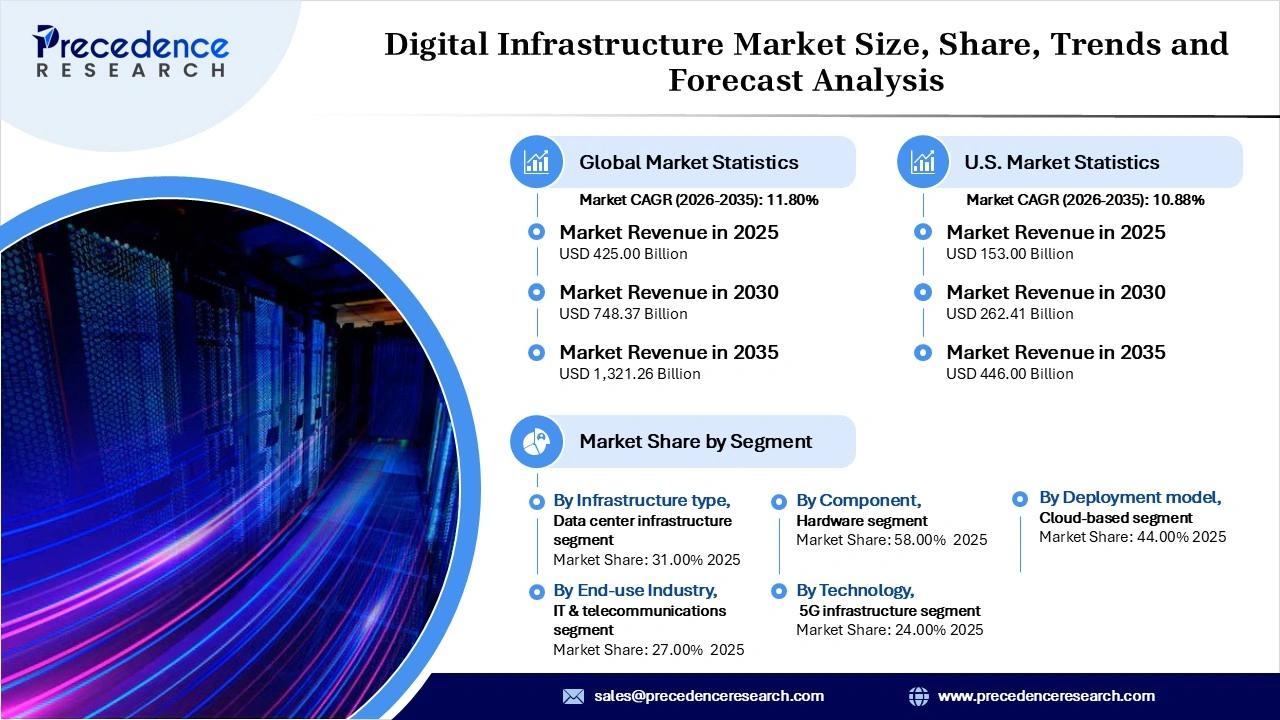
The global digital infrastructure market revenue was valued at USD 425.00 billion in 2025 and is expected to attain around USD 1,321.26 billion by 2035, growing at a CAGR of 11.80% during forecast period. The market is driven by the increasing volume of data produced by cloud computing facilities, AI models, IoT platforms, and 5G architecture, which requires data centers that are able to scale, edge computing nodes, and fast connectivity solutions to process the data.
Market Overview
The digital infrastructure market involves all the physical and virtual assets that let data be created, stored, processed, and sent across networks. It includes various types of data centers like hyperscale, colocation, and edge, along with stuff like routers, switches, and optical transport gear. Fiber optic cables, underwater communication lines, 4G/5G cell towers, software-defined setups, cloud management tools, content delivery networks, and interconnection services are also important components.
Hyperscale data centers set up by AWS, Microsoft, Google, telecom firms, and the government produce massive amounts of data, and thus digital infrastructure becomes crucial for data operations. The market also includes cloud computing, streaming media, IoT, self-driving technology, and training AI models. This market has been witnessing significant growth, driven by the need for speedy, broad bandwidth, and reliable digital services, which keep today’s economy and everyday life moving smoothly.
What are the Growth Potentials of the Digital Infrastructure Market?
Rising Bandwidth Demand
Bandwidth demand in digital infrastructure is surging due to large-scale AI model training, which requires massive data movement across GPU clusters. Traditional copper interconnects and pluggable optics are increasingly unable to meet these performance and power efficiency requirements. Co-packaged optics (CPO) integrated into Ethernet switch silicon is emerging as a key innovation, reducing signal loss, lowering power consumption, and significantly improving port density for hyperscale AI systems.
- In 2025, Broadcom unveiled its Tomahawk 6 (Davisson), which is claimed to be the first 102.4 Tb/s Ethernet switch with CPO. It offers 51.2 Tb/s of optical I/O directly on its package, and it supports 64 ports of 1.6 Tb/s, targeting enormous AI clusters with as many as 64,000 GPUs in one tier.
Next-Gen AI Networking Silicon for Hyperscale Clusters
The latest trend in the market is the development of advanced technologies to facilitate the huge data movement needs of AI training and inference, because traditional networking systems are creating bottlenecks. A next-generation silicon switch has been developed, which includes features like adaptive routing and in-network telemetry. These new chips offer better congestion control, making lossless and low-latency communication possible across big AI clusters with lots of GPUs.
- In 2026, Cisco showed off the Silicon One G300, which is a 102.4 Tbps switch chip made on the TSMC 3-nm process and boasts a 28% boost in AI job completion times. It is expected to be the backbone of their N9000 and 8000 systems, powering massive gigawatt-scale clusters.
Government Initiatives
As nations race to lead in AI technology, governments are crafting strategies to ramp up digital infrastructure like high-powered data centers and fast-paced networks. These plans are key to modern industrial growth, as companies want to stay competitive, draw investments, and take control of crucial AI technologies. In 2025, the U.S. government stepped things up with an Executive Order to speed up federal permits for big AI data center projects. The projects, which add over 100 megawatts of power, will get priority approval from the government. This move aims to bolster the U.S.’s position in the AI competition.
Google Invests USD 15 Billion in Missouri AI Data Center
In 2026, Google announced a USD 15 billion data center in New Florence, Missouri, spanning 900 acres along Interstate 70. This data center is right next to Amazon's data center, which is worth USD 35 billion. This puts the total private investment at USD 50 billion in a single area. These mega facilities show how technology giants are ramping up their fight for land and power to advance their AI infrastructure.
Market Segmentation Overview
- By infrastructure type, the data center infrastructure segment led the digital infrastructure market with a 31% share in 2025, due to the boom in cloud computing, AI, and streaming services. This significantly requires massive, centralized facilities with tons of computing power and storage space. Data centers contain all the crucial hardware like servers, cooling, and backup power systems.
- By infrastructure type, the edge infrastructure segment is expected to expand at the highest CAGR of 15.2% during the forecast period because IoT devices, autonomous systems, and real-time applications need super-fast speeds and sub-millisecond latency. This drives the need for processing data close to where it’s generated, which boosts response times and is crucial for connected cars, smart factories, and AI inference at the edge.
- By component, the hardware segment dominated the digital infrastructure market with a 58% share in 2025, owing to the fact that servers, storage arrays, networking switches, routers, and cooling systems make up the foundation of digital infrastructure.
- By component, the software segment is expected to grow at the fastest CAGR of 13.8% from 2026 to 2035, since it enables virtualization, automation, and orchestration of physical hardware, enabling operators to scale infrastructure dynamically without a big jump in spending. The rise of software-defined networking, cloud-native platforms, and AI-driven tools has sped up the shift to programmable infrastructure.
- By deployment model, the cloud-based segment led the digital infrastructure market with a 44% share in 2025 and is expected to expand at the highest CAGR of 14.1% during the forecast period. This is because it gives organizations on-demand access to scalable resources without owning physical infrastructure. This significantly cuts capital costs and speeds up time-to-market. It also offers built-in resilience, auto updates, and global accessibility.
- By deployment model, the on-premises segment held the second-largest market share of 33% in 2025, owing to the fact that many organizations in regulated industries like BFSI, healthcare, and government demand physical control over their data and infrastructure to comply with strict data privacy rules. Large organizations with existing data center infrastructure prefer on-premises deployments to avoid cloud vendors' lock-in.
- By end-use industry, the IT & telecommunications segment dominated the market with a 27% share in 2025, since the industry is greatly involved in building, operating, and maintaining the core networks, data centers, and cloud platforms that support all digital services. Telecom companies invest in upgrades to support 5G, fiber, and edge computing, while IT firms focus on hyperscale data centers and cloud facilities.
- By end-use industry, the retail & e-commerce segment is expected to grow at the fastest CAGR of 13.2% from 2026 to 2035, due to rapid growth of omnichannel shopping, personalized recommendations, and real-time inventory management, which require huge amounts of data processing both at the edge and on the cloud. There are big spikes in online traffic during sales, meaning infrastructure needs to be elastic and reliable to deal with high transaction volumes without downtime.
- By technology, the 5G infrastructure segment led the digital infrastructure market with a 24% share in 2025, since it facilitates high-speed, low-latency, and high-capacity wireless connectivity. It supports the surge in mobile data, IoT devices, and real-time applications. Rollout of 5G requires huge investments in RAN, backhaul, and core network updates.
- By technology, the artificial intelligence infrastructure segment is expected to grow at the fastest CAGR of 18.7% during the forecast period because big AI models need specialized technologies like GPUs, TPUs, high-bandwidth networking, and lots of storage space. Cloud providers and technology companies have set up new systems optimized for AI tasks.
Regional Analysis
North America registered dominance in the digital infrastructure market by holding a major share of 36% in 2025, owing to its early adoption of hyperscale data centers, widespread 5G coverage, and significant investment from the public sector as well as venture funding. The U.S. dominated the market in North America due to the significant presence of prominent cloud providers like AWS, Microsoft, and Google, as well as AI chip makers like Nvidia and AMD. Canada is a significant contributor to the market because of significant investments in subsea cables and edge computing hubs, and extensive adoption of fiber and 5G networks in urban as well as rural areas.
Asia Pacific is expected to expand at the highest CAGR of 14.5% during the forecast period, due to rapid urbanization, a booming middle class, and government-led digitalization, which creates a significant need for data centers, fiber networks, and edge computing. China led the market in Asia Pacific owing to massive investments in hyperscale data centers, a nationwide 5G rollout, and computing power internet projects. India is witnessing a notable growth because of exploding mobile data use, rapid infrastructure development of national cloud and edge computing, and fast-growing data center capacity from global players as well as local firms.
Europe held the third-largest market share of 25% in 2025 due to the fact that it has energy-efficient digital infrastructure, thanks to strict environmental regulations, robust cross-border connectivity, and indigenous cloud services facilities. Germany dominates the market in Europe owing to the significant presence of the Frankfurt Technology hub, top-tier green data centers, and fast 5G rollout through active implementation of the Industry 4.0 policy. France is a significant contributor to the market because of its well-established eco-friendly nuclear power sector, which appeals to companies to set up sustainable technology infrastructure, the significant presence of hyperscale data centers, and big cloud projects.
Digital Infrastructure Market Coverage
| Report Attribute | Key Statistics |
| Market Revenue in 2025 | USD 425.00 Billion |
| Market Revenue by 2035 | USD 1,321.26 Billion |
| CAGR from 2026 to 2035 | 11.80% |
| Quantitative Units | Revenue in USD million/billion, Volume in units |
| Largest Market | North America |
| Base Year | 2025 |
| Regions Covered | North America, Europe, Asia-Pacific, Latin America, and the Middle East & Africa |
Top Companies in the Digital Infrastructure Market
Cisco Systems, Huawei Technologies, Nokia, and Ericsson are some of the key players that specialize in network infrastructure such as routers, switches, and 5G transport equipment. Dell Technologies, Hewlett Packard Enterprises, Lenovo, and Super Micro Computer excel in server and storage gear needed for cloud and edge data centers. Arista Networks and Juniper concentrate on high-speed data center technologies. Schneider Electric and Vertiv deal with power distribution, cooling, and rack management in data centers. Fujitsu, NEC Corporation, and ZTE Corporation offer a range of services related to servers, storage, and telecom systems with significant focus in Asia Pacific.
Segments Covered in the Report
By Infrastructure Type
- Data Center Infrastructure
- Network Infrastructure
- Cloud Infrastructure
- Edge Infrastructure
- Telecommunications Infrastructure
By Component
- Hardware
- Software
- Services
By Deployment Model
- On-premises
- Cloud-based
- Hybrid
By End-use Industry
- IT & Telecommunications
- BFSI
- Government
- Healthcare
- Manufacturing
- Retail & E-commerce
- Energy & Utilities
- Others
By Technology
- 5G Infrastructure
- Artificial Intelligence Infrastructure
- Internet of Things (IoT) Infrastructure
- Edge Computing Infrastructure
- Software-Defined Infrastructure
By Region
- North America
- Latin America
- Europe
- Asia-pacific
- Middle and East Africa
Get this report to explore global market size, share, CAGR, and trends, featuring detailed segmental analysis and an insightful competitive landscape overview @ https://www.precedenceresearch.com/sample/8466
You can place an order or ask any questions. Please feel free to contact us at sales@precedenceresearch.com |+1 804 441 9344