



Injectable Peptides Drugs Market Revenue and Trends in 2026
Published: 08 May 2026
Author: Precedence Research



Injectable Peptides Drugs Market Revenue to Attain USD 9.20 Bn by 2035
The global injectable peptides drugs market revenue surpassed USD 48.60 billion in 2025 and is predicted to attain around USD 9.20 billion by 2035, growing at a CAGR of 9.20%. The injectable peptides drugs market is driven by increasing demand for effective treatments for diabetes and obesity, along with the growing adoption of peptide-based therapies due to their high specificity and precision compared to conventional drugs.
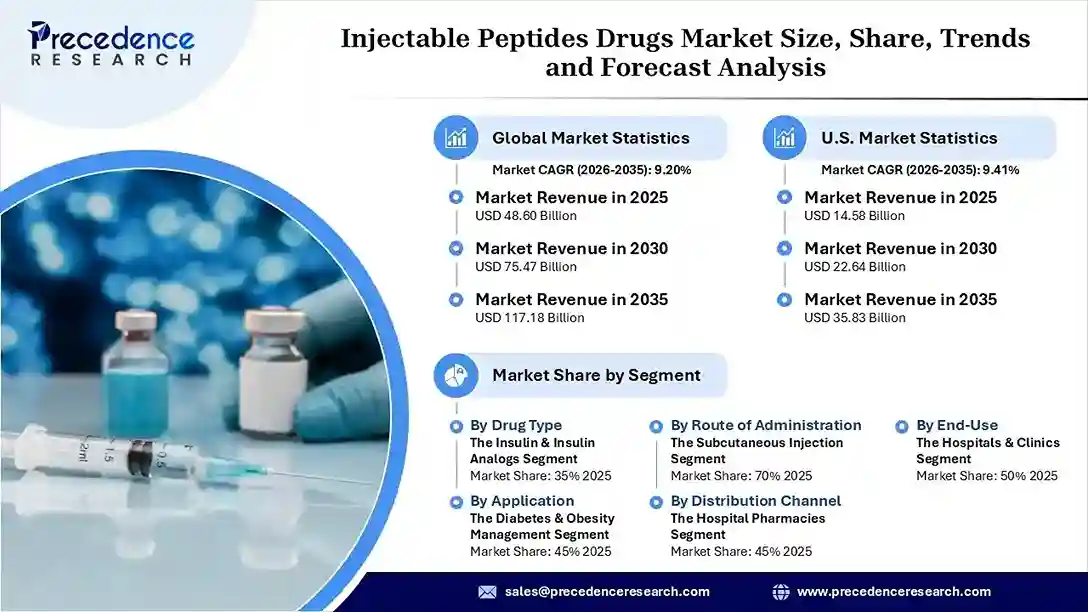
Market at a Glance
The injectable peptides drugs market comprises therapies based on short chains of amino acids that can mimic, enhance, or inhibit natural biological processes with high precision. These drugs are administered via injection to avoid enzymatic degradation and ensure effective bioavailability. They are widely used in the treatment of conditions such as diabetes, obesity, cancer, and hormonal disorders. The market spans the full value chain, including drug discovery, peptide synthesis, formulation development, delivery technologies, and contract manufacturing.
Ongoing innovation is focused on overcoming challenges such as stability, targeted delivery, and scalability. Advances in peptide engineering, sustained-release formulations, and novel delivery systems are expanding the therapeutic scope into areas such as oncology, rare diseases, and cardiometabolic disorders. Overall, market growth is driven not only by clinical effectiveness but also by improvements in manufacturing efficiency and delivery logistics.
Major Trends Impacting the Injectable Peptides Drugs Market
- Clinical Outcomes Expanding Indications: Positive late-stage clinical trial results are expanding the use of peptide therapies beyond traditional applications. For example, dual-hormone peptide candidates have demonstrated significant weight loss outcomes (approximately 16.6% in Phase III trials), outperforming placebo and enabling expansion into obesity, fatty liver disease, and broader cardiometabolic conditions.
- Rising Burden of Obesity and Type 2 Diabetes: The increasing global prevalence of obesity and type 2 diabetes is a major driver of market growth. Peptide-based therapies, particularly GLP-1 receptor agonists, offer effective glucose regulation along with weight management benefits, positioning them as superior alternatives to many conventional treatments.
GLP-1 Adoption Trends: Demographic and Economic Insights
- Approximately 26.5% of adults with diabetes were using GLP-1 injectable therapies in 2024, indicating a shift from niche adoption to mainstream clinical use.
- Usage is highest among individuals aged 50–64 years (33.3%), with lower adoption in older age groups, reflecting differences in treatment strategies and access.
- There are notable demographic variations, with 31.3% usage among Hispanic populations compared to 12.1% among Asian populations, highlighting disparities in adoption.
- Rising obesity prevalence (32.4% globally) is expected to further increase demand for peptide-based therapies.
- The share of GLP-1 injectable use grew significantly from 7.6% in 2018 to 19.4% in 2022, representing over 155% growth.
- Healthcare spending on these therapies increased by more than 500% between 2018 and 2023, reflecting strong real-world demand and commercial expansion.
Market Segmentation Overview
- By drug type, the insulin & insulin analogs segment held a major revenue share of 35.0% in the injectable peptides drugs market in 2025, driven by the critical need for precise diabetes management. These therapies remain essential for millions of patients, where maintaining accurate glycemic control is vital for long-term health outcomes.
- By application, the diabetes & obesity management segment dominated the market with a 45.0% share in 2025 and is expected to maintain its leading position in the coming years. This is mainly due to the rising prevalence of lifestyle-related disorders, leading to sustained demand for peptide-based therapies that support long-term metabolic regulation.
- By route of administration, the subcutaneous injection segment dominated the market with a 70.0% share in 2025 and is expected to maintain its leading position with a CAGR of 9.5% in the coming years. This is due to its ease of administration, minimal invasiveness, and improved patient compliance, making it suitable for long-term treatment regimens.
- By distribution channel, the hospital pharmacies segment held a major revenue share of 45.0% in the injectable peptides drugs market in 2025, due to the need for clinical oversight in the administration of injectable therapies. Hospitals provide the necessary infrastructure for storage, monitoring, and controlled distribution of peptide drugs.
- By end-use, the hospitals & clinics segment accounted for the largest revenue share of 50.0% in the injectable peptides drugs market in 2025, supported by their ability to manage complex treatment protocols and ensure safe administration. Access to specialized healthcare professionals and advanced medical infrastructure reinforces their dominant position.
- By peptide type, the long-chain peptides segment accounted for a major revenue share of 40.0% in the market in 2025, driven by their extended duration of action. Reduced dosing frequency improves patient adherence and supports better continuity of care in real-world settings.
Regional Analysis
North America dominated the global injectable peptides drugs market with a share of 40.0% in 2025 due to high diabetes incidence and increased GLP-1 therapy utilization. In the U.S., a growing number of adults with diabetes are adopting GLP-1 injectable therapies, reflecting strong clinical acceptance and physician confidence in their effectiveness. The country continues to lead in revenue generation due to high diagnosis rates, broad insurance coverage, and rapid clinical uptake of these therapies, supporting sustained market growth.
Asia Pacific held a market share of 22.0% in 2025 and is expected to grow at the fastest CAGR of 11.5% during the forecast period due to rising healthcare access and a large patient population. Countries like China and India, having some of the world’s largest diabetic populations, are steadily expanding access to advanced therapies as healthcare systems deepen. The region’s growth is driven by a widening patient base, improving affordability, and a gradual shift from basic care to targeted peptide-based treatments.
Injectable Peptides Drugs Market Coverage
| Report Attribute | Key Statistics |
| Market Revenue in 2025 | USD 48.60 Billion |
| Market Revenue by 2035 | USD 117.18 Billion |
| CAGR from 2026 to 2035 | 9.20% |
| Quantitative Units | Revenue in USD million/billion, Volume in units |
| Largest Market | North America |
| Base Year | 2025 |
| Regions Covered | North America, Europe, Asia-Pacific, Latin America, and the Middle East & Africa |
Top Companies in the Injectable Peptides Drugs Market
Leading players such as Novo Nordisk and Eli Lilly and Company dominate the market through their leadership in GLP-1 therapies, significantly transforming diabetes and obesity treatment. Other major pharmaceutical companies, including Sanofi, Pfizer, Roche, and AstraZeneca, integrate peptide-based drugs within broader biologics portfolios. Additionally, Amgen and Takeda Pharmaceutical Company focus on specialized and complex therapeutic areas, while Teva Pharmaceutical Industries emphasizes large-scale production and generics, improving accessibility of peptide therapies.
Segments Covered in the Report
By Drug Type
- GLP-1 Receptor Agonists (Semaglutide, Liraglutide)
- Insulin & Insulin Analogs
- GnRH Analogs
- Somatostatin Analogs
- Parathyroid Hormone (PTH) Analogs
- Other Therapeutic Peptides
By Application
- Diabetes & Obesity Management
- Oncology
- Cardiovascular Diseases
- Endocrine Disorders
- Gastrointestinal Disorders
- Others (Dermatology, Infectious Diseases, etc.)
By Route of Administration
- Subcutaneous Injection
- Intravenous Injection
- Intramuscular Injection
By Distribution Channel
- Hospital Pharmacies
- Retail Pharmacies
- Online Pharmacies
By End-Use
- Hospitals & Clinics
- Homecare Settings
- Specialty Treatment Centers
By Peptide Type
- Short-chain Peptides
- Long-chain Peptides
- Modified & Conjugated Peptides
By Region
- North America
- Latin America
- Europe
- Asia-pacific
- Middle and East Africa
Get this report to explore global market size, share, CAGR, and trends, featuring detailed segmental analysis and an insightful competitive landscape overview @ https://www.precedenceresearch.com/sample/8384
You can place an order or ask any questions, please feel free to contact us at sales@precedenceresearch.com |+1 804 441 9344