



Manufacturing Operations Management Software Market Revenue to Attain USD 45.10 Bn by 2035
Published: 13 May 2026
Author: Precedence Research



Manufacturing Operations Management Software Market Revenue and Trends 2026 to 2035
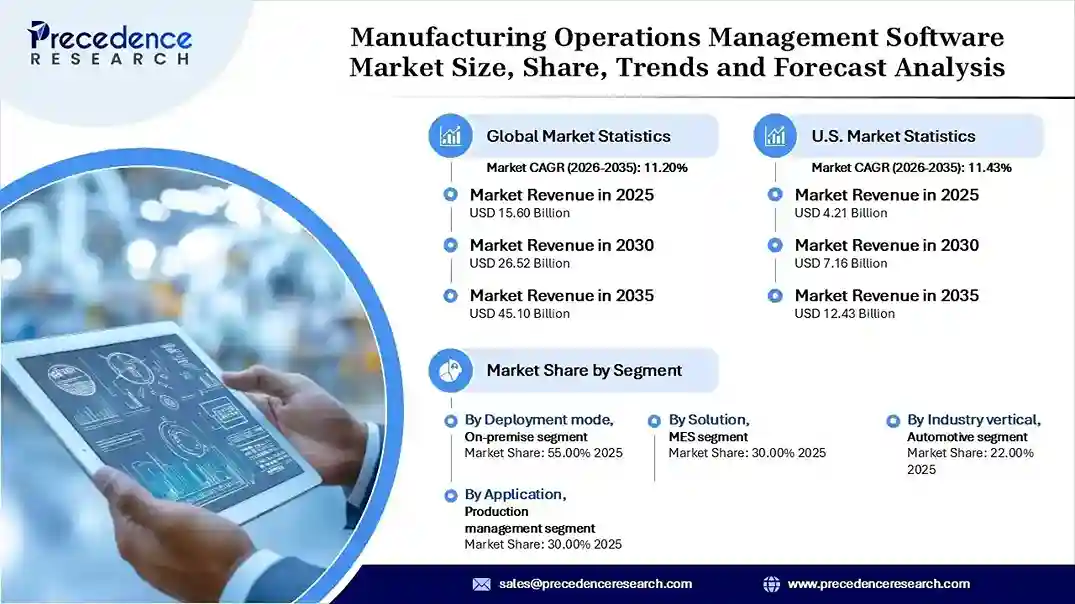
The global manufacturing operations management software market revenue reached USD 15.60 billion in 2025 and is predicted to attain around USD 45.10 billion by 2035 with a CAGR of 11.20%. The market is driven by the increasing requirements of manufacturers to have visibility into production operations, minimize downtime, increase efficiency, and maintain product quality standards.
Market Overview
The manufacturing operations management software market comprises software platforms that facilitate manufacturing activities by managing, monitoring, and optimizing factory floor production activities. This includes manufacturing execution system software, which tracks production order management, including work orders, tracking materials used, and labor involved in these activities.
This market involves quality management software that tracks defect rates, monitors non-conforming materials, and logs corrections. This market also involves OEE dashboards, which show the machine’s uptime, performance efficiency, and quality rate. Some of the industries served by these software platforms include automotive, aerospace, electronics, medical devices, pharmaceutical, food and beverage, heavy equipment manufacturing, and consumer goods.
What are the Major Trends Driving the Market?
Rise of Agentic AI and Digital Twins for Self-Optimizing Factories
The market is benefitting from the development of physical AI ecosystems, where not only advice, but actions themselves are automated by autonomous software agents. Digital twin technology is also being adopted, which is powered by reinforcement learning algorithms, which will allow for reduced-order models and deep learning to speed up the process of simulation and machine learning for real-time optimization. In 2025, Siemens introduced Opcenter X at the SPS 2025 trade fair in Nuremberg, which is a cloud-native manufacturing operations management solution that integrates planning, execution, quality, and analytics onto a single platform.
Adoption of Hybrid Cloud MES for Multi-Site Visibility
The market is witnessing rapid adoption of hybrid cloud manufacturing execution systems by combining on-premise production systems with cloud-based data analytics. This technique facilitates manufacturers to break down data silos, improve efficiency, and gain useful insights generated by AI. Such hybrid systems allow for enterprise-wide visibility and fast data-driven decision-making without abandoning legacy on-premise systems. In 2025, Munksjo Group, a Swedish company that specializes in paper products, rolled out SAP Cloud ERP Private with T.CON MES SUITE at its Unterkochen site in Germany. This project serves as a template for all other global facilities with the integration of analytics, CO2 tracking, and digital shift reports.
Government Initiatives Driving Digital Technologies Adoption in Factories
Governments across the globe have introduced financial assistance, tax benefits, and programs to fast-track the implementation of manufacturing management solutions. Governments are implementing policies to boost the adoption of industrial intelligence agents and funding the research of AI technologies in production and quality management.
Market Segmentation Overview
- By Deployment Model: The on-premise segment led the manufacturing operations management software market with 55% share in 2025, since many manufacturing organizations, especially in regulated sectors like aerospace, defense, and medical device production, have mature production infrastructure and confidential IP that cannot be hosted on the cloud.
- By Deployment Model: The cloud-based segment is expected to expand at the highest CAGR during the forecast period, due to the rapid adoption of Industry 4.0 by companies that need to store large volumes of production data, which is facilitated by cloud facilities.
- By Solution: The MES segment dominated the market with 30% share in 2025. This is because it acts as the main platform through which each work order, each batch of raw materials, machine status, and quality check is performed in the factory.
- By Solution: The QMS segment held the second largest market share of 18% in 2025, because all manufacturers, regardless of the industry and size, must monitor defect rates, handle nonconformities, perform CAPA (Corrective and Preventive Action), and keep traceability records to fulfill customer expectations.
- By Industry Vertical: The automotive segment led the market with 22% share in 2025, due to the complex nature of automobile manufacturing processes, where thousands of parts need to be coordinated for assembling each vehicle, thus they need advanced software to facilitate smooth manufacturing.
- By Industry Vertical: The electronics & semiconductor segment is expected to grow at the fastest rate from 2026 to 2035, because production in this sector demands precise processes at a nanometer level and controlled environments, so they need to adopt digital technologies to maintain optimal precision.
- By Application: The production management segment dominated the manufacturing operations management software market with 30% share in 2025, since it is basically the heart of any manufacturing operation, as it involves production order processing, workforce management, machine management, material consumption management, and production tracking.
- By Application: The performance analysis segment held the second largest market share of 25% in 2025, because it helps to conduct analysis on the production data to uncover any inefficiencies, and also provides performance analysis parameters like OEE, downtime, production trend reports, and root cause analysis.
Regional Analysis
Asia Pacific led the manufacturing operations management software market with 36% share in 2025 and is expected to expand at the highest CAGR during the forecast period, since it has the world’s highest density of manufacturers in electronics, automobile, and heavy industries sectors, which have adopted digital technologies in their operations to boost quality and cut down costs. China dominated the market in Asia Pacific due to its huge scale of manufacturing capabilities, strong government policies such as “Made in China 2025” and “AI + Manufacturing” programs for digitizing the manufacturing processes. Japan is a significant contributor to the market because of its long-term expertise in lean manufacturing and the continuous improvement (Kaizen) method that naturally aligns with the adoption of manufacturing operations management software in factories.
North America held the second largest share of 28% in 2025, since it has a well-developed manufacturing base, especially in aerospace, automotive, medical equipment, pharmaceuticals, and food processing industries, and has a very stringent regulatory framework for quality control. The U.S. led the market in North America due to a robust manufacturing sector, initiatives to bring back manufacturing from Asian countries through reshoring, and the significant presence of manufacturing operations management software vendors. Canada witnessed notable market growth because of its large manufacturing base and government initiatives to digitize small and medium-sized companies so that they can compete with bigger players.
Manufacturing Operations Management Software Market Coverage
| Report Attribute | Key Statistics |
| Market Revenue in 2025 | USD 15.60 Billion |
| Market Revenue by 2035 | USD 45.10 Billion |
| CAGR from 2026 to 2035 | 11.20% |
| Quantitative Units | Revenue in USD million/billion, Volume in units |
| Largest Market | Asia Pacific |
| Base Year | 2025 |
| Regions Covered | North America, Europe, Asia-Pacific, Latin America, and the Middle East & Africa |
Top Companies in the Manufacturing Operations Management Software Market
Siemens, Rockwell Automation, Schneider Electric, ABB, Honeywell, Emerson Electric, and GE Digital are some of the key players that provide manufacturing operations management (MOM) software. Oracle, SAP, Infor, and IFS offer MOM platforms that can be used in ERP and supply chain execution. Dassault Systèmes offers MOM within its comprehensive digital manufacturing suite that includes simulation and production scheduling.
Segments Covered in the Report
By Deployment Model
- Cloud-based
- On-premise
By Solution
- Manufacturing Execution Systems (MES)
- Quality Management Systems (QMS)
- Advanced Planning & Scheduling (APS)
- Inventory & Warehouse Management
- Process & Production Intelligence
By Industry Vertical
- Automotive
- Electronics & Semiconductor
- Food & Beverage
- Pharmaceuticals
- Aerospace & Defense
- Chemicals
- Heavy Machinery
By Application
- Production Management
- Maintenance Management
- Performance Analysis
- Compliance & Traceability
By Region
- North America
- Europe
- Asia Pacific
- Middle East & Africa
- Latin America
Get this report to explore global market size, share, CAGR, and trends, featuring detailed segmental analysis and an insightful competitive landscape overview @ https://www.precedenceresearch.com/sample/8399
You can place an order or ask any questions. Please feel free to contact us at sales@precedenceresearch.com |+1 804 441 9344