



Manufacturing Operations Management Software Market Trends, Companies, Revenue / Sales Performance, Subscriber Growth, Pricing Strategies, Cloud Adoption, Infrastructure Expansion, Competitive Landscape, and Industry Outlook
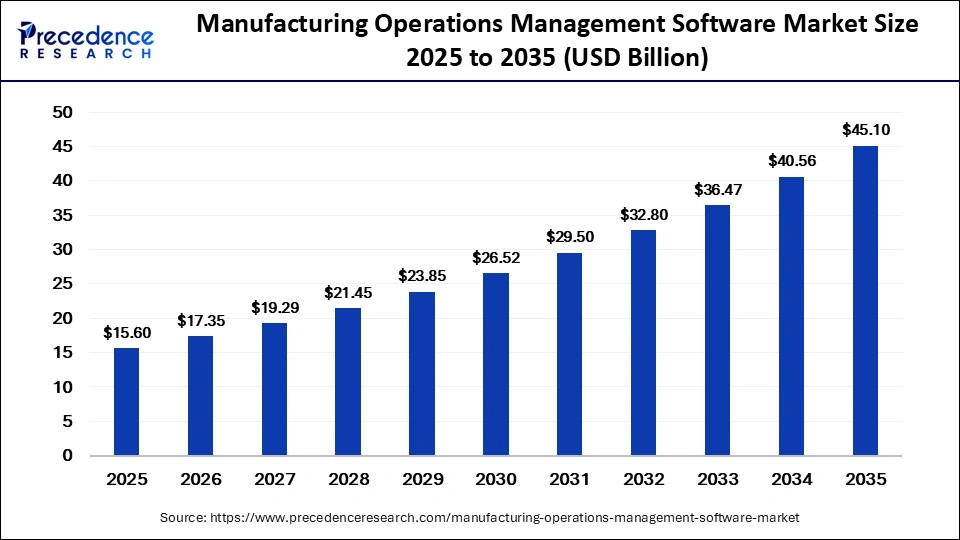
ICT industry specialist Gautam Mahajan estimates the manufacturing operations management software market at USD 17.35 billion in 2026, with continued technology adoption expected to take the market to USD 45.10 billion by 2035 at a CAGR of 11.20%. Leading manufacturing operations management software market providers such as Siemens, Rockwell Automation, Schneider Electric, GE Digital are expanding their capabilities across segments including By Component, By Deployment Model, By Solution, By Organization Size, By Industry Vertical, By Application.
Source: https://www.precedenceresearch.com/manufacturing-operations-management-software-market
 Get a Sample
 Table Of Content


What is the Manufacturing Operations Management Software Market Size in 2026?
The global manufacturing operations management software market size accounted for USD 15.60 billion in 2025 and is predicted to increase from USD 17.35 billion in 2026 to approximately USD 45.10 billion by 2035, expanding at a CAGR of 11.20% from 2026 to 2035. The manufacturing operations management software market is driven by the widespread acceptance of Industry 4.0 technologies, which include IoT, AI, and digital twin technology. This significantly forces manufacturing companies to implement manufacturing operations management software to achieve real-time data monitoring, predictive maintenance, and optimized production efficiency, which together enhance operational speed and decrease production costs.
Key Takeaways
- Asia Pacific dominated the manufacturing operations management software market with a share of 36.00% in 2025.
- North America held the second-largest market share of 28.00% in 2025 and is expected to grow at a CAGR of 9.5% during the forecast period.
- By deployment mode, the on-premise segment accounted for a major revenue share of 55.00% in 2025.
- By deployment mode, the cloud-based segment is expected to grow at a 15.5% CAGR between 2026 and 2035.
- By solution, the MES segment led the global market with a share of 30.00% in 2025.
- By solution, the APS segment is expected to grow at a 12.0% CAGR between 2026 and 2035.
- By industry vertical, the automotive segment accounted for a revenue share of 22.00% in the manufacturing operations management software market in 2025.
- By industry vertical, the electronics & semiconductor segment is expected to grow at the fastest 13.5% CAGR between 2026 and 2035.
- By application, the production management segment accounted for a revenue share of 30.00% in 2025.
- By application, the performance analysis segment is expected to grow at the fastest 12.5% CAGR between 2026 and 2035.
Market Overview
The manufacturing operations management software market comprises software and services that manage, monitor, and synchronize shop-floor activities to boost efficiency, quality, and real-time visibility. It acts as a bridge between high-level ERP systems and shop-floor machines. It is mainly driven by the urgent need for enhanced operational efficiency, digital transformation via Industry 4.0 adoption, and the integration of artificial intelligence and the Internet of Things for real-time, data-driven decision-making.
How is AI Influencing the Manufacturing Operations Management Software Market?
AI is revolutionising manufacturing operations management software from passive data recording tools into proactive, autonomous systems. By integrating machine learning and computer vision, along with predictive analytics, AI improves efficiency, quality control, and predictive maintenance. AI-driven computer vision systems identify defects in real-time with higher accuracy than human inspectors, thus ensuring consistent quality. AI optimizes energy consumption and production schedules, allowing leaner, more cost-effective manufacturing operations.
Manufacturing Operations Management Software Market Trends
- Cloud-first infrastructure is becoming standard, providing firms with increased scalability, remote access, and lower expenses compared to on-premise systems.
- Manufacturers are increasingly utilizing digital twins to create virtual replicas of production processes, allowing simulations that improve efficiency and decrease downtime.
- Integration of artificial intelligence and data analytics is changing manufacturing through predictive maintenance, improved quality control, and better demand forecasting.
- Manufacturing operations management software is playing a vital role in tracking energy consumption and even supporting sustainability initiatives to meet environmental standards.
Market Scope
| Report Coverage | Details |
| Market Size in 2025 | USD 15.60 Billion |
| Market Size in 2026 | USD 17.35 Billion |
| Market Size by 2035 | USD 45.10 Billion |
| Market Growth Rate from 2026 to 2035 | CAGR of 11.20% |
| Dominating Region | North America |
| Fastest Growing Region | Asia Pacific |
| Base Year | 2025 |
| Forecast Period | 2026 to 2035 |
| Segments Covered | Component, Deployment Model, Solution, Organization Size, Industry Vertical, Application, and Region |
| Regions Covered | North America, Europe, Asia-Pacific, Latin America, and Middle East & Africa |
Market Dynamics
Drivers
Rapid Adoption of Industry 4.0 Technologies
The rapid acceptance of Industry 4.0 technologies is a major factor driving the manufacturing operations management software market because these technologies demand a centralized, data-driven platform to handle, analyze, and automate complex, interconnected, as well as real-time production environments. Industry 4.0 depends on connected devices. Manufacturing operations management software thus translates this massive influx of IoT data into actionable insights for decision-making, real-time monitoring, and agility. By determining data, manufacturing operations management software assists in minimizing waste, optimizing energy usage, and enhancing resource efficiency in line with Industry 4.0 goals.
Restraint
High Initial Deployment and Integration Costs
High initial deployment and integration costs restrain the manufacturing operations management software market because they create prohibitive barriers for small or medium-sized enterprises and also complicate upgrades for large companies holding outdated legacy systems. These investments usually involve expensive customization, data migration, and even training, which slow down adoption in cost-sensitive sectors.
Opportunity
Rise of Digital Twin Technology
Digital twin technology is the primary opportunity for the manufacturing operations management software market because it transforms static, historical reporting into real-time, predictive, and autonomous control systems. As manufacturing shifts toward smarter, Industry 4.0 permitted environments, digital twins act as the "connective tissue" that integrates fragmented data from IIoT, PLM, and ERP systems into actionable insights.
Segment Insights
Deployment Model Insights
Manufacturing Operations Management Software Market Share, By Deployment Mode, 2025-2035 (%)
| Deployment Mode | 2025 | 2035 | CAGR (%) |
| On-premise | 55.00% | 45.00% | 8.50% |
| Cloud-based | 45.00% | 55.00% | 15.50% |
The On-premise Segment Held a 55.00% Market Share in 2025
The on-premise segment dominated the manufacturing operations management software market with a share of 55.00% in 2025. This is primarily due to the widespread presence of legacy industrial systems. Manufacturers, especially in the aerospace, defense, and pharmaceutical sectors, handle highly sensitive intellectual property, trade secrets, and proprietary processes, making data security a top priority. On-premise deployments provide greater control over data management and system security while reducing exposure to external cyber threats.
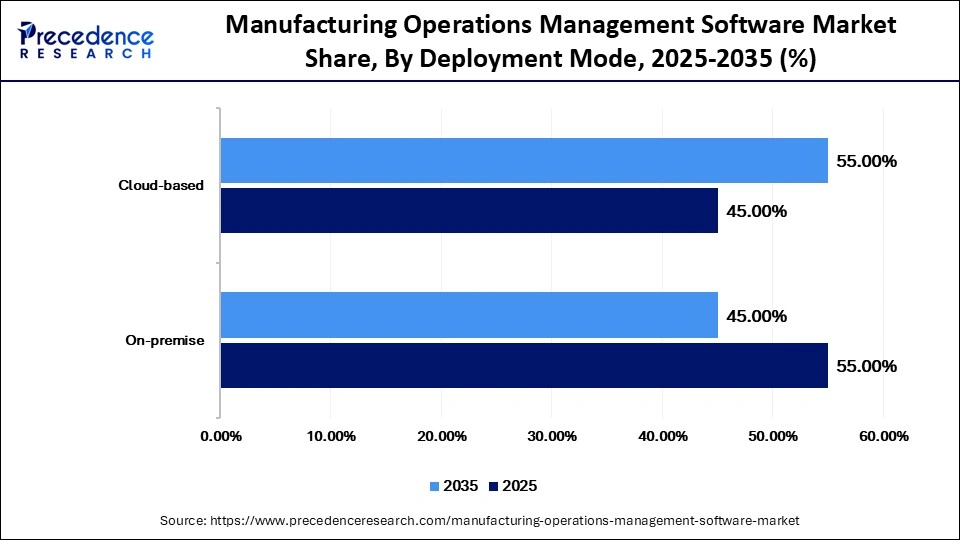
The cloud-based segment held a 45.00% share of the market in 2025 and is expected to grow at the fastest CAGR of 15.5% during the projection period. This is mainly due to the growing Industry 4.0 adoption. Cloud-native architecture makes it easier to now integrate advanced technologies such as artificial intelligence, machine learning, and even the Internet of Things. Cloud platforms offer instantaneous insights into inventory, supply chain, and production performance across global locations, limiting bottlenecks and improving decision-making.
Solution Insights
Why Did the MES Segment Led the Market in 2025?
The MES segment held a dominant position in the manufacturing operations management software market, holding a share of 30.00% in 2025, as they provide core manufacturing control. MES allows agile, lean manufacturing, helping manufacturers handle customization and maintain compliance with industry standards. MES solutions offer immediate tracking of production, labor, and equipment, enabling rapid response to disruptions and ensuring high product quality via comprehensive genealogy.
Manufacturing Operations Management Software Market Share, By Solution, 2025-2035 (%)
| Solution | 2025 | 2035 | CAGR (%) |
| MES | 30.00% | 32.00% | 12.50% |
| QMS | 18.00% | 17.00% | 10.50% |
| APS | 15.00% | 16.00% | 12.0% |
| Inventory & Warehouse Management | 20.00% | 19.00% | 11.0% |
| Process Intelligence | 17.00% | 16.00% | 11.50% |
The QMS segment held the second-largest market share of 18.00% in 2025 and is expected to grow at a CAGR of 10.5% throughout the projection period. This is mainly due to the growing need for maintaining product quality, regulatory compliance, and operational consistency across manufacturing facilities. The segment is expected to grow at a CAGR of 10.5% during the forecast period as manufacturers increasingly adopt automated quality monitoring and data-driven inspection systems to reduce defects, improve efficiency, and enhance customer satisfaction.
The APS segment held a 15.00% share of the market in 2025 and is expected to grow at a CAGR of 12.0% during the projection period, driven by the need for production optimization. APS enhances throughput by optimizing sequence-dependent setups, decreasing idle time, and managing bottlenecks, resulting in faster production cycles. APS enables planners to test the impact of unexpected events, for example, machine breakdown, new rush order, in a virtual environment before implementing changes, allowing proactive rather than reactive management.
Industry Vertical Insights
The Automotive Segment Held a 22.00% Share of the Market in 2025
The automotive segment dominated the manufacturing operations management software market with a share of 22.00% in 2025 because of high automation demand. The shift toward electric and autonomous vehicles demands flexible, highly advanced manufacturing solutions. The automotive industry heavily uses manufacturing operations management for quality management systems, thus ensuring high-quality standards during rapid production.
Manufacturing Operations Management Software Market Share, By Industry Vertical, 2025-2035 (%)
| Industry Vertical | 2025 | 2035 | CAGR (%) |
| Automotive | 22.00% | 23.00% | 11.50% |
| Electronics & Semiconductor | 18.00% | 20.00% | 13.50% |
| Food & Beverage | 15.00% | 14.00% | 10.50% |
| Pharmaceuticals | 12.00% | 13.00% | 12.50% |
| Aerospace & Defense | 10.00% | 9.00% | 10.00% |
| Chemicals | 12.00% | 11.00% | 10.50% |
| Heavy Machinery | 11.00% | 10.00% | 9.50% |
The electronics & semiconductor segment held a 18.00% share of the market in 2025 and is expected to grow at the fastest CAGR of 13.5% during the projection period. This is mainly due to the critical need for extreme precision, high-volume production, and complex, multi-stage traceability. Semiconductor manufacturing includes intricate, multi-step processes. Manufacturing operations management software is vital to manage this complexity, providing "single-wafer traceability" and thus ensuring strict compliance to prevent, rather than just detect, quality defects.
The pharmaceuticals segment held a 12.00% market share in 2025 and is expected to grow at a CAGR of 12.5% in the upcoming period, driven by the compliance requirements. Pharmaceutical manufacturing demands strict adherence to quality standards and documentation, thus making automated, compliant manufacturing operations management systems important for ensuring data integrity and streamlining.
Application Insights
What Made Production Management the Dominant Segment in the Market in 2025?
The production management segment dominated the manufacturing operations management software market with the largest share of 30.00% in 2025, because of its core operations. Production management solutions are important for planning, scheduling, and executing manufacturing tasks, which increases productivity and decreases waste. Production modules within manufacturing operations management systems guarantee compliance with industry standards and handle high-quality standards through tracking and documentation.
Manufacturing Operations Management Software Market Share, By Application, 2025-2035 (%)
| Application | 2025 | 2035 | CAGR (%) |
| Production Management | 30.00% | 32.00% | 12.00% |
| Performance Analysis | 25.00% | 26.00% | 12.5% |
| Maintenance Management | 25.00% | 24.00% | 11.00% |
| Compliance & Traceability | 20.00% | 18.00% | 10.50% |
The performance analysis segment held a 25.00% share of the market in 2025 and is expected to grow at the fastest CAGR of 12.5% during the projection period. This is mainly due to the demand for data-driven decisions. Performance analysis tools process large volumes of information instantly, enabling immediate, actionable insights into production bottlenecks and efficiency improvements. Manufacturers are thus moving away from manual tracking toward digital systems that provide holistic views of operations, from scheduling to delivery, driving the need for advanced analytics.
The maintenance management segment held a 25.00% market share in 2025 and is expected to grow at a notable CAGR of 11.0% during the projection period, owing to a strong focus on enhancing equipment performance. Maintenance software directly impacts profitability by decreasing unscheduled breakdowns and optimizing machinery lifespan.
Regional Insights
North America Manufacturing Operations Management Software Market Size and Growth 2026 to 2035
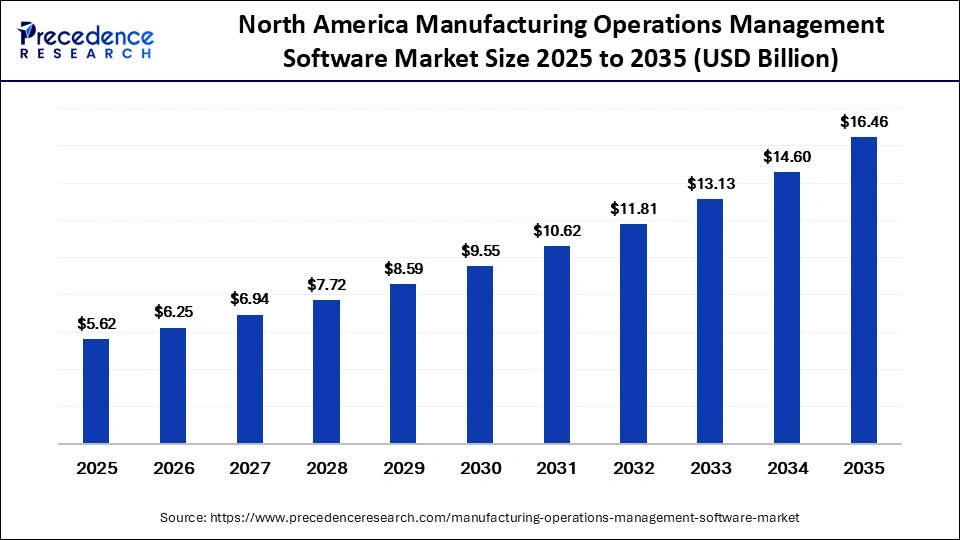
The North America manufacturing operations management software market size is estimated at USD 5.62 billion in 2025 and is projected to reach approximately USD 16.46 billion by 2035, with a 11.34% CAGR from 2026 to 2035.
North America: The Second-Largest Market
North America accounted for the second-largest market share of 28.0% in 2025 and is projected to grow at a CAGR of 9.5% during the forecast period. Market growth is primarily driven by the rapid adoption of industrial automation and Industry 4.0 technologies. In addition, increasing investments in supply chain digitization and digital quality management solutions have accelerated the adoption of manufacturing operations management software across the region.
U.S. Manufacturing Operations Management Software Market Size and Growth 2026 to 2035
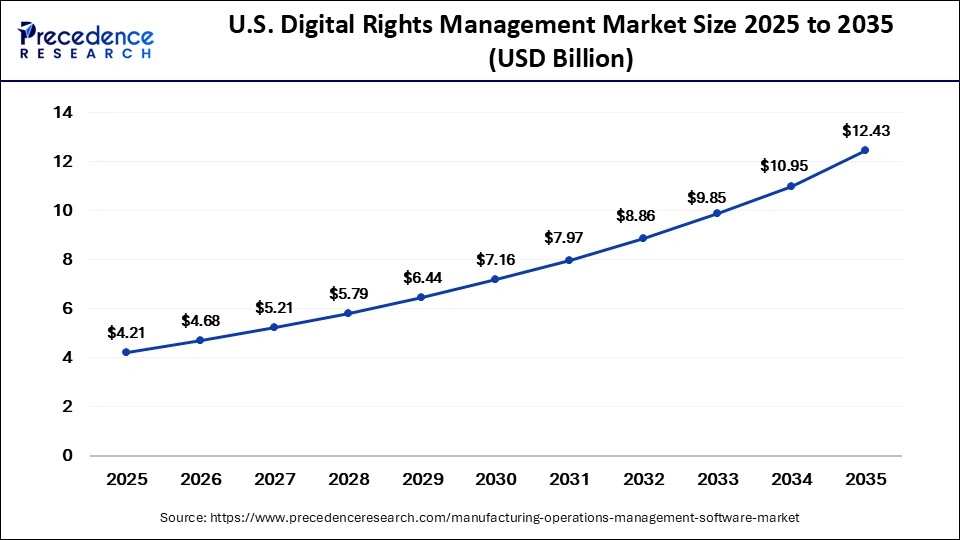
The U.S. manufacturing operations management software market size is calculated at USD 4.21 billion in 2025 and is expected to reach nearly USD 12.43 billion in 2035, accelerating at a strong CAGR of 11.43% between 2026 and 2035.
U.S. Market Analysis
The U.S. manufacturing operations management software market is experiencing significant growth due to rising demand for automation, operational efficiency, and real-time production insights. The resurgence of domestic manufacturing activities has encouraged companies to implement advanced management systems to improve quality control and comply with stringent regulatory standards, particularly in industries such as aerospace and defense.
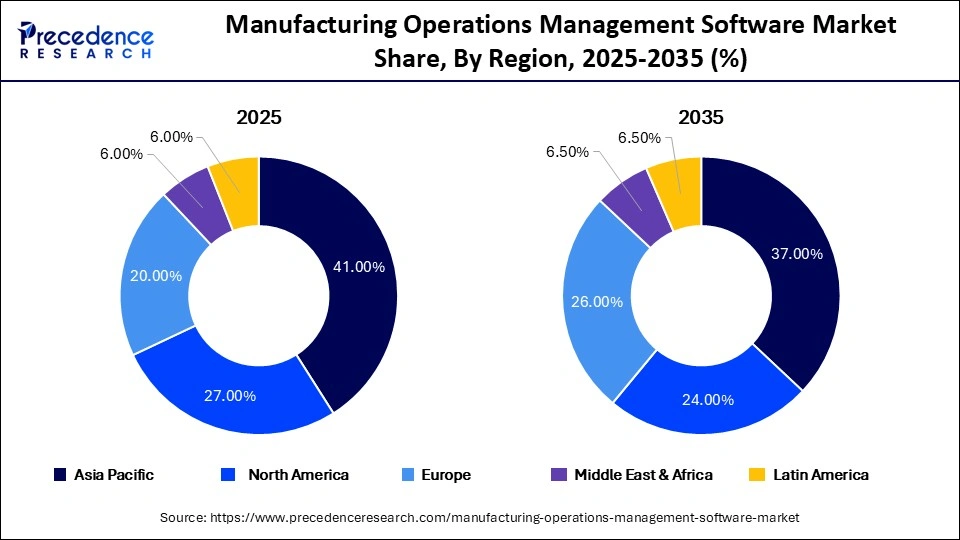
Asia Pacific Led the Global Manufacturing Operations Management Software Market in 2025
Asia Pacific led the market by holding a major share of 36.00% in 2025. This is because the strong presence of large-scale automotive, semiconductor, and electronics industries, which require advanced software solutions for quality control, production scheduling, and supply chain management. Additionally, countries such as Japan and South Korea are increasingly adopting eco-friendly and smart manufacturing technologies to support net-zero goals, further boosting demand for sustainable manufacturing analytics solutions.
China Market Analysis
The manufacturing operations management software market in China is growing rapidly due to increasing demand for operational efficiency, digital transformation, and the integration of IoT-enabled manufacturing systems. Cloud-based solutions are gaining significant traction, while hybrid deployment models continue to remain important among large-scale manufacturers focused on data security and system reliability.
How is the Opportunistic Rise of Europe in the Market?
Europe held a 26.00% share of the market in 2025 and is expected to grow at a CAGR of 10.0% during the projection period. The region's strong automotive and industrial manufacturing base, especially in Germany, France, and the UK, is driving demand for advanced manufacturing operations management software solutions. Furthermore, government initiatives and funding programs such as the Digital Europe Programme are supporting the widespread adoption of automation and smart manufacturing technologies.
UK Market Analysis
The UK market is being driven by the increasing adoption of cloud computing, Industry 4.0 technologies, and AI-based manufacturing solutions. Manufacturers in the country are prioritizing digital transformation tools to improve operational efficiency, productivity, and supply chain resilience, with Manufacturing Execution Systems (MES) playing a key role in this transition.
Manufacturing Operations Management Software Market Companies
- Siemens
- Rockwell Automation
- Schneider Electric
- GE Digital
- Oracle
- SAP
- Dassault Systèmes
- AVEVA
- Epicor
- IFS
- ABB
- Honeywell
- Emerson Electric
- Infor
- Korber
Recent Developments
- In April 2026, Rockwell Automation, Inc., declared its presence at Interpack 2026, where it stated how digital twin technology allows manufacturers to design, integrate, and even optimize end-to-end food and beverage operations.(Source: https://www.rockwellautomation.com)
- In April 2026, Oracle declared Fusion Agentic Applications for finance and supply chain operations. The latest agentic applications are powered by coordinated teams of specialized AI agents, which are outcome-driven, proactive, reasoning-based, and also engineered for enterprise execution. (Source: https://www.oracle.com)
Segments Covered in the Report
By Component
- Software
- Services
By Deployment Model
- Cloud-based
- On-premise
By Solution
- Manufacturing Execution Systems (MES)
- Quality Management Systems (QMS)
- Advanced Planning & Scheduling (APS)
- Inventory & Warehouse Management
- Process & Production Intelligence
By Organization Size
- Large Enterprises
- Small & Medium Enterprises (SMEs)
By Industry Vertical
- Automotive
- Electronics & Semiconductor
- Food & Beverage
- Pharmaceuticals
- Aerospace & Defense
- Chemicals
- Heavy Machinery
By Application
- Production Management
- Maintenance Management
- Performance Analysis
- Compliance & Traceability
By Region
- North America
- Latin America
- Europe
- Asia-pacific
- Middle and East Africa
For inquiries regarding discounts, bulk purchases, or customization requests, please contact us at sales@precedenceresearch.com
Frequently Asked Questions





Ask For Sample
No cookie-cutter, only authentic analysis – take the 1st step to become a Precedence Research client
 Get a Sample




 sales@precedenceresearch.com
 Schedule a Meeting
