



Nanomechanical Testing Market Revenue to Attain USD 2.42 Bn by 2035
Published: 16 Apr 2026
Author: Precedence Research



Nanomechanical Testing Market Revenue and Trends 2026 to 2035
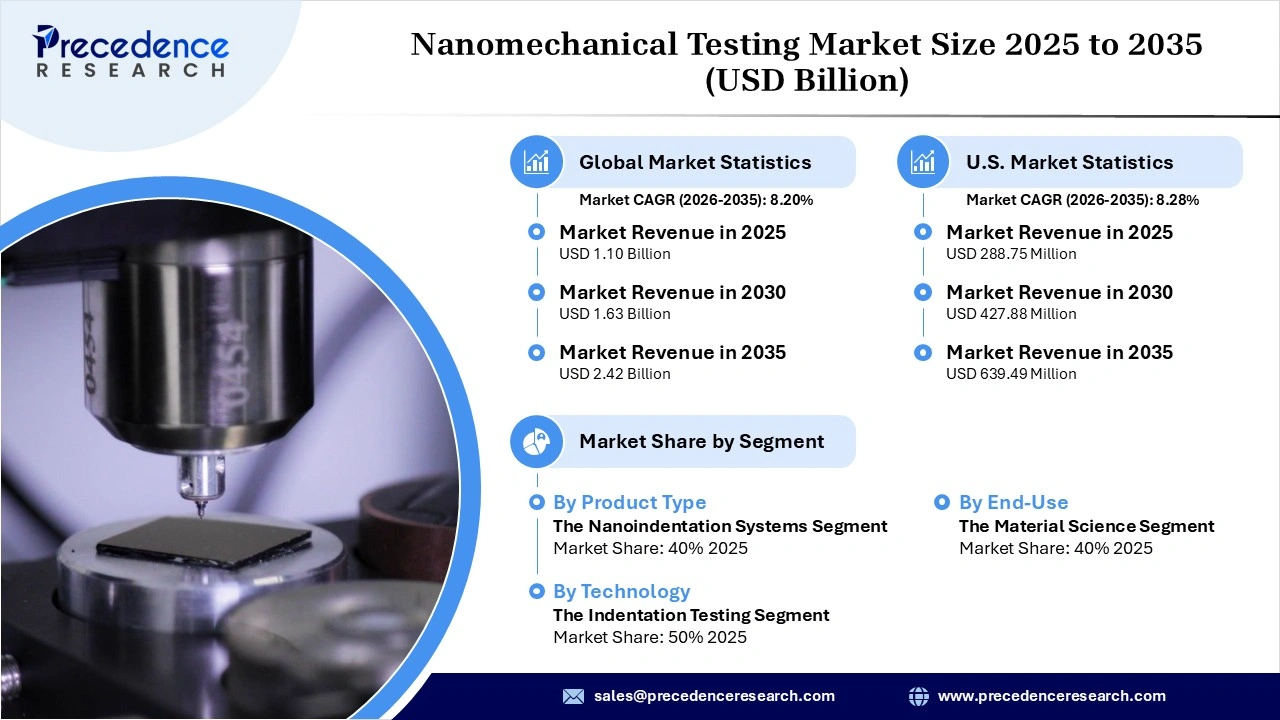
The global nanomechanical testing market revenue surpassed USD 1.10 billion in 2025 and is predicted to attain around USD 2.42 billion by 2035, growing at a CAGR of 8.20%. The market is gaining momentum due to the rising demand for precise nanoscale material characterization driven by advancements in electronics, healthcare, and advanced manufacturing industries.
Market at a Glance
The market comprises advanced tools and techniques such as nanoindentation, nano scratch testing, and microscopy-integrated systems used to analyze mechanical properties like hardness, elasticity, and fracture resistance at the nanoscale. It also includes software and services supporting applications across semiconductors, coatings, biomaterials, and advanced manufacturing, where atomic-level precision is critical for performance.
The nanomechanical testing market is a broad and diverse field supporting industries such as semiconductors, thin films, biomaterials, and high-performance coatings as they operate at the limits of material performance. It includes standalone instruments, integrated systems, analytical software, and specialized testing services used for both industrial validation and advanced research. As materials become increasingly complex and miniaturized, the market bridges laboratory precision with real-world manufacturing needs.
What Drives the Nanomechanical Testing Market?
Technological Advancements in Testing Systems
Integration of AI, automation, and high-throughput systems is improving the speed, accuracy, and consistency of nanomechanical testing. These technologies reduce human error and enable predictive insights, making testing more efficient and widely adoptable across research and industrial applications.
The introduction of high-performance systems such as Bruker Corporation’s Hysitron TI 990 has significantly increased testing throughput, effectively doubling efficiency and expanding wafer-scale analysis capabilities. This advancement improves productivity in semiconductor and polymer research, where faster access to high-quality data plays a critical role in accelerating technology development and adoption.
Miniaturization of electronics and semiconductors
The rapid shift toward smaller and more complex electronic components is a major driver of the nanomechanical testing market. As device dimensions shrink, traditional testing methods become insufficient, increasing the need for precise nanoscale measurement of properties like hardness, adhesion, and deformation.
Growing demand for advanced and high-performance materials
Industries such as aerospace, automotive, and biomedical engineering are increasingly using advanced materials that require strict performance validation. Nanomechanical testing helps evaluate the mechanical strength, durability, and reliability of these materials under real-world conditions.
Market Segmentation Overview
By Product Type
The nanoindentation systems segment held a 40% share of the nanomechanical testing market in 2025. This is mainly due to their exceptional accuracy in measuring mechanical properties at the nanometer scale. These systems play a key role in advanced materials research. Even minute differences in hardness or elasticity can significantly affect performance outcomes across coatings, thin films, and microstructured materials.
The microhardness testers segment held the second-largest market share of 35% in 2025, as these testers are widely used in material science and semiconductor sectors for examination of surface hardness and durability. While they work at slightly larger-scale measurements than nanoindentation systems, they still offer reliable insights for quality control and routine material validation.
By Technology
The indentation testing segment held a major revenue share of 50% in 2025, as this is a key method for evaluating hardness, stiffness, and creep behavior at nanoscale dimensions, where small deformations may get overlooked by conventional mechanical testing. It provides solid, consistent, and repeatable material performance results.
The tensile testing segment was the second-largest shareholder, holding a 20% share in 2025 because this testing has become increasingly common for analyzing material strength. Tensile testing is important in advanced manufacturing settings where understanding stress-strain relationships is critical as component sizes and complexity continue to decrease.
By End-Use
The material science segment accounted for a major revenue share of 40% in the market in 2025, driven by the need for precise measurement of mechanical properties in advanced materials research. The growing development of nanomaterials, composites, and coatings requires detailed characterization to ensure reliable performance at increasingly smaller scales.
The semiconductors and electronics segment is the second-largest shareholder, holding a 20% market share in 2025, as nanoscale mechanical stability directly impacts device efficiency, durability, and functional reliability. Nanomechanical testing is widely used for both quality assurance and performance evaluation of electronic components.
Regional Insights
North America dominated the global nanomechanical testing market with a major share of 35% in 2025 due to the strong demand for advanced testing from core industries such as materials science, aerospace, automotive, and semiconductors that require high-precision nanoscale analysis. The U.S. leads the region with its advanced R&D ecosystem and strong semiconductor manufacturing capabilities, while Canada contributes through innovative academic research and material science advancements. Overall, the region reflects deep integration of nanomechanical testing into both industrial production and quality validation processes.
Asia Pacific held a market share of 30% in 2025 and is expected to grow at the fastest CAGR of 9.2% during the forecast period, driven by rapid industrial expansion and strong investments in high-tech manufacturing. China is advancing semiconductor and materials production, while Japan continues to lead in precision engineering. South Korea is strengthening its chip fabrication capabilities, and India is expanding its research and manufacturing base. The region’s growth is further supported by increasing adoption of nanoindentation technologies and rising demand for nanoscale material validation across electronics and automotive industries.
Nanomechanical Testing Market Coverage
| Report Attribute | Key Statistics |
| Market Revenue in 2025 | USD 1.10 Billion |
| Market Revenue by 2035 | USD 2.42 Billion |
| CAGR from 2026 to 2035 | 8.20% |
| Quantitative Units | Revenue in USD million/billion, Volume in units |
| Largest Market | North America |
| Base Year | 2025 |
| Regions Covered | North America, Europe, Asia-Pacific, Latin America, and the Middle East & Africa |
Top Companies in the Nanomechanical Testing Market
Companies such as Anton Paar GmbH and Shimadzu Corporation focus on precision instrumentation with established legacy expertise, while Keysight Technologies and KLA Corporation integrate nanomechanical capabilities into semiconductor manufacturing workflows. The legacy Hysitron portfolio under Bruker Corporation remains central to high-end nanoindentation systems, alongside contributions from Oxford Instruments and CSEM SA, which bridge research and industrial applications. Additionally, firms like Instron, MTS Systems Corporation, and ZwickRoell are extending traditional mechanical testing expertise into the nanoscale domain.
Segments Covered in the Report
By Product Type
- Microhardness Testers
- Nanoindentation Systems
- Atomic Force Microscopes (AFM)
- Scratch Testers
- Other Nanomechanical Testing Equipment
By Technology
- Indentation Testing
- Friction Testing
- Scratch Testing
- Tensile Testing
- Others
By End-Use
- Material Science
- Semiconductors & Electronics
- Automotive
- Aerospace
- Healthcare & Biotechnology
- Others
By Region
- North America
- Latin America
- Europe
- Asia-pacific
- Middle and East Africa
Get this report to explore global market size, share, CAGR, and trends, featuring detailed segmental analysis and an insightful competitive landscape overview @ https://www.precedenceresearch.com/sample/8305
You can place an order or ask any questions, please feel free to contact us at sales@precedenceresearch.com |+1 804 441 9344