



Nanomechanical Testing Market Size, Companies, Share, Patient Volume, Treatment Adoption Rates, Pricing Analysis, Regulatory Landscape, Competitive Positioning, and Demand Forecast
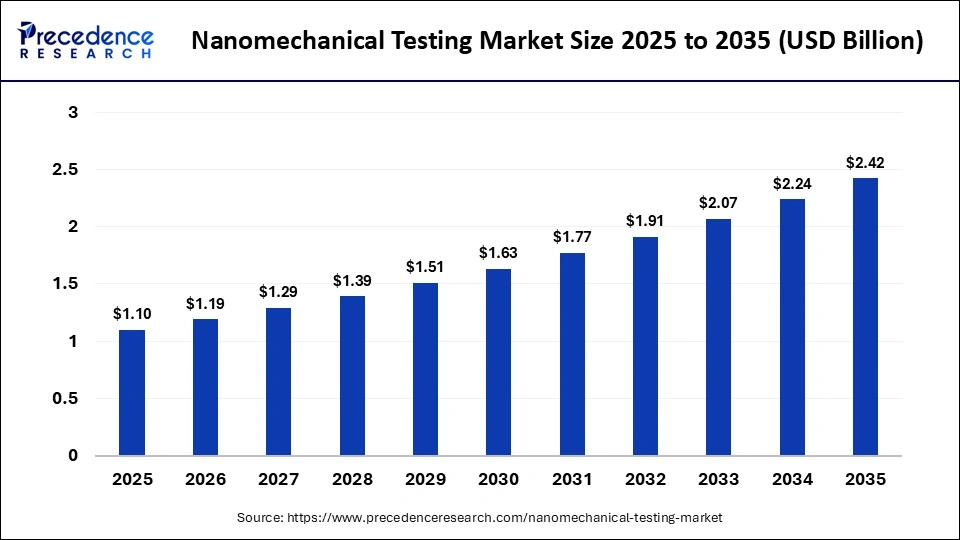
Deepa Pandey, a Healthcare Industry Expert, highlights that the nanomechanical testing market has reached USD 1.19 billion in 2026 and is on track to reach USD 2.42 billion by 2035, advancing at a CAGR of 8.20%. Key nanomechanical testing market companies shaping the market include Anton Paar GmbH, Hysitron (now part of Bruker Corporation), Keysight Technologies Inc., Oxford Instruments PLC, while major growth segments span By Product Type, By Technology, By End-Use.
Source: https://www.precedenceresearch.com/nanomechanical-testing-market
 Get a Sample
 Table Of Content


What is the Nanomechanical Testing Market Size in 2026?
The global nanomechanical testing market size accounted for USD 1.10 billion in 2025 and is predicted to increase from USD 1.19 billion in 2026 to approximately USD 2.42 billion by 2035, expanding at a CAGR of 8.20% from 2026 to 2035. The nanomechanical testing market is driven by rising demand for precise nanoscale material characterization across advanced industries.
Key Takeaways
- North America dominated the global nanomechanical testing market with a share of 35% in 2025.
- The Asia Pacific is expected to grow at the fastest CAGR of 9.2% during the forecast period.
- By product type, the nanoindentation systems segment held a dominant position in the market, accounting for 40% of the market share in 2025.
- By product type, the microhardness testers segment is the second-largest shareholder and is expected to grow at a 7.5% CAGR between 2026 and 2035.
- By technology, the indentation testing segment accounted for a 50% share of the market in 2025.
- By technology, the tensile testing segment is the second-largest shareholder and is expected to grow at a 8% CAGR between 2026 and 2035.
- By end-use, the material science segment led the global market, accounting for 40% share in 2025.
- By end-use, the semiconductors & electronics segment is the second-largest shareholder and is expected to grow at a 8.5% CAGR between 2026 and 2035.
Market Overview
Nanomechanical testing is a specialized method for measuring the mechanical properties of materials at the nanoscale by measuring forces and deflections. The nanomechanical testing market is expanding at a steady growth rate as the importance of characterizing materials with high precision in semiconductors, advanced materials, coatings, and manufacturing industries is increasing. Test capabilities are being further improved due to rapid technological development, such as the development of better instrumentation and integration with automation to allow testing in complex and environmentally challenging conditions. An increase in the investment in research and development, especially in material science and biomedical engineering, also contributes to the growth of the market.
How is AI Integration Impacting the Nanomechanical Testing Market?
The nanomechanical testing market is being transformed by the integration of artificial intelligence, enabling the analysis and interpretation of material properties at the nanoscale. AI-assisted predictive modeling aids in projecting material behavior in various circumstances, eliminating the necessity of a large number of physical tests. AI-guided automation also simplifies processes and reduces the number of people in a company, as well as increases consistency during tests. In addition, AI implementation aids the adaptive testing system, which can dynamically tune parameters according to the real-time feedback in order to achieve maximum effectiveness of testing.
Nanomechanical Testing Market Trends
- Increasing efficiency and minimizing human error through automation, AI-based testing systems, and high-throughput analysis are driving adoption, particularly in large-scale industrial manufacturing and research environments.
- The need for high-quality nanoscale testing solutions is increasing, driven by the miniaturization of electronic devices. Nanomechanical testing improves quality assurance and enhances performance in semiconductor and microelectronics manufacturing.
- The growing application of nanomechanical testing in biological and life sciences is enhancing the understanding of biomaterials, tissues, and cellular mechanics, thereby advancing medical research methodologies and improving healthcare outcomes.
Market Scope
| Report Coverage | Details |
| Market Size in 2025 | USD 1.10 Billion |
| Market Size in 2026 | USD 1.19 Billion |
| Market Size by 2035 | USD 2.42 Billion |
| Market Growth Rate from 2026 to 2035 | CAGR of 8.20% |
| Dominating Region | North America |
| Fastest Growing Region | Asia Pacific |
| Base Year | 2025 |
| Forecast Period | 2026 to 2035 |
| Segments Covered | Product Type, Technology, End-Use, and Region |
| Regions Covered | North America, Europe, Asia-Pacific, Latin America, and Middle East & Africa |
Market Dynamics
Drivers
Rising Miniaturization
The growing trend of miniaturization across various industries is driving the growth of the nanomechanical testing market. Sectors such as semiconductors, consumer electronics, and biomedical engineering are highly dependent on miniaturized components that must meet high standards of performance and durability. Nanomechanical tests allow manufacturers to precisely quantify attributes, including hardness, adhesion, and deformation at very small size scales that guarantee the quality and durability of a product. The necessity to provide accurate nanoscale tests is increasing with the blistering development of technologies such as microelectronics and wearable medical devices.
Restraint
High Cost and Complexity of Equipment
Nanomechanical testing equipment is expensive and complicated, which is a major hindrance to market expansion. It requires substantial investments to acquire advanced metrology equipment, which makes it less accessible to small and medium-sized enterprises and underfunded research labs. Additionally, ongoing expenses for maintenance, calibration, and software updates, along with the need for skilled professionals to operate and interpret results, further limit widespread adoption.
Opportunity
Expanding Applications in Biomedical and Healthcare Sectors
Expanding applications of nanomechanical testing in the biomedical and healthcare sectors create immense opportunities in the nanomechanical testing market. There is a growing need to understand the mechanical behavior of advanced biomaterials and medical devices under physiological conditions. Nanomechanical testing plays a great role in the study of the performance of implants, stents, prosthetics, and tissue engineering scaffolds in such a way that they replicate the mechanical behaviors of human tissues. Also, the rising chronic disease prevalence and an aging global population further drive demand for advanced medical technologies and precise testing solutions.
Segment Insights
Product Type Insights
Nanomechanical Testing Market Share, By Product Type, 2025-2035 (%)
| Product Type | 2025 | 2035 | CAGR (%) |
| Microhardness Testers | 35.00% | 33.00% | 7.50% |
| Nanoindentation Systems | 40.00% | 42.00% | 9.00% |
| Atomic Force Microscopes (AFM) | 10.00% | 9.50% | 8.00% |
| Scratch Testers | 10.00% | 10.50% | 8.50% |
| Other Nanomechanical Testing Equipment | 5.00% | 5.00% | 7.00% |
The Nanoindentation Systems Segment Held a 40% Market Share in 2025
The nanoindentation systems segment dominated the nanomechanical testing market while holding a major share of 40% in 2025 due to their ability to determine mechanical properties, such as hardness, elastic modulus, and creep behavior, at the nanometer scale. These systems are applied extensively in the field of advanced materials research and thin films, as well as semiconductor applications, where accuracy is of utmost importance. Ongoing technological advances have further enhanced their capabilities and performance, contributing to segmental dominance.
The microhardness testers segment held a 35% share of the market in 2025 and is expected to grow at a CAGR of 7.5% during the projection period. This is due to their widespread application in industries such as material science, metallurgy, and semiconductors, in which they are used to measure the hardness of the surface of the product. These testers are valued for their cheapness, convenience, and the ability to test small-scale material properties with acceptable accuracy. Their implementation is also boosted by the fact that the industrial requirement to possess quality control and material validation is increasing.
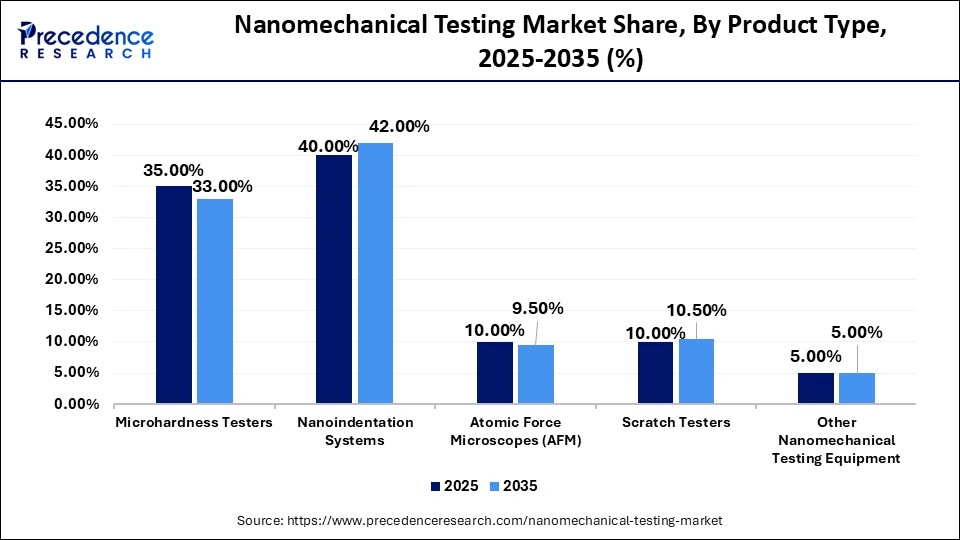
The atomic force microscopes (AFM) segment held a 10% market share in 2025 and is expected to grow at a CAGR of 8% during the forecast period. This is because of their ability to characterize surfaces with high resolution at the nanoscale, which makes them indispensable in the field of materials science, nanotechnology, and biomedical studies. AFMs allow the topography, mechanical properties, and intermolecular forces to be analyzed in a detailed manner.
The scratch testers segment held a 10% share of the market in 2025 and is expected to grow at a significant CAGR of 8.5% in the upcoming period, driven by their key role in assessing the strength of adhesion, wear, and coating life. Scratch testers find application in the automotive, aerospace, and electronics industries, where they are crucial to ensure surface performance and enhance product life. Their effectiveness in industrial quality control processes is also improving through improvements in technology, testing precision, and analysis of data.
Technology Insights
Nanomechanical Testing Market Share, By Technology, 2025-2035 (%)
| Technology | 2025 | 2035 | CAGR (%) |
| Indentation Testing | 50.00% | 52.00% | 8.50% |
| Friction Testing | 15.00% | 14.50% | 7.50% |
| Scratch Testing | 10.00% | 10.50% | 8.00% |
| Tensile Testing | 20.00% | 20.00% | 8.00% |
| Others | 5.00% | 3.00% | 6.50% |
The Indentation Testing Segment Led the Market With a 50% Share in 2025
The indentation testing segment registered its dominance in the nanomechanical testing market with a share of 50% in 2025. This is mainly due to its essential role in testing vital mechanical properties, such as hardness, stiffness, and creep behavior on the nanoscale. It is commonly used in sectors like semiconductors, coatings, and advanced materials due to its precision and consistency. Its ability to achieve refined resolution and automation makes it popular, and continued advancement in this technology further drives segmental growth.
The tensile testing segment was the second-largest shareholder in 2025, holding a 20% share, and is expected to grow at a significant CAGR of 8% during the projection period. This is mainly due to its widespread use to measure the mechanical strength and behavior of deformation of materials on the micro- and nanoscale. It is especially becoming popular in high-tech manufacturing industries, such as aerospace, automotive, and electronics, where the reliability of the material is of vital importance. Tensile testing offers meaningful insights into the relationships of stress and strain, fracture, and elasticity.
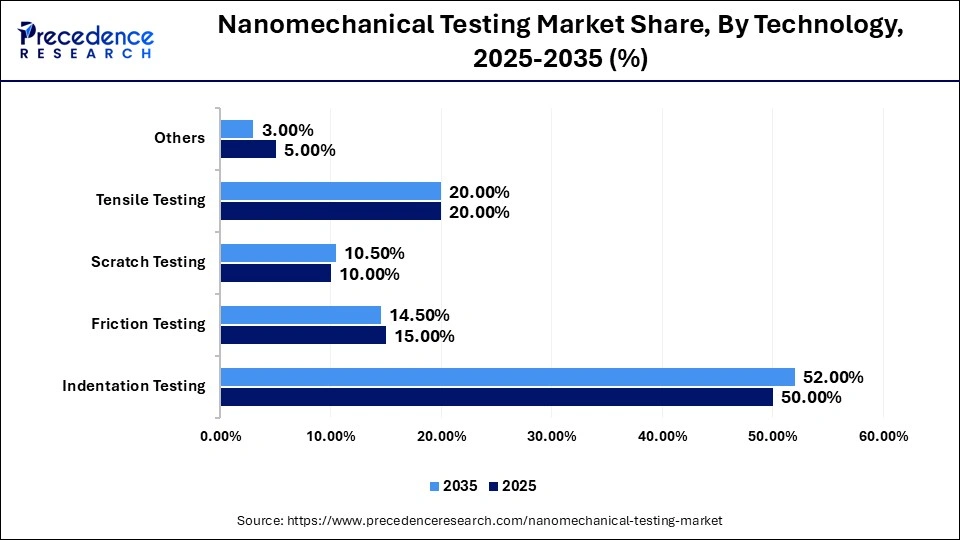
The friction testing segment held a 15% share of the market in 2025 and is expected to grow at a CAGR of 7.5% during the forecast period due to the growing need to measure wear resistance, lubrication efficiency, and the interaction of materials in the surface. Friction testing is an important part of the automotive, manufacturing, and electronics industries where the reduction of wear and enhancement of efficiency are needed. Friction testing is in high demand with increased emphasis on energy efficiency and durability in manufactured items.
The scratch testing segment held a 10% market share in 2025 and is expected to grow at a CAGR of 8% during the projection period, driven by its importance in measuring the adhesion of the coating, its resistance against mechanical damage, and its durability. In the automotive, aerospace, and electronic sectors, a scratch test is a practice that has been widely used, and the protective coating of a product is of significant concern in both product performance and life cycle. The adoption is also boosted through the rising demand for high-performance coatings and surface treatments.
End-Use Insights
The Material Science Segment Held a 40% Share of the Market in 2025
The material science segment dominated the nanomechanical testing market by holding a major share of 40% in 2025 because of the increasing need for precise measurement of mechanical properties in high-tech materials research. Nanomechanical testing finds a wide application in identifying the properties of nanoscale hardness, elasticity, and deformation behavior, which are greatly important in research. Nanomechanical testing becomes particularly important in the production of new materials like nanocomposites, thin films, and high-performance alloys.
The semiconductors & electronics segment held the second-largest market share of 20% in 2025 and is expected to grow at a significant CAGR of 8.5% during the projection period. This is mainly due to the growing sophistication and reduced size of electronic components, necessitating exact testing at very small scales. Nanomechanical testing techniques have been widely applied in quality control, failure analysis, and performance evaluation. With the increasing demand for high performance consumer electronics, integrated circuits, and smart devices, there is increased investment in advanced testing technology.
Nanomechanical Testing Market Share, By End-Use, 2025-2035 (%)
| End-Use | 2025 | 2035 | CAGR (%) |
| Material Science | 40.00% | 42.00% | 9.00% |
| Semiconductors & Electronics | 20.00% | 18.00% | 8.50% |
| Automotive | 15.00% | 14.50% | 7.00% |
| Aerospace | 10.00% | 10.50% | 8.00% |
| Healthcare & Biotechnology | 5.00% | 5.50% | 7.00% |
| Others | 10.00% | 10.50% | 6.50% |
The automotive segment held a 15% share of the market in 2025 and is expected to grow at a CAGR of 7% during the projection period, owing to increasing utilization of advanced materials and finishes in automobiles. Nanomechanical testing is used in testing surface wear, adhesion of surfaces, and material durability, which assures high performance and safety standards. The auto manufacturers have shown a rising interest in performing at a higher efficiency level, reducing emissions, and extending the products' life, which has led to an increased demand for new testing equipment.
The aerospace segment held a 10% market share in 2025 and is expected to grow at a CAGR of 8% during the forecast period, driven by the higher demand for materials with high performance fulfilling the extended environmental conditions such as high pressure, temperature, and mechanical stress. Nanomechanical testing proves very beneficial in the strength, durability, and reliability of aerospace materials like composites and coatings. The increasing concern of fuel economy and safety is encouraging the use of lightweight and developing materials.
Regional Insights
North America Nanomechanical Testing Market Size and Growth 2026 to 2035
The North America nanomechanical testing market size is estimated at USD 385.00 million in 2025 and is projected to reach approximately USD 847.00 million by 2035, with a 8.20% CAGR from 2026 to 2035.
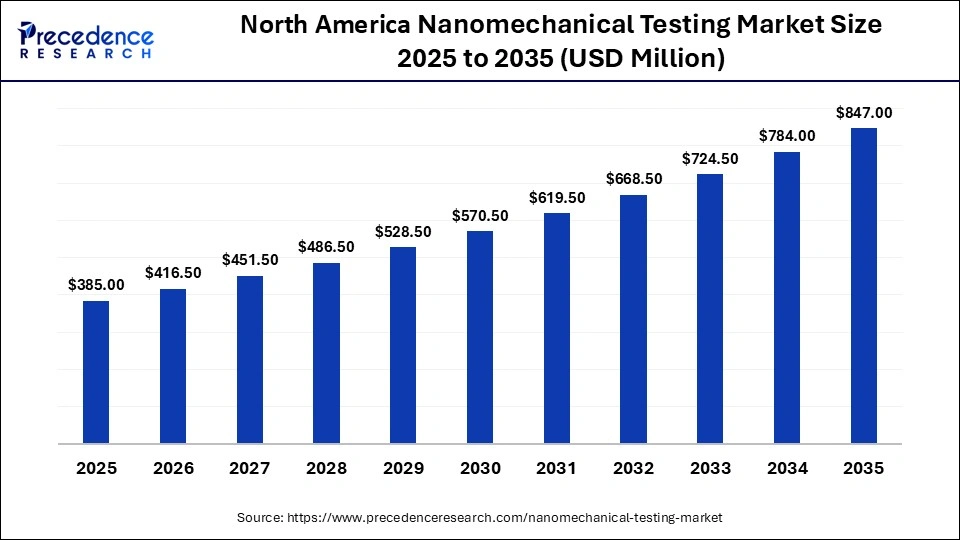
North America Led the Global Nanomechanical Testing Market in 2025
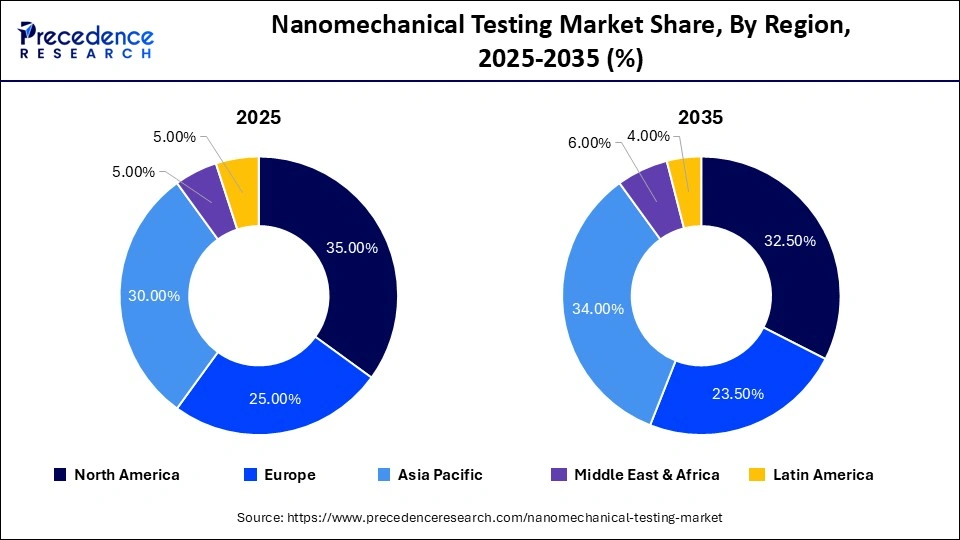
North America dominated the global nanomechanical testing market by holding a 35% share in 2025, driven by its well-established industrial and research infrastructure, which supports advanced material characterization and high adoption of cutting-edge testing technologies. The region also benefits from substantial government funding, strong collaboration between academic institutions and industry, and continuous innovation driven by leading universities and research laboratories. Additionally, ongoing investments in R&D and industrial modernization initiatives further strengthen its leadership in the global market.
U.S. Nanomechanical Testing Market Size and Growth 2026 to 2035
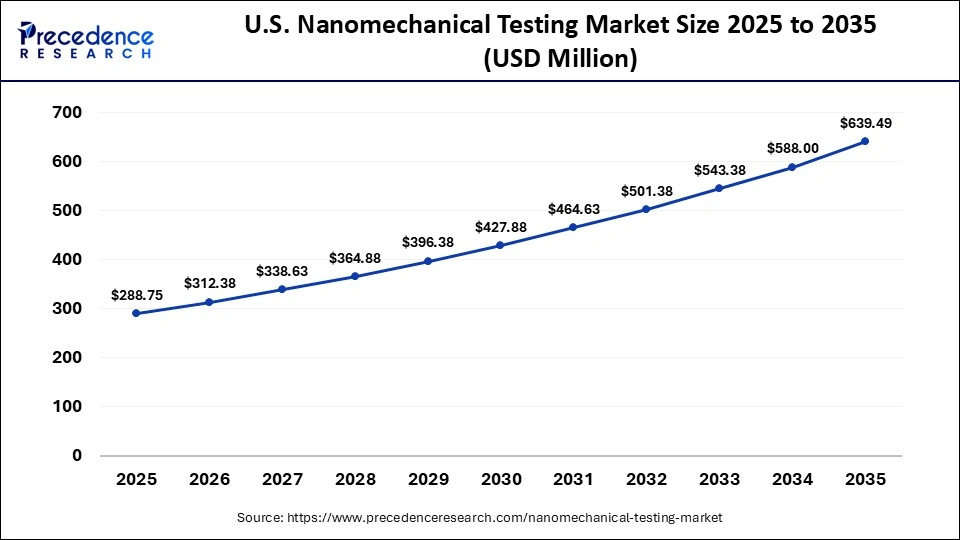
The U.S. nanomechanical testing market size is calculated at USD 288.75 million in 2025 and is expected to reach nearly USD 639.49 million in 2035, accelerating at a strong CAGR of 8.28% between 2026 and 2035.
U.S. Market Analysis
The U.S. is a major contributor to the North American nanomechanical testing market because of its well-developed technological foundation and the presence of high-tech industries. Its well-established semiconductor sector heavily relies on nanomechanical testing to evaluate the mechanical properties of microchips, thin films, and electronic components, while aerospace and automotive industries also drive demand to ensure material reliability, performance, and safety. Additionally, significant investments in nanoscience and nanoengineering R&D are accelerating technological advancements and market growth.
What Makes Asia Pacific the Fastest-Growing Region in the Nanomechanical Testing Market?
Asia Pacific held a 30% share of the nanomechanical testing market in 2025 and is expected to grow at the fastest CAGR of 9.2% during the projection period, driven by rapid industrial expansion and rising investments in high-tech manufacturing. Strong contributions from countries such as China, Japan, South Korea, and India, along with increasing focus on precision engineering and quality control, are boosting demand for nanomechanical testing systems. Additionally, cost-effective manufacturing capabilities and a skilled workforce are positioning the region as a global hub for electronics and semiconductor production.
Japan Market Analysis
The market in Japan is rapidly growing, supported by its strong manufacturing base across electronics, automotive engineering, and materials science. Companies widely use these testing systems to evaluate the mechanical properties, durability, and reliability of advanced materials used in microelectronics, vehicles, and industrial applications. The market growth is further driven by increasing R&D investments, government support for innovation-led industries, and Japan's strong focus on robotics, miniaturized devices, and next-generation materials, all of which require precise nanoscale testing technologies.
How is the Opportunistic Rise of Europe in the Nanomechanical Testing Market?
Europe held a 25% share of the nanomechanical testing market in 2025 and is expected to grow at a notable CAGR of 6.8% during the projection period, owing to the need to have advanced manufacturing technologies, precision engineering, and the development of high-performance materials. Key economies such as Germany, France, and the UK play a major role in market growth due to their established automotive, aerospace, and industrial manufacturing sectors. Additionally, Europe's strong focus on research and innovation, supported by government funding and collaboration between academia and industry, continues to foster technological advancement and market expansion.
UK Market Analysis
The UK plays a significant role in the European nanomechanical testing market, backed by its strong research ecosystem and advanced industrial base. The country's well-established aerospace, automotive, defense, and materials science sectors rely heavily on precise nanoscale testing to evaluate material quality and ensure performance standards. Additionally, UK universities and research institutions are at the forefront of nanotechnology research, continuously developing new testing methodologies, while government funding and strategic initiatives further strengthen advanced manufacturing and engineering capabilities.
Nanomechanical Testing Market Companies
- Anton Paar GmbH
- Hysitron (now part of Bruker Corporation)
- Keysight Technologies Inc.
- Oxford Instruments PLC
- KLA Corporation
- Instron (part of ITW)
- MTS Systems Corporation
- ZwickRoell GmbH & Co. KG
- Shimadzu Corporation
- CSEM SA
- Nanomechanics Inc.
- Buehler, a division of ITW
- LUM GmbH
- Elionix Inc.
- Micro Materials Ltd.
Recent Developments
- In January 2026, the National Nanotechnology Center (NANOTEC), as part of NSTDA in Thailand, along with SPIKE ARCHitectonics Co., Ltd. and Furutaka Electronics Co., Ltd. of Japan, unveiled the Microspike Technology Pfavi at the nano tech 2026 in Tokyo. The project emphasizes the development of microspike and nanotechnology solutions, facilitating foreign networking and development in the nanomechanical and nanotechnology ecosystem.(Source: https://www.nanotec.or.th)
- In July 2024, FemtoTools AG was acquired by Oxford Instruments plc to build its high-precision nanoindentation and micro-force technologies. The acquisition increases the capabilities of the company in nanomechanical testing by incorporating the latest sensing and characterization instruments in research and industrial functions.(Source: https://www.oxinst.com)
Segments Covered in the Report
By Product Type
- Microhardness Testers
- Nanoindentation Systems
- Atomic Force Microscopes (AFM)
- Scratch Testers
- Other Nanomechanical Testing Equipment
By Technology
- Indentation Testing
- Friction Testing
- Scratch Testing
- Tensile Testing
- Others
By End-Use
- Material Science
- Semiconductors & Electronics
- Automotive
- Aerospace
- Healthcare & Biotechnology
- Others
By Region
- North America
- Latin America
- Europe
- Asia-pacific
- Middle and East Africa
For inquiries regarding discounts, bulk purchases, or customization requests, please contact us at sales@precedenceresearch.com
Frequently Asked Questions





Ask For Sample
No cookie-cutter, only authentic analysis – take the 1st step to become a Precedence Research client
 Get a Sample
.webp)



 sales@precedenceresearch.com
 Schedule a Meeting
