



Non-Hodgkins Lymphoma Market Revenue to Attain USD 26.22 Bn by 2035
Published: 18 May 2026
Author: Precedence Research



Non-Hodgkin's Lymphoma Market Revenue and Trends 2026 to 2035
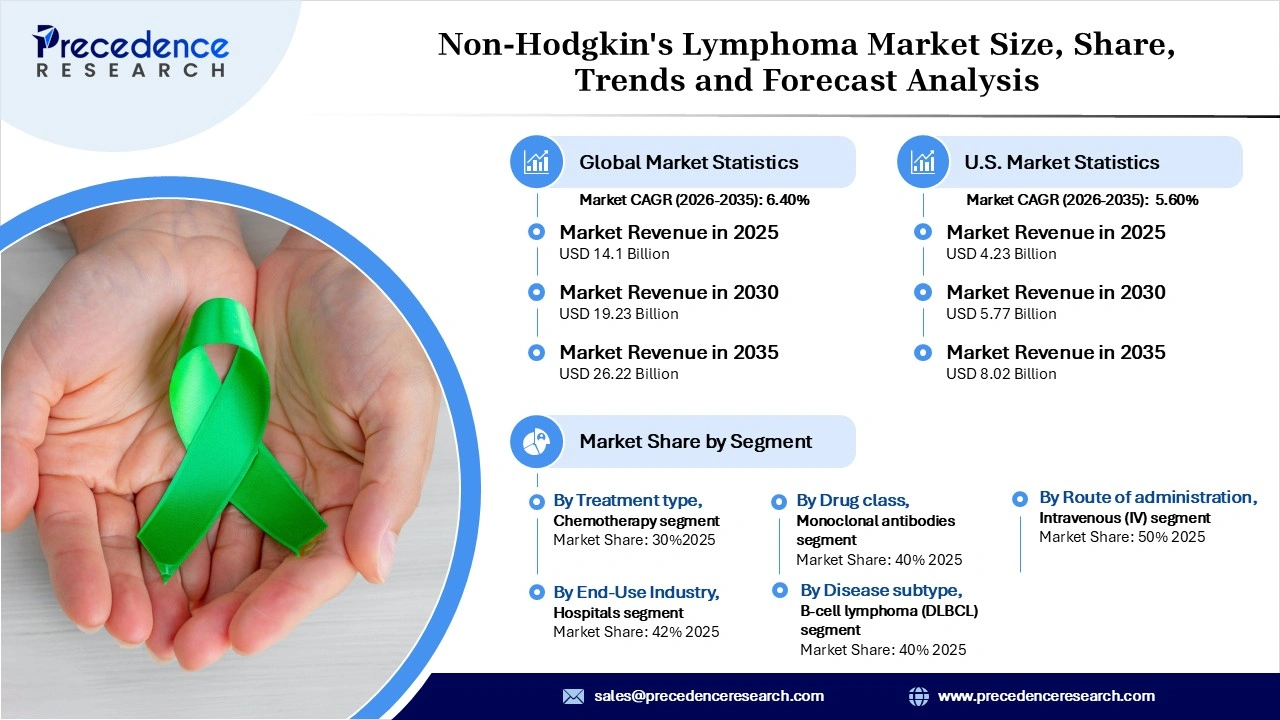
The global non-Hodgkin’s lymphoma market revenue surpassed USD 14.10 billion in 2025 and is predicted to attain around USD 26.22 billion by 2035, growing at a CAGR of 6.40%. The market is growing steadily, due to greater occurrences of lymphoma, prolonged survival of patients, and rapid utilization of targeted immunotherapies, generating demand for new and sustainable cancer therapeutics.
Market at a Glance
The non-Hodgkin’s lymphoma market consists of a worldwide system of products and treatments tailored to the treatment of cancer, including tumors arising from B-cells, T-cells, and natural killer cells. That includes chemotherapy therapies and immunotherapy modalities such as CAR T-cell therapy, but also includes imaging, diagnosis by laboratory tests, and supportive care services. The rise in this industry resulted from increased cancer incidence rates, enhanced diagnostics, and the ongoing progress in precision oncology.
The market is inclusive of the spectrum from the point of early diagnosis up to the time of relapse. This consists of branded products and biosimilars; cell-based therapies; companion diagnostics; hospital treatment facilities; and follow-up care. It also focuses on potential prospects in emerging markets, proactive clinical R&D activities, and next-generation immunotherapeutic regimens aimed at increasing longevity and minimizing adverse outcomes.
Market Forecast for the Non-Hodgkin’s Lymphoma Market
- CAR-T Therapy is Driving the Market: Gilead’s Kite announced that Yescarta received an FDA label update in 2026 for relapsed/refractory primary central nervous system lymphoma, widening use in an aggressive NHL subtype. Every label expansion deepens the commercial runway for cell therapy makers.
- Rising Disease Prevalence in an Aging Population : The American Cancer Society notes that more than half of NHL patients are diagnosed at age 65 or older. As populations age across the U.S., Europe, Japan, and China, the addressable treatment population is expected to widen steadily.
Rising Demand in Non-Hodgkin Lymphoma Treatment Market
- Incyte’s late-stage trial enrolled about 900 newly diagnosed high-risk DLBCL patients, showing how large oncology studies are fueling future treatment expansion in non-Hodgkin lymphoma.
- The therapy met its primary endpoint of progression-free survival, meaning patients lived longer without disease worsening versus standard treatment alone. That is the kind of data hospitals and payers tend to notice.
- Diffuse large B-cell lymphoma (DLBCL) represents nearly 40% of adult NHL cases worldwide, making it the commercial heavyweight within the lymphoma space.
- Around 24,000 people in the U.S. are diagnosed with DLBCL each year, ensuring a steady annual treatment population.
- Analysts estimate the regimen could capture 15%-20% of the first-line DLBCL market, translating into $500 million to $1 billion in potential sales.
- Incyte plans to seek expanded U.S. approval in 2026, signaling more frontline competition and broader therapy access in the NHL market.
Market Segmentation Overview
- By treatment type, the chemotherapy segment dominated the non-Hodgkin’s lymphoma market with a 30% market share in 2025, as a result of its established role in treating different lymphoma subtypes. So, this has remained largely accessible to most people at an economic disadvantage, while combination therapies have become even more important as both first and salvage treatments for cancer in hospitals and cancer care facilities.
- By treatment type, the immunotherapy segment is expected to grow at the fastest CAGR of 9.3% in the market between 2026 and 2035, due to the rising use of immune checkpoint inhibitors and increasing adoption of CAR-T cell therapies for advanced stages. Expanding research funding and a crowded clinical trial pipeline are likely to further accelerate commercial momentum.
- By drug class, the monoclonal antibodies segment held a major revenue share of 40% in the market in 2025, as they had become central to first-line lymphoma treatment regimens. Such widespread familiarity among physicians of these kinds of treatments, and the continuing introduction of new monoclonal antibody products, have resulted in their increasingly effective application together with other therapies in important healthcare markets.
- By drug class, the CAR-T cell therapy segment is steadily growing with a CAGR of 10.5% in the market between 2026 and 2035, as demand rises for relapsed or refractory lymphoma treatment. Increasing regulatory approvals of CAR-T therapies and high potential for long-term remission in patients are likely to position this segment as a premium-growth category.
- By route of administration, the intravenous (IV) segment accounted for a considerable revenue share of 50% in the non-Hodgkin’s lymphoma market in 2025, because it had remained the standard delivery method for most lymphoma therapies. Monoclonal antibodies and chemotherapy agents were routinely administered through IV channels, supported by strong availability across hospitals and oncology clinics.
- By route of administration, the subcutaneous (SC) segment is expected to expand rapidly in the market with a CAGR of 8% in the coming years, due to easier at-home administration and greater convenience for long-term therapy patients. Rising interest in shorter clinic visits and growing availability of SC formulations for monoclonal antibodies are likely to fuel demand.
- By end-use industry, the hospitals segment held a major revenue share of 42% in the market in 2025, because of an increasing demand for specialized oncology facilities necessary for advanced lymphoma treatment. The growing prevalence of non-Hodgkin's lymphoma and cancer treatments, targeted therapy use, and CAR-T treatment administration have strengthened their leading market share.
- By end-use industry, the research institutes segment is steadily growing with a CAGR of 9% in the market between 2026 and 2035, due to increasing research on novel lymphoma therapies. Rising funding for disease-specific clinical trials and increasing partnerships with pharmaceutical companies are likely to make this segment a future innovation hub.
- By disease subtype, the diffuse large B-cell lymphoma (DLBCL) segment accounted for a considerable revenue share of 40% in the market in 2025, as it had remained the most common form of non-Hodgkin lymphoma. Strong treatment demand, strong clinical trials, research investment, and a growing number of targeted therapy approvals for DLBCL have kept this subtype commercially significant.
- By disease subtype, the primary mediastinal B-cell lymphoma (PMBCL) segment is expected to grow at the fastest CAGR of 8.5% in the market between 2026 and 2035, as combination therapy regimens become more common in clinical practice. Rising research investment in rare lymphoma subtypes and the growing demand for personalized treatment strategies are likely to reshape care pathways and improve outcomes in this niche segment.
Regional Analysis
North America held a major revenue share of 40% in the non-Hodgkin’s lymphoma market in 2025, due to its well-established healthcare infrastructure, strong reimbursement mechanisms, and wide access to advanced oncology treatments. Many of the region’s clinical trials and research initiatives have moved CAR-T therapies and immunotherapies to market quickly. The growing incidence of non-Hodgkin lymphoma has contributed to the demand for treatments. Fast adoption of innovations and the establishment of specialized cancer centers assisted the United States in dominating this growth, and Canada advanced its own progress through universal healthcare coverage and expanding networks for hematology treatments.
Asia-Pacific held a market share of 20% in 2025 and is expected to grow at the fastest CAGR of 9.1% in the non-Hodgkin’s lymphoma market during the forecast period, due to rising incidences of non-Hodgkin lymphoma in densely populated countries, driving patient demand. Governments in this region are making substantial investments in healthcare infrastructure as access to advanced cancer therapies continues to improve steadily. Affordable oncology care is also expanding access to treatment beyond major urban areas. China will lead this expansion through comprehensive healthcare development and domestic production of biologics.
Non-Hodgkin's Lymphoma Market Coverage
| Report Attribute | Key Statistics |
| Market Revenue in 2025 | USD 14.10 Billion |
| Market Revenue by 2035 | USD 26.22 Billion |
| CAGR from 2026 to 2035 | 6.40% |
| Quantitative Units | Revenue in USD million/billion, Volume in units |
| Largest Market | North America |
| Base Year | 2025 |
| Regions Covered | North America, Europe, Asia-Pacific, Latin America, and the Middle East & Africa |
Top Companies in the Non-Hodgkin’s Lymphoma Market
Roche remained a major player in the market, supported by its established lymphoma portfolio and continuing progress with bispecific antibodies and diagnostic tools. Both Bristol Myers Squibb and Novartis still mattered because they enjoyed strong capabilities in cell therapy and robust hematology development pipelines. Gilead Sciences, through Kite, solidified its status as a leader in advanced therapy by moving forward in CAR-T technology. Meanwhile, Eli Lilly and Co., along with Merck & Co., diversified into oncology as an area to develop precision medicine and immunotherapy. Amgen, AbbVie, and Pfizer played pivotal roles in shaping competitive dynamics thanks to their biologics and combination therapy know-how and proactivity in licensing.
Segments Covered in the Report
By Treatment Type
- Chemotherapy
- Targeted Therapy
- Immunotherapy
- Radiation Therapy
- Stem Cell Transplant
By Drug Class
- Monoclonal Antibodies
- Kinase Inhibitors
- Immune Checkpoint Inhibitors
- CAR-T Cell Therapy
- Antineoplastic Agents
By Route of Administration
- Intravenous (IV)
- Subcutaneous (SC)
- Oral
By End-Use
- Hospitals
- Oncology Clinics
- Research Institutes
- Homecare
By Disease Subtype
- Diffuse Large B-cell Lymphoma (DLBCL)
- Follicular Lymphoma (FL)
- Mantle Cell Lymphoma (MCL)
- Primary Mediastinal B-cell Lymphoma (PMBCL)
- Others
By Region
- North America
- Europe
- Asia-Pacific
- Latin America
- Middle East & Africa
Get this report to explore global market size, share, CAGR, and trends, featuring detailed segmental analysis and an insightful competitive landscape overview @ https://www.precedenceresearch.com/sample/8414
You can place an order or ask any questions. Please feel free to contact us at sales@precedenceresearch.com |+1 804 441 9344