



Recarbonization in Chemicals Market Revenue to Attain USD 50.66 Bn by 2035
Published: 04 May 2026
Author: Precedence Research



Recarbonization in Chemicals Market Revenue and Trends 2026 to 2035
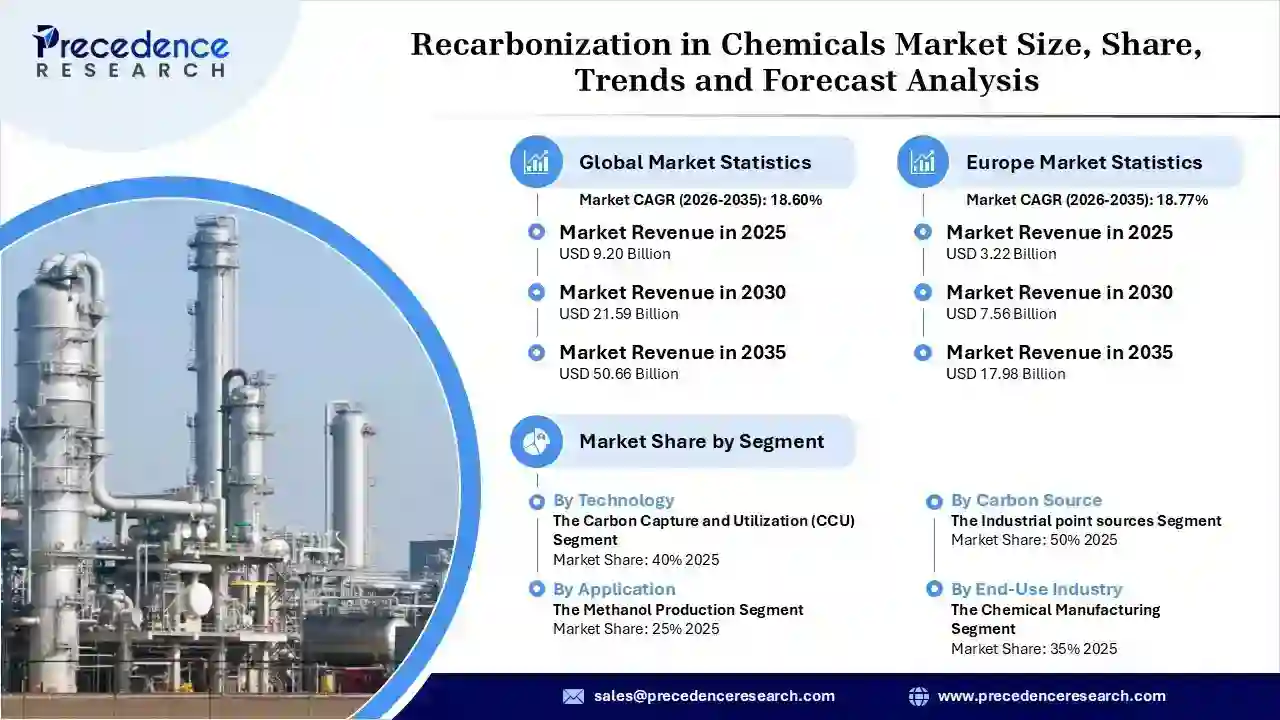
The global recarbonization in chemicals market revenue was valued at USD 9.20 billion in 2025 and is expected to attain around USD 50.66 billion by 2035, growing at a CAGR of 18.60% during forecast period. The market is driven by the stringent regulatory norms aimed at lowering the level of carbon emissions along the entire chemical production value chain, rising emphasis on carbon capture and utilization techniques for production of chemicals.
Market Overview
The recarbonization in chemicals market involves recovery of carbon dioxide from industrial emissions or directly from the environment to be used to manufacture chemicals, rather than releasing it into the atmosphere or storing it underground. This market is benefitting from a broad array of innovations, including carbon capture and utilization technology, electrochemical reactions of carbon dioxide to generate carbon monoxide and formic acid, and thermocatalysis.
The recovered carbon is mixed with hydrogen to synthesize methanol, ethanol, olefins, and synthetic natural gas. This market has been adopted in industries which manufacture sustainable aviation fuel, polycarbonate plastics, polyurethane foams, concrete admixtures, and specialty chemicals. The end-users in the market include chemicals and petrochemicals, oil and gas, energy, cement, steel, and agricultural sectors.
What ae the Major Trends Impacting the Market?
- Adoption of Electrolysis and Biological Techniques to Convert CO2 Into Chemicals: There is a swift uptake of electrolytic reduction, whereby CO2 is mixed with water in an electrolysis cell and subjected to electricity to manufacture carbon monoxide, formic acid, and ethylene. The market is also benefitting from the adoption of microbial electrosynthesis, where genetically modified bacteria are employed to absorb CO2 and electricity to create complex products such as butanol, hexanol, and medium chain fatty acids. In 2026, BASF unveiled a steam cracker at the company’s new Verbund site in Zhanjiang, China. It boasts an annual production capacity of 1 MT of ethylene, becoming first cracker worldwide to use 100 percent renewable energy to drive its compressors.
- Implementing CO2-Based Polyols and E-Methanol Production: The recarbonization in chemicals market is experiencing widespread adoption of large-scale production of polyols using captured CO2, which acts as a direct substitute for fossil-derived polyols in polyurethanes that are used in foams, paints, and automobile parts. The market is also benefitting from the development of large-scale e-methanol production that utilizes captured biogenic CO2 together with hydrogen from renewable sources to manufacture sustainable fuels used in marine transport and chemical synthesis. In 2026, Monument Chemical became the first company to manufacture polyols from captured CO2 in the U.S at its factory in Brandenburg, Kentucky. It introduced a new range of product named Poly-CO2 that is 20 to 30 percent lower in global warming potential than traditional polyols.
- Government Support for Carbon Capture and Chemical Recarbonization: Governments across the globe have introduced targeted financial support schemes to assist industrial sectors in deploying carbon capture, utilization, and storage technologies. The emitted carbon dioxide is used to produce commercial products instead of being released into the environment. The financial support schemes include projects related to geologic storage demonstration, monitoring, and utilization applications that involve the production of commercially usable substances. In 2026, the Canadian Government awarded nearly USD 12 million through Natural Resources Canada’s Energy Innovation Program to finance five CCUS projects in Saskatchewan, Ontario, and Quebec involving electrochemical applications for converting CO2 into commercial products such as salts and acids.
Market Segmentation Analysis
- By Technology: The carbon capture and utilization (CCU) segment led the recarbonization in chemicals market with a 40% share in 2025, as it immediately converts the captured CO2 into commercial chemicals like methanol, ethanol, polyols, and artificial fuels that provide profits to the industries emitting CO2.
- By Technology: The direct air capture (DAC) segment is expected to expand at the highest CAGR during the forecast period, due to its capability to absorb CO2 anywhere on earth irrespective of the source of emission, and it is one of the best solutions that can scale up to address emissions in agriculture and transport.
- By Application: The methanol production segment dominated the market with a 25% share in 2025, since methanol is among the easiest chemical building blocks which can be synthesized from captured CO2 and hydrogen through catalysts, where CO2-based methanol acts as an ideal substitute to the existing methanol.
- By Application: The synthetic fuels (e-fuels) segment is expected to grow at the fastest rate from 2026 to 2035, due to the fact that e-fuels can replace fossil fuels as drop-ins in internal combustion engines and aviation as there is no need for engine adjustments, which makes it the only solution for such difficult-to-abate sectors.
- By Carbon Source: The industrial point sources segment led the recarbonization in chemicals market with a 50% share in 2025, because of its high efficiency in capturing carbon dioxide. The flue gases coming out of cement kilns, steel plants, refineries, chemical facilities have significant concentration of CO2.
- By Carbon Source: The direct air capture sources segment is expected to grow at the highest CAGR during the forecast period, as DAC systems do not require any particular emission source and can be installed anywhere. These systems are gaining importance due to the growing necessity of carbon removal credits among stricter regulations.
- By End-Use Industry: The chemical manufacturing segment dominated the market with a 35% share in 2025, owing to the fact that it emits CO2 from its processes and are the biggest users of carbon-containing raw materials that can be substituted with captured CO2.
- By End-Use Industry: The energy & fuels segment is expected to grow at the fastest rate from 2026 to 2035, because of the significant requirement to include low-carbon synthetic fuels in aviation and marine fuels and strict regulatory mandates regarding usage of e-fuels by various governments.
Regional Analysis
Europe led the recarbonization in chemicals market with a 35% share in 2025, since the European Union has put in place the most aggressive carbon pricing norms, by creating the Emissions Trading Scheme, which sees industrial emitters pay over 80 euros per ton of carbon dioxide emissions. Germany dominated the market in Europe due to a significant presence of prominent chemical manufacturing companies, and financial backing from the government through Climate Protection Contracts. UK is a significant contributor to the market because it came up with its own Emissions Trading Scheme after exiting the EU and allocated over 20 billion pounds towards carbon capture utilization and storage (CCUS) clusters.
Asia Pacific is expected to expand at the highest CAGR during the forecast period because it has the highest density of emission-intensive industries, such as cement production, steel mills, and chemical production. China led the market in Asia Pacific as it produces the largest volume of methanol and ammonia and has bold government goals to achieve carbon neutrality. India witnessed significant market growth due to its rapidly growing industrial sector and the implementation of the Carbon Credit Trading Scheme by the government.
Recarbonization in Chemicals Market Coverage
| Report Attribute | Key Statistics |
| Market Revenue in 2025 | USD 9.20 Billion |
| Market Revenue by 2035 | USD 50.66 Billion |
| CAGR from 2026 to 2035 | 18.60% |
| Quantitative Units | Revenue in USD million/billion, Volume in units |
| Largest Market | North America |
| Base Year | 2025 |
| Regions Covered | North America, Europe, Asia-Pacific, Latin America, and the Middle East & Africa |
Top Companies in the Recarbonization in Chemicals Market
Linde plc, Air Liquide S.A., BASF SE, and Dow Inc. are some of the key players in the market which focus on recarbonization through hydrogen-based low-carbon chemicals. ExxonMobil Corporation, Shell plc, TotalEnergies SE, and Occidental Petroleum Comporation (Oxy Low Carbon Ventures) concentrate on large-scale CCUS and DAC. Carbon Clean Solutions Ltd., Climeworks AG, Aker Carbon Capture ASA, and Svante Inc offer pure-play carbon capture technology through modular and point-source technologies for chemicals.
Segments Covered in the Report
By Technology
- Carbon Capture and Utilization (CCU)
- Carbon Capture and Storage (CCS)
- Direct Air Capture (DAC)
- Carbon Mineralization
By Application
- Methanol Production
- Urea & Fertilizers
- Polymer & Plastics Production
- Synthetic Fuels (e-fuels)
- Concrete & Building Materials
By Carbon Source
- Industrial Point Sources (Cement, Steel, Refineries)
- Biogenic Sources (Biomass, Fermentation)
- Direct Air Capture Sources
By End-Use Industry
- Chemical Manufacturing
- Energy & Fuels
- Construction Materials
- Agriculture
- Automotive & Industrial
By Region
- North America
- Latin America
- Europe
- Asia-pacific
- Middle and East Africa
Get this report to explore global market size, share, CAGR, and trends, featuring detailed segmental analysis and an insightful competitive landscape overview @ https://www.precedenceresearch.com/sample/8363
You can place an order or ask any questions, please feel free to contact us at sales@precedenceresearch.com |+1 804 441 9344