



Recarbonization in Chemicals Market Size, Companies, Share, Production Capacity, Raw Material Pricing, Export & Import Analysis, Manufacturing Cost, Competitive Positioning, and Demand Forecast
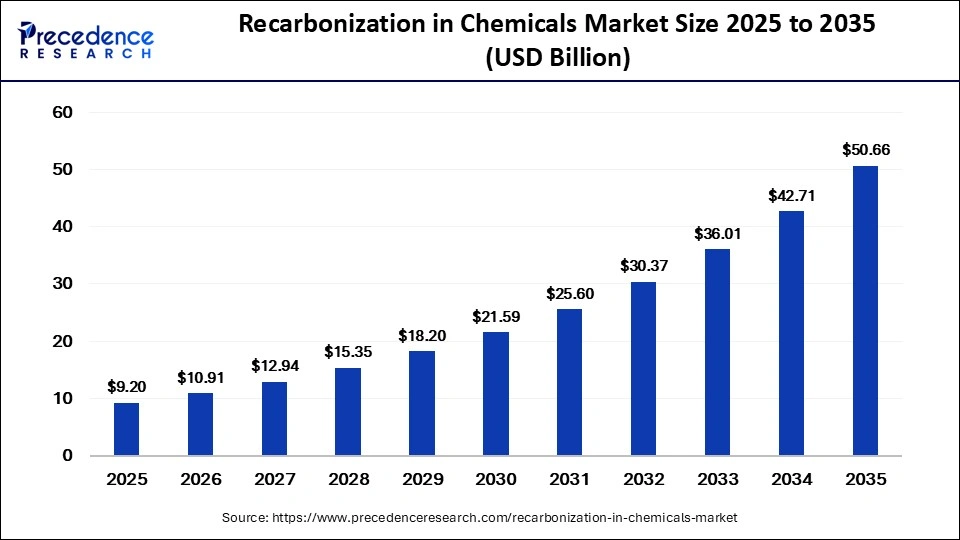
Yogesh Kulkarni, a Chemical and Materials Industry Expert, estimates the recarbonization in chemicals market at USD 10.91 billion in 2026, with the market projected to reach USD 50.66 billion by 2035 at a CAGR of 18.60%. Major recarbonization in chemicals market companies such as Linde plc, Air Liquide S.A., ExxonMobil Corporation, Shell plc. are competing across key material and application segments, including By Technology, By Application, By Carbon Source, By End-Use Industry.
Source: https://www.precedenceresearch.com/recarbonization-in-chemicals-market
 Get a Sample
 Table Of Content


What is the Recarbonization in Chemicals Market Size in 2026?
The global recarbonization in chemicals market size accounted for USD 9.20 billion in 2025 and is predicted to increase from USD 10.91 billion in 2026 to approximately USD 50.66 billion by 2035, expanding at a CAGR of 18.60% from 2026 to 2035. The market is growing due to rising demand for carbon capture and utilization technologies, driven by stricter climate regulations and the push toward sustainable, low-emission chemical production.
Key Takeaways
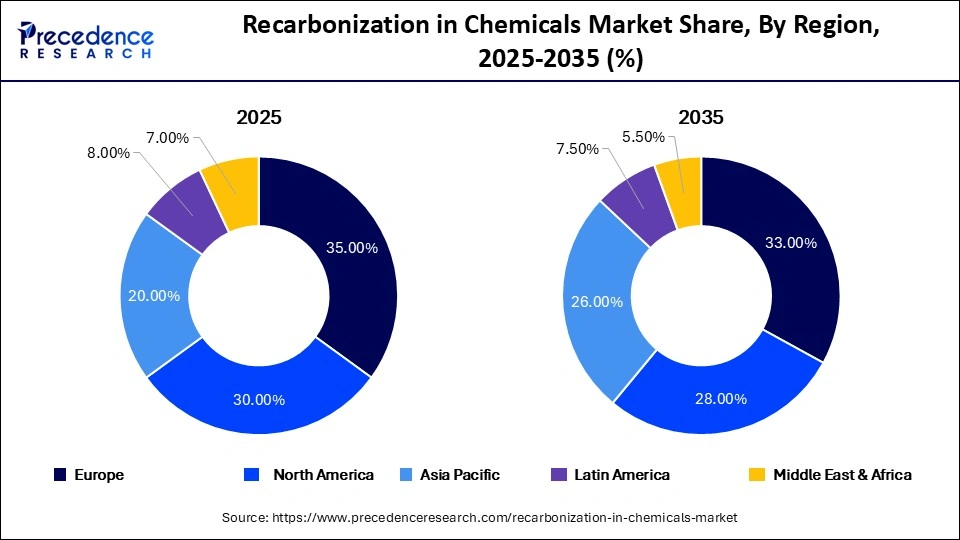
- Europe dominated the recarbonization in chemicals market with a 35% share in 2025.
- Asia Pacific is expected to grow at the fastest CAGR of 21.5% between 2026 and 2035.
- By technology, the carbon capture and utilization (CCU) segment contributed the highest market share of 40% in 2025.
- By technology, the direct air capture (DAC) segment is expected to grow at the fastest CAGR of 24% between 2026 and 2035.
- By application, the methanol production segment contributed the highest market share of 25% in 2025.
- By application, the synthetic fuels (e-fuels) segment is expected to grow at the fastest CAGR of 23.5% between 2026 and 2035.
- By carbon source, the industrial point sources segment dominated the market with a 50% share in 2025.
- By carbon source, the direct air capture sources segment is expected to grow at the fastest CAGR of 23% between 2026 and 2035.
- By end-use industry, the chemical manufacturing segment contributed the highest market share of 35% in 2025.
- By end-use industry, the energy & fuels segment is expected to expand at the fastest CAGR of 21% between 2026 and 2035.
Market Overview
The recarbonization in chemicals market is gaining momentum as industries shift toward carbon capture, utilization, and sustainable production methods. Companies are increasingly using COâ‚‚ as a feedstock to produce chemicals, fuels, and materials. Rising environmental regulations and net-zero commitments are also driving market growth. Technological advancements and investments in green chemistry are further supporting growth, making recarbonization a key pillar in decarbonizing the chemical industry.
Impact of AI on the Recarbonization in Chemicals Market
Artificial intelligence is enhancing recarbonization processes by optimizing carbon capture efficiency, process design, and resource utilization. AI helps analyze large datasets to improve reaction pathways and reduce energy consumption. It also supports predictive maintenance and real-time monitoring of systems. As companies focus on cost efficiency and scalability, AI-driven solutions are becoming essential for improving performance and accelerating adoption.
Major Market Trends
- Carbon Capture and Utilization (CCU) Integration: Chemical companies are increasingly adopting carbon capture technologies to convert CO2 emissions into valuable feedstocks such as methanol, urea, and polymers. This trend is turning emissions into economic assets while helping firms meet decarbonization targets and regulatory requirements.
- Shift Toward Green Hydrogen and Renewable Feedstocks: The use of green hydrogen and bio-based raw materials is gaining traction as companies move away from fossil-based inputs. This transition supports low-carbon chemical production and enables the creation of sustainable products aligned with circular economy goals.
- Digitalization and Process Optimization: Advanced analytics, AI, and digital twins are being deployed to optimize energy use and improve carbon efficiency across chemical processes. These technologies help reduce emissions, lower operational costs, and enhance overall plant performance in real time.
Market Scope
| Report Coverage | Details |
| Market Size in 2025 | USD 9.20 Billion |
| Market Size in 2026 | USD 10.91 Billion |
| Market Size by 2035 | USD 50.66 Billion |
| Market Growth Rate from 2026 to 2035 | CAGR of 18.60% |
| Dominating Region | Europe |
| Fastest Growing Region | Asia Pacific |
| Base Year | 2025 |
| Forecast Period | 2026 to 2035 |
| Segments Covered | Technology, Application, Carbon Source, End-Use Industry, and Region |
| Regions Covered | North America, Europe, Asia-Pacific, Latin America, and Middle East & Africa |
Market Dynamics
Drivers
Strong environmental regulations and global commitments to reduce carbon emissions are major drivers of the recarbonization in chemicals market. Industries are under pressure to adopt sustainable production methods and reduce their carbon footprint. Increasing demand for green chemicals and rising investments in carbon capture technologies are further accelerating market growth across multiple industrial sectors.
Restraint
High implementation costs and technological complexity act as key restraints in the recarbonization market. Carbon capture and utilization technologies require significant investment and infrastructure, limiting adoption among smaller companies. In addition, scalability challenges and lack of standardized processes can slow down commercialization, making it difficult for industries to transition quickly toward recarbonization practices.
Opportunity
Growing focus on circular economy models and sustainable innovation presents strong opportunities for the recarbonization in chemicals market. Increasing investments in green technologies and government incentives are encouraging adoption. Expansion into new applications, such as COâ‚‚-based fuels and materials, along with advancements in technology, is expected to unlock new revenue streams and support long-term market growth.
Segment Insights
Technology Insights
Recarbonization in Chemicals Market Share, By Technology, 2025-2035 (%)
| Technology | 2025 | 2035 | CAGR (%) |
| Carbon Capture and Utilization (CCU) | 40.00% | 42.00% | 19.5% |
| Carbon Capture and Storage (CCS) | 30.00% | 27.00% | 16.0% |
| Direct Air Capture (DAC) | 15.00% | 18.00% | 24.0% |
| Carbon Mineralization | 15.00% | 13.00% | 17.0% |
The Carbon Capture and Utilization (CCU) Segment Held a 40% Market Share in 2025
The carbon capture and utilization (CCU) segment dominated the recarbonization in chemicals market with the highest share of 40% in 2025, driven by its ability to convert captured COâ‚‚ into valuable chemicals, fuels, and materials. Industries are adopting CCU to reduce emissions while creating economic value. Strong regulatory support, sustainability goals, and growing demand for low-carbon products are further strengthening the segment's dominant position in the market.
The direct air capture (DAC) segment is expected to grow at the fastest CAGR of 24% between 2026 and 2035. This is mainly due to its ability to remove COâ‚‚ directly from the atmosphere. Rising climate targets, carbon offset demand, and increasing investments are accelerating its adoption despite current cost challenges.
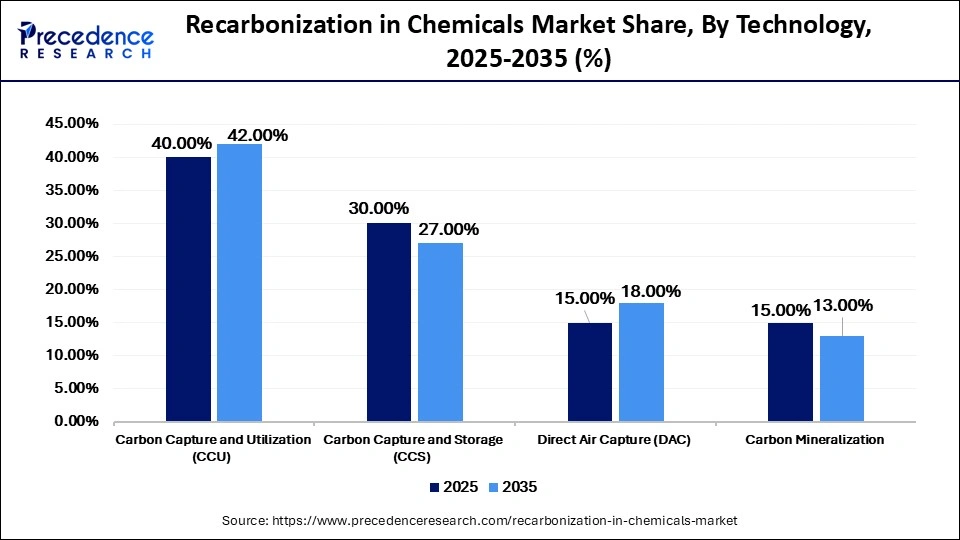
The carbon capture and storage (CCS) segment held a 30% market share in 2025 and is expected to grow at a CAGR of 16% between 2026 and 2035, as industries focus on large-scale emission reduction. Its role in safely storing COâ‚‚ underground makes it essential for heavy industries transitioning toward low-carbon operations.
The carbon mineralization segment held a 15% market share in 2025 and is expected to grow at a CAGR of 17% between 2026 and 2035, as it converts COâ‚‚ into stable solid materials. Its long-term storage benefits and use in construction materials are supporting growing interest and adoption.
Application Insights
Why Did the Methanol Production Segment Dominate the Market in 2025?
The methanol production segment dominated the recarbonization in chemicals market with a 25% share in 2025, driven by its wide use as a chemical feedstock and fuel alternative. COâ‚‚-based methanol is gaining attention as a cleaner option, supporting decarbonization goals. Strong industrial demand, ease of integration into existing processes, and growing interest in sustainable fuels are key factors behind its leading position.
The synthetic fuels (e-fuels) segment held a 15% share of the market in 2025 and is expected to grow at the fastest CAGR of 23.5% between 2026 and 2035, supported by rising demand for low-carbon alternatives in aviation and transportation. Advancements in COâ‚‚ conversion technologies and increasing investments in clean energy are accelerating their adoption globally.
Recarbonization in Chemicals Market Share, By Application, 2025-2035 (%)
| Application | 2025 | 2035 | CAGR (%) |
| Methanol Production | 25.00% | 27.00% | 20.0% |
| Urea & Fertilizers | 20.00% | 18.00% | 16.5% |
| Polymer & Plastics Production | 20.00% | 22.00% | 19.0% |
| Synthetic Fuels (e-fuels) | 15.00% | 18.00% | 23.5% |
| Concrete & Building Materials | 20.00% | 15.00% | 17.0% |
The urea & fertilizers segment held a 20% share of the market in 2025 and is expected to grow at a CAGR of 16.5% in the upcoming period, as COâ‚‚ is widely used in fertilizer production. Rising agricultural demand and focus on sustainable inputs are supporting expansion in this segment.
The polymer & plastics production segment held a 20% share of the market in 2025 and is expected to grow at a CAGR of 19% between 2026 and 2035. This is mainly due to the increasing demand for sustainable materials and circular economy initiatives. Recarbonization process is gaining momentum with the use of COâ‚‚-based materials. Growing demand for sustainable plastics is driving adoption.
Carbon Source Insights
The Industrial Point Sources Segment Dominated the Market in 2025
The industrial point sources segment dominated the recarbonization in chemicals market with a 50% share in 2025, as they provide concentrated and easily capturable COâ‚‚ from power plants, refineries, and manufacturing units. This makes capture more cost-effective and scalable. Strong regulatory pressure on industrial emissions and the need for immediate decarbonization solutions are key factors driving continued reliance on these sources.
The direct air capture sources segment held a 25% share of the market in 2025 and is expected to grow at the highest CAGR of 23% between 2026 and 2035, driven by their ability to remove COâ‚‚ directly from the atmosphere. Rising climate goals, carbon removal initiatives, and increasing investments are accelerating adoption despite higher operational costs.
The biogenic sources segment held a 25% market share in 2025 and is expected to grow at a CAGR of 19.5% between 2026 and 2035, as they capture COâ‚‚ from biomass and organic processes. Their renewable nature and alignment with circular carbon systems are supporting steady growth.
End-use Industry Insights
The Chemical Manufacturing Segment Held a 35% Market Share in 2025
The chemical manufacturing segment dominated the recarbonization in chemicals market with the highest share of 35% in 2025, as this industry widely uses captured COâ‚‚ as a feedstock for producing chemicals like methanol and polymers. The shift toward sustainable production and circular carbon processes is driving adoption. Strong industrial demand and regulatory pressure to reduce emissions are key factors supporting growth in this segment.
The energy & fuels segment held the second-largest market share of 25% in 2025 and is expected to grow at the fastest CAGR of 21% between 2026 and 2035, driven by rising demand for low-carbon fuels such as e-fuels and synthetic fuels. Global decarbonization goals and investments in clean energy technologies are accelerating adoption across transportation and energy sectors.
Recarbonization in Chemicals Market Share, By End-Use Industry, 2025-2035 (%)
| End-Use Industry | 2025 | 2035 | CAGR (%) |
| Chemical Manufacturing | 35.00% | 37.00% | 19.0% |
| Energy & Fuels | 25.00% | 27.00% | 21.0% |
| Construction Materials | 15.00% | 13.00% | 17.0% |
| Agriculture | 15.00% | 14.00% | 16.0% |
| Automotive & Industrial | 10.00% | 9.00% | 18.0% |
The construction materials segment held a 15% market share in 2025 and is expected to grow at a CAGR of 17% in the coming years, owing to the rising use of COâ‚‚ in concrete and building materials. Its ability to store carbon permanently while improving material performance is supporting steady growth.
The agriculture segment held a 15% share of the market in 2025 and is expected to grow at a0 CAGR of 16% between 2026 and 2035, driven by increased use of COâ‚‚ in fertilizers and greenhouse applications. Rising food demand and focus on sustainable farming practices are driving adoption.
Regional Insights
Europe Recarbonization in Chemicals Market Size and Growth 2026 to 2035
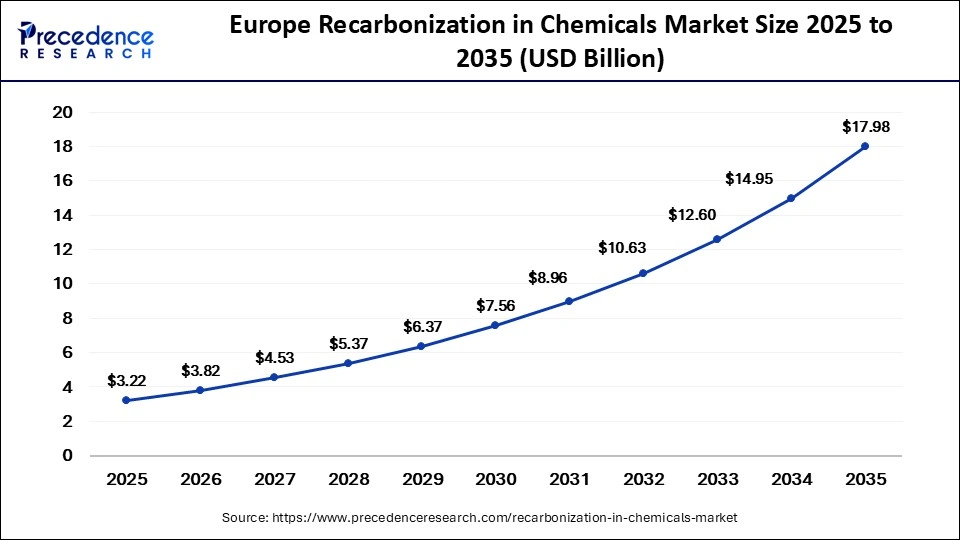
The Europe recarbonization in chemicals market size is estimated at USD 3.22 billion in 2025 and is projected to reach approximately USD 17.98 billion by 2035, with a 18.77% CAGR from 2026 to 2035.
Why Did Europe Lead the Market in 2025?
Europe dominated the recarbonization in chemicals market with a 35% share in 2025, driven by strong climate policies and early adoption of carbon reduction technologies. The region benefits from strict emission regulations and frameworks such as the European Union Green Deal, which encourages industries to adopt carbon capture and utilization solutions. Significant investments in sustainable chemistry, renewable energy integration, and circular economy practices are accelerating growth. Countries like Germany, France, and Netherlands are leading innovation, supported by strong industrial bases, research institutions, and government incentives promoting low-carbon technologies.
North America: The Second-Largest Market
North America is the second-largest market for recarbonization in chemicals, holding around 30% share in 2025, driven by strong investments in carbon capture, utilization, and sustainable chemical technologies. The region benefits from advanced industrial infrastructure, supportive environmental regulations, and growing corporate commitments toward net-zero goals. Increasing adoption of COâ‚‚-based production methods and innovation in clean technologies are accelerating market expansion. Collaboration between industry players, research institutions, and government bodies is further strengthening development, making North America a key region for advancing recarbonization practices in the chemicals sector.
U.S. Market Analysis
The U.S. remains the largest contributor within North America, supported by significant investments in carbon capture technologies and strong policy support for reducing industrial emissions. The country has a well-established chemical industry that is actively adopting sustainable production methods. Growing focus on innovation, along with funding for research and development, is accelerating the use of COâ‚‚ as a feedstock. Increasing partnerships between private companies and government agencies are further driving the adoption of recarbonization solutions across various industrial applications.
Why is Asia Pacific Undergoing the Fastest Growth in the Market?
Asia Pacific is expected to grow at the fastest CAGR of 21.5% between 2026 and 2035, driven by rapid industrialization and increasing focus on reducing carbon emissions. Governments across the region are promoting carbon capture, utilization, and sustainable chemical production through supportive policies and investments. Rising energy demand, expanding manufacturing sectors, and growing awareness of environmental impact are accelerating adoption. Improvements in infrastructure and technology access are also making recarbonization solutions more viable, positioning Asia Pacific as a key growth engine in the global market.
China Market Analysis
China plays a major role in the market within Asia Pacific, supported by large-scale industrial activity and strong government initiatives to reduce emissions. The country is investing heavily in carbon capture technologies and sustainable chemical production to meet its climate targets. With a vast manufacturing base and increasing demand for cleaner production methods, China is rapidly adopting recarbonization solutions. Continuous investments in innovation, infrastructure, and domestic technology development are further strengthening its position as a leader in this market.
India Market Analysis
India is emerging as a rapidly growing market due to increasing industrial expansion and rising awareness of sustainable practices. Government initiatives promoting clean energy and carbon reduction are encouraging adoption of recarbonization technologies. Growing demand for chemicals, fuels, and fertilizers is also supporting the use of COâ‚‚-based processes. With improving infrastructure, expanding manufacturing capacity, and increasing investments in green technologies, India is steadily advancing toward more sustainable and efficient chemical production systems.
Middle East & Africa Recarbonization in Chemicals Market Analysis
The Middle East & Africa (MEA) held a 8% market share in 2025 and is expected to grow at a 16.5% CAGR over the forecast period, supported by increasing investments in sustainable technologies and diversification efforts beyond oil and gas. Governments in the region are focusing on reducing carbon emissions while maintaining industrial growth. Rising adoption of carbon capture solutions in energy and industrial sectors is contributing to market expansion. Improving infrastructure and growing awareness of environmental sustainability are also supporting gradual adoption of recarbonization practices across key industries.
Latin America Recarbonization in Chemicals Market Analysis
Latin America held a 7% market share in 2025 and is expected to expand at a 15% CAGR in the coming years, primarily driven by increasing demand for sustainable chemical production and rising environmental awareness. Countries in the region are gradually adopting carbon capture and utilization technologies to reduce emissions and improve efficiency. Expanding industrial activities and growing investments in clean energy are supporting market growth. As regulatory frameworks and technological capabilities continue to improve, the region is expected to steadily increase its adoption of recarbonization solutions.
Recarbonization in Chemicals Market Companies
- Linde plc
- Air Liquide S.A.
- ExxonMobil Corporation
- Shell plc
- BASF SE
- Dow Inc.
- TotalEnergies SE
- Carbon Clean Solutions Ltd.
- Climeworks AG
- Mitsubishi Heavy Industries, Ltd.
- Aker Carbon Capture ASA
- Svante Inc.
- CarbonCure Technologies Inc.
- Occidental Petroleum Corporation (Oxy Low Carbon Ventures)
- SABIC
Recent Developments
- In February 2026, the Government of India announced 20,000 crore funding in the Union Budget 2026–27 to scale Carbon Capture, Utilization and Storage (CCUS) across chemicals and other heavy industries, aiming to accelerate industrial decarbonization and technology deployment.(Source: https://economictimes.indiatimes.com)
- In November 2025, China launched its first coal-to-chemicals project using green hydrogen, marking a major step toward cleaner chemical production and reduced emissions in a traditionally high-carbon sector.(Source: https://www.reuters.com)
- In October 2025, Germany launched a €6 billion industrial decarbonization program incorporating carbon capture and storage (CCS) for chemicals and heavy industries, offering long-term subsidies to accelerate low-carbon production transitions.(Source: https://www.reuters.com)
- In June 2025, Europe commissioned one of the world's first commercial-scale e-methanol plants using captured COâ‚‚, highlighting progress in producing low-emission fuels and chemicals from recycled carbon.(Source: https://www.reuters.com)
Segments Covered in the Report
By Technology
- Carbon Capture and Utilization (CCU)
- Carbon Capture and Storage (CCS)
- Direct Air Capture (DAC)
- Carbon Mineralization
By Application
- Methanol Production
- Urea & Fertilizers
- Polymer & Plastics Production
- Synthetic Fuels (e-fuels)
- Concrete & Building Materials
By Carbon Source
- Industrial Point Sources (Cement, Steel, Refineries)
- Biogenic Sources (Biomass, Fermentation)
- Direct Air Capture Sources
By End-Use Industry
- Chemical Manufacturing
- Energy & Fuels
- Construction Materials
- Agriculture
- Automotive & Industrial
By Region
- North America
- Latin America
- Europe
- Asia-pacific
- Middle and East Africa
For inquiries regarding discounts, bulk purchases, or customization requests, please contact us at sales@precedenceresearch.com
Frequently Asked Questions





Ask For Sample
No cookie-cutter, only authentic analysis – take the 1st step to become a Precedence Research client
 Get a Sample




 sales@precedenceresearch.com
 Schedule a Meeting
