



Retail Cloud Market Revenue to Attain USD 238.17 Bn by 2035
Published: 30 Jun 2026
Author: Precedence Research



Retail Cloud Market Revenue and Trends 2026 to 2035
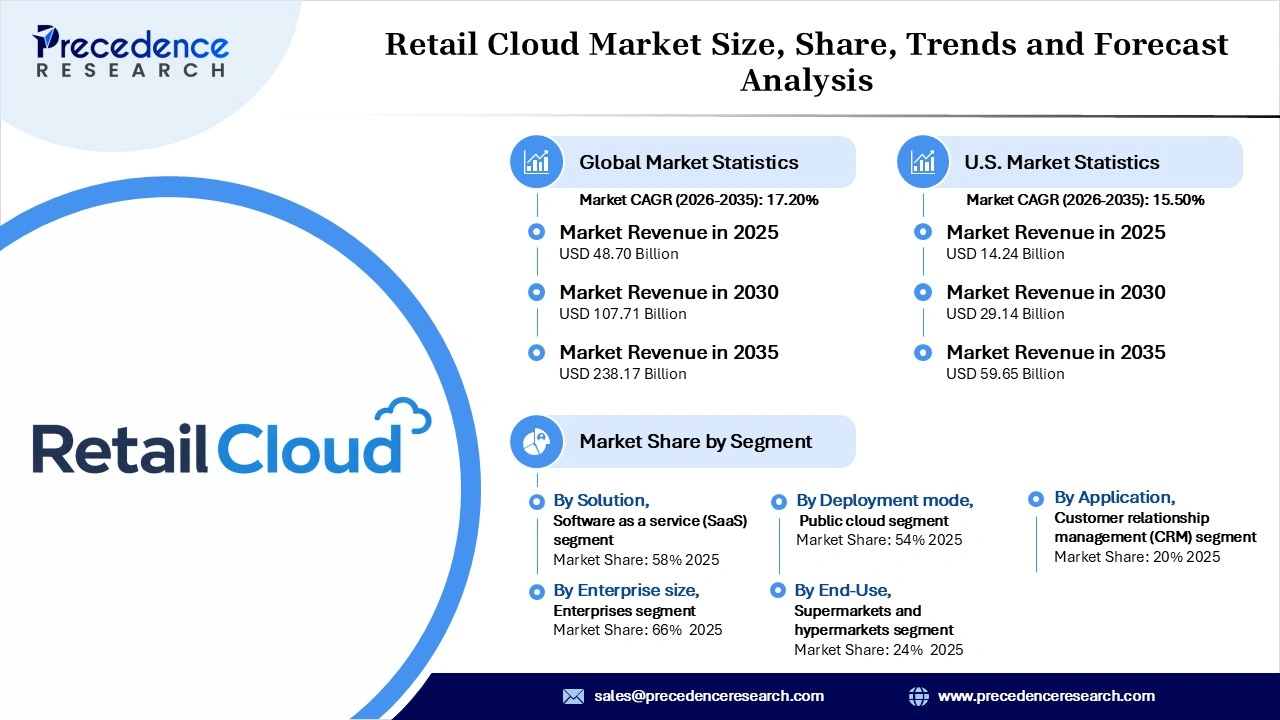
The global retail cloud market revenue was valued at USD 48.70 billion in 2025 and is expected to attain around USD 238.17 billion by 2035, growing at a CAGR of 17.20% during forecast period. The market is driven by the rapid transition to omnichannel retailing, the increasing requirement for integrating inventory and customer data in real time, the rising demand for analytics solutions using AI, and the cost-efficient nature of cloud infrastructure.
Unified Commerce: The Cloud Platform for Modern Retail
The retail cloud market comprises cloud-based software, platforms, and services used to support retail activities, which include e-commerce, point-of-sale, inventory management, logistics, customer relationship management, and data analytics. Some of the offerings in this market include software-as-a-service (SaaS) applications, platform-as-a-service (PaaS) solutions, and infrastructure-as-a-service (IaaS) aimed at supporting retail operations and services that help customers migrate and integrate on-premise retail systems with cloud-based systems.
This market encompasses cloud-hosted e-commerce platforms, cloud point-of-sale applications, unified commerce platforms, and AI-powered analytics tools. It includes headless commerce, microservices, and API-first solutions, which allow retailers to swiftly respond to changing customer needs. This market has been adopted by big format retailers, specialty retailers, D2C players, and brick-and-mortar retailers.
Cloud-Native AI Agents Enable Conversational Commerce for Any Retailer
The market is evolving from classic e-commerce platforms towards agentic AI platforms capable of creating a personalized shopping experience for customers via conversations at scale. The integration of internal technologies in cloud-native services, leaders in the retail cloud space are providing all retailers with the possibility of deploying highly advanced AI assistants without having to develop them from scratch. In 2026, AWS introduced its Agentic Shopping Assistant, a deployable AI platform that packages the architecture and code of Amazon’s Alexa for Shopping in a service for other retailers. It takes about 60 days to deploy the service with AWS, and it is powered by Amazon Bedrock, AgentCore, and OpenSearch.
Accelerated Cloud Migration of Global Fashion Brands for Unified Omnichannel Operations
The retail cloud market is witnessing a trend of cloud migration in the retail industry, as fashion and consumer brands move their store-related systems from on-premise to cloud-based platforms to gain real-time insights into inventories. It facilitates seamless omnichannel collaboration and smooth handling of high-traffic product launches. Enterprises are taking multi-cloud and hybrid approaches to gain scalability and reliability along with data-driven decision-making capabilities. In 2026, Tencent Cloud, UXSoft, and BAPE Hong Kong Limited signed a collaboration agreement that entails migrating BAPE’s core point-of-sale and inventory management systems to the cloud environment provided by Tencent Cloud. The task of implementing the omnichannel retail would be done by UXSoft in order to ensure the smooth operation of BAPE’s operations on a global scale.
National Programs for Digital Commerce Fuel Retail Cloud Adoption
Governments across the world are creating national-level programs on digital commerce to digitize the retail industry through cloud services to facilitate order processing, inventory visibility, and working capital management. These programs use the open digital infrastructure to onboard millions of retailers and bring them into a digitally integrated supply chain system. In 2026, the Department for Promotion of Industry and Internal Trade (DPIIT) India, together with Open Network for Digital Commerce (ONDC) conducted a CPG Roundtable to discuss DigiDukaan. It is a program focused on the digitization of 14 million small grocery and convenience stores in India. The DigiDukaan program provides direct procurement, digital payments, and data flow from the shop level, and the program has already onboarded more than 10,000 retailers and 35 brands in Hyderabad, with further plans in Mumbai, Bengaluru, and Delhi-NCR.
Cloud Retail Raises USD 3 Million Seed Funding for All-In-One E-Commerce Solution
Cloud Retail is a company based in London that raised USD 3 million in seed capital, backed by Somersault Ventures in 2025. The company runs 21 London stores, providing 4,500 deliveries daily as a 15-minute delivery service company, and shifted gears in 2022 to build its modular e-commerce software suite. Its AI technology reduces the time taken to launch retail from 5 months to just 1 week.
Market Segmentation Overview
- By solution, the software as a service (SaaS) segment led the retail cloud market with 58% share in 2025 and is expected to expand at the highest CAGR of 18.6% during the forecast period, since it gives retailers a subscription-based low-cost entry into cloud computing services that facilitate point of sale and inventory management without requiring any costly on-premise infrastructure.
- By solution, the platform as a service (PaaS) segment held the second-largest market share of 24% in 2025, because it offers an environment where retailers can build and deploy their unique applications based on their needs without being concerned about the underlying infrastructure. This solution is more flexible compared to using off-the-shelf solutions and gives them more capabilities compared to using fully managed infrastructure.
- By deployment mode, the public cloud segment dominated the market with 54% share in 2025 and is expected to grow at the fastest CAGR of 19.1% from 2026 to 2035, owing to its high scalability, cost-effectiveness, and the ability to leverage the latest technologies of AI and analytics that do not require any big investments from retail companies. This segment helps the companies to cope with traffic fluctuations, scale their operations, and introduce new features very quickly.
- By deployment mode, the hybrid cloud segment held the second-largest market share of 27% in 2025, since it provides the flexibility of adopting a moderate approach, which enables major retail businesses dealing with customer data, legacy on-premise infrastructure, and other compliance issues to retain critical services and proprietary information in their premises. Such businesses use the scalability of public clouds for customer applications and handling spikes in seasonal traffic.
- By application, the customer relationship management (CRM) segment led the retail cloud market with 20% share in 2025, because it helps retailers to consolidate customer information collected through various touchpoints, such as web, store, mobile, and social media, into one unified view for providing customers with personalized marketing and promotion.
- By application, the omnichannel commerce segment is expected to expand at the highest CAGR of 20.1% during the forecast period, due to the immense pressure on retailers to offer an omnichannel experience through their online store, mobile apps, social media, and in-store operations. There is an increasing demand among consumers for an “anytime, anywhere, any device” shopping experience.
- By enterprise size, the large enterprises segment dominated the market with 66% share in 2025, since they run thousands of stores, complicated logistics, and huge inventories that need advanced and cloud native retail technology that facilitates real-time inventory management and customer data integration in various locations and channels. Large retailers have the necessary funds and IT infrastructure to implement cloud transformation, custom integrations, and advanced enterprise solutions.
- By enterprise size, the small and medium enterprises (SMEs) segment is expected to grow at the fastest CAGR of 20.2% from 2026 to 2035, because cloud-based retail solutions have become more economical and accessible through SaaS subscriptions, allowing smaller and mid-sized retailers access to enterprise-level features.
- By end-use, the e-commerce retailers segment led the market with 28% share in 2025 and is expected to grow at the fastest CAGR of 21.5% from 2026 to 2035, owing to the large amount of digital transactions made by e-commerce websites and the need for always-on, scalable cloud infrastructure to support the traffic on their sites.
- By end-use, the supermarkets and hypermarkets segment held the second-largest market share of 24% in 2025, since they have to coordinate thousands of stock-keeping units in hundreds of stores, and therefore need to use cloud computing to coordinate the inventory that is located in both physical shelves and their digital delivery platforms.
Regional Analysis
North America dominated the retail cloud market with 39% share in 2025, owing to its early and rapid adoption of e-commerce platforms, the significant presence of prominent cloud infrastructure firms such as AWS, Microsoft, Azure, and Google Cloud, as well as a high number of leading retailers that invested a lot into digitalization. The U.S. led the market in North America due to its enormous retail and e-commerce markets, where companies like Walmart, Target, and Amazon migrated to cloud technologies to enable omnichannel and AI-powered customer experience. Canada witnessed notable market growth because of its well-developed retail technology landscape and deep connections with U.S. supply chains, which ensured the adoption of cloud technologies among Canadian retailers.
Asia-Pacific is expected to expand at the highest CAGR of 21.4% during the forecast period, due to its rapidly growing retail market, rapid urbanization, growing disposable incomes, and an explosion in the number of e-commerce platforms. China dominated the market in Asia Pacific owing to its highly developed digital infrastructure, the largest e-commerce market in the world, and government initiatives to promote cloud computing and AI. India is a significant contributor to the market because of the presence of affordable cloud services, the Open Network for Digital Commerce initiative of the government, and a fast-growing retail market where cloud digital solutions are being rapidly adopted.
Europe held the second-largest market share of 27% in 2025, owing to a well-established, highly diversified retail environment, the presence of some of the biggest luxury, fashion, and grocery retailers of the world, coupled with data protection legislation such as GDPR, which promotes the adoption of secure cloud infrastructure. Germany led the market in Europe due to its large industrial base, which needs cloud technologies for inventory management and supply chain visibility, and the presence of mature public cloud infrastructure and enterprise technology environment. The U.K. witnessed notable market growth because of its advanced retail market, early adoption of cloud-native applications by the supermarket chains and fashion retailers, and the growing trend among retailers towards adopting AI-driven analytics for customer experience and inventory management.
Retail Cloud Market Coverage
| Report Attribute | Key Statistics |
| Market Revenue in 2025 | USD 48.70 Billion |
| Market Revenue by 2035 | USD 238.17 Billion |
| CAGR from 2026 to 2035 | 17.20% |
| Quantitative Units | Revenue in USD million/billion, Volume in units |
| Largest Market | North America |
| Base Year | 2025 |
| Regions Covered | North America, Europe, Asia-Pacific, Latin America, and the Middle East & Africa |
Top Companies in the Retail Cloud Market
Microsoft, Amazon Web Services, Google, and Oracle are some of the key players that offer essential cloud infrastructure and platform services that facilitate the retail business, such as data analytics, AI, and supply chain management. SAP, Salesforce, IBM, and Adobe provide retail cloud solutions for customer experience, commerce, and marketing automation services. Shopify, commercetools, and VTEX are composable and headless commerce platforms that help create an agile omnichannel retailing experience. Manhattan Associates, Infor, and NCR Volyx offer cloud-based supply chain, inventory management, and point-of-sale solutions for the retail industry. Cegid provides cloud retail management solutions for fashion and luxury retail stores.
Segments Covered in This Report
By Solution
- Software as a Service (SaaS)
- Platform as a Service (PaaS)
- Infrastructure as a Service (IaaS)
By Deployment Mode
- Public Cloud
- Private Cloud
- Hybrid Cloud
By Application
- Customer Relationship Management (CRM)
- Supply Chain Management
- Inventory and Warehouse Management
- Omnichannel Commerce
- Point of Sale (POS)
- Data Analytics and Business Intelligence
By Enterprise Size
- Large Enterprises
- Small and Medium Enterprises (SMEs)
By End-Use
- Supermarkets and Hypermarkets
- Department Stores
- Specialty Stores
- E-commerce Retailers
By Region
- North America
- Latin America
- Europe
- Asia-pacific
- Middle and East Africa
Get this report to explore global market size, share, CAGR, and trends, featuring detailed segmental analysis and an insightful competitive landscape overview @ https://www.precedenceresearch.com/sample/8526
You can place an order or ask any questions. Please feel free to contact us at sales@precedenceresearch.com |+1 804 441 9344