



Public Cloud Migration Market Size, Share and Trends 2026 to 2035
Public Cloud Migration Market (By Migration Type: Rehosting, Replatforming, Refactoring/Re-architecting, Repurchasing, Retiring/Replacing, Hybrid Migration; By Migration Mode: Offline Migration, Online/Live Migration, Automated Migration; By Workload Type: Application Migration, Database Migration, Storage Migration, Security & Identity Migration, Platform/Middleware Migration; By Deployment Approach: Single Cloud, Multi-Cloud, Hybrid Cloud; By End-Use Industry: BFSI, IT & Telecom, Healthcare, Retail & E-commerce, Manufacturing, Government & Public Sector, Media & Entertainment, Energy & Utilities) - Global Industry Analysis, Size, Trends, Leading Companies, Regional Outlook, and Forecast 2026 to 2035
Source: https://www.precedenceresearch.com/public-cloud-migration-market
 Get a Sample
 Table Of Content


What is the Public Cloud Migration Market Size?
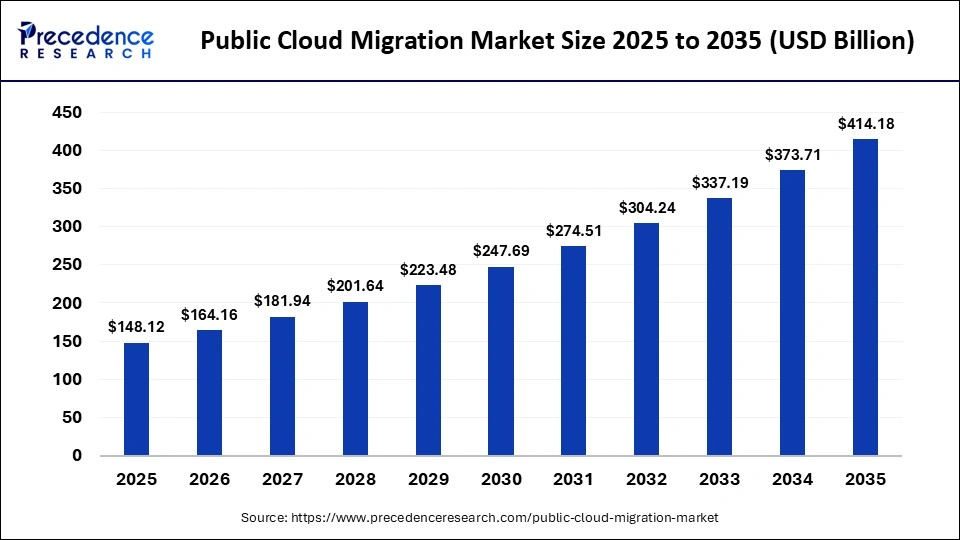
The global public cloud migration market size is calculated at USD 148.12 billion in 2025 and is predicted to increase from USD 164.16 billion in 2026 to approximately USD 414.18 billion by 2035, expanding at a CAGR of 10.83% from 2026 to 2035. The market is witnessing substantial growth due to the increasing emphasis on digital transformation, the demand for enhanced data security and compliance, and the global shift toward remote and hybrid work models, which are accelerating the necessity for seamless, agile, and resilient public cloud migration solutions that help organizations adapt to evolving business landscapes and improve overall performance.
Market Highlights
- North America accounted for the largest market share of 45.90% in 2025.
- Asia Pacific is expected to expand at the fastest CAGR of 22.5% between 2026 and 2035.
- By migration type, the rehosting (Lift & Shift) segment held the largest market share of 35.4% in 2025.
- By migration type, the refactoring/re-architecting segment is expected to grow at a 19.4% CAGR from 2026 to 2035.
- By migration mode, the online/live migration segment contributed the highest market share of 62.2% in 2025.
- By migration mode, the automated migration segment is growing at the fastest CAGR of 19.9% between 2026 and 2035.
- By workload type, the application migration segment led the market with more than 36.7% of the market share in 2025.
- By workload type, the database migration segment is expanding at a notable CAGR of 19.6% from 2026 to 2035.
- By deployment approach, the single-cloud segment led the market with a 54.5% share in 2025.
- By deployment approach, the multi-cloud segment is poised to grow at the fastest CAGR of 20.4% from 2026 to 2035.
- By end-use industry, the BFSI segment held the major market share of 35.6% in 2025.
- By end-use industry, the healthcare segment is expected to grow at a 20.4% CAGR from 2026 to 2035.
What is the Public Cloud Migration Market?
The public cloud migration market refers to services, tools, and solutions that help enterprises move applications, data, workloads, and IT resources from on-premises or private environments to public cloud platforms. It includes assessment, planning, rehosting, replatforming, refactoring, and ongoing modernization. Organizations adopt public cloud migration to reduce IT costs, improve scalability, enhance agility, strengthen security, and accelerate digital transformation. Growth is driven by increasing cloud-native adoption, modernizing legacy infrastructure, expanding multi-cloud, and demand for automation-based migration frameworks.
How AI is Transforming the Public Cloud Migration Market?
AI is transforming the public cloud migration market by automating complex tasks such as assessment, planning, and execution, which reduces errors, costs, and migration time. It leverages predictive analytics to optimize resource allocation and maps IT dependencies to recommend the most efficient migration strategies. AI also enhances security through proactive threat detection, anomaly identification, and automated responses, ensuring safer cloud environments. Furthermore, real-time AI-enabled monitoring helps identify bottlenecks, forecast future capacity needs, and continuously optimize cloud operations for improved performance and scalability.
Public Cloud Migration Market Outlook
- Industry Growth Overview: The public cloud migration market is expected to experience strong growth from 2026 to 2035. This growth is driven by increasing demand for business agility, scalability, and cost efficiency, as organizations worldwide pursue aggressive digital transformation efforts to modernize legacy IT systems, further fueling market expansion.
- Rapid Shift Toward Hybrid & Multi-Cloud Strategies: This major trend is being driven by vendor lock-in concerns and data sovereignty, as well as the integration of AI/ML for automated migration, the rise of Serverless & Edge Computing, and an intense focus on Security & Compliance to manage risks.
- Global Expansion: The market is growing worldwide, driven by digital transformation, cost savings, agility, and remote work, with North America leading but Asia-Pacific showing the fastest growth. However, regulatory hurdles and legacy system complexities slow growth, encouraging hybrid and multi-cloud strategies. Europe, Latin America, and the Middle East & Africa are also influencing the global market.
- Major Investors: Many corporations such as AWS, Microsoft Corporation, IBM, Accenture plc, and Google LLC focus on expanding their offerings and global reach through partnerships and acquisitions. Along with this, venture capital firms like Mucker Capital and Redpoint Ventures are actively funding innovative cloud technology startups.
- Startup Ecosystem: Various startups are focusing on disruptive innovations, particularly in specialized cloud solutions and automation tools. Startups are also concentrating on developing cost-effective, customized solutions that help small and medium-sized enterprises overcome migration complexities.
Market Scope
| Report Coverage | Details |
| Market Size in 2025 | USD 148.12 Billion |
| Market Size in 2026 | USD 164.16 Billion |
| Market Size by 2035 | USD 414.18 Billion |
| Market Growth Rate from 2026 to 2035 | CAGR of 10.83% |
| Dominating Region | North America |
| Fastest Growing Region | Asia Pacific |
| Base Year | 2025 |
| Forecast Period | 2026 to 2035 |
| Segments Covered | Migration Type, Migration Mode, Workload Type, Deployment Approach, End-Use Industry, and Region |
| Regions Covered | North America, Europe, Asia-Pacific, Latin America, and Middle East & Africa |
Segment Insights
Migration Type Insights
What Made Rehosting (Lift & Shift) the Dominant Segment in the Public Cloud Migration Market in 2025?
The rehosting (Lift & Shift) segment dominated the market with a 35.4% share in 2025. This is mainly because of its speed, lower initial cost, and minimal disruption to current operations. Since rehosting involves moving applications and data to the cloud with minimal code changes or architectural redesign, it is the fastest migration method and often the first step in many organizations' broader cloud transformation journey. Additionally, rehosting acts as a practical entry point into the cloud, providing immediate benefits like improved scalability, increased security, and better disaster recovery.
The refactoring/re-architecting segment is expected to grow at a CAGR of 19.4% during the forecast period. This is because it enables organizations to fully unlock the foundational, long-term benefits of cloud computing, such as maximum scalability, agility, performance, and cost optimization. Refactoring moves applications beyond basic hosting to leverage cloud-native services such as microservices, containers, and serverless computing. Cloud-native architectures allow applications to automatically scale up or down based on actual demand, improving performance and simplifying resource management compared to legacy environments.
Migration Mode Insights
How Does the Online/Live Migration Segment Lead the Public Cloud Migration Market in 2025?
The online/live migration segment led the market with a 62.2% share in 2025. This is due to its ability to minimize or eliminate business downtime, ensuring business continuity during the transition. Live migration allows virtual machines and applications to continue running on the source environment while data is transferred to the cloud, which is critical for business systems. Many organizations also utilize a hybrid cloud strategy during migration, keeping some systems on-premises while moving others to the cloud, making workload transitions seamless within this hybrid setup.
The automated migration segment is expected to grow at a CAGR of 19.9% in the coming period. This growth is mainly due to its support for modernizing legacy systems, boosting agility, reducing costs, and cutting human error, with AI/ML driving efficiency. Automation lessens manual work, speeds up processes, and prevents costly mistakes and overruns typical in manual migrations. It also enables complex transformations to improve scalability and performance by leveraging cloud-native features for faster, more efficient migrations.
Workload Type Insights
Why Did the Application Migration Segment Lead the Public Cloud Migration Market?
The application migration segment led the market with a 36.7% share in 2025. This is mainly because of the ongoing demand from enterprises to modernize their legacy systems and leverage cloud-native technologies. Cloud migration services help ensure compatibility and smooth integration of existing enterprise applications with changing cloud environments. This allows for faster deployment and the integration of modern technologies like AI, machine learning, and data analytics, fostering greater agility and innovation.
The database migration segment is expected to grow at a CAGR of 19.6% during the forecast period. This growth is driven by the need for cloud agility to support modern apps, AI/ML, and cost savings. As businesses shift from costly, inflexible on-premises systems to cloud-native advantages such as elasticity and agility, core databases are being migrated. Transitioning from large capital investments in hardware to operational expenses on cloud services helps lower total costs. Moreover, the growing demand for support for Big Data, AI, and IoT applications accelerates database migrations.
Deployment Approach Insights
What Made Single-Cloud the Dominant Segment in the Public Cloud Migration Market in 2025?
The single-cloud segment dominated the market with a 54.5% share in 2025. This is mainly due to its scalability, cost-effectiveness, and ease of deployment, especially as more businesses undergo digital transformation. Companies can rapidly scale resources up or down based on demand, a challenge with on-premises infrastructure amid changing market and customer needs. Cloud providers manage infrastructure updates and maintenance, simplifying IT management for organizations.
The multi-cloud segment is expected to grow quickly, with a CAGR of 20.4%. This growth is mostly driven by higher demands for data sovereignty, regulatory compliance, avoiding vendor lock-in, and balancing costs. It enables privacy-sensitive data while leveraging public cloud agility for general workloads. Industries like finance and healthcare also benefit from the flexibility, security, and disaster recovery features of multi-cloud setups, making hybrid cloud solutions highly attractive.
End-Use Industry Insights
Why Did the BFSI Segment Lead the Public Cloud Migration Market in 2025?
The BFSI segment led the market with a 35.6% share in 2025. This is mainly because of strict regulatory needs, the push for digital transformation, and the advantage of using advanced technologies like AI to stay competitive. Since BFSI is highly regulated, modern public cloud infrastructure is designed to meet strict standards for incident reporting, resilience testing, and third-party oversight. Cloud migration enables BFSI organizations to move from expensive, on-premise infrastructure to a flexible, cost-effective pay-as-you-go model.
The healthcare segment is expected to grow at the fastest CAGR of 20.4% during the forecast period. This growth is driven by the need for advanced data analytics, AI-powered fraud detection, faster claims processing, and better member engagement. It also helps streamline complex insurance processes, improve customer satisfaction, and cut administrative costs. The growth is further supported by massive volumes of data generated from EHRs, IoT, and telehealth, which require scalable, secure cloud solutions for cost-effective management, innovation, and delivering value-based care.
Regional Insights
How Big is the North America Public Cloud Migration Market Size?
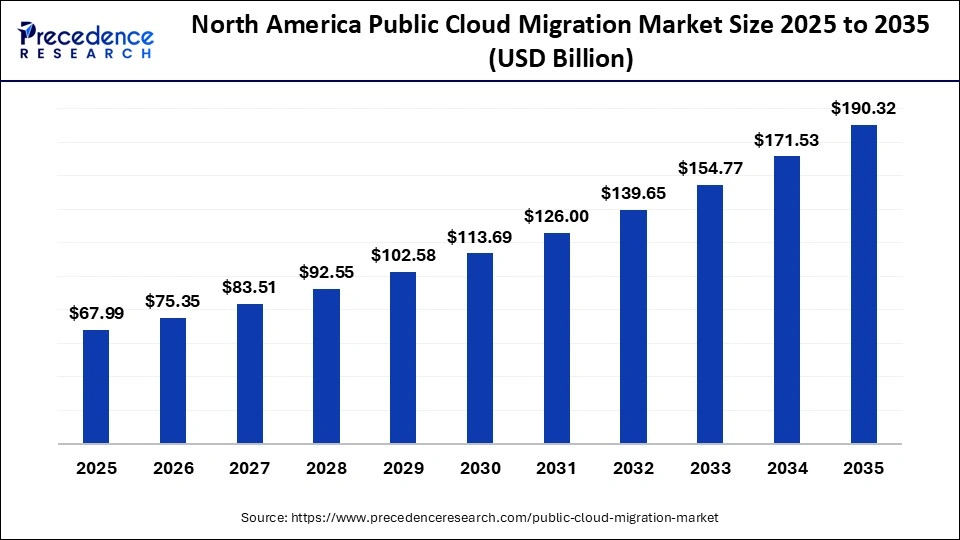
The North America public cloud migration market size is estimated at USD 67.99 billion in 2025 and is projected to reach approximately USD 190.32 billion by 2035, with a 10.84% CAGR from 2026 to 2035.
What Made North America the Dominant Region in the Public Cloud Migration Market in 2025?
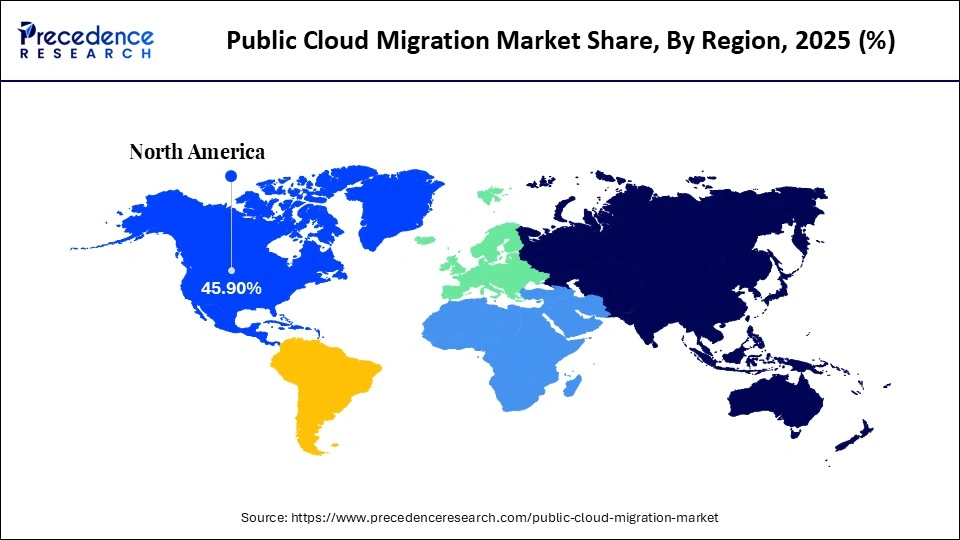
North America dominated the public cloud migration market, accounting for 45.9% in 2025. This leadership is mainly due to advanced IT infrastructure, the presence of major global cloud providers, high levels of digital transformation, and supportive government initiatives. Enterprises in the U.S. and Canada are actively upgrading their legacy IT systems to boost operational agility, scalability, and cost efficiency, making cloud migration a key part of their strategies. Government policies, like the U.S. federal Cloud Smart policy, promote and require the migration of public sector workloads to the cloud, setting an example for private industries. The region hosts top cloud service providers such as AWS, Microsoft, and Google Cloud, which fuel innovation and technical expertise.
What is the Size of the U.S. Public Cloud Migration Market?
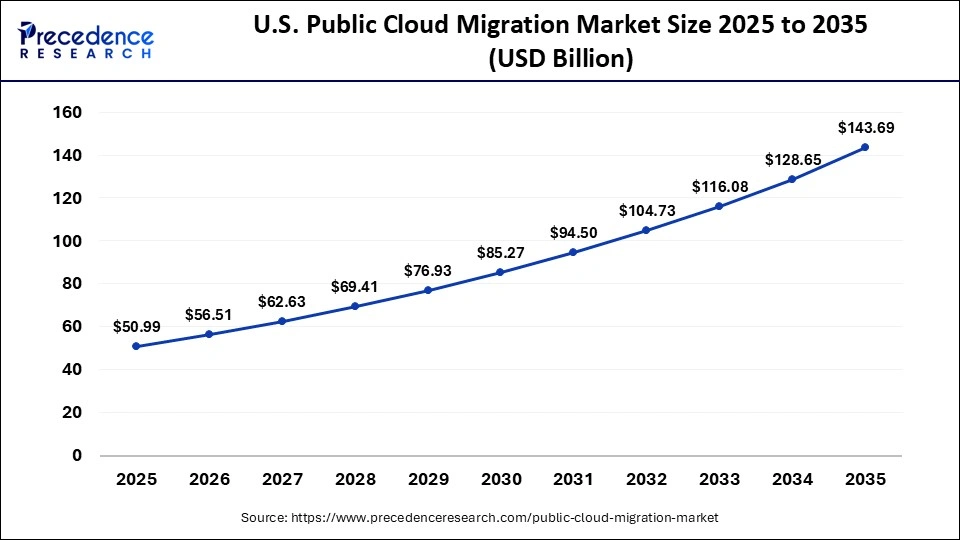
The U.S. public cloud migration market size is calculated at USD 50.99 billion in 2025 and is expected to reach nearly USD 143.69 billion in 2035, accelerating at a strong CAGR of 10.92% between 2026 and 2035.
U.S. Public Cloud Migration Market Trends
The U.S. is the market leader, supported by major global cloud service providers such as AWS, Microsoft, Google, and Oracle, along with extensive R&D investments and high adoption rates of hybrid and multi-cloud strategies across various industries. The market is mature, with a strong focus on security, compliance, and utilizing cloud-native solutions to enable remote work and AI workloads. Public sector investments in cloud modernization initiatives further reinforce this leading position.
Why is Asia Pacific Considered the Fastest-Growing Region in the Public Cloud Migration Market?
Asia Pacific is expected to expand at a CAGR of 22.5% over the forecast period. This growth is attributed to widespread digital transformation initiatives, strong government support, hyperscaler investments, and the rapid rise of AI and related technologies. Regional players such as Alibaba Cloud, Huawei Cloud, and Tencent Cloud are investing heavily in establishing new data centers. Countries like India and Indonesia are prioritizing digital transformation to enhance operational efficiency and customer engagement. The flourishing e-commerce and FinTech sectors in the region require flexible cloud infrastructure to manage large volumes of data, handle traffic spikes, and ensure reliable online services.
India Public Cloud Migration Market Trends
The market in India is growing due to its rapid digital transformation, a burgeoning startup ecosystem, and strong government initiatives like Digital India and the National E-Governance Plan. The country is opting for cloud-native solutions over traditional infrastructure, with the IT and telecommunications sectors leading the adoption. The primary drivers of this trend are the need for cost-effectiveness, scalability, and the rise of local tech giants like TCS, Infosys, and Wipro, which offer a full spectrum of cloud services.
How is Europe Contributing to the Public Cloud Migration Market?
Europe is expected to experience notable growth in the near future. This is primarily due to widespread digital transformation, a strong focus on data sovereignty and regulatory compliance, and the demand for scalable and cost-effective IT solutions. Ongoing efforts across Europe to digitize industries and public services further support this growth. The complex data protection landscape, particularly the General Data Protection Regulation, encourages the use of cloud solutions that ensure data residency and compliance, spurring demand for specific local and sovereign cloud options.
Germany Public Cloud Migration Market Trends
Germany is leading the market in Europe, mainly due to its strengths in Industry 4.0 and the Industrial Internet of Things. Major factors include widespread IoT adoption in discrete and hybrid manufacturing, a focus on data sovereignty, and strict EU data protection rules. German companies like Bosch, Siemens, and SAP SE are heavily investing in AI-driven automation and secure, localized data management solutions, favoring hybrid cloud architectures to meet compliance while maintaining operational flexibility.
What Potentiates the Latin American Public Cloud Migration Market?
In Latin America, the market is potentiated by the rapid digital transformation across various industries and substantial investments in regional data center infrastructure. Multi-tier government strategies in countries like Brazil, Colombia, and Chile encourage cloud adoption for digital services, including e-invoicing, public health networks, and education platforms. Additionally, businesses, especially small and medium-sized enterprises, are shifting to the public cloud to cut capital spending on hardware and data centers and to lower operational costs related to maintenance.
Brazil Public Cloud Migration Market Trends
In Brazil, the market is expanding due to the growing adoption of cloud services, which improve operational efficiency and agility. The market is steadily increasing, with more businesses across various sectors, including finance and e-commerce, transitioning to the cloud to support digital innovation and manage data effectively.
What Opportunities Exist in the Middle East & Africa for the Public Cloud Migration Market?
The Middle East & Africa (MEA) offers immense opportunities for the market, driven by aggressive government-led digital transformation strategies, increased investment in local infrastructure, and the need for business scalability and cost efficiency. These factors are accelerating the shift from traditional IT infrastructure to cloud-based solutions. The introduction of stringent data protection and sovereignty laws like KSA's Personal Data Protection Law and South Africa's POPIA has increased demand for localized data centers.
UAE Public Cloud Migration Market Trends
The UAE is a significant player in the global market. The country is heavily investing in advanced technologies like AI, 5G, and IoT as part of its efforts to diversify away from oil-based economies. This focus on smart infrastructure requires scalable, cloud-based data platforms, positioning the UAE as an important growth area for public cloud migration services, fueled by large-scale government and private-sector projects.
Public Cloud Migration Market Value Chain
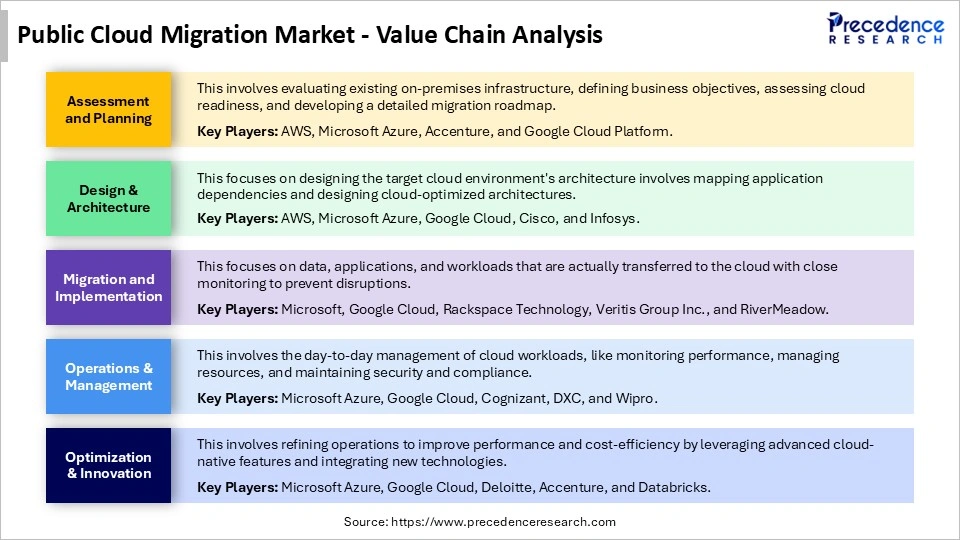
Top Companies in the Public Cloud Migration Market & Their Offerings
- Amazon Web Services (AWS): AWS provides a wide range of migration tools and services, including the AWS Migration Hub, AWS Professional Services, and the AWS Migration Acceleration Program (MAP), and funding support to streamline enterprise migrations.
- Microsoft Azure: Microsoft leverages its existing enterprise ecosystem (Office 365, Windows Server) to offer seamless integration. Its primary tool is Azure Migrate and Azure Arc.
- Google Cloud: Offers solutions like Google Cloud Migrate for virtual machine migration and the Database Migration Service (DMS) for seamless database transitions.
- Accenture: Through its Cloud First initiative, Accenture offers end-to-end services covering strategy, consulting, migration, and managed operations across AWS, Azure, and Google Cloud platforms.
- IBM: Provides AI-powered migration suites, and the use of the Red Hat OpenShift platform helps modernize applications and ensure security and compliance for regulated industries.
Other Key Players
- Oracle
- Cisco
- Capgemini
- Infosys
- TCS (Tata Consultancy Services)
- Wipro
- Cognizant
- Rackspace Technology
- HCLTech
- DXC Technolog
Recent Developments
- In December 2025, Solifi announced a strategic partnership with Liventus and Consult Disrupt to offer equipment finance clients enhanced implementation, automation, and cloud migration services. The collaboration combined Solifi's Open Finance Platform and Leasepath with Liventus's development and operational expertise to provide end-to-end support for firms modernizing systems, automating workflows, and moving to Solifi's cloud-based solutions.(Source: https://www.solifi.com)
- In April 2025, SCC, a leading European IT services provider, launched its Cloud Migration & Security suite on AWS Marketplace. The multi-product solution allowed customers to easily purchase packaged offerings designed to help migrate, adopt, and secure their AWS Cloud deployments.(Source: https://www.scc.com)
Segments Covered in the Report
By Migration Type
- Rehosting
- Replatforming
- Refactoring/Re-architecting
- Repurchasing
- Retiring/Replacing
- Hybrid Migration
By Migration Mode
- Offline Migration
- Online/Live Migration
- Automated Migration
By Workload Type
- Application Migration
- Database Migration
- Storage Migration
- Security & Identity Migration
- Platform/Middleware Migration
By Deployment Approach
- Single Cloud
- Multi-Cloud
- Hybrid Cloud
By End-Use Industry
- BFSI
- IT & Telecom
- Healthcare
- Retail & E-commerce
- Manufacturing
- Government & Public Sector
- Media & Entertainment
- Energy & Utilities
By Region
- North America
- Asia Pacific
- Europe
- Middle East & Africa
- Latin America
For inquiries regarding discounts, bulk purchases, or customization requests, please contact us at sales@precedenceresearch.com
Frequently Asked Questions





Ask For Sample
No cookie-cutter, only authentic analysis – take the 1st step to become a Precedence Research client
 Get a Sample




 sales@precedenceresearch.com
 Schedule a Meeting
