



IoT for Public Safety Market Size, Share and Trends 2026 to 2035
IoT for Public Safety Market (By Component: Solutions, Services; By Solution Type: Critical Communication, Surveillance Systems, Incident Management, Disaster Management, Traffic Monitoring, Cybersecurity; By Service Type: Professional Services, Managed Services; By Application: Emergency Communication, Disaster Response, Crime Detection & Prevention, Fire & Safety Monitoring, Critical Infrastructure Security, Environmental Monitoring) - Global Industry Analysis, Size, Trends, Leading Companies, Regional Outlook, and Forecast 2026 to 2035
Source: https://www.precedenceresearch.com/iot-for-public-safety-market
 Get a Sample
 Table Of Content


What is the IoT for Public Safety Market Size?
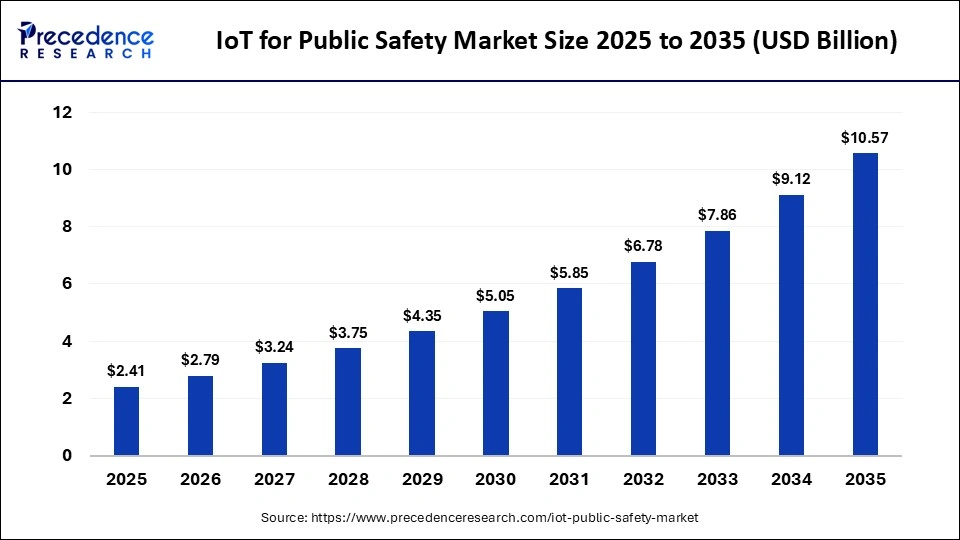
The global IoT for public safety market size is calculated at USD 2.41 billion in 2025 and is predicted to increase from USD 2.79 billion in 2026 to approximately USD 10.57 billion by 2035, expanding at a CAGR of 12.93% from 2026 to 2035. The market is experiencing significant growth due to the increasing integration of AI and data analytics, which support the development of more advanced, predictive, and real-time public safety solutions. At the same time, rising urbanization and the growth of smart city initiatives worldwide are driving the need for innovative solutions for surveillance, emergency communication, and disaster management. IoT systems help address these needs by providing improved situational awareness and faster response times.
Market Highlights
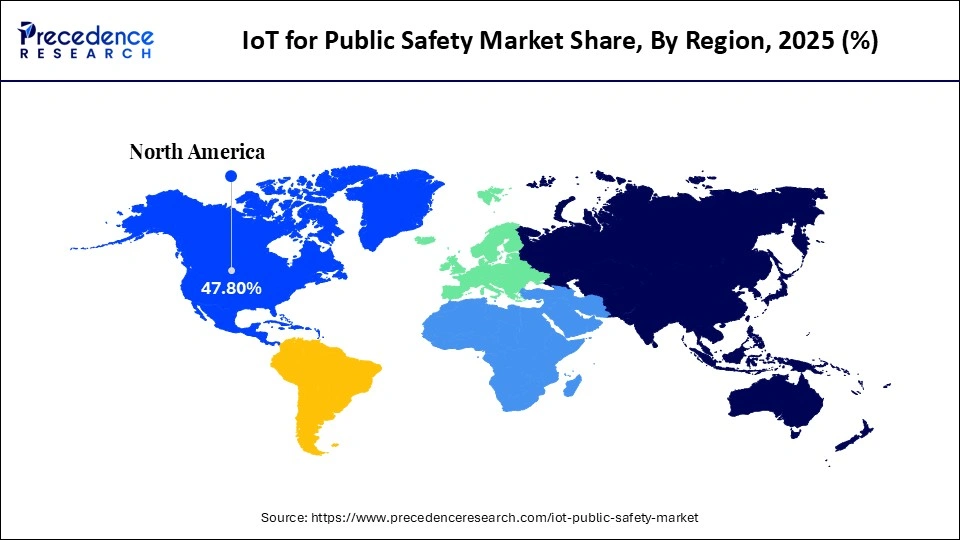
- North America held the largest market share of 47.8% in 2025.
- Asia Pacific is expected to grow at the fastest CAGR of 12.5% during the foreseeable period.
- By component, the solutions segment held the largest market share of 72.7% in 2025.
- By component, the services segment is expected to grow at a 11.1% CAGR from 2026 to 2035.
- By solution type, the surveillance systems segment held the largest market share of 32.4% in 2025.
- By solution type, the disaster management segment is expected to expand at the fastest CAGR of 10.9% during the foreseeable period.
- By service type, the professional services segment led with 72.5% of market share in 2025.
- By service type, the managed services segment is expected to grow at the fastest CAGR of 10.8% during the foreseeable period.
- By application, the crime detection & prevention segment led the market with a 34.3% share in 2025.
- By application, the disaster response segment is expected to grow at the fastest CAGR of 11.2% during the foreseeable period.
What is IoT for Public Safety Market?
The IoT for public safety market includes technologies, devices, platforms, and services that leverage IoT connectivity to enhance emergency response, disaster management, law enforcement, infrastructure monitoring, and public protection. It integrates sensors, real-time analytics, surveillance systems, communication networks, and cloud platforms to improve situational awareness and decision-making. Growth is driven by rising smart city initiatives, increasing natural disasters, expanding use of predictive analytics, and government investments in connected public safety solutions for proactive monitoring and rapid incident response.
How is AI Impacting the IoT for Public Safety Market?
Artificial intelligence (AI) is transforming the global market. AI analyzes video feeds from IoT cameras to identify unusual activities, weapons, or people, triggering automatic alerts for security teams. AI processes large amounts of IoT data into actionable insights for better decision-making in real-time. It also examines traffic flow from sensors, optimizing routes and issuing alerts to prevent accidents, which enhances public transportation safety. Furthermore, AI reviews extensive datasets from various IoT sources to predict crime hotspots and provides real-time situational awareness to first responders.
IoT for Public Safety Market Outlook
- Industry Growth Overview: The IoT for public safety market is poised for strong growth from 2026 to 2035. This growth is primarily driven by increasing urbanization, government initiatives to build smart cities, and the rising demand for enhanced security measures and efficient emergency response systems.
- Global Expansion: The market is expanding worldwide, driven by smart city initiatives, advanced technology integration, and the higher demand for efficient emergency response. Emerging regions offer immense opportunities in the market, supported by growing digitization across industries and rising adoption of connected devices for real-time monitoring.
- Major Investors: Many prominent technology companies, including IBM, Microsoft, Hitachi Vantara, and Cisco Systems, are the primary investors and major players in the market. Furthermore, venture capital and government funding are also important, particularly for smart city deployments and cybersecurity.
- Startup Ecosystem: Various startup ecosystems are focusing on AI-driven video analytics, connected wearables for first responders, and specialized sensor technologies. Companies like Carbyne and SmartCone Technologies are actively developing cutting-edge solutions.
Market Scope
| Report Coverage | Details |
| Market Size in 2025 | USD 2.41 Billion |
| Market Size in 2026 | USD 2.79 Billion |
| Market Size by 2035 | USD 10.57 Billion |
| Market Growth Rate from 2026 to 2035 | CAGR of 12.93% |
| Dominating Region | North America |
| Fastest Growing Region | Asia Pacific |
| Base Year | 2025 |
| Forecast Period | 2026 to 2035 |
| Segments Covered | Component, Solution Type, Service Type, Application, and Region |
| Regions Covered | North America, Europe, Asia-Pacific, Latin America, and Middle East & Africa |
Segment Insights
Component Insights
What Made Solutions the Dominant Segment in the IoT for Public Safety Market?
The solutions segment dominated the market with a 72.7% share in 2025. This dominance is attributed to the increased adoption of comprehensive, ready-to-deploy systems that incorporate advanced technologies such as AI, video analytics, and cloud computing to enable effective implementation. Solutions combine multiple functions, such as real-time surveillance, incident detection, and emergency response coordination, into a single, integrated platform for public safety agencies to use from different vendors. By providing real-time data collection and analysis, these solutions greatly enhance situational awareness for first responders and command centers.
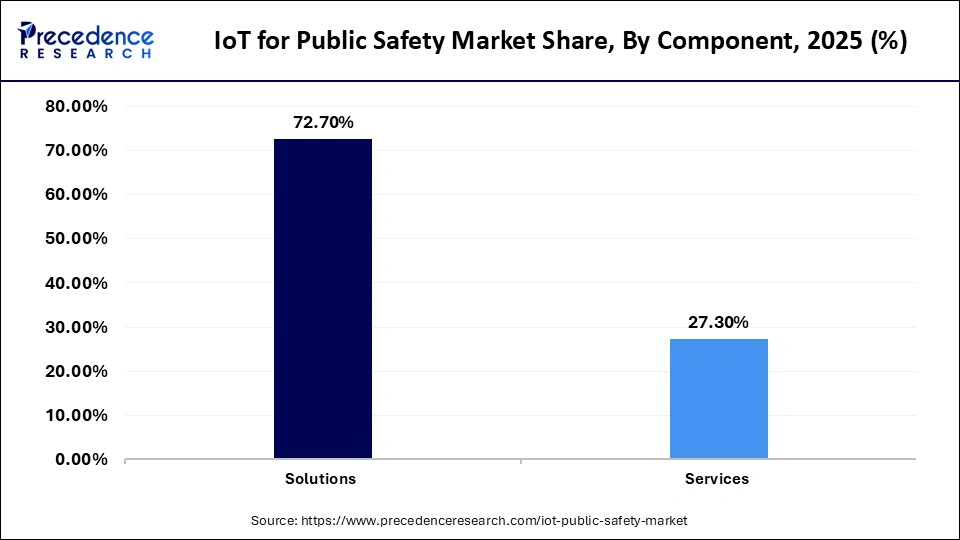
The services segment is expected to grow at a CAGR of 11.1% during the forecast period. This growth is primarily driven by increasing demand for specialized installation, integration, data analytics, consulting, and ongoing maintenance. Complex IoT deployments, rising smart city initiatives, and the need for actionable insights from large data streams to enable effective emergency response, cybersecurity, and proactive policing also boost the demand for services. Additionally, there is a high need for managed services to ensure systems function efficiently, stay secure, and deliver real-time intelligence to public safety agencies, thereby driving segmental growth.
Solution Type Insights
How Does the Surveillance Systems Segment Lead the IoT for Public Safety Market in 2025?
The surveillance systems segment led the market with a 32.4% share in 2025. This dominance results from the integration of AI, IoT, and Cloud technologies, enabling real-time, data-driven monitoring, faster threat detection, and better situational awareness for agencies. This leadership is further supported by smart city projects and the increased need for security measures. These systems provide comprehensive, scalable solutions for proactive policing and efficient emergency response, moving beyond simple monitoring to intelligent analysis, helping law enforcement anticipate and prevent incidents, and significantly enhancing public safety.
The disaster management segment is expected to grow at the fastest CAGR of 10.9% in the coming years. This growth is driven by the increasing frequency and severity of natural disasters, along with the proven effectiveness of IoT solutions in providing real-time data for early warning systems and improving response speed and coordination. Additionally, there is a growing emphasis on using IoT sensors to monitor the structural integrity of critical infrastructure such as bridges and dams for early detection of weaknesses and preventive maintenance, leading to more accurate forecasts and proactive mitigation strategies.
Service Type Insights
Why Did the Professional Services Segment Dominate the IoT for Public Safety Market in 2025?
The professional services segment dominated the market, accounting for a 72.5% share in 2025. This is because deploying complex IoT systems for emergency response, surveillance, and disaster management requires expert assistance in planning, system integration, data analytics, and cybersecurity. Also, these services involve consulting and leadership, as agencies need skilled partners to ensure effective, scalable, and secure deployments that can manage vast data and meet operational needs. These services also help agencies define roadmaps, select appropriate technologies, build architectures, and integrate diverse systems for seamless operation.
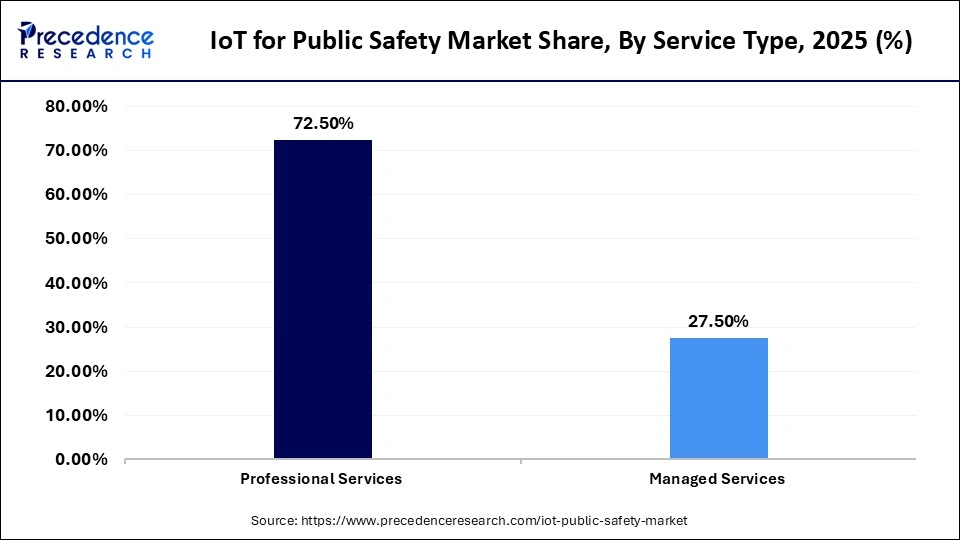
The managed services segment is expected to expand at the fastest CAGR of 10.8% over the projection period. This is mainly due to the growing need for affordable, specialized expertise and public safety agencies' desire to focus on their core operations rather than managing complex, evolving technology. Outsourcing to managed service providers eliminates the necessity for large investments in hardware, software, and hiring and training specialized IT staff, by transferring the responsibility of managing complex IT infrastructure, especially during emergencies, to external providers.
Application Insights
What Made Crime Detection & Prevention the Dominant Segment in the IoT for Public Safety Market in 2025?
The crime detection & prevention segment dominated the market with a 34.3% share in 2025. This leadership is driven by the widespread adoption of AI-powered smart cameras, smart sensors, and advanced analytics for real-time monitoring and predictive policing. These technologies are transforming traditional reactive policing into proactive crime prevention by providing data-driven insights, enhancing situational awareness, and improving resource allocation. The growth of this segment is further fueled by smart city initiatives and increased government investments in integrated security solutions. These efforts help identify high-risk areas and enable law enforcement agencies to strategically deploy resources, often before crimes occur.
The disaster response segment is expected to grow at a CAGR of 11.2% during the forecast period. This growth is largely driven by the increasing frequency of natural disasters, which fuels the demand for IoT-based early warning systems, real-time data for quicker and more coordinated responses, as well as the use of drones, wearables, and other technologies that improve situational awareness. These advancements help save lives and minimize damage by enabling better prediction and faster, more effective actions by emergency services. As a result, the shift from traditional, slower methods to proactive, data-driven crisis management positions disaster response as the fastest-growing sector in the market.
Regional Insights
How Big is the North America IoT for Public Safety Market Size?
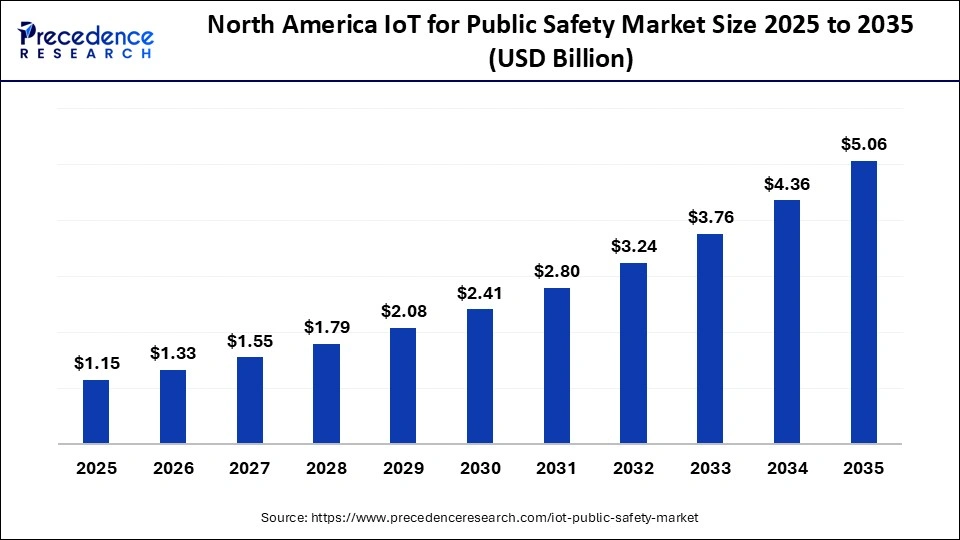
The North America IoT for public safety market size is estimated at USD 1.15 billion in 2025 and is projected to reach approximately USD 5.06 billion by 2035, with a 15.97% CAGR from 2026 to 2035.
What Made North America the Dominant Region in the IoT for Public Safety Market?
North America dominated the IoT for public safety market by capturing a 47.8% share in 2025. This leadership is primarily attributed to its advanced technological infrastructure, substantial government investments and support, the presence of key technology providers, and high adoption rates of innovative public safety solutions. The region is home to many leading technology companies, including IBM, Microsoft, Cisco Systems, and Motorola Solutions, which drive innovation and research & development. Additionally, North America's highly developed infrastructure facilitates the seamless integration and operation of complex IoT systems, supported by robust connectivity, including 5G networks.
What is the Size of the U.S. IoT for Public Safety Market?
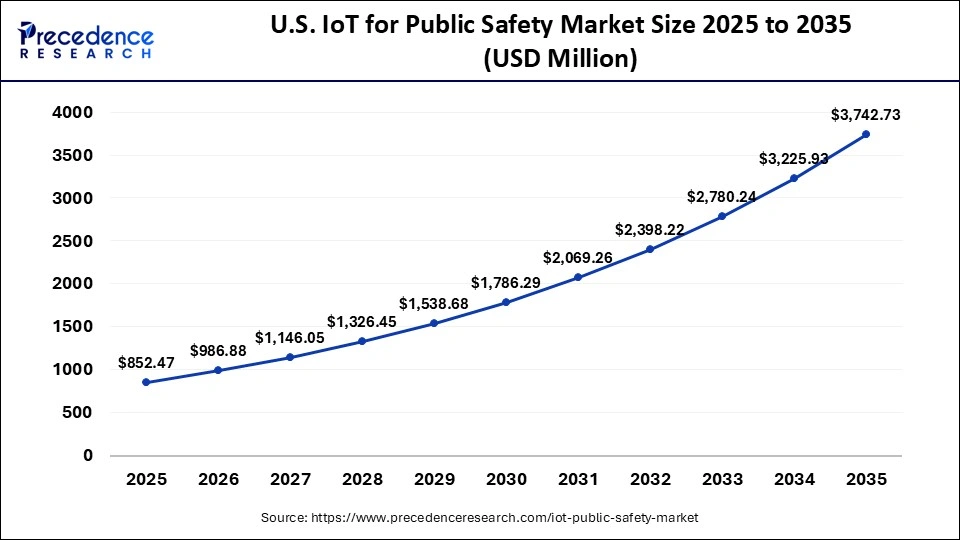
The U.S. IoT for public safety market size is calculated at USD 852.47 million in 2025 and is expected to reach nearly USD 3,742.73 million in 2035, accelerating at a strong CAGR of 15.94% between 2026 and 2035.
U.S. IoT for Public Safety Market Trends
The U.S. is a key player in the global market, capitalizing on its advanced infrastructure and high technology adoption to implement cutting-edge IoT solutions in areas such as smart surveillance, AI-driven traffic management, and disaster preparedness. The government is focusing on enhancing public safety by making substantial investments and providing support for the development of homeland security and emergency response systems, thereby contributing to market growth.
Why is Asia Pacific is Considered the Fastest-Growing Region in the IoT for Public Safety Market?
Asia Pacific is expected to grow at the fastest CAGR of 12.5% over the forecast period. The regional market growth is driven by rapid urbanization, substantial government investment in smart city initiatives, and the widespread rollout of 5G networks. Countries in the region, particularly China, India, Japan, and South Korea, are investing heavily in digital transformation and smart city projects that integrate IoT to enhance public safety and emergency services. The region faces diverse security threats, including natural disasters and rising crime rates, necessitating advanced early-warning and monitoring systems powered by IoT, leveraging private-sector expertise and infrastructure.
India IoT for Public Safety Market Trends
In India, the market is driven by large government-led smart city initiatives and growing urbanization. Major projects include AI-based surveillance systems for prisons, predictive policing software, and drone use for disaster response and traffic management. The emphasis is on creating affordable solutions to address security issues in crowded urban areas, thereby contributing to market growth.
What Makes Europe a Notably Growing Area in the IoT for Public Safety Market?
Europe is a notably growing region in the market. The market in the region is driven by strong government support and investment, rapid growth of smart city projects, and a solid regulatory environment that emphasizes data protection and cybersecurity. The region benefits from a well-established technological ecosystem and the quick deployment of 5G networks, which allow for faster, more reliable data sharing for emergency services. Leading global and regional companies in the IoT and public safety sectors, such as Siemens AG, Bosch Software Innovations, Nokia Networks, and Thales Group, promote innovation and increase competition in the market.
Germany IoT for Public Safety Market Trends
Germany plays a major role in the European market and leads in technology integration, with the presence of key local vendors like Siemens and Bosch. The country focuses on data privacy and strong security measures while deploying smart environmental sensors for early disaster detection, such as floods and storms, as well as connected emergency vehicle systems. Moreover, there is a strong focus on enhancing public safety, which supports market growth.
How is the Opportunistic Rise of Latin America in the IoT for Public Safety Market?
Latin America is expected to experience an opportunistic rise in the market, driven by high crime rates, rising frequency of natural disasters, and smart city initiatives. Brazil and Mexico are leading the way in IoT adoption, driven by the integration of surveillance systems, real-time monitoring, and government investments across sectors like healthcare, transportation, and emergency response. This trend is creating strong demand for IoT security solutions and advanced data analytics to improve citizen safety and operational efficiency. Furthermore, high crime rates, the threat of terrorism, and frequent natural disasters are fueling the need for smart surveillance and faster emergency response systems.
Brazil is actively addressing high crime rates and managing frequent natural disasters, such as floods and forest fires. The government is encouraging public-private partnerships and the adoption of real-time monitoring through integrated urban management platforms. These efforts include AI-driven surveillance and early warning systems in high-risk areas to enhance preparedness and response.
What Opportunities Exist in the Middle East & Africa (MEA) for the IoT for Public Safety Market?
The Middle East & Africa (MEA) offers significant opportunities for the market, driven by significant smart city investments, rapid urbanization, and strong government support for digital transformation. This has led to increased demand for connected cameras, drones, and AI analytics to improve emergency response, smart surveillance, and secure critical infrastructure management, particularly amid the rising adoption of 5G technology and heightened cybersecurity focus. Substantial investments in smart cities in the GCC and beyond further fuel demand for IoT in traffic management, waste management, and public safety, including surveillance and emergency systems.
UAE IoT for Public Safety Market Trends
The UAE is also actively shaping the market by adopting advanced technologies as part of its vision for future smart cities and national security. The region has seen collaborations, such as Nokia's partnership with the Dubai government's security network provider, Nedaa, to develop innovative 5G network slicing specifically for smart city and public safety applications.
Ked Advancements Impacting the IoT for Public Safety
| Emerging Innovation | Key Technologies Involved | Impact on Public Safety Market |
| AI-Powered Predictive Policing | Data analytics, ML algorithms, social media monitoring, and historical crime data analysis | Enables predictive policing and threat detection, enabling proactive resource deployment and reducing crime rates. |
| 5G Network Integration | High-speed, low-latency connectivity | Facilitates faster emergency response times, seamless communication for first responders, and reliable real-time video feeds. |
| Smart Surveillance & Video Analytics | IoT cameras, AI, ML, motion/behavior detection sensors | Enhances law enforcement situational awareness, leading to more efficient and targeted responses to security threats. |
| Connected Wearables for First Responders | Biometric sensors, GPS, robust communication modules | Improves the safety and well-being of front-line personnel and enhances coordination during emergencies. |
| Disaster Early Warning Systems | Environmental sensors, automated alert systems | Significantly reduces response times, minimizes damage during incidents, and can help save lives by initiating action immediately. |
| Drone-Assisted Response & Data Collection | UAVs, IoT sensors, aerial imagery, MEC | Facilitates damage assessment and data collection in hazardous areas, improving situational awareness during disasters. |
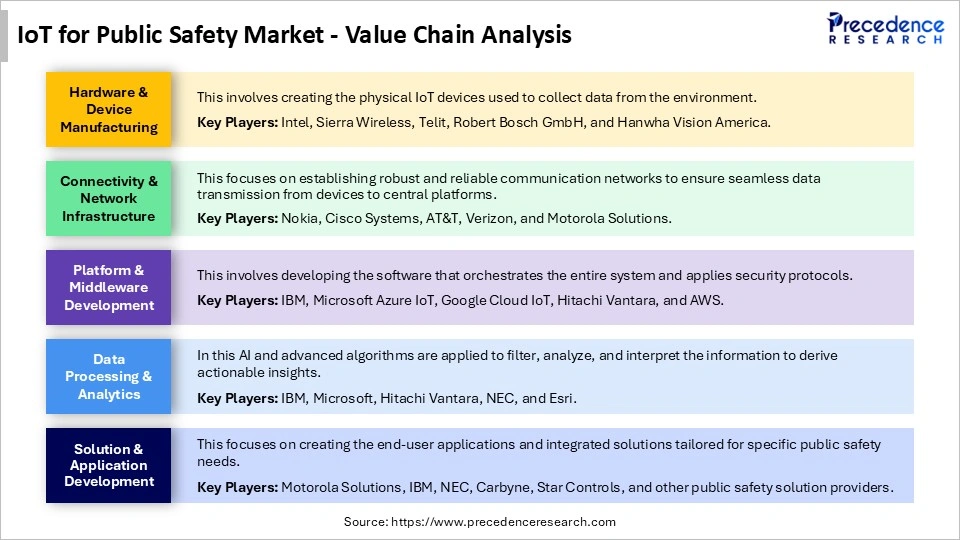
IoT for Public Safety Value Chain
Top Companies in the IoT for Public Safety Market and Their Offerings
- Cisco Systems: Offers a comprehensive portfolio of connected safety and security solutions, including video surveillance and analytics, physical access management, and the Cisco IP Interoperability and Collaboration System (IPICS).
- IBM: Offerings include the IBM Intelligent Operations Center for Emergency Management, which uses real-time data to provide situational awareness and support decision-making.
- Nokia: Focuses on mission-critical communication networks, offering private LTE/5G infrastructure for first responders.
- Hitachi: Offers Hitachi Visualization Suite (HVS for real-time crime prevention and investigation. It also offers IoT solutions for worker safety, using wearables and sensors to monitor health and location in hazardous environments.
- NEC Corporation: A major player in the market, known for its expertise in integrating data from various sources to provide comprehensive public safety platforms.
Other Key Players
- Huawei
- Sierra Wireless
- Telit
- Honeywell
- Motorola Solutions
- AT&T
- Verizon
- Bosch Security Systems
- Thales Group
- Microsoft
Recent Developments
- In October 2025, JVCKENWOOD Corporation announced its acquisition of ESChat to enhance its Communications Systems Business focused on public safety. ESChat, with over 700,000 global users, provides reliable broadband PTT services that support various communication devices. Its recent FedRAMP authorization strengthens its credibility for federal use. (Source: https://www.criticalcommunicationsreview.com)
- In October 2025, IBM introduced new product capabilities aimed at helping enterprises advance beyond AI experimentation and improve productivity across various workflows. The TechXchange event highlighted IBM's developments in agentic AI, hybrid cloud, quantum computing, and intelligent infrastructure. Dinesh Nirmal, Senior Vice President of IBM Software, stated that these advancements will help clients streamline their technology lifecycles and enhance developer productivity.(Source: https://newsroom.ibm.com)
- In March 2025, NEC Corporation India launched enhanced solutions as part of its Global Smart City Suite. This includes NEC Mi-Command, Mi-City, Mi-Eye, and Mi-WareSync, which aim to improve management and decision-making for organizations, thereby enhancing citizen engagement. These technologies reflect NEC's commitment to leveraging India's engineering talent to foster global growth and address evolving community needs.(Source: https://av-icnx.com)
Segments Covered in the Report
By Component
- Solutions
- Services
By Solution Type
- Critical Communication
- Surveillance Systems
- Incident Management
- Disaster Management
- Traffic Monitoring
- Cybersecurity
By Service Type
- Professional Services
- Managed Services
By Application
- Emergency Communication
- Disaster Response
- Crime Detection & Prevention
- Fire & Safety Monitoring
- Critical Infrastructure Security
- Environmental Monitoring
By Region
- North America
- Europe
- Asia-Pacific
- Latin America
- Middle East and Africa
For inquiries regarding discounts, bulk purchases, or customization requests, please contact us at sales@precedenceresearch.com
Frequently Asked Questions





Ask For Sample
No cookie-cutter, only authentic analysis – take the 1st step to become a Precedence Research client
 Get a Sample




 sales@precedenceresearch.com
 Schedule a Meeting
