



Radiotherapy Monitoring Devices Market Size, Companies, Share, Patient Volume, Treatment Adoption Rates, Pricing Analysis, Regulatory Landscape, Competitive Positioning, and Demand Forecast
Radiotherapy Monitoring Devices Market (By Device: Imaging devices, Sensors and detectors, Treatment planning systems; By End-User: Hospitals, Diagnostic centers, Cancer research institutes; By Component: Hardware, Software) - Global Industry Analysis, Size, Trends, Leading Companies, Regional Outlook, and Forecast 2026 to 2035
Source: https://www.precedenceresearch.com/radiotherapy-monitoring-devices-market
 Get a Sample
 Table Of Content


What is Radiotherapy Monitoring Devices Market Size in 2026?
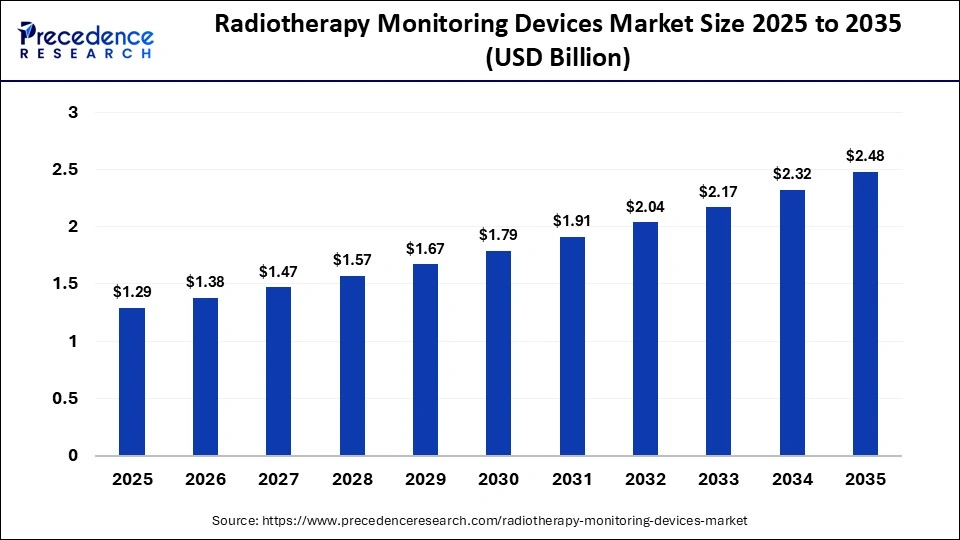
The global radiotherapy monitoring devices market size was calculated at USD 1.29 billion in 2025 and is predicted to increase from USD 1.38 billion in 2026 to approximately USD 2.48 billion by 2035, expanding at a CAGR of 6.74% from 2026 to 2035. The market is rapidly growing due to the rising cancer prevalence, technological innovations in radiation delivery, and the adoption of AI in radiotherapy, enabling more accurate tumor targeting and improved treatment planning drive demand for intelligent, connected monitoring devices. The increased use of diagnostic imaging tools contributes to the overall rise in radiation-related healthcare, boosting the need for monitoring solutions.
Key Takeaways
- North America held the largest market share in 2025.
- Asia-Pacific is expected to grow at the fastest CAGR during the foreseeable period.
- By device, the imaging devices segment held the largest market share in 2025.
- By device, the sensors and detectors segment is expected to grow at the fastest CAGR during the forecast period.
- By end-user, the hospitals segment held the largest market share in 2025.
- By end-user, the diagnostic centers segment is expected to grow at the fastest CAGR between 2026 and 2035.
- By component, the hardware segment held the largest market share in 2025.
- By component, the software segment is expected to grow at the fastest CAGR during the foreseeable period.
What are Radiotherapy Monitoring Devices?
The radiotherapy monitoring devices market comprises various devices, such as in-room imaging, patient positioning sensors, and electronic dosimeters, designed to track tumor location and measure radiation dose delivery in real time. These devices are most commonly used in image-guided radiotherapy, intensity-modulated radiotherapy, and stereotactic radiosurgery, where they significantly improve treatment precision.
Its major benefits include the maximization of tumor control, sparing of healthy surrounding tissue, reduction of side effects, and enhanced patient safety through continuous, real-time monitoring. The market growth is driven by the rising global prevalence of cancer, the increasing demand for personalized and precise cancer treatment, and the integration of AI for real-time tracking.
How is AI Influencing the Radiotherapy Monitoring Devices Market?
The integration of AI, specifically machine learning (ML), is significantly transforming the radiotherapy monitoring devices industry by automating complex, time-consuming tasks and enhancing the precision of cancer treatment. This technology allows for the rapid, automated segmentation of tumors and organs at risk, reducing contouring time from hours to minutes while improving consistency and reducing human errors. In addition to planning, AI enables real-time adaptive radiotherapy by analyzing daily imaging data, such as cone-beam CT (CBCT), to adjust dosages on the fly based on daily anatomical changes in the patient. ML is increasingly integrated into predictive analytics to forecast potential treatment complications and patient-specific responses, tailoring therapies to individual needs.
Radiotherapy Monitoring Devices Market Trends
- Surface-Guided Radiation Therapy: The rise of surface-guided radiation therapy, SGRT, has emerged as a standard-of-care, using optical sensors to track a patient's skin surface in real-time to ensure accurate positioning and motion monitoring, and deep-inspiratory breath-holding techniques.
- Adaptive Radiotherapy: Adoption of real-time adaptive radiotherapy enables clinicians to adjust the treatment plan during a patient's session based on daily, high-resolution imaging.
- Solid-State Sensors: The strong shift towards smaller, solid-state detector technology in personal dosimeters and area monitors propels market growth. These wearable devices allow for continuous, real-time exposure monitoring for personal and the move towards solid-state sensors offers superior resolution and durability.
- Portable Devices: The development of low-cost and portable solutions, increasing trends towards portable and affordable linear accelerators and monitoring equipment, also boost the market.
Market Scope
| Report Coverage | Details |
| Market Size in 2025 | USD 1.29 Billion |
| Market Size in 2026 | USD 1.38 Billion |
| Market Size by 2035 | USD 2.48 Billion |
| Market Growth Rate from 2026 to 2035 | CAGR of 6.74% |
| Dominating Region | North America |
| Fastest Growing Region | Asia Pacific |
| Base Year | 2025 |
| Forecast Period | 2026 to 2035 |
| Segments Covered | Device, End-User, Component, and region |
| Regions Covered | North America, Europe, Asia-Pacific, Latin America, and Middle East & Africa |
Segmental Insights
Device Insights
Why Did the Imaging Devices Segment Lead the Radiotherapy Monitoring Devices Market?
The imaging devices segment led the market by holding the largest share in 2025. This is because of the rising global cancer burden and a decisive shift toward non-invasive, complex modalities, such as proton therapy, which demand rigorous real-time monitoring to safeguard healthy tissue. The integration of hybrid imaging and automated compliance tools is no longer a luxury but a critical requirement for meeting stringent international safety standards. These advancements are transforming radiotherapy from a standardized procedure into a highly personalized, data-driven discipline that prioritizes both clinical efficacy and patient safety.
The sensors and detectors segment is expected to show the fastest growth over the forecast period, due to transitional real-time monitoring from clinical advantages to a fundamental necessity for protecting healthy tissue. The stringent global regulatory mandates from the IAEA and FDA necessitate the adoption of advanced, fail-safe dosimetry protocols. The miniaturization of solid-state detector technology is streamlining these safety workflows, making high-fidelity monitoring more accessible across diverse clinical settings.
End-User Insights
How the Hospitals Segment Dominated the Radiotherapy Monitoring Devices Market?
The hospitals segment held a dominant position in the market in 2025, because hospitals have a robust infrastructure and the ability to manage the high capital expenditure required for sophisticated, AI-enabled monitoring systems. The institutional need to comply with stringent ALARA safety mandates, ensuring both patient and staff protection through advanced dosimetry. The hospitals remain the critical anchor for market growth, bridging the gap between high-volume patient needs and the cutting edge of precision radiotherapy.
The diagnostic centers segment is expected to gain the highest market share between 2026 and 2035, due to faster and more convenient alternatives to traditional hospital settings. These centers are acting as early adopters of AI-assisted, solid-state monitoring systems, leveraging high-precision technology to meet the rising clinical needs of the growing global cancer population, particularly within the APAC region. The shift is supported by aggressive infrastructure investments in developing economies like India and China, where private centers are increasingly mandated to implement automated safety protocols to ensure regulatory compliance.
Component Insights
Which Component Segment Led the Radiotherapy Monitoring Devices Market?
The hardware segment led the market in 2025, as injections serve as high-capital equipment, such as linear accelerators and ion chambers, forming the indispensable physical foundation of any radiotherapy department. Mandatory regulatory compliance with global bodies like the IAEA and NRC necessitates the constant use of calibrated, hardware-based dosimeters to ensure both patient and occupational safety. The continuous innovation in solid-state detectors and IoT-enabled wearables is driving a massive replacement cycle as clinics upgrade from legacy systems to real-time monitoring solutions.
The software segment is expected to witness the fastest growth in the market over the forecast period, due to a software-led evolution that enables the transition to highly personalized treatments, such as proton therapy, where complex dose calculations must precisely spare healthy tissue. Beyond clinical efficacy, advanced data management platforms now allow for the seamless, multi-vendor monitoring of radiation exposure, ensuring strict adherence to global safety and documentation standards. The rising cancer prevalence and sophisticated software for real-time motion management have led to market growth.
- In October 2025, IBM's AI product launches, the value is shifting toward "Agentic AI" and Adaptive Radiotherapy (ART) software. Software enables real-time data analytics and autonomous plan adjustments, carrying higher margins and recurring subscription revenue.
Regional Insights
Why North America Dominated the Radiotherapy Monitoring Devices Market?
North America registered its dominance in the market in 2025. This is mainly due to a sophisticated healthcare infrastructure that supports the advanced modalities, such as IMRT and proton therapy. The significant FDA and OSHA safety mandates necessitate the universal adoption of high-precision dosimeters and real-time monitoring to protect both patient and specialized personnel.
There is a global hub for innovation, where industry leaders, such as Varian and Mirion Technologies, are actively integrating AI and IoT-enabled detectors into clinical workflows to manage an aging demographic. The high healthcare expenditure and a centralized network of elite cancer centers ensure that radiotherapy monitoring advancements.
U.S. Market Analysis
The market in the U.S. is growing due to the technological transition toward cloud-based digital dosimetry, which streamlines regulatory reporting and allows for seamless data integration across hospital information systems. The adoption of miniaturized solid-state detectors and wearable sensors is providing unprecedented accuracy in monitoring personal radiation exposure for both patients and staff. Ultimately, these innovations driven by stringent U.S. safety mandates and a rising cancer burden, are establishing a highly automated, data-driven ecosystem that prioritizes clinical efficiency and maximum patient safety.
How is Asia-Pacific Growing in the Radiotherapy Monitoring Devices Market?
Asia-Pacific is expected to host the fastest-growing market in the coming years, due to the combination of rising clinical volumes, stricter regulatory frameworks, and expanded reimbursement policies, positioning APAC as the primary global engine for next-generation radiation monitoring adoption. Governments in emerging economies like India and China are aggressively upgrading clinical facilities with advanced IMRT and proton therapy systems, which fundamentally require high-precision monitoring to maintain ALARA safety standards.
China Market Analysis
In China, the market is evolving due to the domestic production of high-performance, cost-effective medical devices to reduce import dependency. The rapid clinical adoption of AI-powered adaptive CT-Linac systems and IoT-integrated sensors is enabling near-real-time data accuracy, fundamentally enhancing patient safety across a surging oncology sector. The rise of digital dosimetry and wearable detectors is ensuring stricter adherence to national safety regulations while providing more reliable exposure analytics for healthcare professionals.
Will Europe Grow in the Radiotherapy Monitoring Devices Market?
Europe is expected to grow at a notable CAGR in the foreseeable future, driven by heavy infrastructural investments in leading economies like Germany, France, and the UK, where oncology departments are being upgraded with wireless, wearable detectors to maximize operational safety. Europe's focus on minimizing treatment side effects through digitized, high-fidelity tracking is setting a global benchmark for standardized, high-quality radiation protection. The world's most stringent safety frameworks, such as Euratom, mandate rigorous, real-time dosimetry for both patients and healthcare professionals.
Germany Market Analysis
Germany's stringent regulatory landscape mandates the use of high-precision tools like solid-state detectors and OSL technology to minimize healthy tissue damage in advanced modalities like proton therapy. The adoption of miniaturized, wearable monitoring devices is enhancing both patient comfort and continuous occupational safety across modern oncology departments. The aging populations drive an increase in complex cancer cases; these technological upgrades are becoming the indispensable standard for modernizing European cancer care infrastructure.
What Makes Latin America a Significantly Growing Region in the Radiotherapy Monitoring Devices Market?
Latin America is considered to be a significantly growing area, due to the increasing healthcare expenditure aimed at replacing aging infrastructure with advanced linear accelerators that necessitate sophisticated, real-time dosimetry and safety monitoring. The rise of medical tourism in the region is compelling providers to adopt international safety standards, fueling the demand for portable, cost-effective dosimeters and area monitors to ensure ALARA compliance.
Which Factors Drive the Market in the Middle East and Africa?
The Middle East and Africa are expected to grow at a considerable CAGR in the upcoming period, due to the integration of AI-driven treatment planning and real-time monitoring tools like SGRT, which ensure the high-precision tumor targeting required for reducing treatment complications. The stricter regulatory mandates from bodies like SAHPRA are enforcing universal compliance with safety protocols, fueling a high-growth services segment focused on the calibration and maintenance of these complex devices. Strategic public-private partnerships enable the region to successfully bridge technology gaps, providing sophisticated, less-invasive cancer care to a growing and increasingly health-conscious population.
Radiotherapy Monitoring Devices Market Comapnies
- Accuray Inc.
- Brainlab AG
- Best Medical International Inc.
- C RAD AB
- Fluke Corp.
- Elekta AB
- GE Healthcare Technologies
- LAP GmbH
- Koninklijke Philips NV
- Modus Medical Devices Inc.
- RaySearch Laboratories
- Orfit Industries NV
- ScandiDos AB
Recent Developments
- In February 2026, the American Society for Radiation Oncology (ASTRO) launched a national initiative, creating Authorized User Training Centers to bridge the gap in qualified physicians for radiopharmaceutical therapy (RPT) and improve patient access. Supported by an educational grant from Novartis, the program offers a no-cost, mentored pathway for training to address the increasing demand for targeted, precision cancer treatments. (Source: https://www.appliedradiationoncology.com)
- In September 2025, Philips introduced the Rembra RT and Areta RT CT platforms featuring NanoPanel Precise XD detectors, designed to enhance precision in radiation therapy with AI-driven, high-speed imaging. Additionally, the company launched the helium-free BlueSeal RT 1.5T MR system in North America, offering sustainable, AI-accelerated simulation to improve workflow efficiency and patient comfort. (Source: https://www.philips.com)
- In December 2025, GE HealthCare and Mayo Clinic launched Gemini-RT, a strategic initiative related to AI-enabled process automation, multi-modal connected care, and personalized monitoring across the radiotherapy journey. This collaboration focuses on pillars, automation, predictive oncology, multi-modal therapies, and outpatient monitoring, enhancing clinical outcomes and reducing clinical burdens.
Segments Covered in the Report
By Device
- Imaging devices
- Sensors and detectors
- Treatment planning systems
By End-User
- Hospitals
- Diagnostic centers
- Cancer research institutes
By Component
- Hardware
- Software
By Region
- North America
- Asia Pacific
- Europe
- Latin America
- Middle East & Africa
For inquiries regarding discounts, bulk purchases, or customization requests, please contact us at sales@precedenceresearch.com
Frequently Asked Questions





Ask For Sample
No cookie-cutter, only authentic analysis – take the 1st step to become a Precedence Research client
 Get a Sample
.webp)



 sales@precedenceresearch.com
 Schedule a Meeting
