



US AI in Medical Imaging Market Size, Key Companies, Company Market Share, Patient Volume, Treatment Adoption Rates, Pricing Analysis, Regulatory Landscape, Competitive Positioning, and Demand Forecast
Rohan Patil, a Healthcare Industry Expert, highlights that the US AI in medical imaging market has reached USD 909.63 billion in 2026 and is on track to reach USD 7,640.97 billion by 2035, advancing at a CAGR of 26.71%. Key US AI in medical imaging market companies shaping the market include GE HealthCare, Microsoft, Digital Diagnostics Inc., while major growth segments span technology, application, modalities, end use.
Source: https://www.precedenceresearch.com/us-ai-in-medical-imaging-market
 Get a Sample
 Table Of Content


US AI in Medical Imaging Market Size and Forecast 2026 to 2035
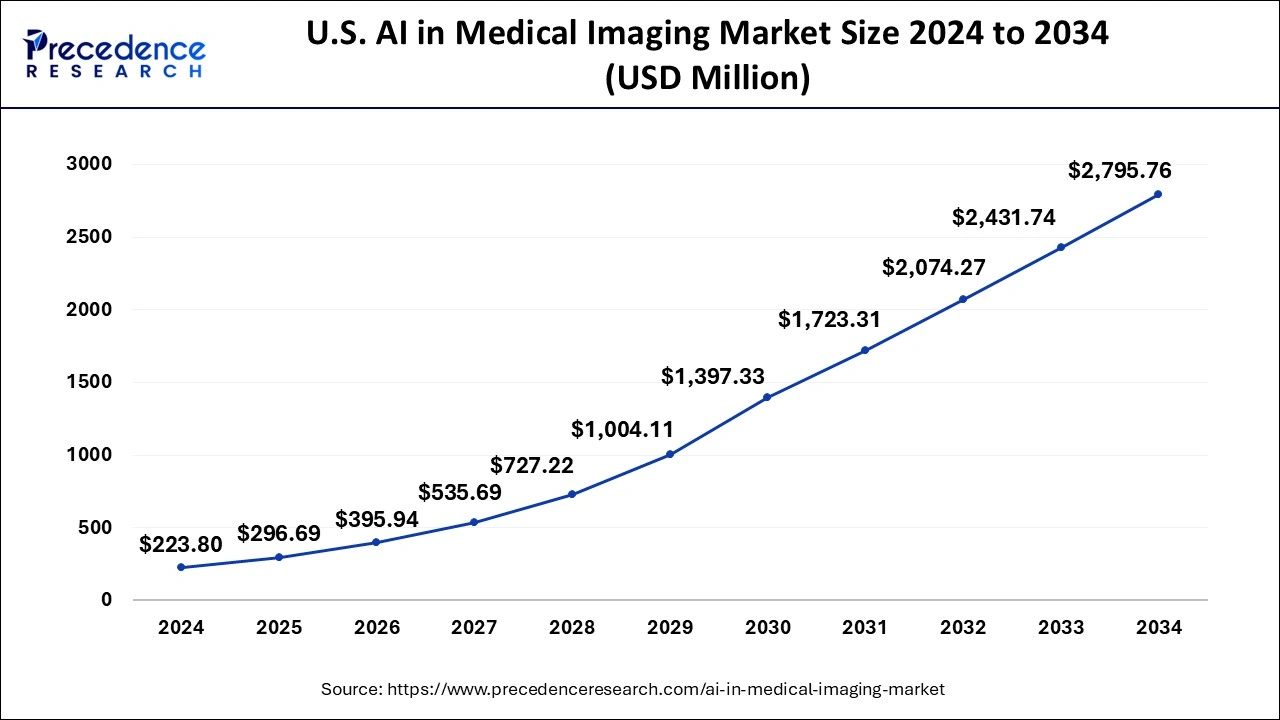
The US AI in medical imaging market size accounted for USD 716.22 billion in 2025 and is predicted to increase from USD 909.63 billion in 2026 to approximately USD 7,640.97 billion by 2035, expanding at a CAGR of 26.71% from 2026 to 2035. The market growth is attributed to rising adoption of AI-powered diagnostic tools, increasing imaging volumes, and expanding FDA-cleared imaging applications across healthcare systems.
Key Takeaways
- By technology, the deep learning segment held the largest market share in 2025.
- By technology, the natural language processing (NLP) segment is expected to expand with the highest CAGR during the forecast period.
- By application, the neurology segment held the largest share of the market in 2025.
- By application, the cardiology segment is expected to grow at the fastest CAGR between 2026 and 2035.
- By modalities, the X-rays segment held the highest market share in 2025.
- By modalities, the ultrasound segment is expected to grow with the highest CAGR during the forecast period.
- By end use, the hospitals segment dominated the market in 2025.
- By end use, the diagnostic imaging centers segment is expected to grow with the highest CAGR during the forecast period.
Market Overview
The U.S. AI in medical imaging market is driven by the growing need for faster and more accurate diagnostic imaging solutions. In medical imaging, AI algorithms apply machine learning and deep learning techniques to analyze data from X-rays, magnetic resonance imaging (MRI), mammograms, and ultrasound (US) images. The technologies enable the radiologist to detect an abnormality, request a more critical study, and increase their diagnostic confidence in all types of clinical situations.
The U.S. FDA has listed a large growth in the number of AI-powered medical devices approved for healthcare use, with radiology being the biggest category. A recent peer-reviewed study revealed that among the 950 AI and machine learning medical devices that have been given FDA authorization, 723 were created for radiology applications. The growing demand for imaging and continued labor shortages in radiology throughout the country drive market growth.
Market Report Coverage and Key Metrics
| Report Coverage | Details |
| Market Size in 2025 | USD 716.22 Billion |
| Market Size in 2026 | USD 909.63 Billion |
| Market Size by 2035 | USD 7,640.97 Billion |
| Market Growth Rate from 2026 to 2035 | CAGR of 26.71% |
| Base Year | 2025 |
| Forecast Period | 2026 to 2035 |
| Segments Covered | Technology, Application, Modalities, and End Use |
Market Dynamics
Drivers
Rising Diagnostic Imaging Volumes Across Healthcare Systems
Rising diagnostic imaging volumes across U.S. healthcare systems are expected to accelerate the market in the coming years. Hospitals and imaging centers process increasing numbers of CT, MRI, X-ray, mammography, and ultrasound examinations each year, creating substantial workloads for radiology departments.
- According to the Read My MRI 2025 report, approximately 150 to 200 million MRI scans are performed each year globally.
AI programs help with workflow optimization by enabling image triage, automated measurement, and tracking for abnormalities. Furthermore, the rising need for early disease detection and precision diagnostics is set to be a key driver for the market.
Restraint
High Implementation and Integration Costs
High implementation and integration costs across healthcare facilities are expected to fuel the market in the coming years. Adopting a comprehensive software solution, cloud infrastructure, data storage, and computing platforms can be a major expense for hospitals. Additionally, restraining broader technology adoption, data privacy, and cybersecurity concerns are anticipated to remain significant challenges across medical imaging environments.
Opportunity
Increasing FDA Clearances for AI-Enabled Imaging Solutions
Increasing FDA clearances for AI-enabled imaging solutions are projected to create immense opportunities for the players competing in the market. Expansion of commercial opportunities across the healthcare imaging value chain is expected as more FDA clearances of AI-powered imaging devices come to market.
Ongoing approval of imaging algorithms increases the availability of approved products in multiple diagnostic areas. Moreover, the surging investments in healthcare AI and imaging informatics are estimated to drive technological advancements throughout the U.S. imaging sector.
Market Segmentation Analysis
Technology Insights
The Deep Learning Segment Dominated the Market in 2025
The deep learning segment dominated the market in 2025 due to the technology's superior image recognition and pattern analysis capabilities. Deep learning algorithms ingest a vast amount of imaging information and can detect intricate anatomical structures in exams such as CT, MRI, mammograms, X-rays, and ultrasound scans.
In 2025, the FDA's database exceeded 1,000 AI-powered medical device authorisations across all medical specialties, and radiology accounted for the highest percentage of all authorisations.
The natural language processing (NLP) segment is expected to grow at a significant CAGR from 2026 to 2035, as healthcare providers seek greater value from unstructured clinical data. NLP technologies identify information that is actionable from radiology reports, physician notes, pathology records, and electronic health records. NLP systems have the capacity to break down complex imaging results into structured and searchable formats that further enhance the accessibility of diagnostic information.
Application Insights
The Neurology Segment Dominated the Market in 2025
The neurology segment dominated the market with a share in 2025 due to the critical need for rapid diagnosis of stroke, traumatic brain injury, aneurysms, and neurodegenerative disorders.
Around 795,000 people suffer from a stroke each year in the U.S., according to the American Stroke Association, creating a need for sophisticated diagnostic technologies. Furthermore, the growing adoption of AI-assisted triage solutions across comprehensive stroke centers further strengthened neurology's leadership position within the application landscape.
The cardiology segment is expected to grow at a significant CAGR between 2026 and 2035, supported by the rising volume of cardiovascular imaging procedures and increasing prevalence of heart disease.
Heart disease is the leading cause of death in the U.S. and is responsible for some 919,032 deaths in the country in 2023, according to the CDC. AI imaging platforms help clinicians to analyse cardiac imaging studies such as cardiac CT, cardiac MRI, echocardiography, and coronary imaging with efficiency and accuracy.
Modalities Insights
The X-rays Segment Dominated the Market in 2025
The X-rays segment dominated the market in 2025, fuelled by their widespread use in hospital workflows, orthopedics, primary care, pulmonary diagnostics, and emergency care. Furthermore, with AI-powered X-ray solutions, radiologists can identify fractures and any other abnormal conditions with superior workflow efficiency.
The ultrasound segment is expected to grow at a robust CAGR between 2026 and 2035, as healthcare providers increasingly adopt portable, real-time, and cost-effective imaging technologies. AI-based ultrasound solutions aid clinicians in image acquisition, anatomical structure identification, measurement automation, and interpretation of the diagnosis.
End Use Insights
The Hospitals Segment Dominated the Market in 2025
The hospitals segment held the largest market share in 2025 due to its high patient volumes, extensive imaging infrastructure, and broad adoption of advanced diagnostic technologies. Large hospital systems conduct a substantial number of CT scans, MRIs, X-rays, ultrasound, and mammography procedures every day, making AI-powered solutions for image analysis very demanding in these settings.
The diagnostic imaging centers segment is expected to expand rapidly between 2026 and 2035, as imaging procedures are increasingly carried out in specialty outpatient facilities. AI-driven imaging solutions aid diagnostic centers in keeping up with ever-increasing quantities of scans without compromising productivity and efficiency.
U.S. AI in Medical Imaging Market: Country-Level Analysis
Why Does California Dominate the Market?
The market in California is growing due to its presence of top health care institutions, AI developers, and medical imaging technology firms. Stanford Medicine, the University of California health system, and several prominent research centers continue advancing AI applications for radiology, oncology imaging, and neurological diagnostics. The arrival of big cloud computing and AI infrastructure companies is likely to further solidify California's market growth in the coming years.
U.S. AI in Medical Imaging Market Value Chain Analysis
- Imaging Data Generation & Acquisition
Hospitals, imaging centers, and healthcare networks generate large imaging datasets from CT, MRI, X-ray, ultrasound, and mammography systems.
Key Players: GE HealthCare, Siemens Healthineers, Philips, Canon Medical Systems, Fujifilm Healthcare.
- AI Algorithm Development & Training
Technology companies and research institutions develop and train AI models using annotated medical imaging datasets.
Key Players: Aidoc, Viz.ai, Qure.ai, Lunit, NVIDIA, Microsoft.
- Software Integration & Regulatory Validation
Developers integrate AI solutions into imaging workflows and obtain clinical validation and regulatory clearances.
Key Players: GE HealthCare, Siemens Healthineers, Philips, Aidoc, HeartFlow, FDA.
- Clinical Deployment & End-User Adoption
Healthcare providers deploy AI-enabled imaging platforms for diagnosis, workflow optimization, and clinical decision support.
Key Players: Mayo Clinic, Cleveland Clinic, Stanford Medicine, Johns Hopkins Medicine, Mass General Brigham.
Market Competitive Landscape: Leading Companies and Strategies
The U.S. AI in medical imaging market is moderately consolidated, with global imaging companies and specialized AI developers competing aggressively. Key players are GE HealthCare, Siemens Healthineers, Philips, Canon Medical Systems, Aidoc, Viz.ai, Qure.ai, Lunit, Annalise.ai, and HeartFlow. Large imaging vendors benefit from their built-up installed equipment bases and the integration of adequate platforms in healthcare. Companies providing specialized applications of AI in stroke detection, oncology imaging, and cardiovascular diagnostics boost their standing in the field.
In 2025, NVIDIA bolstered its efforts in healthcare imaging with the introduction of new NVIDIA Clara and MONAI platforms, and Microsoft reinforced its healthcare AI capabilities related to clinical imaging workflows. Lunit continued to see gains in the use of AI-enabled cancer detection technologies, while HeartFlow increased the use of AI-based coronary assessment solutions. Furthermore, future competition is expected to intensify as imaging vendors, AI specialists, and major technology companies expand investments in advanced diagnostic intelligence and next-generation healthcare AI solutions.
U.S. AI in Medical Imaging Market Companies
- GE HealthCare
- Microsoft
- Digital Diagnostics Inc.
- TEMPUS
- Butterfly Network, Inc.
- Advanced Micro Devices, Inc.
- HeartFlow, Inc.
- Enlitic, Inc.
- Canon Medical Systems USA, Inc.
- Viz.ai, Inc.
- EchoNous, Inc.
- HeartVista Inc.
- Exo Imaging, Inc
- Nano-X Imaging Ltd.
Recent Developments U.S. AI in Medical Imaging Market (2025-2026)
- In June 2026, Royal Philips formed a seven-year alliance with WellSpan Health to advance imaging and diagnostic technologies across Central Pennsylvania and Northern Maryland. This collaboration aims to enhance innovation, clinical research, and the adoption of AI-driven healthcare solutions in the regional network. (Source: https://www.philips.com)
- In May 2026, Medidata launched an enhanced AI-powered imaging solution within its Medidata Data Experience platform at the ASCO 2026 Annual Meeting. This upgraded technology uses advanced AI and feedback from clinical teams to improve imaging workflows, speed up image reviews, and enhance data accuracy, especially in oncology research.(Source: https://www.medidata.com)
Segments Covered in the Report
By Technology
- Deep Learning
- Natural Language Processing (NLP)
- Other
By Application
- Neurology
- Respiratory and Pulmonary
- Cardiology
- Breast Screening
- Orthopedics
- Others
By Modalities
- CT Scan
- MRI
- X-rays
- Ultrasound
- Nuclear Imaging
By End Use
- Hospitals
- Diagnostic Imaging Centers
- Others
For inquiries regarding discounts, bulk purchases, or customization requests, please contact us at sales@precedenceresearch.com
Frequently Asked Questions





Ask For Sample
No cookie-cutter, only authentic analysis – take the 1st step to become a Precedence Research client
 Get a Sample




 sales@precedenceresearch.com
 Schedule a Meeting
