



US Direct-To-Consumer Laboratory Testing Market Size, Companies, Share, Patient Volume, Treatment Adoption Rates, Pricing Analysis, Regulatory Landscape, Competitive Positioning, and Demand Forecast
US Direct-To-Consumer Laboratory Testing Market (By Product: Medical Genetic Laboratory Testing, Routine Clinical Laboratory Testing; By Test Type: Genetic Testing, COVID-19, Cancer, Diabetes Testing, Disease Risk Assessment Testing, Sexually Transmitted Disease Testing, Routine Testing, Complete Blood Count, CNS-related/Neurological Disease, Thyroid Stimulating Hormone Testing, Other; By Sample Type: Blood, Urine, Saliva, Others) - Industry Analysis, Size, Trends, Leading Companies, Regional Outlook, and Forecast 2026 to 2035
Source: https://www.precedenceresearch.com/us-direct-to-consumer-laboratory-testing-market
 Get a Sample
 Table Of Content


US Direct-To-Consumer Laboratory Testing Market Size and Forecast 2026 to 2035
The US direct-to-consumer laboratory testing market size accounted for USD 1.23 billion in 2025 and is predicted to increase from USD 1.34 billion in 2026 to approximately USD 2.92 billion by 2035, expanding at a CAGR of 9.03% from 2026 to 2035. The market growth is attributed to rising demand for preventive healthcare, personalized diagnostics, at-home testing solutions, and increasing adoption of digital laboratory platforms.
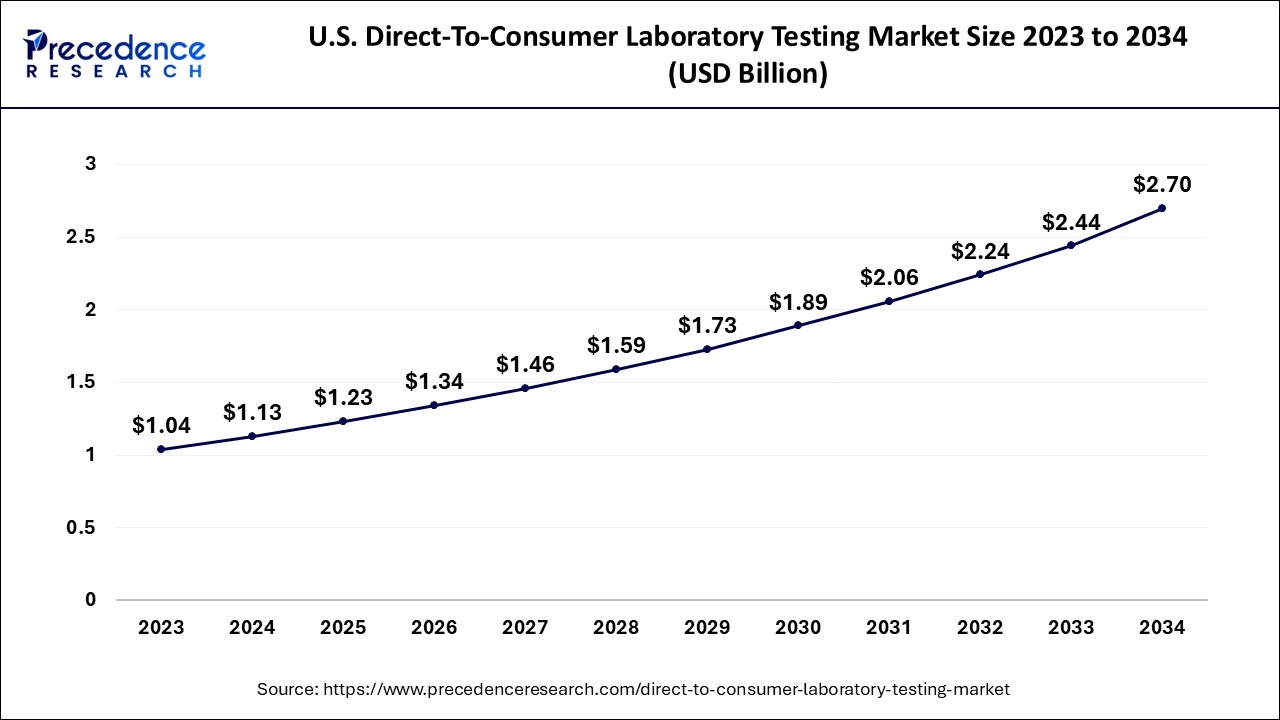
Key Takeaways
- By product, the routine clinical laboratory testing segment held the largest market share in 2025 and is expected to expand with the fastest CAGR during the forecast period.
- By test type, the genetic testing segment dominated the market in 2025.
- By test type, the disease risk assessment testing segment is expected to grow with the fastest CAGR between 2026 and 2035.
- By sample type, the saliva segment held the highest share of the market in 2025.
- By sample type, the blood segment is expected to grow with the fastest CAGR during the forecast period.
Market Overview
The U.S. direct-to-consumer laboratory testing market is driven by growing demand for preventive healthcare and personalized health management solutions. Direct-to-consumer (DTC) laboratory testing empowers consumers to order directly and independently test themselves for diagnostic results on digital platforms. The technology enables early detection of disease, wellness monitoring, and health-risk assessment without clinical pathways.
The Centers for Disease Control & Prevention (CDC) reports that almost 129 million Americans have one or more of the leading chronic conditions. The rise in the involvement in genomics and biomarker testing is also fueling the growth of the market and consumer engagement. Furthermore, the growing adoption of personalized healthcare and preventive screening remains a major driver supporting long-term market growth.
Impact of Artificial Intelligence on the United States Direct-To-Consumer Laboratory Testing Market
AI's influence on the United States direct-to-consumer laboratory testing industry has transformed the way health information is collected, understood, and shared with individuals, making tests more accessible, usable, and informative. Consumer-friendly reports and actionable recommendations generated by AI-powered platforms based on complex genomic, biomarker, and laboratory data. Additionally, AI can enrich the use of at-home testing by combining lab results with digital health and personalized wellness monitoring tools.
Market Report Coverage and Key Metrics
| Report Coverage | Details |
| Market Size in 2025 | USD 1.23 Billion |
| Market Size in 2026 | USD 1.34 Billion |
| Market Size by 2035 | USD 2.92 Billion |
| Market Growth Rate from 2026 to 2035 | CAGR of 9.03% |
| Base Year | 2025 |
| Forecast Period | 2026 to 2035 |
| Segments Covered | Product, Test Type, and Sample Type |
Market Dynamics
Drivers
Rising Demand for Preventive Healthcare and Early Disease Detection
Rising demand for preventive healthcare and early disease detection accelerates the growth of the market. Consumers are increasingly wanting to have quick, easy access to health information before health becomes an issue or develops.
Lab testing directly to consumers allows people to have their cholesterol, blood glucose, hormone, infectious disease, and nutritional results tested without visiting a physician for a referral. Regular health screening and risk assessment will gain interest, as about one in four Americans suffers from one or more major chronic diseases, according to the CDC.
Restraint
Concerns Regarding Test Interpretation and Clinical Accuracy
Concerns regarding test interpretation and clinical accuracy hinder market growth. The issues of interpretation of probabilistic genetic data and of non-diagnostic screening results remain a concern in healthcare. Moreover, the restrained industry growth through data privacy and health information security challenges is anticipated to affect consumer confidence across the testing landscape.
Opportunity
Growing Integration of Digital Health Platforms and At-Home Testing Solutions
The growing integration of digital health platforms and at-home testing solutions is expected to create immense opportunities for market growth. The use of telehealth continues to play its supporting role in bringing diagnostic testing and health care consultation together.
Businesses are spending lots of money to create user-friendly interfaces to lessen the testing processes and increase consumer engagement. Additionally, the high consumer awareness of wellness monitoring and health optimization is estimated to strengthen demand for direct-access laboratory services.
Market Segmentation Analysis
Product Insights
The Routine Clinical Laboratory Testing Segment Dominated the Market in 2025
The routine clinical laboratory testing segment dominated the United States direct-to-consumer laboratory testing market in 2025 and is expected to sustain its dominance over the studied period, due to the growing need for easy health monitoring and frequent diagnostic tests. The increased consciousness of preventive health care is helping to drive demand for regular testing over single testing.
Laboratory testing is responsible for some 70% of medical decision-making, even though it consumes a small percentage of the healthcare budget, according to the American Clinical Laboratory Association (ACLA). Additionally, the growing consumer adoption of recurring wellness testing subscriptions and digital health monitoring platforms further supports long-term segment expansion.
The medical genetic laboratory testing segment is expected to grow at a significant CAGR from 2026 to 2035, driven by increasing use of consumer genomics for health management and preventive decision-making. Furthermore, the segment continued to strengthen through further investments by leaders in the space, including 23andMe, Myriad Genetics, Natera, and GeneDx, to expand their testing portfolios and fix the data interpretation system.
Test Type Insights
The Genetic Testing Segment Dominated the Market in 2025
The genetic testing segment dominated the United States direct-to-consumer laboratory testing market in 2025 due to the growing consumer demand for more knowledge about their inherited health risks, origin on earth, and personal wellness traits. Genomic testing, which was available via direct access, increasingly enabled a determination of carrier status, inherited cancer predispositions, cardiovascular predispositions, and the effect of drugs on metabolism.
The NHGRI reports that more than 7,000 rare diseases have been identified, and genetic factors play a significant role in several of the diseases. Additionally, the increasing availability of clinically actionable genomic findings continued to strengthen demand for direct-access genetic testing services.
The disease risk assessment testing segment is expected to grow at the highest CAGR between 2026 and 2035, supported by increasing emphasis on preventive healthcare and early health risk identification. The demand for disease risk assessment testing is expected to grow significantly as consumers look for proactive information on potential diseases. They assess markers, genetic markers, family history markers, and lifestyle markers to form a rough idea of the risk of contracting certain diseases.
Sample Type Insights
The Saliva Segment Dominated the Market in 2025
The saliva segment held the largest United States direct-to-consumer laboratory testing market share in 2025 due to the increasing preference for non-invasive sample collection and consumer-friendly testing experiences. The sample type eliminates the need for needles and simplifies the collection process for them to take home, increasing participation for a wider age range.
The blood segment is expected to gain the highest market share between 2026 and 2035, due to the broad clinical utility of blood biomarkers across preventive, wellness, and disease-monitoring applications. The ACLA estimates that blood tests help diagnose and treat many different types of medical conditions, which contributes to sustaining demand for blood testing. DTC providers broadened the availability of venous collection sites and now have at-home finger-prick testing options, enabling easier access for analytical quality that has not decreased.
United States Direct-To-Consumer Laboratory Testing Market: Country-Level Analysis
Why Did California Dominate the United States Direct-To-Consumer Laboratory Testing Industry?
The market in California is growing due to its strong concentration of genomics companies, advanced diagnostic laboratories, and precision medicine research activities. The innovative landscape in California also includes world-renowned centers, such as Stanford Medicine, UCSF, and the Salk Institute, and ongoing progress in genomics and personalized medicine research. The growing uptake of digital health solutions and preventive health services from consumers also drove demand for direct access testing solutions.
Why Is Texas Expected to Lead Future Growth in the United States Direct-To-Consumer Laboratory Testing Industry?
Texas is considered to be a significantly growing area, supported by an expanding population base, healthcare infrastructure investments, and increasing adoption of preventive health services. The state is home to the Texas Medical Center, which consists of over 60 medical and research institutions and is one of the biggest medical complexes in the world. Better infrastructure and increasing digital health use to support wider access to consumer-initiated testing. These aforementioned factors enable further market growth in the coming years.
US Direct-To-Consumer Laboratory Testing Market Value Chain Analysis
- Test Kit & Consumable Manufacturing
Manufacturers produce collection kits, reagents, assay materials, and laboratory consumables used in consumer testing services.
Key Players: Thermo Fisher Scientific, QIAGEN, Bio-Rad Laboratories, Agilent Technologies.
- Sample Collection & Logistics
Consumers provide blood, saliva, or other samples through at-home kits or collection centers, followed by secure transportation to laboratories.
Key Players: Everlywell, LetsGetChecked, Quest Diagnostics, Labcorp.
- Laboratory Testing & Data Analysis
Certified laboratories perform biomarker, genetic, and disease-risk analyses using advanced diagnostic and sequencing technologies.
Key Players: Quest Diagnostics, Labcorp, Natera, Myriad Genetics, GeneDx.
- Digital Reporting & Consumer Health Platforms
Testing providers deliver results through digital platforms with health insights, risk assessments, and personalized recommendations.
Key Players: 23andMe, Tempus AI, Helix, Everlywell, Color Health.
Market Competitive Landscape: Leading Companies and Strategies
The United States direct-to-consumer laboratory testing market is moderately consolidated, with major diagnostic laboratories and genomics companies holding significant competitive positions. The market is well consolidated with broad testing portfolios and existing laboratory infrastructure from Quest Diagnostics and other wide-range testing specialists, ranked from strong to medium presence. Significant entry barriers are caused by regulatory compliance and lab accreditation standards. Established participants benefit from strong brand recognition, extensive datasets, and nationwide operational capabilities.
Strategic collaborations, technology investments, and product innovation continue shaping the competitive environment. Expanding artificial intelligence further propelled Tempus AI's trailblazing work in data-driven health analytics. New uses for AI further bolstered Tempus AI's groundbreaking work in data-driven health analytics. Additionally, the growing investment in predictive analytics, bioinformatics, and at-home testing technologies is expected to reshape future competitive positioning across the industry.
US Direct-To-Consumer Laboratory Testing Market Companies
- OME Care
- Natera, Inc.
- Myriad Genetics, Inc.
- MyMedLab, Inc.
- Laboratory Corporation of America Holdings
- Home Access Health Corporation
- HealthCheckUSA
- Gene by Gene, Ltd.
- Full Genomes Corporation, Inc.
- EverlyWell, Inc.
- Direct Laboratory Services, LLC
- DanteLabs Inc.
- Counsyl, Inc.
- Color Genomics, Inc.
- Any Lab Test Now, Inc.
- Ancestry.com LLC
- Ambry Genetics Corp.
- 23andMe, Inc.
Recent Developments US Direct-To-Consumer Laboratory Testing Market (2025-2026)
- In June 2026, TestWell launched a personalized lab testing platform that allows consumers to choose and manage their health screenings easily, integrating test selection, physician collaboration, and transparent purchasing online.(Source: https://finance.yahoo.com)
- In May 2026, Diagnostic Orders Direct in Las Vegas expanded its virtual consultations to 30 states, providing direct-to-consumer access for imaging and lab tests for a flat fee of USD 40. Patients consult with a licensed professional to determine the appropriateness of imaging exams, with a recent eGFR lab test required for certain procedures.(Source: https://radiologybusiness.com)
Segments Covered in the Report
By Product
- Medical Genetic Laboratory Testing
- Routine Clinical Laboratory Testing
By Test Type
- Genetic Testing
- COVID-19
- Cancer
- Diabetes Testing
- Disease Risk Assessment Testing
- Sexually Transmitted Disease Testing
- Routine Testing
- Complete Blood Count
- CNS-related/Neurological Disease
- Thyroid Stimulating Hormone Testing
- Other
By Sample Type
- Blood
- Urine
- Saliva
- Others
For inquiries regarding discounts, bulk purchases, or customization requests, please contact us at sales@precedenceresearch.com
Frequently Asked Questions





Ask For Sample
No cookie-cutter, only authentic analysis – take the 1st step to become a Precedence Research client
 Get a Sample




 sales@precedenceresearch.com
 Schedule a Meeting
