



US DNA Synthesis Market Size, Share and Trends 2026 to 2035
US DNA Synthesis Market (By Service: Oligonucleotide Synthesis, Custom Oligonucleotide Synthesis, Pre-designed Oligonucleotide Synthesis, Gene Synthesis; By Application: Research and Development, Therapeutics, Diagnostic; By End-User: Biopharmaceutical Companies, Academic and Research Institutes, Contract Research Organizations) - Industry Analysis, Size, Trends, Leading Companies, Regional Outlook, and Forecast 2026 to 2035
 Get a Sample
 Table Of Content


US DNA Synthesis Market Size and Forecast 2026 to 2035
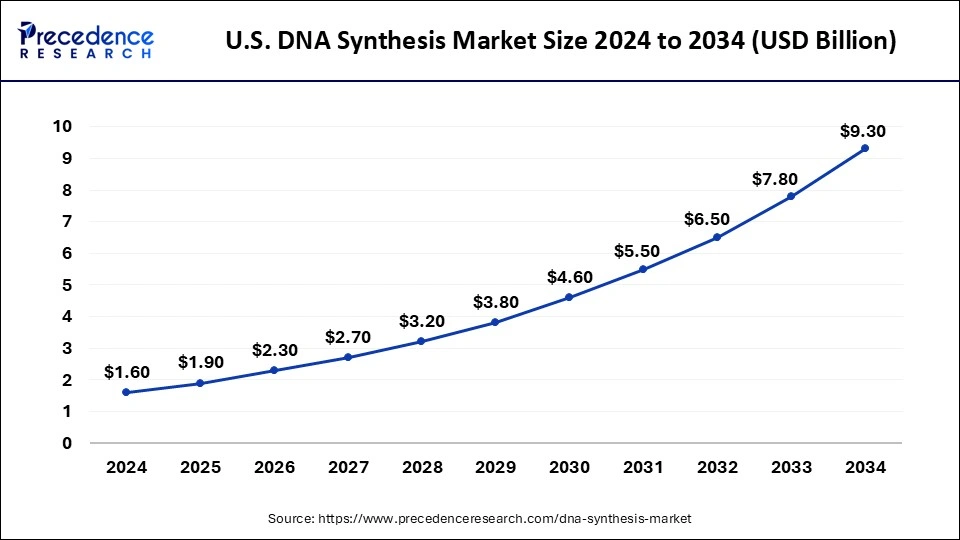
The US DNA synthesis market size was calculated at USD 1.90 billion in 2025 and is predicted to increase from USD 2.30 billion in 2026 to approximately USD 10.66 billion by 2035, expanding at a CAGR of 18.82% from 2026 to 2035. The growing investments in the biotechnology industry and technological advancements in the genetic engineering sector have accelerated the market expansion.
Key Takeaways
- By service, the oligonucleotide synthesis segment dominated the market in 2025.
- By service, the gene synthesis segment is expected to grow with a significant CAGR during the forecast period.
- By application, the research and development segment held the largest market share in 2025.
- By application, the therapeutics segment is expected to grow with the highest CAGR during the forecast period.
- By end-user, the biopharmaceutical companies segment held the highest market share in 2025.
- By end-user, the academic and research institutes segment is expected to grow at the fastest CAGR during the forecast period.
Market Overview
The U.S. DNA synthesis industry is growing significantly due to technological advancements in the biotechnology sector. This industry has been supported by several governmental initiatives along with the surging investments by public-sector entities. The growing adoption of DNA-based therapies for the treatment of chronic disorders, as well as the surging proliferation of genetic engineering startups, has accelerated the industry in a positive direction.
What is the Role of AI in the U.S. DNA Synthesis Market?
Artificial intelligence plays a transformative role in the gene synthesis industry. AI-based platforms help in the design of genetic material from a manual process to a data-driven science. It accelerates the genetic drug discovery process by reducing laboratory errors and enabling the creation of optimized biological systems. AI-enabled software helps in sorting and assembling short DNA fragments into complex sequences.
- In June 2026, Incyte collaborated with Genesis. This collaboration was done to invest more than US$1 billion in deploying AI technologies for the production of genetic therapies.
Market Report Coverage and Key Metrics
| Report Coverage | Details |
| Market Size in 2025 | USD 1.90 Billion |
| Market Size in 2026 | USD 2.30 Billion |
| Market Size by 2035 | USD 10.66 Billion |
| Growth Rate from 2026 to 2035 | CAGR of 18.82% |
| Base Year | 2025 |
| Forecast Period | 2026 to 2035 |
| Segments Covered | Service, Application, and End-User |
Market Dynamics
Drivers
Surging Demand for Genetic Therapies
Genetic therapies are used to correct or replace infected genes with modified cells in living organisms. These therapies find application in targeting oncological disorders, curing monogenic inherited diseases, and neurodegenerative issues. It is also adopted by healthcare professionals for the treatment of metachromatic leukodystrophy and Leber's congenital amaurosis.
- In May 2026, Trogenix Ltd launched the TGX-007. TGX-007 is a dual-payload adeno-associated virus (AAV)-based gene therapy for the treatment of brain cancer.
Restraint
Biological Limitations and Stringent Regulations
The DNA synthesis industry in the U.S. has been facing several issues in its daily operations. The U.S. government has set strict rules for commercializing DNA therapies, which in turn has a negative impact on the industry. The DNA strands can be stretched up to a certain length for maintaining its genetic effects, which limits their biological usage, thereby hampering the market growth.
Opportunity
High-Throughput Microarray Synthesis and Sidewinder Technology
The advancements in microfluidics and silicon-based synthesis have enabled genetic engineering companies to synthesize DNA samples. Researchers are continuously adopting sidewinder technology to join synthetic oligonucleotides with long chains of DNA. Thus, the growing popularity of high-throughput microarray synthesis and significant investments in sidewinder technology are anticipated to create various opportunities for the industry leaders in the coming years.
What are the Trends of the U.S. DNA Synthesis Industry?
- Collaborations: Genetic engineering companies are collaborating with biopharma brands to develop high-quality therapies.
- Business Expansions: CDMO providers are investing rapidly in opening new R&D centers to enhance DNA synthesis.
- Product Launches: Market players are engaged in launching a wide range of tools to enhance the DNA synthesis methodology.
Market Segmentation Analysis
Service Insights
The Oligonucleotide Synthesis Segment Dominated the Market in 2025
The oligonucleotide synthesis segment held the largest share of the U.S. DNA synthesis market in 2025. This is due to the growing use of oligonucleotides to create short strands of DNA. Antisense oligonucleotides (ASOs) bind to specific messenger RNA to block disease-causing proteins. Oligonucleotide therapies find application in the treatment of rare neuromuscular diseases, including spinal muscular atrophy (SMA).
The gene synthesis segment is expected to grow significantly during the forecast period, owing to the surging application of gene synthesis to create customized genetic blueprints for industrial biotechnology. Biopharma companies are constantly engaged in the production of genetic vaccines for the treatment of chronic disorders. Gene synthesis, which also finds application in crop engineering and synthetic biology to enhance food security, has accelerated the segmental expansion.
Application Insights
What made Research and Development the Dominant Segment in the U.S. DNA Synthesis Market?
The research and development segment dominated the market in 2025, due to the growing focus of genetic engineering companies on advancing R&D of DNA formulations. Numerous government initiatives aimed at constructing biotech research institutions in Massachusetts and New Jersey have boosted the segmental expansion. The integration of AI and IoT sensors in the DNA production centers to enhance nucleotide synthesis is contributing to the segmental growth.
The therapeutics segment is expected to grow at the highest CAGR during the forecast period, owing to the increasing demand for DNA-based therapies for the treatment of cancers and rare diseases. The surging investment by biopharma companies in developing genetic therapies for treating CVDs has fostered the segmental expansion. Collaborations among public and private companies to establish new therapeutics centers are driving the growth of this segment.
End-User Insights
The Biopharmaceutical Companies Segment Led the Market in 2025
The biopharmaceutical companies segment led the U.S. DNA synthesis market in 2025, owing to the surging investment by biopharma brands to enhance the research and development of advanced therapeutics. Collaborations among biopharma companies and AI providers to deploy AI-integrated drug discovery solutions in the production centers accelerate the segmental expansion. In addition, the surging focus of the government on deploying advanced technologies in the biopharma industry propels the segmental growth.
The academic and research organizations segment is expected to expand rapidly during the forecast period. This is due to the rise in the number of academic centers in prominent cities, including New York, Los Angeles, and Chicago. The rapid investment by the government in opening new biotech research organizations has further expanded the DNA synthesis capabilities.
State-Wise Analysis
- Utah Market Trends: Utah is a significant contributor to the growth of the U.S. DNA synthesis industry. The rise in the number of biotechnology startups has reshaped the industrial landscape. The U.S. government has been investing significantly in establishing academic centers in this area. Companies such as Myriad Genetics and Sera Prognostics have increased the demand for custom DNA libraries and synthetic probes for enabling genetic testing.
- Massachusetts Market Trends: In Massachusetts, the growing prevalence of chronic disorders such as cancer and CVD has increased the demand for genetic therapies. Researchers have started using CRISPR tools for fragmenting DNA sequences. Leading biotech companies are collaborating with pharma brands to develop advanced vaccines.
- New Jersey Market Trends: The availability of a skilled workforce and the deployment of advanced technologies such as AI and ML in the genetic engineering sector have contributed to industrial development. Also, the surging demand for novel therapeutics, along with the increasing prevalence of rare diseases, has increased the application of gene therapies.
U.S. DNA Synthesis Market Value Chain Analysis
- Raw Materials Sourcing
Raw materials used in the extraction of DNA include dNTPs, DNA polymerase, phosphonamidites, and nucleotide monomers.
Key Players: Roche Diagnostics, Takara Bio, and Merck KGaA.
- Clinical Trials and Regulatory Approval
Clinical trials for a DNA-based therapy help in evaluating the efficacy, safety, and dosing of a synthetic DNA product in human patients. It follows a highly regulated, multi-phase process standardized, like any investigational drug.
Key Players: Integrated DNA Technologies (IDT), Twist Bioscience, and Genewiz.
- Distribution Channel
DNA therapies are distributed through tightly controlled, end-to-end cold-chain supply chains from manufacturers directly to authorized medical centers and hospitals.
Key Players: Charles River Laboratories, Thermo Fisher Scientific, and Azenta Life Sciences.
Market Competitive Landscape: Leading Companies and Strategies
The U.S. DNA synthesis market is highly competitive due to the presence of several leading companies and numerous startups operating in this field. Top companies dealing in this sector include LGC Biosearch Technologies, Bioneer Corporation, Thermo Fisher Scientific, Inc., Eton Bioscience, and Quintara Biosciences. These companies are engaged in the research and development of DNA-based solutions for the end-users. Also, they are adopting several strategies, such as collaborations and product launches, to uphold their position in this industry.
- In February 2026, Thermo Fisher Scientific launched the Thermo Scientific Sequential Protein/DNA/RNA Extraction Kit. This extraction kit was designed to enable the sequential extraction of DNA, protein, and RNA from a single sample.
The rising cost of extraction equipment and strict biosecurity regulations have created problems among the market players. The growing adoption of DNA data storage systems by the research centers, along with the technological advancements in DRT3 solutions, will create a suitable landscape for the market's future.
Top Companies in the US DNA Synthesis Market
- LGC Biosearch Technologie
- Bioneer Corporation
- Thermo Fisher Scientific, Inc.
- Eurofins Scientific
- Integrated DNA Technologies, Inc
- GenScript Biotech Corporation
- Eton Bioscience
- Quintara Biosciences
Recent Developments US DNA Synthesis Market (2025-2026)
- In May 2026, 4basebio launched the enzymatic ssDNA platform. This platform was designed to accelerate the development of safer, more precise genetic therapies by enabling targeted gene editing, advanced cell engineering, and innovative nucleic acid-based medicines.(Source: https://firstwordpharma.com)
- In April 2026, Ansa Biotechnologies announced the presentation of its direct, sequence-perfect clonal DNA products that deliver unmatched quality, ultra-fast turnaround times at affordable costs. The products enable researchers to design and assemble longer, more complex constructs for next-generation cell and gene therapies, genome engineering, bioproduction, vaccine research, and agrigenomics applications.(Source: https://ansabio.com)
- In April 2026, Covaris announced the launch of its truCOLLECT solution, a novel integrated system for remote whole blood collection, stabilization, and downstream processing. It is designed to address pre-analytical variability and logistical constraints associated with venipuncture-based collection, particularly in decentralized and geographically distributed studies.(Source: https://www.drugdiscoverynews.com)
Segments Covered in the Report
By Service
- Oligonucleotide Synthesis
- Custom Oligonucleotide Synthesis
- Pre-designed Oligonucleotide Synthesis
- Gene Synthesis
By Application
- Research and Development
- Therapeutics
- Diagnostic
By End-User
- Biopharmaceutical Companies
- Academic and Research Institutes
- Contract Research Organizations
For inquiries regarding discounts, bulk purchases, or customization requests, please contact us at sales@precedenceresearch.com
Frequently Asked Questions





Ask For Sample
No cookie-cutter, only authentic analysis – take the 1st step to become a Precedence Research client




 sales@precedenceresearch.com
 Schedule a Meeting



