



US Active Pharmaceutical Ingredients Market Size, Share and Trends 2026 to 2035
US Active Pharmaceutical Ingredients Market (By Type of Synthesis: Biotech, Synthetic; By Type of Manufacturer: Captive APIs, Merchant APIs; By Type: Generic APIs, Innovative APIs; By Drug Type: Prescription, OTC; By Application: Cardiovascular Diseases, Oncology, CNS & Neurological Disorders, Orthopedic Disorders, Endocrinology, Pulmonology, Gastrointestinal Disorders, Nephrology, Ophthalmology, Others) - Industry Analysis, Size, Trends, Leading Companies, Regional Outlook, and Forecast 2026 to 2035
 Get a Sample
 Table Of Content


US Active Pharmaceutical Ingredients Market Size and Forecast 2026 to 2035
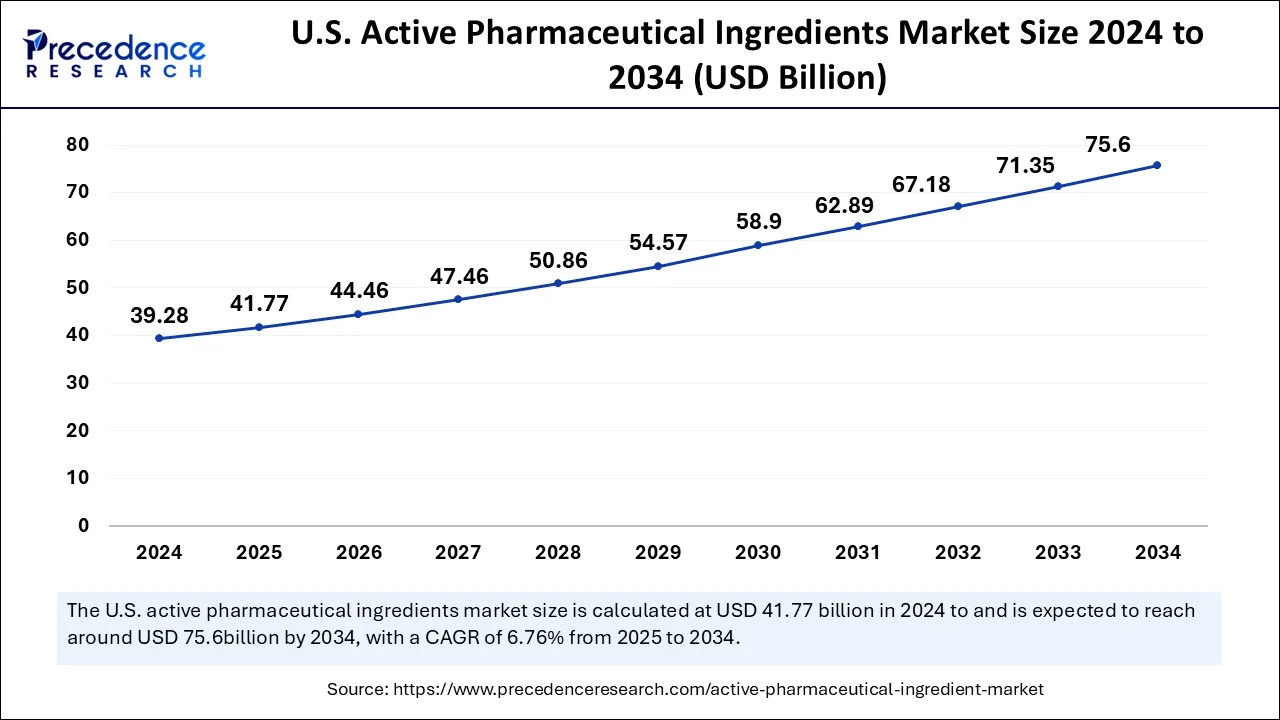
The US active pharmaceutical ingredients market size accounted for USD 41.77 billion in 2025 and is predicted to increase from USD 44.46 billion in 2026 to approximately USD 79.80 billion by 2035, expanding at a CAGR of 6.69% from 2026 to 2035. The increasing demand for precision medicines, along with the technological advancements in the biopharma industry, has driven the market.
Key Takeaways
- By type of synthesis, the synthetic API segment dominated the market in 2025.
- By type of synthesis, the biotech API segment is expected to expand at the fastest rate during the forecast period.
- By type, the innovative API segment held the largest share of the market in 2025.
- By type, the generic API segment is expected to grow with the highest CAGR during the forecast period.
- By type of manufacturer, the captive API segment dominated the market in 2025.
- By type of manufacturer, the merchant API segment is expected to grow with the fastest CAGR during the forecast period.
- By drug type, the prescription segment led the market in 2025.
- By drug type, the OTC segment is expected to grow at the fastest rate in the coming years.
- By application, the cardiology segment held the highest share of the market in 2025.
- By application, the oncology segment is anticipated to grow at the highest CAGR during the forecast period.
Market Overview
The U.S. active pharmaceutical ingredients market is a critical component of the pharmaceutical industry, encompassing the production and supply of active compounds used in branded, generic, and biologic medicines. The market is gaining momentum due to the rapid investments by public companies, along with numerous government policies for strengthening the pharma sector. The increasing demand for mRNA therapies, as well as the surging prevalence of chronic disorders, also drives market expansion.
What is the significance of AI in the U.S. Active Pharmaceutical Ingredients Market?
Artificial intelligence plays a significant role in transforming the U.S. active pharmaceutical ingredients industry. AI algorithms help to screen a wide range of compounds to identify novel API candidates and repurpose existing drugs by lowering research timelines. Machine learning models are used to analyze chemical reactions to design cost-effective and eco-friendly synthetic pathways. AI is deployed to predict potential shortages of raw materials, forecast global demand, and optimize inventory management to protect against disruptions in the pharmaceutical supply chain.
- In January 2026, Phlow partnered with Enveda. This partnership was done to launch an AI-based chemistry to enhance domestic pharmaceutical development and transform the drug substance manufacturing process.
What are the Major Trends in the U.S. Active Pharmaceutical Ingredients Industry?
- Collaborations: Numerous pharma brands are collaborating with third-party API providers to develop personalized therapies.
- Business Expansions: The leading companies are making significant investments to establish new production centers to enhance the manufacturing of APIs.
- Technological Advancements: The API manufacturers are deploying AI and ML in their production units to enhance scalability.
Market Report Coverage and Key Metrics
| Report Coverage | Details |
| Market Size in 2025 | USD 41.77 Billion |
| Market Size in 2026 | USD 44.46 Billion |
| Market Size by 2036 | USD 79.80 Billion |
| Growth Rate from 2026 to 2035 | CAGR of 6.69% |
| Base Year | 2025 |
| Forecast Period | 2026 to 2035 |
| Segments Covered | Type of Synthesis, Type of Manufacturer, Application, Type, and Drug type |
Market Dynamics
Drivers
Surging Cases of Cardiac and Orthopedic Conditions
The increasing cases of coronary artery disease, heart failure, arrhythmias, and peripheral artery disease are driving demand for precision medicines and advanced therapeutic formulations, boosting the need for high-quality APIs. Additionally, the growing incidence of osteoarthritis, osteoporosis, back and neck pain, and sports-related injuries is increasing the production and consumption of generic pharmaceuticals, further expanding demand for cost-effective generic APIs across the healthcare sector.
Restraint
Stringent Compliances and Trade Conflicts
Stringent regulatory requirements and supply chain disruptions are restraining the growth of the market. Regulatory agencies enforce rigorous quality, safety, and compliance standards for API approval and manufacturing, increasing development costs and extending approval timelines. Additionally, geopolitical tensions, trade disputes, and global supply chain disruptions can impact the availability of raw materials and API imports, creating procurement challenges and increasing operational risks for pharmaceutical manufacturers.
Opportunity
GLP-1 Agonists and Smart Factories
The demand for GLP-1 agonists has grown significantly for manufacturing diabetes and obesity drugs. The pharma brands are investing rapidly in constructing smart factories. These factories have integrated robotics and AI-enabled production monitoring for continuous synthesis and predictive maintenance. Thus, the surging popularity of smart factories and GLP-1 agonists is expected to create opportunities for the market players in the upcoming years.
Market Segmentation Analysis
Type of Synthesis Insights
The Synthetic Segment Dominated the Market in 2025
The synthetic segment led the U.S. active pharmaceutical ingredients market with the largest share in 2025. This is due to the increasing use of synthetic active pharmaceutical ingredients (APIs) for producing medicines with the desired therapeutic effect. They are the vital ingredients used for diagnosing, curing, mitigating, treating, or preventing diseases. Synthetic APIs are used for the production of advanced therapies to manage heart conditions and prevent strokes.
The biotech segment is expected to be the fastest-growing segment during the forecast period. This is due to the surging usage of biotech API for manufacturing high-quality medicines for the treatment of infectious diseases. Biotech APIs are used to diagnose, protect, and treat complex diseases. These APIs are produced from yeast, bacteria, or mammalian cells using recombinant DNA technology.
Type Insights
What Made Innovative APIs the Dominant Segment in the Market?
The innovative APIs segment held the dominant share of the U.S. active pharmaceutical ingredients market in 2025. This is mainly due to the surging use of captive APIs to cure, diagnose, mitigate, and treat diseases. Also, these APIs offer superior efficacy, enhanced safety, and targeted delivery, as compared to traditional generic drugs. The demand for innovative APIs has increased among pharma companies to develop personalized medicines.
The generic APIs segment is expected to grow at the highest CAGR during the forecast period. This is due to the rising use of generic active pharmaceutical ingredients (APIs) to manufacture affordable and therapeutically equivalent alternatives to branded drugs. These APIs contain identical active biological components that are used to produce low-cost drugs for middle-class consumers. The U.S. government is supporting the use of generic APIs for the production of affordable medicines.
Type of Manufacturer Insights
The Captive APIs Segment Held a Major Market Share in 2025
The captive APIs segment led the U.S. active pharmaceutical ingredients market while holding a major share in 2025. This is due to the growing investments by the pharma brands to manufacture captive APIs to strengthen their supply chain. Captive APIs are widely used for the production of complex molecules, including peptides, biologics, and highly potent active pharmaceutical ingredients (HPAPIs).
The merchant APIs segment is expected to expand with the fastest CAGR during the forecast period. This is due to the growing interest of the pharma companies in purchasing APIs from third-party companies to shorten their production times. These APIs enable small and mid-sized firms to manufacture high-quality drugs without investing in specialized production capabilities.
Drug Type Insights
Why Did the Prescription Segment Dominate the Market in 2025?
The prescription segment dominated the U.S. active pharmaceutical ingredients market in 2025. This is mainly due to the high demand for prescription medications used in the treatment of chronic and complex conditions such as cardiovascular diseases, diabetes, cancer, and neurological disorders. The segment's leadership was further supported by increasing utilization of specialty drugs, biologics, and personalized therapies, which require high-quality and highly regulated APIs for manufacturing.
The OTC segment is expected to grow at the fastest rate in the upcoming period, owing to increasing consumer preference for self-medication and easy access to treatments for common health conditions such as colds, pain, allergies, and digestive disorders. The growth of the segment is further supported by rising health awareness, expanding availability of OTC products through retail and online channels, and growing demand for cost-effective healthcare solutions that reduce dependence on prescription-based treatments.
Application Insights
What Made Cardiology the Leading Segment in the Market?
The cardiology segment led the market in 2025. This is due to the growing cases of cardiovascular disorders across the U.S. Additionally, the increasing focus of the pharma companies on developing advanced therapies for the treatment of cardiac disorders bolstered segmental growth. Moreover, the biotech companies are collaborating with AI providers to deploy advanced technologies for developing cardiovascular therapies.
The oncology segment is anticipated to grow at the highest CAGR during the forecast period. This is owing to the surging cases of breast cancer and prostate cancer, which increase the demand for advanced therapies. In addition, governments around the world are investing rapidly in strengthening cancer treatment infrastructure. The API manufacturers are partnering with cancer researchers to develop high-quality drugs for the treatment of cancer.
State-Wise Analysis
- New Jersey: New Jersey is a significant contributor to the U.S. API industry. The demand for specialty drugs and complex biologics has been increasing rapidly in this state. Additionally, several pharma brands have established new R&D centers to accelerate the production of APIs. Also, the availability of well-established logistics and supply-chain infrastructure supports the growth of this industry.
- Massachusetts: Massachusetts is known for its well-established pharma base. The pharma companies are operating in this state due to the availability of a skilled workforce and the technological advancements in the healthcare sector. Moreover, the government is launching several policies for strengthening the pharmaceutical sector.
- Texas: Texas benefits from a highly skilled workforce supported by leading research institutions such as University of Texas System and Texas A&M University, which supply expertise in chemistry, engineering, and pharmaceutical manufacturing. Additionally, the rising prevalence of chronic diseases such as obesity and cardiovascular disorders is driving pharmaceutical production and increasing demand for API manufacturing within the state.
U.S. Active Pharmaceutical Ingredients Market Value Chain Analysis
- Raw Materials Sourcing
The raw materials used in the manufacturing of active pharmaceutical ingredients consist of simple organic chemicals, ketones, amines, and specialized petrochemical derivatives.
Key Companies: The Dow Chemical Company, Huntsman Corporation, and Fluor Corporation.
Clinical Trials and Regulatory Approvals
Active Pharmaceutical Ingredients (APIs) are approved and tested indirectly through the clinical trials of the final formulated medication.
Key Companies: FDA, Intertek, and BSI Group America.
Distribution Channel
The distribution channel for active pharmaceutical ingredients (APIs) is strictly regulated by a B2B supply chain for transporting raw chemical/biological materials to drug manufacturers.
Key Companies: AbbVie Inc, Viatris Inc., and Fresenius Kabi AG.
Market Competitive Landscape: Leading Companies and Strategies
The U.S. active pharmaceutical ingredients market is moderately fragmented due to the presence of established players and new startups. Top companies operating in this market include Albemarle Corporation, Cambrex, Aurobindo Pharma, Merck & Co., Inc, Reddy's Laboratories Ltd., AbbVie Inc, Teva Pharmaceutical Industries Ltd., Mylan N.V., and Cipla Inc. These companies are engaged in the research & development of APIs and are adopting numerous strategies, including business expansions, investments, and product launches.
- In March 2026, Cambrex announced an investment of US$120 million. This investment was made to expand its U.S. API manufacturing capabilities in the U.S.
US Active Pharmaceutical Ingredients Market Companies
- AbbVie Inc
- Viatris Inc
- Fresenius Kabi AG
- Curia
- Pfizer Inc. (Pfizer Center One)
- Bristol-Myers Squibb Company
- Amgen Inc.
- Johnson & Johnson
- Catalent, Inc.
- Ampac Fine Chemicals (AFC)
Recent Developments US Active Pharmaceutical Ingredients Market (2025-2026)
- In May 2026, Novartis announced an investment of US$23 billion. Through this investment, Novartis plans to establish a new active pharmaceutical ingredients facility in North Carolina.(Source: https://megaproject.com)
- In February 2026, AbbVie invested around US$380 million. This investment was made to open an active pharmaceutical ingredient manufacturing center in North Chicago, U.S.(Source: https://www.prnewswire.com)
- In December 2025, Eli Lilly and Company announced to invest US$6 billion. Through this investment, this company aims to open an API unit in Alabama, U.S.
(Source: https://www.prnewswire.com)
Segments Covered in the Report
By Type of Synthesis
- Biotech
- Monoclonal Antibodies
- Recombinant Proteins
- Vaccines
- Synthetic
By Type of Manufacturer
- Captive APIs
- Merchant APIs
- Generic APIs
- Innovative APIs
By Type
- Generic APIs
- Innovative APIs
By Drug Type
- Prescription
- OTC
By Application
- Cardiovascular Diseases
- Oncology
- CNS & Neurological Disorders
- Orthopedic Disorders
- Endocrinology
- Pulmonology
- Gastrointestinal Disorders
- Nephrology
- Ophthalmology
- Others
For inquiries regarding discounts, bulk purchases, or customization requests, please contact us at sales@precedenceresearch.com
Frequently Asked Questions





Ask For Sample
No cookie-cutter, only authentic analysis – take the 1st step to become a Precedence Research client




 sales@precedenceresearch.com
 Schedule a Meeting



