



U.S. Electron Microscopy Market Size, Companies, Share, Patient Volume, Treatment Adoption Rates, Pricing Analysis, Regulatory Landscape, Competitive Positioning, and Demand Forecast
Rohan Patil, a Healthcare Industry Expert, highlights that the U.S. electron microscopy market has reached USD 1.50 billion in 2026 and is on track to reach USD 2.99 billion by 2035, advancing at a CAGR of 7.88%. Key U.S. electron microscopy market companies shaping the market include Olympus Corporation, Nikon Corporation, Leica Microsystems GmbH, while major growth segments span By Type, By End User, By Application.
Source: https://www.precedenceresearch.com/us-electron-microscopy-market
 Get a Sample
 Table Of Content


US Electron Microscopy Market Size and Forecast 2026 to 2035
The US electron microscopy market size was calculated at USD 1.40 billion in 2025 and is predicted to increase from USD 1.50 billion in 2026 to approximately USD 2.99 billion by 2035, expanding at a CAGR of 7.88% from 2026 to 2035. The market growth is attributed to rising semiconductor investments, expanding nanotechnology research, and increasing demand for atomic-scale characterization capabilities.
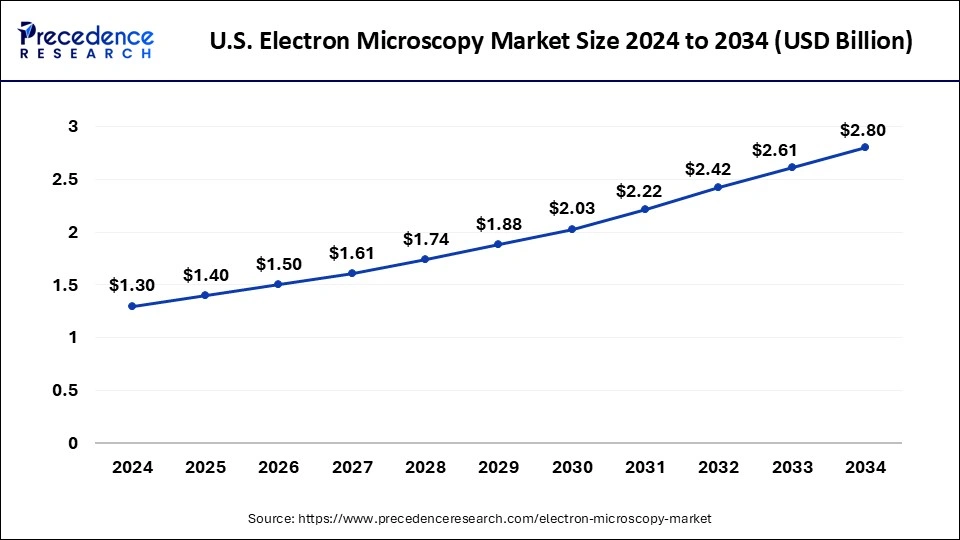
Key Takeaways
- By type, the scanning electron microscopy segment held the largest U.S. electron microscopy market share in 2025.
- By type, the transmission electron microscopy segment is expected to expand with the highest CAGR during the forecast period.
- By end user, the industries segment held the largest market share in 2025.
- By end user, the academic and research institutes segment is expected to grow with a significant CAGR between 2026 and 2035.
- By application, the life sciences segment held the highest share of the market.
- By application, the material science segment is expected to grow with the highest CAGR during the forecast period.
Market Overview
The U.S. electron microscopy market is primarily driven by growing investments in semiconductor manufacturing, nanotechnology, and advanced materials research. Electron microscopy involves high-speed electrons' acceleration to create extremely high-resolution images, which are far beyond the resolution of optical microscopes. The technology used to characterize nanometer and atomic scale structures, biological samples, and materials in detail.
The growing complexity of semiconductors creates demand for new transmission and scanning electron microscopes for defect analysis and process optimization. The U.S. Department of Energy (DOE) is still helping to foster the innovation of microscopy through its national laboratories and advanced characterization facilities. Furthermore, the continued federal funding, semiconductor miniaturization, and demand for nanoscale characterization remain key drivers supporting market growth.
Impact of Artificial Intelligence on the U.S. Electron Microscopy Market
AI is playing a pivotal role in transforming the market by boosting imaging productivity and accuracy in analysis, particularly within research and industrial applications. AI-powered software plays a crucial role in processing vast amounts of microscopy data and discovering nanoscale characteristics with greater speed in laboratories and semiconductor fabrication houses.
AI systems can analyze structures with complex patterns, classify materials, and identify defects, tasks that were previously hard to do with manual testing. The expanding complexity of device designs is likely to expand the use of AI in the semiconductor industry for advanced process control, failure analysis, and yield optimization.
Market Report Coverage and Key Metrics
| Report Coverage | Details |
| Market Size in 2026 | USD 1.40 Billion |
| Market Size in 2026 | USD 1.50 Billion |
| Market Size by 2035 | USD 2.99 Billion |
| Growth Rate from 2026 to 2035 | CAGR of 7.88% |
| Base Year | 2025 |
| Forecast Period | 2026 to 2035 |
| Segments Covered | Type, End User, and Application |
Market Dynamics
Drivers
Rising Investments in Semiconductor Manufacturing and Advanced Chip Development
Rising investments in semiconductor manufacturing and advanced chip development are expected to accelerate demand for electron microscopy systems across the U.S. Scanning and transmission electron microscopes are the tools used by semiconductor manufacturers.
They check devices for nanoscale structures and defects and verify ever-increasing device architectures. Rapidly increasing emphasis on domestic semiconductor production is helping to increase the purchase of advanced analytical instruments within commercial and research facilities.
Restraint
High Capital and Operational Costs
Substantial capital investment requirements, which are expected to limit adoption among smaller institutions and laboratories, are expected to hinder the market growth. The transition from the basic to the advanced TEM is an expensive process, as the instruments may require multimillion-dollar purchases, special facility modifications, and environmental control. Furthermore, the hamper market penetration across certain regions due to uneven access to high-end microscopy facilities and analytical resources.
Opportunity
Surging Adoption of Cryo-Electron Microscopy in Life Science Research
The surging adoption of cryo-electron microscopy in life science research is likely to create immense opportunities for the market across biomedical institutions. As cryo-electron microscopy (cryoEM) becomes increasingly adopted in life science research, there will be a growing demand for advanced imaging platforms in biomedical institutions.
Cryo-EM is used to study proteins, viruses, cellular structure, and molecular interactions at almost atomic resolution. Investment in next-generation microscopy infrastructure is validated by continued strong interest in precision medicine and biologics research.
Market Segmentation Analysis
Type Insights
The Scanning Electron Microscopy Segment Dominated the Market in 2025
The scanning electron microscopy segment dominated the U.S. electron microscopy market in 2025 due to the widespread application of technologies for surface characterization across various industries such as semiconductors, materials science, aerospace, and industrial manufacturing. Unlike platforms used for TEM, SEM has the advantages of low operational requirements, quick sample analysis, and high-resolution imaging.
The rising investment in domestic semiconductor manufacturing plants also continued to fuel advanced inspection and metrology solutions. Additionally, the research institutes increased the use of electron microscopy in various projects on nanotechnology, metallurgy, battery materials, and additive manufacturing.
The transmission electron microscopy segment is expected to grow at the fastest CAGR from 2026 to 2035, driven by growing demand for atomic-scale imaging and ultra-high-resolution characterization capabilities. Researchers can now view the crystal structure, interfaces, defects, and the behavior of nanoscale materials with unparalleled detail using TEM systems.
Thermo Fisher Scientific is expanding access to co-staining, structural biology research, and AI-driven microscopy workflows with the launch of the Talos 12 TEM and the Krios 5 Cryo-TEM in 2025. Furthermore, these technological advances and growing research requirements are estimated to strengthen the segment's position throughout the forecast period.
End User Insights
The Industries Segment Dominated the Market in 2025
The industries segment dominated the U.S. electron microscopy market in 2025 due to the broad deployment of microscopy systems across multiple commercial sectors. Electron microscopy is being used in material manufacturing for the characterization of microstructures, assisting in developing new products faster and enhancing the performance of old ones.
The academic and research institutes segment is expected to grow at the highest CAGR between 2026 and 2035, supported by growing investment in emerging industries such as nanotechnology, quantum research, and structural biology, and research in advanced materials. Electron microscopy is being used more and more in universities and research centers to learn about the atomic-level properties and structures of materials and the mechanisms of biological activity.
Application Insights
The Life Science Segment Dominated the Market in 2025
The life science segment dominated the U.S. electron microscopy market in 2025 due to the expanding role of structural biology in modern healthcare research. Precision medicine and biologics research are driving the need for high-performance imaging platforms across research institutions. Additionally, the increasing adoption of electron microscopy in structural biology, cellular research, virology, and drug discovery applications further facilitates the segment growth in the coming years.
The material science segment is expected to grow at a significant CAGR between 2026 and 2035, driven by extensive use of electron microscopy for nanoscale characterization, structural analysis, and advanced materials development. Scanning electron microscopy and transmission electron microscopy are used to investigate the crystal structures, grain boundaries, defects, thin films, and nanomaterials with extraordinary accuracy and precision.
U.S. Electron Microscopy Market: Country-Level Analysis
Why Is Texas Emerging as the Future Growth Leader in the Market?
Texas is expected to grow at a notable CAGR in the foreseeable future due to its expanding semiconductor manufacturing investments, advanced research activities, and growing technology-sector development. Technological development and advanced research activities are expected to increase the growth of the Texas economy through the forecast period and make it the fastest-growing state. Materials science and microelectronics programs increasingly relied on the use of electron microscopy (EM)-based characterization, which continued to grow at research centers throughout Texas.
U.S. Electron Microscopy Market Value Chain Analysis
- Component & Precision Material Sourcing
The supply chain begins with specialized electronic components, detectors, lenses, vacuum systems, and high-purity materials required for microscope production.
Key Players: Hamamatsu Photonics, Basler AG, HORIBA Scientific, Oxford Instruments.
- Electron Microscope Manufacturing & System Integration
Manufacturers assemble electron columns, imaging systems, detectors, and analytical software into complete microscopy platforms.
Key Players: Thermo Fisher Scientific, JEOL Ltd., Hitachi High-Tech Corporation, Carl Zeiss Microscopy, TESCAN Group.
- Distribution, Installation & Technical Services
Finished systems are delivered to end users with installation, calibration, training, and maintenance support services.
Key Players: Thermo Fisher Scientific, JEOL USA, Hitachi High-Tech America, ZEISS Microscopy.
- End-User Research & Industrial Applications
Electron microscopes are utilized across semiconductor, life science, materials science, and advanced manufacturing environments.
Key Players: Intel Corporation, NVIDIA, IBM Research, Lawrence Berkeley National Laboratory, Oak Ridge National Laboratory.
Market Competitive Landscape: Leading Companies and Strategies
The U.S. electron microscopy market is moderately consolidated with the presence of key players as well as specialized technology providers. Thermo Fisher Scientific, JEOL Ltd., Hitachi High-Tech, ZEISS, and TESCAN are strong competitors. These competitions include imaging performance, analysis, automation, and service networks. There are high entry barriers due to the cost of instruments and the complexity of the technology requirements.
Thermo Fisher Scientific introduced the Krios 5 Cryo-TEM and Talos 12 TEM in 2025, bringing high-resolution imaging to the market. JEOL kept with steady forward progress on its cryogenic and analytical microscopy platforms for structural biology and materials research applications. Partnerships among microscopy vendors, national laboratories, universities, semiconductor manufacturers, and biotechnology organizations are accelerating technology development and application expansion. Furthermore, the heavy R&D investments and advanced engineering skills are expected to continue to maintain significant competitive advantages as well as influence future market leadership.
U.S. Electron Microscopy Market Companies
- Olympus Corporation
- Nikon Corporation
- Leica Microsystems GmbH
- Jeol Ltd
- FEI Co. Hitachi High-Technologies Corporation
- Danish Micro Engineering
- Danaher Corporation
- Carl Zeiss AG
- Bruker Corporation
- Bio-Rad Laboratories
Recent Developments U.S. Electron Microscopy Market (2025-2026)
- In May 2026, MVTec Software GmbH and ZEISS announced a collaboration, integrating MVTec HALCON into ZEISS Blockwise, a software platform for automated microscopy. This partnership aims to enhance measurement and analysis in electron microscopy, particularly benefiting the semiconductor industry.(Source: https://metrology.news)
- In May 2026, PicoQuant launched Solira, a new microscope for time-resolved photoluminescence (TRPL) measurements and advanced materials characterization. Solira supports various methods, including TRPL imaging and carrier diffusion mapping, and will debut at the E-MRS Spring Meeting 2026 in Strasbourg, France, from May 25-29. (Source: https://www.azom.com)
Segments Covered in the Report
By Type
- Scanning Electron Microscopy (SEM)
- Transmission Electron Microscopy (TEM)
- Others
By End User
- Industries
- Academic and Research Institutes
- Others
By Application
- Lifesciences
- Material Sciences
- Semiconductors
- Nanotechnology
- Others
For inquiries regarding discounts, bulk purchases, or customization requests, please contact us at sales@precedenceresearch.com
Frequently Asked Questions





Ask For Sample
No cookie-cutter, only authentic analysis – take the 1st step to become a Precedence Research client
 Get a Sample




 sales@precedenceresearch.com
 Schedule a Meeting
