



U.S. Medical Oxygen Concentrators Market Size, Companies, Share, Patient Volume, Treatment Adoption Rates, Pricing Analysis, Regulatory Landscape, Competitive Positioning, and Demand Forecast
U.S. Medical Oxygen Concentrators Market (By Product Insights: Portable, Fixed; By Application Insights: Home Care, Non- Home Care; By Technology Insights: Continuous Flow, Pulse Flow) - Global Industry Analysis, Size, Trends, Leading Companies, Regional Outlook, and Forecast 2026 to 2035
Source: https://www.precedenceresearch.com/us-medical-oxygen-concentrators-market
 Get a Sample
 Table Of Content


What is U.S. Medical Oxygen Concentrators Market Size in 2026?
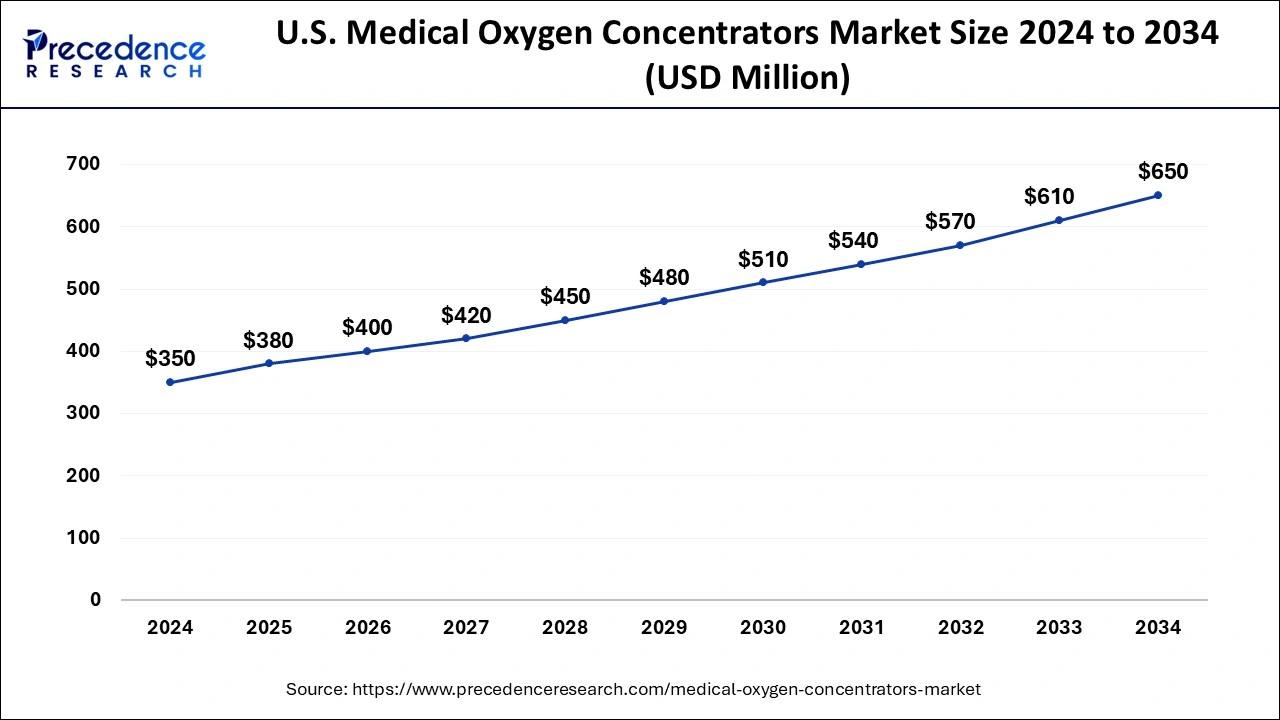
The U.S. medical oxygen concentrators market size was calculated at USD 380 million in 2025 and is predicted to increase from USD 400 million in 2026 to approximately USD 690 million by 2035, expanding at a CAGR of 6.15% from 2026 to 2035. The growth of this market is mainly driven by the increasing incidence of respiratory conditions, including chronic obstructive pulmonary disease, asthma, and sleep apnea, along with the continuous introduction of technologically advanced devices.
Key Takeaways
- By product type, the portable segment dominated the market with the largest share in 2025.
- By product type, the fixed segment is expected to grow at the fastest CAGR during the forecast period.
- By technology, the continuous flow segment dominated the market with the largest share in 2025.
- By technology, the pulse dose segment is predicted to grow at the fastest CAGR during the forecast period.
- By application, the home care segment dominated the market with the largest share in 2025.
- By application, the non-homecare segment is expected to grow at the fastest CAGR during the forecast period.
Market Overview
The U.S. medical oxygen concentrators market comprises devices designed to deliver purified oxygen to individuals who require supplemental respiratory support. These systems work by extracting nitrogen from ambient air and supplying concentrated oxygen to patients through a mask or nasal cannula. They are widely used in the management of chronic respiratory conditions such as COPD, asthma, and other disorders. The rising global prevalence of respiratory illness is the key factor accelerating market growth.
According to the Centers for Disease Control and Prevention, chronic obstructive pulmonary disease (COPD) is a leading cause of death in the U.S., affecting nearly 16 million adults, with many more undiagnosed. Oxygen concentrators, in particular, have gained strong traction due to their compact design, ease of transport and suitability for home care settings as well. Beyond clinical use, these devices are also utilized in high altitude environments and specialized industrial applications where oxygen levels are insufficient.
How are Technological Advances Impacting the U.S. Medical Oxygen Concentrators Market?
Ongoing technological advancements are significantly transforming the market with a strong focus on smart, efficient, and patient-centered solutions. Modern devices now integrate artificial intelligence and advanced sensors to monitor real-time physiological parameters and automatically adjust oxygen flow for precise personalized therapy. Features such as remote patient monitoring, telehealth connectivity, and early fault detection enhance clinical oversight and patient safety. Improvements in miniaturization, lightweight design, battery life, and energy efficiency have also increased the appeal of portable oxygen concentrators. Additionally, predictive maintenance capabilities and enhanced manufacturing quality controls are improving device reliability, positioning next-generation oxygen concentrators as intelligent connected respiratory care solutions.
Major Market Trends
- Rising prevalence of respiratory disorders: The increasing incidence of chronic obstructive pulmonary diseases and other respiratory illnesses is a major factor driving the demand for oxygen concentrators. Factors such as smoking among the younger population, exposure to occupational hazards, air pollution, and unhealthy lifestyles are significantly contributing to respiratory complications, thereby boosting the need for oxygen concentrators.
- Shift toward portable and home care-based oxygen concentrators: There is a clear transition from traditional stationary oxygen systems to portable oxygen concentrators. Advancements in lightweight design, battery efficiency, and compact technology are making portable devices more convenient for patients.
- Technological advancements and product innovation: Manufacturers are increasingly integrating advanced technologies to enhance device efficiency, durability, and cost-effectiveness. Companies are focusing on developing high performance energy efficient oxygen concentrators to meet rising demand.
- Supportive government policies: Favorable reimbursement policies increased health care expenditure, and government funding initiatives are encouraging market expansion. In addition, strategic activities such as mergers, acquisitions, and partnerships among manufacturers are fostering innovation and expanding distribution networks.
- Reimbursement support & policy influence: Favorable Medicare and private insurance coverage for home oxygen equipment continues to support market growth by reducing out-of-pocket costs for patients.
- Focus on patient comfort & compliance: Manufacturers are prioritizing quiet operation, ergonomic design, and ease of use to improve patient comfort and adherence to prescribed oxygen therapy regimens.
Market Scope
| Report Coverage | Details |
| Market Size in 2025 | USD 380 Million |
| Market Size in 2026 | USD 400 Million |
| Market Size by 2035 | USD 690 Million |
| Market Growth Rate from 2026 to 2035 | CAGR of 6.15% |
| Base Year | 2025 |
| Forecast Period | 2026 to 2035 |
| Segments Covered | Product Type, Technology, Application |
Segment Analysis
Product Type Insights
Why Did the Portable Segment Dominate the U.S. Medical Oxygen Concentrators Market?
The portable segment dominated the market with the largest share in 2025. The dominance of the segment is attributed to the increasing patient preference for mobility, independence, and active lifestyles. Portable oxygen concentrators are lightweight, compact, and battery-powered, allowing users to conveniently access oxygen therapy at workplaces while travelling in outdoor environments. As awareness and demand for flexible oxygen therapy solutions rise, the portable segment is projected to sustain its leadership in the coming years.
The fixed segment is expected to grow at the fastest rate during the projection period, primarily due to its strong adoption among patients requiring continuous and high-flow oxygen therapy. Fixed oxygen concentrators are widely used in hospitals, long-term care centers, and home health care settings, especially for individuals suffering from COPD and chronic respiratory disorders. Fixed concentrators provide stable oxygen output, continuous flow delivery, and long-term operational reliability, making them a dependable solution for bedridden and elderly patients. In addition, the geriatric population and the rising prevalence of chronic respiratory diseases continue to sustain demand in this segment.
Technology Insights
What Made Continuous Flow the Dominant Segment in the Market?
The continuous flow segment dominated the U.S. medical oxygen concentrators market in 2025. The segment's dominance is driven by strong adoption among patients requiring uninterrupted and high-flow oxygen therapy, particularly those with severe COPD and advanced chronic respiratory conditions. Continuous flow systems provide a steady oxygen supply, making them suitable for low activity patients and those needing flow rates above 5 lpm. Their widespread use across hospitals, home healthcare, and long-term care facilities, along with proven clinical reliability and safety compared to oxygen cylinders, continues to support their leading market position.
The pulse dose segment is expected to experience the fastest growth during the forecast period. The growth of the segment is fueled by rising demand for lightweight portable and energy-efficient oxygen solutions that support active lifestyles. Pulse flow devices deliver oxygen in synchronized bursts during inhalation, making them ideal for patients requiring lower oxygen volumes. Their extensive integration into portable oxygen concentrators and increasing preference for home-based and travel-friendly therapy are key factors accelerating segment expansion.
Application Insights
Why Does the Home Care Segment Lead the U.S. Medical Oxygen Concentrators Market?
The home care segment led the market, accounting for the largest revenue share in 2025. This dominance is primarily driven by the growing preference for at-home treatment among patients with chronic respiratory conditions, driven by convenience and comfort. Medicare and private insurance reimbursement policies also support home oxygen therapy, making devices more accessible to patients. Additionally, the rise in chronic diseases like COPD and an aging population have increased the demand for home-based oxygen solutions.
The non-homecare segment is expected to grow at the fastest rate during the forecast period, driven by rising hospital admissions due to respiratory illness cases and growing use of oxygen therapy in hospitals and clinics. The COVID-19 pandemic significantly accelerated demand for institutional oxygen support, highlighting the importance of reliable oxygen in infrastructure in healthcare facilities. Continued increases in respiratory disease prevalence and an ageing population are expected to maintain strong demand for oxygen therapy in clinical settings, driving segmental growth.
Country Level Analysis
The region is currently experiencing a notable transformation, and this transformation is being driven by various factors that influence demand and supply dynamics. The increasing prevalence of respiratory disorders, coupled with an aging population are propelling the need for efficient oxygen delivery systems. Furthermore, advancements in technology are leading to the development of more compact and user-friendly devices, which are set to enhance accessibility for patients in both, clinical as well as home settings. This shift towards home healthcare solutions further highlights how oxygen therapy is administered, suggesting a growing preference for portable and lightweight concentrators.
In addition to technological advancements, regulatory frameworks are evolving to ensure the safety and efficacy of medical devices. This regulatory landscape may foster an innovative and competitive environment, encouraging oxygen concentrator companies, along with portable oxygen manufacturers, to invest in research and development.
Moreover, the rising awareness of the importance of oxygen therapy in managing chronic conditions could further stimulate market growth. As stakeholders navigate these trends, the market is likely to witness a robust expansion, characterized by increased product offerings and enhanced service delivery models.
Value Chain Analysis
- Research & Development: The research & development stage focuses on designing an advanced oxygen concentrator with improved efficiency, oxygen purity, and battery performance.
Key Players: Philips Respironics, ResMed, and Inogen Inc. - Clinical Trials and Approvals by Authorities: This stage ensures device safety performance testing and compliance with regulatory standards for market authorization as a medical device.
Key Players: Besco Medical Co., CAIRE, and GCE Group - Packaging and Serialization: This process ensures that the medical oxygen concentrators are handled safely with secure packaging, labelling, and traceability.
Key Players: Inogen, Inc., ResMed Inc., Invacare Corporation, Drive DeVilbiss Healthcare. - Distribution to Hospitals, Pharmacies: Supply chain features manufacturers, distributors, wholesalers, hospitals, home care services, and e-commerce portals, with products being sold or rented out via numerous retail channels.
Key Players: Precision Medical Inc., GCE Group, Inogen, Inc. - Patient Support and Services: This stage encompasses all post-sale activities, such as installation training, maintenance, and customer assistance for long-term device usage.
Key Players: Philips Respironics, Inogen, Chart Industries, Inc., and DeVilbiss Healthcare.
Competitive Landscape
The Global Medical Oxygen Concentrators Market is currently characterized by a dynamic competitive landscape, driven by increasing demand for home healthcare solutions and advancements in technology. Key players such as Philips, Invacare, and AirSep are strategically positioning themselves through innovation and regional expansion.
In terms of business tactics, companies are increasingly localizing manufacturing to reduce costs and enhance supply chain efficiency. The competitive landscape in the market appears to be moderately fragmented, with several key players innovating and diversifying their offerings in order to establish a strong foothold. The collective actions of these companies indicate a shift towards more integrated supply chains and localized production, which may enhance their competitive positioning.
Top Companies Operating in the Market
- AirSep Corporation
- CAIRE Inc.
- Chart Industries, Inc
- Drive DeVilbiss Healthcare
- Inogen, Inc.
- Inova Labs, Inc.
- Invacare Corporation
- O2 CONCEPTS LLC.
- Oxus America, Inc.
- Philips Respironics
- Precision Medical, Inc.
- ResMed
- Smith's Medical, Inc.
- Zadro Health Solutions
Recent Developments
- In January 2025, Inogen Inc., a U.S.-based supplier of lightweight, FAA-approved portable oxygen concentrators for prescribed therapy, launched the Voxi 5 stationary oxygen concentrator, a compact continuous flow device designed for long-term home oxygen therapy with improved noise reduction and energy efficiency. (Source: https://investor.inogen.com)
- In February 2025, CAIRE expanded the portfolio of its stationary oxygen concentrators with upgraded high-efficiency concentrator models focusing on reduced power consumption and improved durability for home care. (Source: https://www.caireinc.com)
- In March 2025, VARON introduced the VP-8G portable oxygen concentrator featuring multiple pulse flow settings, lightweight construction, and extended battery backup for ambulatory patients. (Source: https://varoninc.uk)
Segments Covered in the Report
By Product Insights
- Portable
- Fixed
By Application Insights
- Home Care
- Non- Home Care
By Technology Insights
- Continuous Flow
- Pulse Flow
For inquiries regarding discounts, bulk purchases, or customization requests, please contact us at sales@precedenceresearch.com
Frequently Asked Questions





Ask For Sample
No cookie-cutter, only authentic analysis – take the 1st step to become a Precedence Research client
 Get a Sample
.webp)



 sales@precedenceresearch.com
 Schedule a Meeting
