



AI Control Tower Market Trends, Companies, Revenue / Sales Performance, Subscriber Growth, Pricing Strategies, Cloud Adoption, Infrastructure Expansion, Competitive Landscape, and Industry Outlook
AI Control Tower Market (By Control Tower Type: Supply chain control tower, Logistics and transportation control tower, Network operations control tower, Security operations control tower; By Primary AI Capability: Predictive analytics and forecasting, Prescriptive optimization and recommendation, Autonomous agent orchestration and workflow automation, Computer vision and document intelligence; By Component: Software platform , Professional services, Managed services; By End-use Industry: Manufacturing, Retail and e-commerce, Healthcare and life sciences, Logistics and transportation, Energy and utilities , BFSI, Telecom and IT) - Global Industry Analysis, Size, Trends, Leading Companies, Regional Outlook, and Forecast 2026 to 2035
Source: https://www.precedenceresearch.com/ai-control-tower-market
 Get a Sample
 Table Of Content


What is the AI Control Tower Market Size in 2026?
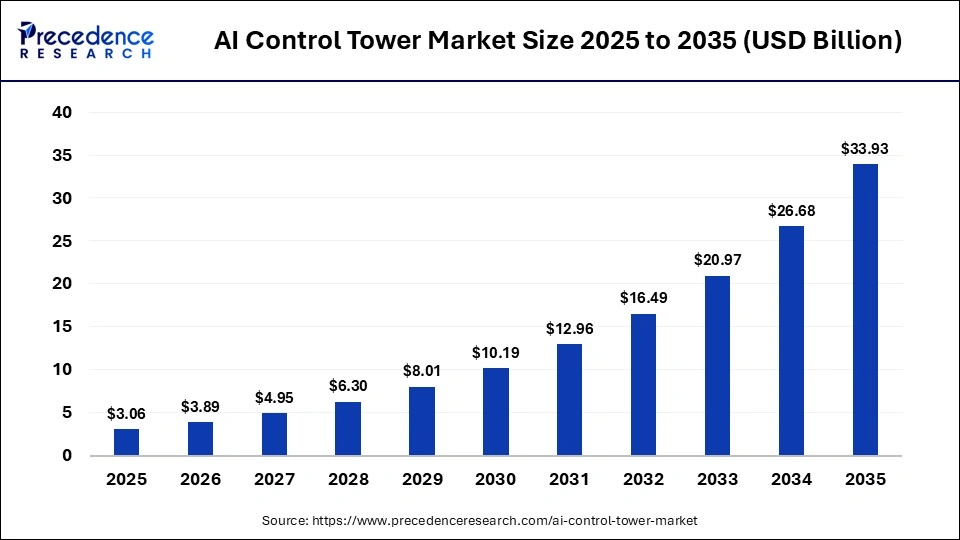
The global AI control tower market size was calculated at USD 3.06 billion in 2025 and is predicted to increase from USD 3.89 billion in 2026 to approximately USD 33.93 billion by 2035, expanding at a CAGR of 28.20% from 2026 to 2035. The market is rapidly expanding due to the increasing adoption of predictive analytics in a diverse sector, cost-cutting pressures, AI adoption to automate real-time decisions, and a growing shift toward real-time monitoring across sectors like manufacturing, retail, healthcare, and others.
Key Takeaways
- North America held the largest market share of nearly 37.60% in 2025.
- Asia Pacific is projected to grow at the fastest CAGR during the foreseeable period.
- By control tower type, the supply chain control tower segment held the largest market share of nearly 36.70% in 2025.
- By control tower type, the security operations control tower segment is projected to grow at the fastest CAGR during the foreseeable period.
- By primary AI capability, the predictive analytics and forecasting segment held the largest market share of 33.60% in 2025.
- By primary AI capability, the autonomous agent orchestration and workflow automation segment is projected to grow at the fastest CAGR during the foreseeable period.
- By component, the software platform segment held the largest market share of 63.80% in 2025.
- By end-use industry, the manufacturing segment held the largest market share of 18.70% in 2025.
- By end-use industry, the healthcare and life sciences segment is projected to grow at the fastest CAGR during the foreseeable period.
Market Overview
The AI control tower market covers centralized, real-time decision platforms that unify operational data, KPIs, and event signals and apply AI to detect exceptions, predict risk, recommend actions, and automate workflows across enterprise operations. Solutions typically combine data integration, monitoring dashboards, alerting, scenario simulation, and orchestration with machine learning, optimization, and agentic automation. Deployments span cloud and hybrid environments and are monetized through platform subscriptions, implementation services, and managed operations that continuously tune models and workflows.
AI Control Tower Market Trends
- There is a rapid shift from a reactive to a proactive approach to data visibility. Modern AI control towers are increasingly integrating data from IoT devices, artificial intelligence systems, and third-party platforms to provide a comprehensive, end-to-end view of the supply chain across industries such as healthcare and manufacturing.
- The emergence of generative AI and conversational AI is transforming market dynamics by gradually replacing conventional and complex dashboards. Users can interact with systems using natural language, making supply chain management more accessible and user-friendly.
- Modern AI control towers have evolved from simply monitoring past activities to predicting future events with greater accuracy. These platforms enable autonomous decision-making for routine tasks, allowing professionals to focus on more strategic and value-driven activities.
- Specialized AI control tower platforms, such as those developed by ServiceNow, are emerging to support and manage agentic AI initiatives while ensuring proper model governance, risk management, and compliance with regulatory requirements.
Market Scope
| Report Coverage | Details |
| Market Size in 2025 | USD 3.06 Billion |
| Market Size in 2026 | USD 3.89 Billion |
| Market Size by 2035 | USD 33.93 Billion |
| Market Growth Rate from 2026 to 2035 | CAGR of 28.20% |
| Dominating Region | North America |
| Fastest Growing Region | Asia Pacific |
| Base Year | 2025 |
| Forecast Period | 2026 to 2035 |
| Segments Covered | Control Tower Type, Primary AI Capability, Component, End-use Industry, and region |
| Regions Covered | North America, Europe, Asia-Pacific, Latin America, and Middle East & Africa |
Drivers
Acceleration of cloud migration and digital transformation
The growing trend of cloud migration and broad digital transformation in organizations is also generating high demand for AI control towers. Firms are integrating disparate data from ERP, CRM, and IoT solutions so that integrated intelligence layers reduce the errors of forecasting and coordination, offering a more holistic view of the business on an ever more integrated framework.
Restraints
Data security and regulatory concerns
Data privacy, cybersecurity, and regulatory compliance concerns remain obstacles to the application of AI control towers. Since these platforms are dependent on continuous data collection across multiple systems, organizations are significantly more vulnerable to breaches, and this leads industries, including healthcare, finance, and government, to be wary of selecting implementations.
Opportunities
Expansion into emerging markets and SMEs
The trends in emerging markets and small to medium-sized enterprises (SMEs) highlight adoption opportunities for the use of AI control towers. Cloud-based solutions have reduced initial investment in infrastructure, prompting SMEs to adopt scalable intelligence platforms that were more often a domain of large companies, achieving widespread exposure across emerging economies and mid-tier industrial establishments.
Segment Insights
Control Tower Type Insights
AI Control Tower Market Share, By Control Tower Type, 2025-2035 (%)
| Control Tower Type | 2025 | 2035 |
| Supply Chain Control Tower | 36.70% | 30.60% |
| Logistics and Transportation Control Tower | 28.40% | 29.70% |
| Network Operations Control Tower | 19.60% | 21.40% |
| Security Operations Control Tower | 15.30% | 18.30% |
Why Did the Supply Chain Control Tower Segment Dominate the AI Control Tower Market?
The supply chain control tower segment dominated the market with the largest share of nearly 36.70% in 2025, as it meets the need for real-time visibility, cost efficiency, and disruption management in several complex supply chains. Companies are increasingly looking for a real-time and holistic view of their supply chain from production to destination delivery and managing middle disruption without a time delay for maximum cost savings and efficiency. Therefore, companies from industries like retail, consumer goods, and automotive are leveraging AI to automate workflows and improve demand forecasting.
The security operations control tower segment is projected to grow at the fastest CAGR during the forecast period. This is mainly due to the urgent need for real-time threat detection, automated incident response, and AI-powered centralized management amid growing cyberattacks. Also, to minimize complex manual work and manage security alerts, generative AI and automated playbooks are embedded into security operations centers to enhance operational efficiency.
Primary AI Capability Insights
AI Control Tower Market Share, By Primary AI Capability, 2025-2035 (%)
| Primary AI Capability | 2025 | 2035 |
| Predictive Analytics and Forecasting | 33.60% | 24.70% |
| Prescriptive Optimization and Recommendation | 28.70% | 27.30% |
| Autonomous Agent Orchestration and Workflow Automation | 22.40% | 34.60% |
| Computer vision and Document Intelligence | 15.30% | 13.40% |
Why Did the Predictive Analytics and Forecasting Segment Lead the AI Control Tower Market?
The predictive analytics and forecasting segment held the largest market share of 33.60% in 2025, as it transforms reactive operations to proactive strategies to enhance supply chain efficiency and resilience. Predictive analytics tools offer actionable and data-driven insights that enable immediate adjustments to market changes. According to the sources, predictive analytics reduces downtime by up to 30% and boosts inventory management and enhances forecast accuracy by 15%.
The autonomous agent orchestration and workflow automation segment is projected to grow at the fastest CAGR during the foreseeable period due to the rapid shift from reactive to proactive operations. Its unmatched offerings of end-to-end visibility and resolving issues are likely to support segmental growth. Orchestration allows systems to analyse data and anticipate disruptions, detect issues, and execute remediation workflows like re-routing traffic and adjusting orders without the need for human backup. These tools significantly reduce operational friction with optimum cost cuts, and 90% faster support and higher ROI by automation in multi-step processes.
Component Insights
AI Control Tower Market Share, By Component, 2025-2035 (%)
| Component | 2025 | 2035 |
| Software Platform | 63.80% | 70.60% |
| Professional Services | 23.60% | 16.40% |
| Managed Services | 12.60% | 13.00% |
What Made Software Platform the Leading Segment in the AI Control Tower Market?
The software platform segment led the market, holding the largest share of 63.80% in 2025, and the same segment is projected to grow at the fastest CAGR during the foreseeable period. This is mainly due to its ability to offer highly scalable, cloud-based and integrated solutions that helps into end-to-end visibility, real-time analytics and automated decision making across data-driven supply chains. Many enterprises prioritize unified platforms like ServiceNow AI control tower to govern, monitor, and secure various AI agents in a single location with models and workflows in one location.
End-Use Industry Insights
Why Did the Manufacturing Industry Hold the Largest Share in the AI Control Tower Market?
The manufacturing segment held the largest market share of 18.70% in 2025 due to the industry's need to secure higher ROI from complex supply chain optimization in the manufacturing sector. Manufacturers are constantly dealing with the multi-tier supply networks that are inherently intricate to handle. AI offers essential visibility and enables manufacturers to predict machine failures while optimizing production schedules and reducing downtime. The manufacturing sector generates massive datasets that are highly anticipated in AI-driven analytics and further necessitate AI control towers to enhance agility and supply chain resilience in manufacturing operations.
The healthcare and life sciences segment is projected to grow at the fastest CAGR during the foreseeable period. This is mainly due to the increasing use of AI-driven equipment and services in the healthcare and life sciences sector, and the need to comply with strict regulations amid increasing cyberattacks. AI control towers offer unmatched security for sensitive pharma products like biologics development via real-time monitoring and adherence to environmental regulations.
Regional Insights
North America AI Control Tower Market Size and Growth 2026 to 2035
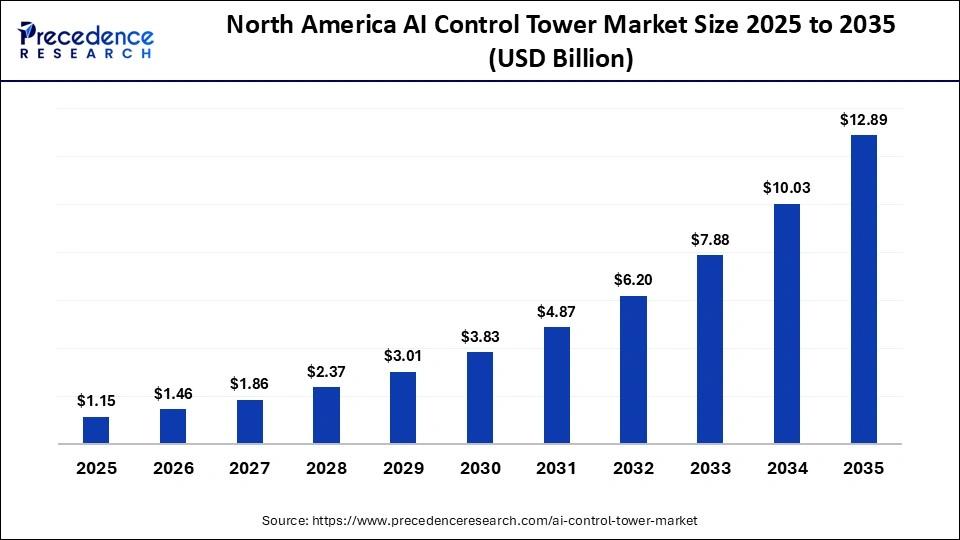
The North America AI control tower market size is estimated at USD 1.15 billion in 2025 and is projected to reach approximately USD 12.89 billion by 2035, with a 27.34% CAGR from 2026 to 2035.
What Made North America the Dominant Region in the AI Control Tower Market?
North America dominated the market by capturing nearly 37.60% share in 2025. This dominance is primarily attributed to the early adoption of advanced technologies such as 5G, IoT, and AI/ML models, supported by robust IT infrastructure across the region. Additionally, the strong presence of major technology companies, including NVIDIA and Amazon Web Services, has significantly contributed to market growth.
The region's dominance in the market is further reinforced by the growing need for resilient supply chains, the adoption of 5G-enabled edge computing, and substantial investments in predictive analytics. Key industries such as manufacturing, logistics, and healthcare are increasingly leveraging AI-driven technologies to enhance operational efficiency, improve demand forecasting, and optimize supply chain management. Moreover, government initiatives supporting rapid digitalization across critical sectors, along with a strong focus on data sovereignty, are further accelerating market development in the region.
U.S. AI Control Tower Market Size and Growth 2026 to 2035
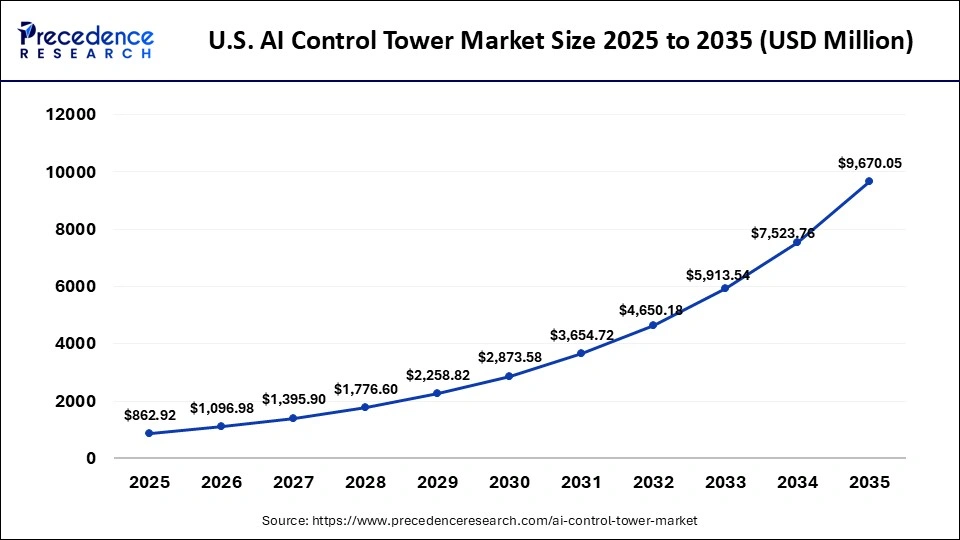
The U.S. AI control tower market size is calculated at USD 862.92 billion in 2025 and is expected to reach nearly USD 9,670.05 billion in 2035, accelerating at a strong CAGR of 27.33% between 2026 and 2035.
U.S. AI Control Tower Market Analysis
The U.S. is a major contributor to market growth, driven by substantial investments in AI-driven technologies from both government and private sector organizations that support continuous innovation. The country benefits from a strong ecosystem of technology firms, high-speed 5G networks, and advanced cloud computing infrastructure, enabling the rapid development and deployment of AI-powered solutions across sectors such as retail, manufacturing, and logistics.
Furthermore, the growing adoption of analytical and predictive AI control towers highlights the increasing importance of real-time visibility in supply chain operations. These technologies help organizations anticipate disruptions, improve decision-making, and enhance overall supply chain resilience.
Why is Asia Pacific Rapidly Expanding in the AI Control Tower Market?
Asia Pacific is projected to grow at the fastest CAGR during the foreseeable period due to the rapid industrialization, increasing supply chain complexity, and government-backed AI initiatives supported by stringent regulatory frameworks for data protection and AI applications. The growing adoption of IoT and AI technologies across logistics, transportation, and manufacturing sectors is creating a strong demand for centralized AI control towers capable of addressing supply chain challenges in real time.
Moreover, the rapid expansion of data centers, accelerating digitalization, and the development of 5G infrastructure are further supporting the growth of AI control towers that can predict bottlenecks, identify risks, and ensure business continuity. Additionally, strong government support for AI infrastructure, along with substantial investments from major technology companies such as Alibaba Group and Tencent, is fostering a vibrant ecosystem for AI-powered logistics and supply chain management across the Asia-Pacific region, further increasing the need for advanced AI control tower solutions.
China AI Control Tower Market Trends
China is recognized as a global leader in AI, driven by active national AI programs and regulatory initiatives such as the ‘Interim Administrative Measures for Generative AI Services', which govern AI development and deployment in the country. These programs strongly support the integration of AI across key sectors, including logistics and manufacturing, to enhance productivity and operational efficiency. China's approach emphasizes the ethical use of AI and promotes innovative strategies for AI adoption across multiple industries, while also fostering regional collaboration in artificial intelligence research and applications.
What are the Advancements in the AI Control Tower Market in Europe?
Europe is expected to have significant growth in the market, driven by the region's stringent regulations that are aimed at enhancing supply chain transparency and sustainability. The European Union's Green Deal is a significant key driver, pushing companies towards sustainable practices. Countries such as Germany, France, and the UK are leading players in the region.
Germany Market Trends
The country's market landscape is characterized by a mix of established firms and emerging startups focusing on niche markets. There is also a strong emphasis on sustainability and regulatory compliance, helping to drive investments in control tower technologies, making it a key player in the global market.
What are the Key Trends in the AI Control Tower Market in Latin America?
Latin America is expected to have significant growth in the market, driven by increasing urbanization, rising e-commerce activities, and the need for efficient supply chain management. Countries like Brazil and Mexico are leading players as they are supported by strong government initiatives that are aimed at enhancing logistics infrastructure and digital transformation in supply. The region is also witnessing rising investments in technology and infrastructure.
Brazil Market Trends
The region's market landscape features both global players and local firms, with key companies diversifying their offerings to capture the highest market share. The region's focus on innovation and technology adoption positions is also a key driver for market growth.
How is the Middle East and Africa Region Growing in the AI Control Tower Market?
The Middle East and Africa region is expected to have significant growth, driven by ongoing infrastructure development and increasing investments in logistics and supply chain technologies. Countries like the UAE and South Africa are leading players, with government initiatives aimed at enhancing trade and logistics capabilities, thus creating a favorable environment for control tower solutions.
Saudi Arabia Market Trends
Key players in the region are focusing on building partnerships to enhance their service offerings. The region's strategic location as a trade hub further boosts its market potential, making it an attractive market for AI control tower technologies as businesses seek to optimize their supply chains.
AI Control Tower Market Value Chain Analysis
- Data Ingestion and Connectivity: This stage deals with data gathering from sources like IoT sensors, ERP systems, and external source data with high-speed connectivity and edge computing.
Key Players: AWS, Honeywell, Microsoft, Informatica, and Salesforce. - Data Storage: This stage deals with raw data processing and storing it in data warehouses and ensures data separation from silos, which makes AI readable.
Key Players: Snowflake, Databricks, Google Cloud, Oracle, and Teradata. - AI Orchestration with Modeling: This stage deals with intelligence building by using machine learning to predict future demand, digital twins to simulate cases, and generative AI for queries.
Key Players: IBM, C3.ai, Palantir, DataRobot, and o9 solutions.
AI Control Tower Market Companies
- SAP
- Oracle
- IBM
- Microsoft
- Amazon Web Services
- Google Cloud
- Kinaxis
- o9 Solutions
- Blue Yonder
- E2open
- Manhattan Associates
- Infor
- ServiceNow
- project44
- FourKites
Recent Developments
- In May 2026, ServiceNow, Inc. (US) expanded its AI Control Tower from an old basic visibility tool to a fully-fledged control system for enabling agent discovery, monitoring, security enforcement measures, and return on investment (ROI) measurements on an enterprise-level AI system for Agent Discovery, Monitoring, Security Enforcement, and ROI across enterprise-level AI systems. With the upgrade, it is becoming an indispensable “system of record” for managing artificial intelligence operations, and also a sign of the shift from passive observability to active management of workflows and agents.
- In September 2025, Covasant Technologies Pvt. Ltd. (India) introduced its AI Control Tower, a product for enterprise solutions, solving a common problem in enterprise problem, which was the disparate adoption of AI agents across different platforms. This system is a platform that focuses on discovery, orchestration, and governance in siloed (or fragmented) AI worlds.
- In March 2026, ServiceNow Government Forum announced at its annual government forum the launch of powerful new solutions to deliver highly critical outcomes for the public sector with the help of trusted AI. They created a conversational AI front door for an agency workforce and its mission.(Source: https://newsroom.servicenow.com)
- In March 2026, EasTone and Ericsson collaborated for a 3-year strategic program to advance AI-driven and high-performing 5G in Taiwan. This agreement will focus on improved spectral efficiency, energy performance, automation, and advanced evolution of 5G.(Source: https://www.ericsson.com)
Segments Covered in the Report
By Control Tower Type
- Supply chain control tower
- Logistics and transportation control tower
- Network operations control tower
- Security operations control tower
By Primary AI Capability
- Predictive analytics and forecasting
- Prescriptive optimization and recommendation
- Autonomous agent orchestration and workflow automation
- Computer vision and document intelligence
By Component
- Software platform
- Professional services
- Managed services
By End-use Industry
- Manufacturing
- Retail and e-commerce
- Healthcare and life sciences
- Logistics and transportation
- Energy and utilities
- BFSI
- Telecom and IT
By Region
- North America
- Latin America
- Europe
- Asia-pacific
- Middle and East Africa
For inquiries regarding discounts, bulk purchases, or customization requests, please contact us at sales@precedenceresearch.com
Frequently Asked Questions
Tags





Ask For Sample
No cookie-cutter, only authentic analysis – take the 1st step to become a Precedence Research client
 Get a Sample




 sales@precedenceresearch.com
 Schedule a Meeting
