



AI in Smart Buildings and Infrastructure Market Trends, Companies, Revenue / Sales Performance, Subscriber Growth, Pricing Strategies, Cloud Adoption, Infrastructure Expansion, Competitive Landscape, and Industry Outlook
AI in Smart Buildings and Infrastructure Market (By Component: AI Software & Platforms, Building analytics, Predictive maintenance, Professional Services, Implementation, Consulting & integration; By Technology: Machine Learning & Predictive Analytics, Natural Language Processing (for voice/assistants), Edge AI Processing, Other AI Techniques; By Application: Energy & HVAC Optimization, Security & Surveillance Analytics, Predictive & Condition-Based Maintenance, Smart Lighting & Control Systems, Other Infrastructure Applications; By End User: Commercial Buildings & Offices Residential & Multi-Family Buildings, Healthcare Facilities, Government & Public Infrastructure) - Global Industry Analysis, Size, Trends, Leading Companies, Regional Outlook, and Forecast 2026 to 2035
Source: https://www.precedenceresearch.com/ai-in-smart-buildings-and-infrastructure-market
 Get a Sample
 Table Of Content


What is the AI in Smart Buildings and Infrastructure Market Size in 2026?
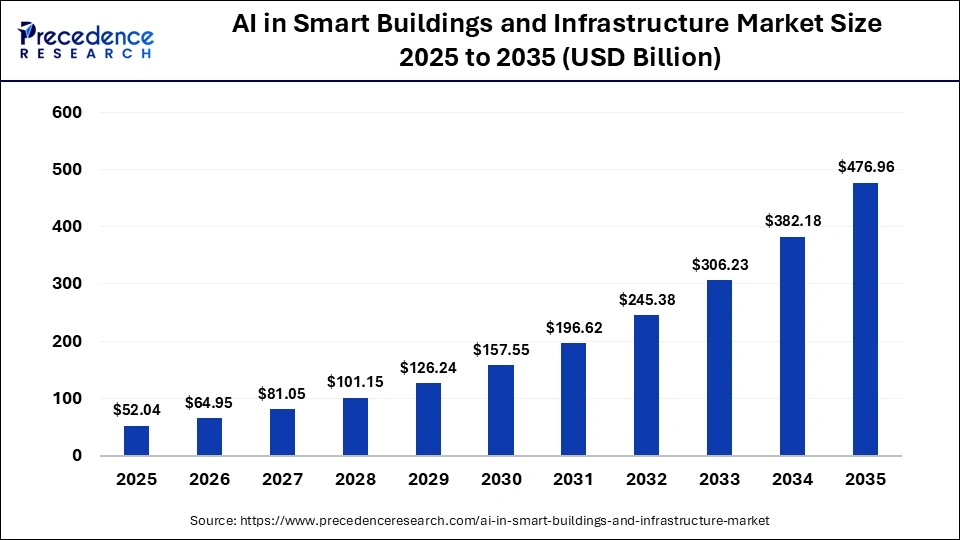
The global AI in smart buildings and infrastructure market size was calculated at USD 52.04 billion in 2025 and is predicted to increase from USD 64.95 billion in 2026 to approximately USD 476.96 billion by 2035, expanding at a CAGR of 24.80% from 2026 to 2035. The market is significantly expanding due to the integration of IoT-enabled building systems, increasing carbon reduction targets, and the rapid adoption of advanced AI/ML algorithms for smart city development projects.
Key Takeaways
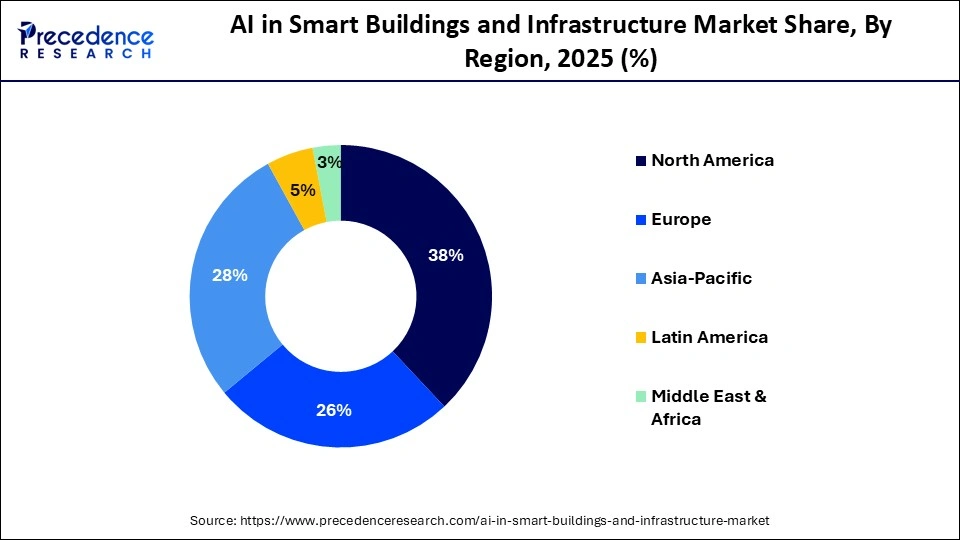
- North America held the largest market share of nearly 38% in 2025.
- The Asia Pacific is projected to grow at the fastest CAGR during the foreseeable period.
- By component, the AI software & platforms segment held the largest market share of nearly 52% in 2025.
- By component, the AI-enabled hardware & sensors segment is projected to grow at the fastest CAGR during the foreseeable period.
- By technology, the machine learning & predictive analytics segment held the largest market share of nearly 45% in 2025.
- By technology, the edge AI processing segment is projected to grow at a significant CAGR during the projection period.
- By application, the energy & HVAC optimization segment held the largest market share of nearly 32% in 2025.
- By application, the occupancy & space utilization analytics segment is projected to grow at the fastest CAGR during the forecast period.
- By end user, the commercial buildings & offices segment held the largest market share of nearly 44% in 2025.
- By end user, the residential & multi-family buildings segment is projected to grow at the fastest CAGR during the foreseeable period.
Market Overview
The global AI in smart buildings and infrastructure market encompasses artificial intelligence technologies integrated into building management systems (BMS), energy management, security & surveillance, predictive maintenance, occupancy analytics, and connected infrastructure platforms. These solutions leverage machine learning, computer vision, IoT telemetry, and advanced analytics to optimize energy usage, enhance occupant comfort, automate facility operations, and reduce operational costs across commercial, industrial, institutional, and residential smart buildings.
AI in Smart Buildings and Infrastructure Market Trends
- The market is witnessing a major trend in terms of IoT and edge AI integration, where sensors and gateways are increasingly supporting AI models locally to offer control of HAVC and lighting.
- AI-based virtual replicas of buildings are rapidly being used in real-world applications, from just a concept that allows professionals to simulate every scenario for energy savings and infrastructure updates before implementation.
- Generative AI is a game-changer for the development of smart buildings due to its unmatched offerings to analyze complex data from IoT sensors and offer natural insights on energy savings.
- AI platforms are increasingly used for real-time carbon tracking, building operations optimization for carbon reduction, and cost savings.
- Smart building AI systems are increasingly being connected with cloud platforms for scalability, remote monitoring, and analytics-driven decision-making.
Market Scope
| Report Coverage | Details |
| Market Size in 2025 | USD 52.04 Billion |
| Market Size in 2026 | USD 64.95 Billion |
| Market Size by 2035 | USD 476.96 Billion |
| Market Growth Rate from 2026 to 2035 | CAGR of 24.80% |
| Dominating Region | North America |
| Fastest Growing Region | Asia Pacific |
| Base Year | 2025 |
| Forecast Period | 2026 to 2035 |
| Segments Covered | Component, Technology, Application, End User, and region |
| Regions Covered | North America, Europe, Asia-Pacific, Latin America, and Middle East & Africa |
Segment Insights
Component Insights
Why Did the AI Software & Platforms Segment Dominate the Market?
The AI software & platforms segment dominated the AI in smart buildings and infrastructure market while holding the largest share of 52% in 2025. This is because of their crucial role in turning raw data into an actionable roadmap with efficiency and high ROI, with energy savings, predictive maintenance, and optimized operations. AI platforms predict equipment failure before it occurs and minimize downtime and maintenance costs. Cloud-based AI platforms offer easy integration with existing building management systems and higher scalability across multiple building portfolios. It offers quantifiable savings in energy and labor, along with increasing ESG compliance.
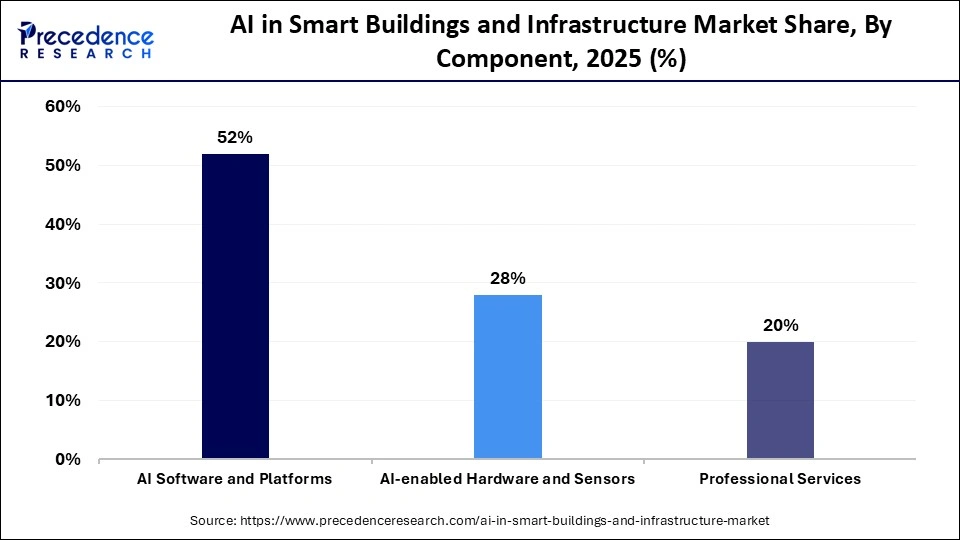
The AI-enabled hardware & sensors segment is projected to grow at the fastest CAGR during the foreseeable period. This is mainly due to the crucial role played by hardware systems in real-time data acquisition, automation, and predictive maintenance. The rapidly increasing demand for energy savings requires an edge-capable device to process huge amounts of data locally, which is a key driver of the segment. Additionally, commercial and industrial sectors increasingly seek durable and secure hardware to support critical infrastructure, contributing to segmental growth.
Technology Insights
Why Does the Machine Learning & Predictive Analytics Segment Dominate the Market?
The machine learning & predictive analytics segment dominated the AI in smart buildings and infrastructure market, holding the largest share of nearly 45% in 2025. This is because of its crucial role in transforming raw data from sensors into actionable insights to optimize energy efficiency, minimize operational cost, and assist in predictive maintenance. These technologies analyze patterns to prevent equipment failure before it occurs. Machine learning can also analyze occupants' behavior and environment changes to offer energy savings through lighting and temperature optimization. Machine learning reduces the need for continuous supervision by automating routine building operations like managing security protocols.
The edge AI processing segment is projected to grow at the highest CAGR during the forecast period, as it enables real-time decision making, increases data privacy, and minimizes operational costs by processing data at the edge. It reduces the need to transfer sensitive data over cloud-based channels or public networks that enhances data safety and helps avoid data breaches. Edge AI can further filter data by transmitting only relatable insights, which essentially need lower bandwidth and cloud storage, in turn reducing the operational costs.
Application Insights
Why Did the Energy & HVAC Optimization Segment Hold the Highest Share in the Market?
The energy & HVAC optimization segment held the largest market share of nearly 32% in 2025, as AI-driven systems significantly reduce energy consumption, optimize heating, ventilation, and air conditioning performance, and lower operational costs. The increasing forces from ESG reporting and the government's strict safety regulations are forcing companies to adopt AI for efficient energy management. AI can further analyze sensor data and predict equipment failure, which reduces downtime and lowers the maintenance costs. It integrates broader building management systems and utilizes IoT sensors to adjust to the indoor environment.
The occupancy & space utilization analytics segment is projected to grow at the fastest CAGR during the forecast period due to its essential role in lowering operational costs and increasing real estate ROI by using hybrid work adaptation and enhancing occupant experiences. Occupancy data drives smart, automated, and predictive HVAC that reduces energy consumption and supports ESG targets. AI offers insights on active and passive energy usage that allow professionals to reconfigure layouts with more precise data than assumptions.
End User Insights
Why Does the Commercial Buildings & Offices Segment Lead the AI in Smart Buildings and Infrastructure Market?
The commercial buildings & offices segment held the largest market share of nearly 44% in 2025 as AI offers next-generation solutions and enables the deployment of building applications that work intelligently alongside the commercial layouts and facilities. Data-driven actions allow better space utilization and optimize indoor experiences, air quality, and comfort for tenants. Commercial buildings face higher scrutiny to meet net-zero targets and comply with regulations on critical infrastructure. AI can analyze data to predict equipment failure and offer prior solutions to actively repair equipment before it fails and reduce downtime.
The residential & multi-family facilities segment is projected to grow at the fastest CAGR during the foreseeable period due to the increasing urbanization, increased energy utilization, and growing demand for effective energy management. Many consumers are looking for a better-ventilated and convenient environment that encourages developers to integrate AI for safety and comfort. Also, the increasing technology adoption with sustainable residential construction is boosting the segment's growth further.
Regional Insights
North America AI in Smart Buildings and Infrastructure Market Size and Growth 2026 to 2035
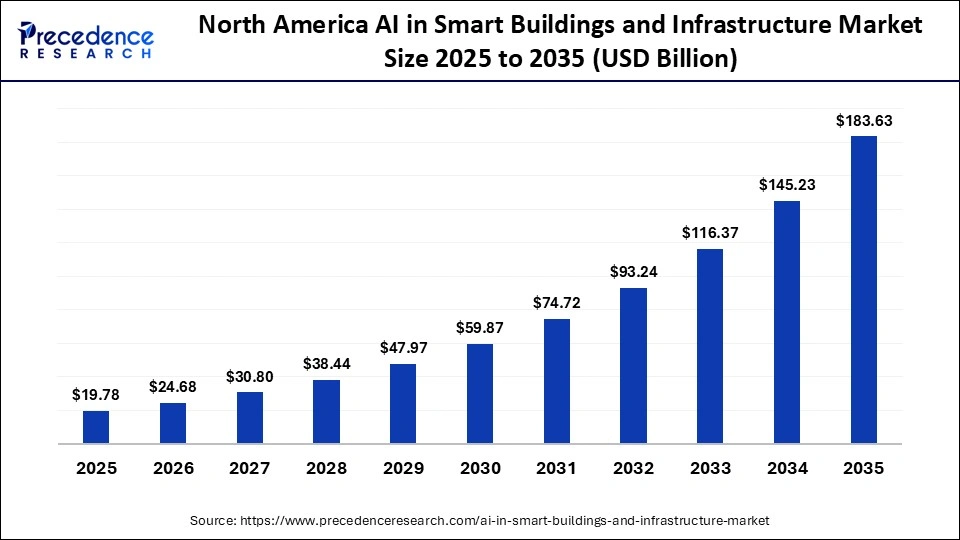
The North America AI in smart buildings and infrastructure market size is estimated at USD 19.78 billion in 2025 and is projected to reach approximately USD 183.63 billion by 2035, with a 24.96% CAGR from 2026 to 2035.
What Made North America the Dominant Region in the AI in Smart Buildings and Infrastructure Market?
North America dominated the market with a major share of nearly 38% in 2025 due to a combination of factors, including the rapid adoption of 5G and IoT technologies, which enable advanced automation and real-time monitoring in commercial and industrial buildings. Supportive government policies promoting energy efficiency and carbon reduction have further driven the integration of AI-powered solutions across infrastructure projects. Significant investments by key players in R&D and strategic acquisitions have strengthened the region's technological capabilities and market presence. Additionally, urbanization trends, economic resilience, and the need to upgrade aging infrastructure have reinforced North America's leading position in the market.
U.S. AI in Smart Buildings and Infrastructure Market Size and Growth 2026 to 2035
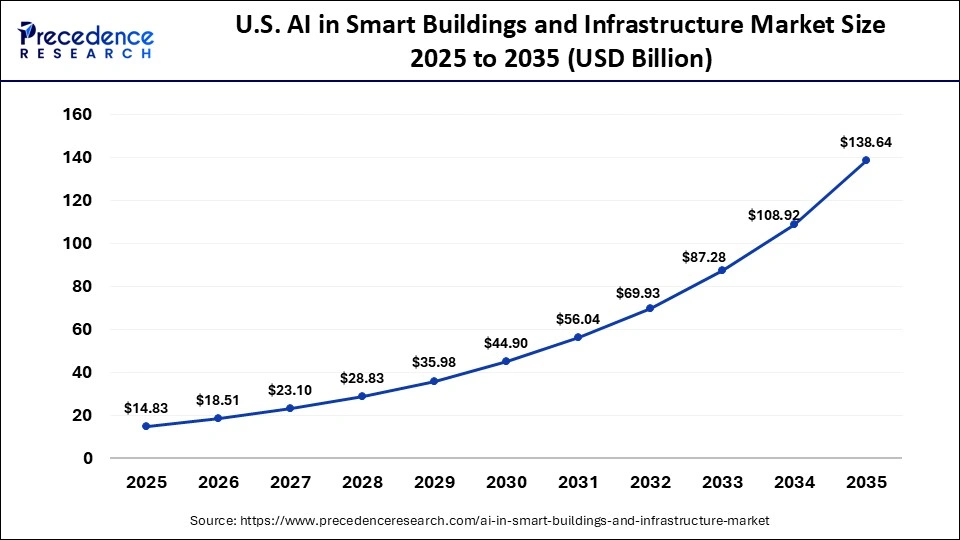
The U.S. AI in smart buildings and infrastructure market size is calculated at USD 14.83 billion in 2025 and is expected to reach nearly USD 138.64 billion in 2035, accelerating at a strong CAGR of 25.05% between 2026 and 2035.
U.S. AI in Smart Buildings and Infrastructure Market
The U.S. is a major contributor to the North American market growth due to its advanced building automation software sector, modern infrastructure, and high technology adoption. Strong institutional frameworks and regulatory compliance further support market expansion. Companies in the U.S. are focusing on operational resilience, cost efficiency, and supply-chain risk mitigation amid evolving global trade dynamics. Additionally, leading players are optimizing building operations and production footprints to meet safety standards and reduce costs.
Why is Asia Pacific Rapidly Expanding in the AI in Smart Buildings and Infrastructure Market?
Asia Pacific is projected to grow at the fastest CAGR during the foreseeable period, driven by strategic initiatives to become a global data center hub and substantial investments in AI-powered energy management and operations. Rapid urbanization is boosting demand for optimized building operations, including HVAC and grid management. The adoption of intelligent infrastructure systems, supported by emerging technologies like 5G and IoT, is further accelerating market expansion. These factors collectively position the region as a key growth frontier in smart building AI solutions.
Leading countries in Asia Pacific, such as China and Japan, are making significant investments in AI to support smart cities and expand industrial automation. Reports indicate that China alone is investing nearly USD 98 billion to develop AI systems. Governments in the region are emphasizing ESG standards and addressing high energy costs, which can be mitigated through AI/ML integration in smart buildings and infrastructure. These initiatives highlight the dynamic growth and evolving potential of the market in the region.
China AI in Smart Buildings and Infrastructure Market Analysis
China is rapidly expanding its AI capabilities through massive investments and strong government backing. Key initiatives include smart city projects, green energy development, and sustainable infrastructure programs. AI is being used to optimize lighting, security, and HVAC systems, driving digital adoption in real estate and construction. Advanced technologies like 5G, edge computing, and AI are increasingly integrated across sectors to maintain competitiveness in the market.
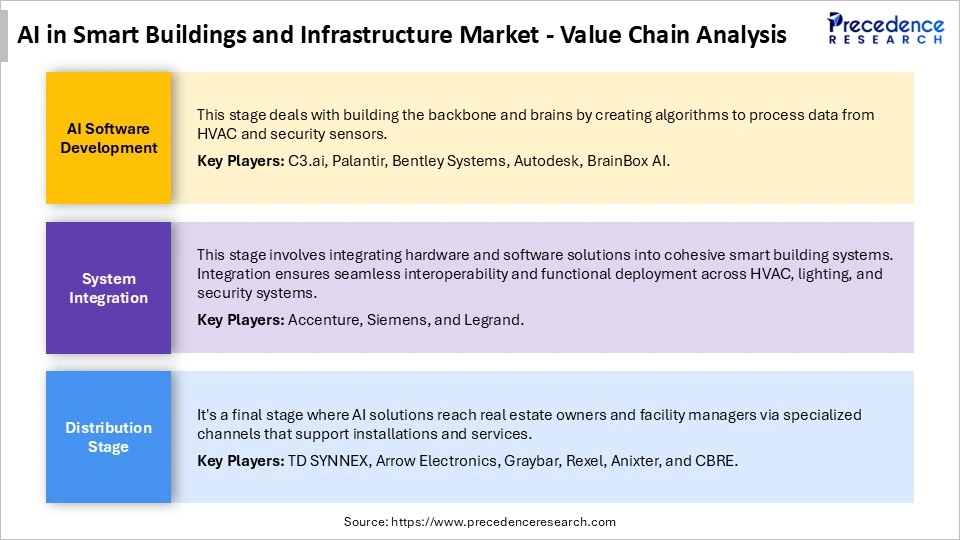
AI in Smart Buildings and Infrastructure Market Value Chain Analysis
AI in Smart Buildings and Infrastructure Market Companies
- Siemens AG
- Honeywell International Inc.
- Johnson Controls International pl
- Schneider Electric SE
- IBM Corporation
- Cisco Systems, Inc.
- Microsoft Corporation
- Intel Corporation
- Google LLC
- Amazon Web Services, Inc.
- General Electric Company
- ABB Ltd.
- Oracle Corporation
- Huawei Technologies Co., Ltd.
- Hitachi, Ltd.
Recent Developments
- In July 2025, Siemens and Microsoft entered into a partnership to enhance IoT data access for smart buildings, integrating Siemens' Building X platform with Microsoft Azure IoT Operations to improve connectivity and data insights for enterprise commercial buildings and data centers.(Source: https://www.iotworldtoday.com)
- In June 2025, Honeywell introduced a new AI platform for building management, aiming to integrate critical building software and technologies with the help of systems used by Verizon Communications and Vanderbilt University.(Source: https://www.iotworldtoday.com)
Segments Covered in the Report
By Component
-
- AI Software & Platforms
- Building analytics
- Predictive maintenance
- AI-enabled Hardware & Sensors
- Smart sensors
- Cameras & edge AI devices
- Professional Services
- Implementation
- Consulting & integration
- AI Software & Platforms
By Technology
- Machine Learning & Predictive Analytics
- Computer Vision Systems
- Natural Language Processing (for voice/assistants)
- Edge AI Processing
- Other AI Techniques
By Application
- Energy & HVAC Optimization
- Security & Surveillance Analytics
- Occupancy & Space Utilization Analytics
- Predictive & Condition-Based Maintenance
- Smart Lighting & Control Systems
Other Infrastructure Applications
By End User
- Commercial Buildings & Offices
- Industrial & Manufacturing Facilities
- Residential & Multi-Family Buildings
- Healthcare Facilities
- Government & Public Infrastructure
By Region
- North America
- Europe
- Asia-Pacific
- Latin America
- Middle East & Africa
For inquiries regarding discounts, bulk purchases, or customization requests, please contact us at sales@precedenceresearch.com
Frequently Asked Questions





Ask For Sample
No cookie-cutter, only authentic analysis – take the 1st step to become a Precedence Research client
 Get a Sample




 sales@precedenceresearch.com
 Schedule a Meeting
