



AI for Smart City Traffic Optimization Market Trends, Companies, Revenue / Sales Performance, Subscriber Growth, Pricing Strategies, Cloud Adoption, Infrastructure Expansion, Competitive Landscape, and Industry Outlook
AI for Smart City Traffic Optimization Market (By Component: Hardware, Solutions/Software, Services; By System/Application: Urban Traffic Management & Control (UTMC), Adaptive Traffic Control Systems, Incident Detection & Location Systems., Smart Parking Management., Journey Time Management Systems.; By Deployment Mode: On-Premises, Cloud-Based; By Technology: Machine Learning & Deep Learning, Computer Vision, Natural Language Processing (NLP)) - Global Industry Analysis, Size, Trends, Leading Companies, Regional Outlook, and Forecast 2026 to 2035
Source: https://www.precedenceresearch.com/ai-for-smart-city-traffic-optimization-market
 Get a Sample
 Table Of Content


What is the AI for Smart City Traffic Optimization Market Size in 2026?
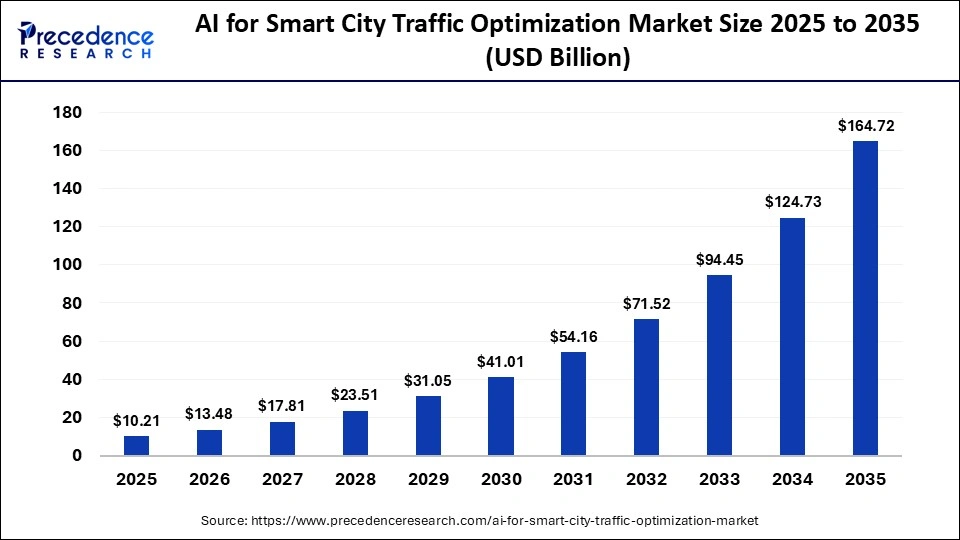
The global AI for smart city traffic optimization market size was calculated at USD 10.21 billion in 2025 and is predicted to increase from USD 13.48 billion in 2026 to approximately USD 164.72 billion by 2035, expanding at a CAGR of 32.06% from 2026 to 2035. The market growth is driven by rapid urbanization, the need to address traffic congestion, and government-backed initiatives promoting AI-driven systems to reduce carbon emissions through advanced data analytics and real-time technologies.
Key Takeaways
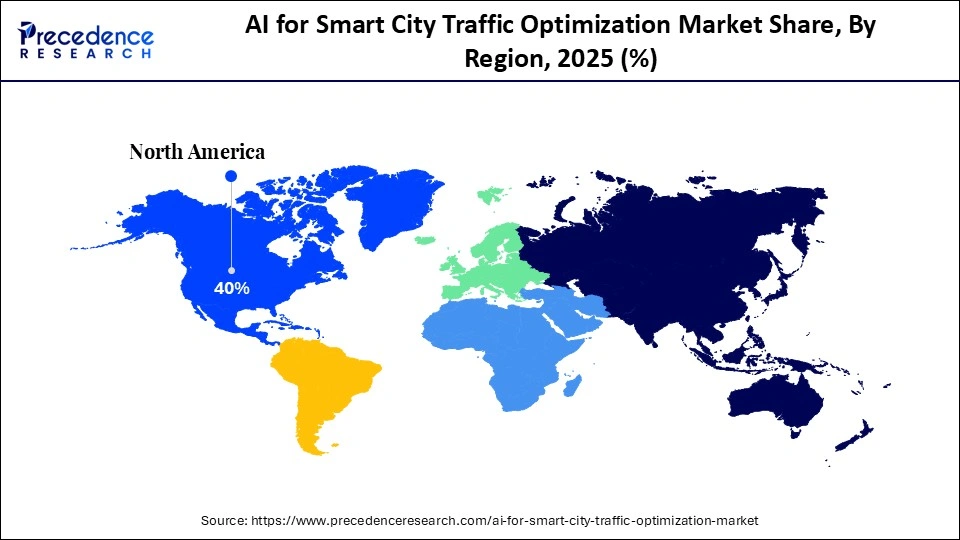
- North America held the largest market share in 2025.
- Asia Pacific is projected to grow at the fastest CAGR during the foreseeable period.
- By component, the hardware segment held the largest market share in 2025.
- By component, the solutions/software segment is projected to grow at the fastest CAGR during the foreseeable period.
- By system/application, the urban traffic management & control (UTMC) segment held the largest market share in 2025.
- By system/application, the adaptive traffic control systems (ATCS) segment is projected to grow at the fastest CAGR during the foreseeable period.
- By deployment mode, the cloud-based segment held the largest market share in 2025, and the same segment is projected to grow at the fastest CAGR during the foreseeable period.
- By technology, the machine learning & deep learning segment held the largest market share in 2025.
- By technology, the natural language processing segment is projected to grow at the fastest CAGR during the foreseeable period.
Market Overview
The AI for smart city traffic optimization market is experiencing rapid growth as urban centers integrate machine learning to combat congestion, reduce emissions, and enhance public safety. The market is rapidly evolving, driven by core applications in adaptive signal control, incident detection, emergency vehicle prioritization, and smart parking management. Key factors fueling growth include improved safety through AI systems, a focus on reducing environmental impact, and demand for intelligent traffic management systems.
AI for Smart City Traffic Optimization Market Trends
- There is an increasing shift from centralized cloud processing to edge AI that directly processes data on sensors and cameras, which reduces latency and increases data safety.
- Leading cities are rapidly embracing digital twins, which create a virtual replica of urban infrastructure to simulate traffic scenarios, review AI policies, and help predict traffic before 1 hour at least.
- The integration of IoT sensors with AI enables comprehensive monitoring and quick, actionable insights, such as identifying accidents, parking issues, and abnormal traffic patterns.
- Connected vehicle communication is a growing trend, allowing vehicles to communicate with roadside units to optimize traffic flow for autonomous and connected vehicles.
- Growing focus on sustainability and emission reduction also supports market growth. AI-driven traffic optimization systems are being designed to reduce carbon emissions by optimizing traffic flow, supporting cities' sustainability goals and complying with environmental regulations.
Market Scope
| Report Coverage | Details |
| Market Size in 2025 | USD 10.21 Billion |
| Market Size in 2026 | USD 13.48 Billion |
| Market Size by 2035 | USD 164.72 Billion |
| Market Growth Rate from 2026 to 2035 | CAGR of 32.06% |
| Dominating Region | North America |
| Fastest Growing Region | Asia Pacific |
| Base Year | 2025 |
| Forecast Period | 2026 to 2035 |
| Segments Covered | Component, System/Application, Deployment Mode,T echnology, and region |
| Regions Covered | North America, Europe, Asia-Pacific, Latin America, and Middle East & Africa |
Segment Insights
Component Insights
Why Did the Hardware Segment Dominate the AI for Smart City Traffic Optimization Market?
The hardware segment dominated the market while holding the largest share in 2025. This is mainly due to the crucial role played by hardware solutions, including cameras, sensors, and smart traffic lights, in enabling AI-driven traffic management systems. These solutions enhance real-time data collection and support traffic-free roads. The increasing deployment of specialized hardware like AI accelerators and GPUs is highly essential for real-time traffic analysis and decision-making. Hardware devices are highly scalable and can be integrated with the existing smart city infrastructure.
The solutions/software segment is expected to grow at the fastest CAGR during the foreseeable period, as it enables core intelligence that makes real-time data-driven decisions possible. AI software like ML/DL analyzes huge datasets from cameras and sensors to adjust traffic signals accordingly and predict traffic flow with congestion. AI software further allows city officers to forecast traffic patterns and actively reduce congestion before it occurs. Software also powers high ROI and is crucial to managing applications like adaptive traffic signal control, automated parking management, and emergency vehicle prioritization.
System/Application Insights
Why Does the UTMC Segment Lead the AI for Smart City Traffic Optimization Market?
The urban traffic management & control (UTMC) segment led the market with the largest share in 2025 due to its comprehensive ability to monitor, analyze, and manage traffic flow in real-time. By integrating AI-driven surveillance, UTMC systems can detect accidents, halted vehicles, and traffic violations, enabling rapid response and enhancing road safety. Government investments in smart city infrastructure further support the adoption of these systems, often linking them with command and control centers. This integration of data from sensors, GPS, and IoT into a single platform reduces manual intervention, minimizes errors, and provides a more efficient and scalable solution for managing urban traffic.
The adaptive traffic control systems (ATCS) segment is projected to grow at the fastest CAGR during the foreseeable period, owing to their ability to break down cities into smaller areas and analyze specific traffic patterns. These systems respond to granular data such as vehicle count, congestion, and pedestrian flow at a localized level. By utilizing AI algorithms to assess traffic potential in real-time, ATCS enables efficient traffic management and reduces waiting times, adapting to dynamic conditions for smoother traffic flow.
Deployment Mode Insights
What Makes Cloud-Based the Dominant Segment in the Market?
The cloud-based segment dominated the AI for smart city traffic optimization market by holding the largest share in 2025 and is expected to sustain its dominant position during the foreseeable period. This is because it offers unmatched computational power and centralized data integration with higher scalability, which is essential to manage massive, real-time datasets from IoT sensors within cities, sensors, and cameras. Cloud deployment is highly crucial for AI training, predictive analytics, and traffic flow coordination across whole metropolitan areas. Cloud platforms offer nearly infinite storage with high processing power that allows cities to scale up and manage physical data centers in the cities.
One of the key benefits of cloud-based deployment is that AI systems on cloud platforms can analyze both historical data and real-time feeds to predict traffic trends and needs in advance. This provides city planners with a comprehensive view of potential traffic management scenarios, improving long-term infrastructure stability and supporting the large-scale adoption of cloud-based solutions.
Technology Insights
Why Did the Machine Learning & Deep Learning Segment Hold the Largest Market Share?
The machine learning & deep learning segment held the largest share of the AI for smart city traffic optimization market in 2025. This is because of the ability of these technologies to analyze massive and real-time datasets and predict traffic patterns to optimize flow effectively. ML algorithms enable automated decision-making, reducing congestion and improving efficiency and safety. They are essential for analyzing data from sensors, IoT devices, and connected vehicles, allowing real-time adjustments to traffic signals, offering a significant advantage over static, pre-programmed traffic systems based on conventional methods.
The natural language processing (NLP) segment is projected to grow at the fastest CAGR during the foreseeable period due to its ability to enhance user interaction and understand plain language without extensive coding. NLP allows real-time voice-based communication, interpreting data from voice or text-based bots. Thus, it is heavily used in AI-powered virtual assistants and chatbots designed for public services, supporting the traffic management-related queries and reports in real-time. NLP further improves user experience in a smart transportation system by enabling hands-free and voice-controlled interfaces for citizens and drivers.
Regional Insights
North America AI for Smart City Traffic Optimization Market Size and Growth 2026 to 2035
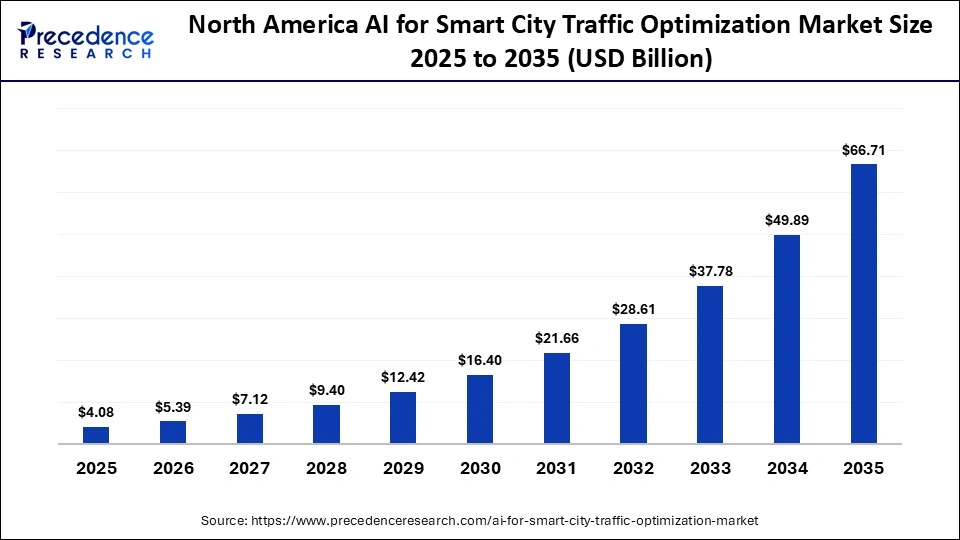
The North America AI for smart city traffic optimization market size is estimated at USD 4.08 billion in 2025 and is projected to reach approximately USD 66.71 billion by 2035, with a 32.24 % CAGR from 2026 to 2035.
What Made North America the Leading Region in the AI for Smart City Traffic Optimization Market?
North America led the AI for smart city traffic optimization market by holding the largest share in 2025. This is mainly due to a combination of factors like rapid digital transformation, huge public-private investments in intelligent traffic management systems, and government-backed smart city initiatives. Major initiatives in the region, like the SMART grant program and huge investments to modernize the infrastructure of smart transportation, accelerated the deployment of AI systems for traffic management and seamless smart city functioning.
The region also benefits from the presence of leading AI companies that are actively working on developing AI-powered platforms and tools for traffic optimization. The region's market expansion is further supported by the widespread adoption of cutting-edge technologies such as IoT sensors and 5G communication systems, coupled with favorable regulatory frameworks and a commitment to creating a safe, smart urban environment.
U.S. AI for Smart City Traffic Optimization Market Size and Growth 2026 to 2035
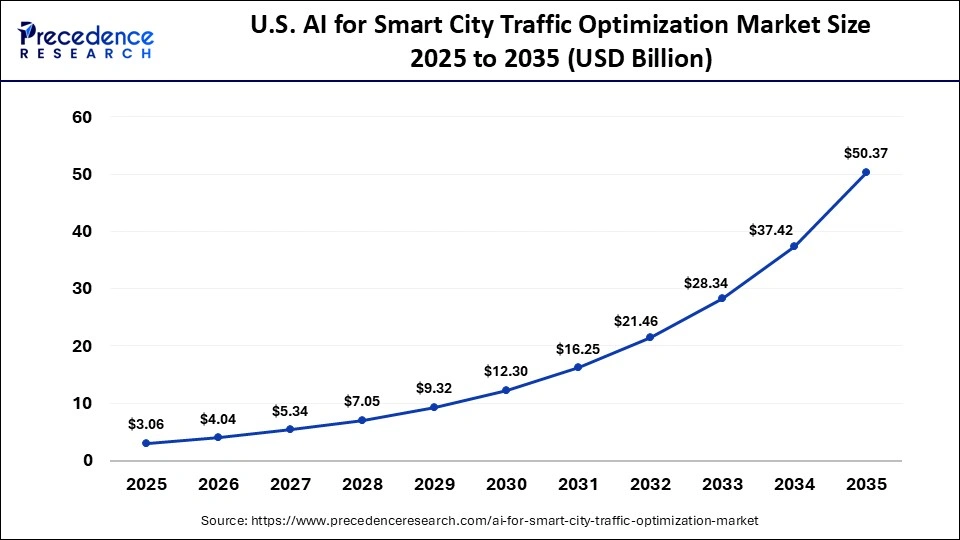
The U.S. AI for smart city traffic optimization market size is calculated at USD 3.06 billion in 2025 and is expected to reach nearly USD 50/37 billion in 2035, accelerating at a strong CAGR of 32.33% between 2026 and 2035.
U.S. AI for Smart City Traffic Optimization Market Analysis
The U.S. is the leading contributor to the North American market, driven by significant investments in smart infrastructure and a focus on resolving urban congestion with advanced technologies. Government initiatives like the Smart City Challenge by the Department of Transportation, which provides substantial funding, are promoting the adoption of AI-driven traffic management systems. With nearly 80% of the U.S. population living in cities, severe traffic congestion is a critical issue, making strict enforcement of traffic rules, such as signal violations, essential, something that can be effectively addressed through immediate, AI-driven solutions.
Why is Asia Pacific Rapidly Expanding in the AI for Smart City Traffic Optimization Market?
Asia Pacific is projected to grow at the fastest CAGR during the foreseeable period due to the urgency to address severe traffic congestion issues, especially in densely populated urban areas, and government-backed smart city initiatives in several countries. Additionally, increasing public-private collaborations to implement smart traffic management systems are accelerating the adoption of AI-driven solutions, supporting overburdened existing traffic infrastructure.
The integration of IoT devices, high-speed 5G, and AI-powered predictive analytics has helped reduce congestion by approximately 20%. Major cities in Asia Pacific are adopting AI-driven systems to create greener, more efficient transportation networks, aiming to mitigate carbon emissions and enhance safety. This shift is driving sustained market growth in the region for the long term.
India AI for Smart City Traffic Optimization Market Analysis
The integration of AI-driven traffic management systems in India goes beyond traffic control, offering safer, smarter, and more sustainable solutions for densely populated urban areas. AI has become a crucial tool in addressing the complexities of urban mobility, improving efficiency and safety. Initiatives like the Smart City Mission and city modernization projects provide essential funding and frameworks to integrate dynamic AI systems into traffic management, driving innovation and long-term sustainability in urban mobility.
AI for Smart City Traffic Optimization Market Companies
- Siemens Mobility (Siemens AG)
- IBM Corporation
- Cisco Systems, Inc.
- Thales Group
- Huawei Technologies Co., Ltd.
- Kapsch TrafficCom AG
- Cubic Corporation (Cubic Transportation Systems)
- Iteris, Inc.
- SWARCO AG
- No Traffic
Recent Developments
- In February 2026, a group of researchers from the Department of Electronics and Communication Engineering at the National Institute of Technology Rourkela introduced a smart roadside system that can identify vehicles entering blind spots or corners and alert drivers in real time to avoid fatal accidents.(Source: https://educationworld.in)
- In February 2026, Iveda launched its new Traffic Management Module within IvedaAI™, enhancing the platform with real-time intersection monitoring, traffic optimization, and automated road safety analytics.(Source: https://finance.yahoo.com)
- In February 2026, Cyberabad Police reviewed an AI-based predictive traffic management system designed to forecast congestion, simulate real-time road conditions, and optimize signal timings. At a meeting at the Police Smart Integrated Operations Centre (PSIOC), Commissioner M Ramesh directed officials to assess the feasibility of implementing intelligent traffic technologies to improve congestion management, enforcement efficiency, and road safety.(Source: https://www.thehindu.com)
- In July 2025, North Carolina installed nearly 2,500 AI-based traffic signals, which is the largest live deployment of AI-driven traffic signal software in the U.S. that assists traffic engineers in enhancing signal operations.(Source: https://www.smartcitiesdive.com)
Segments Covered in the Report
By Component
- Hardware
- Solutions/Software
- Services
By System/Application
- Urban Traffic Management & Control (UTMC)
- Adaptive Traffic Control Systems
- Incident Detection & Location Systems
- Smart Parking Management.
- Journey Time Management Systems.
By Deployment Mode
- On-Premises.
- Cloud-Based
By Technology
- Machine Learning & Deep Learning
- Computer Vision
- Natural Language Processing (NLP)
By Region
- North America
- Asia Pacific
- Europe
- Latin America
- Middle East & Africa
For inquiries regarding discounts, bulk purchases, or customization requests, please contact us at sales@precedenceresearch.com
Frequently Asked Questions





Ask For Sample
No cookie-cutter, only authentic analysis – take the 1st step to become a Precedence Research client
 Get a Sample




 sales@precedenceresearch.com
 Schedule a Meeting
