



AI Security Operations Center (SOC) Market Size, Share, Trends, and Forecast 2026-2035
Gautam Mahajan is an ICT market research analyst. He researched AI-native SOC platforms, AI security agents, automated alert investigation, generative AI copilots, integration with SIEM and SOAR, XDR, and managed security operations. His analysis assists cybersecurity vendors, enterprises, MSSPs, and security teams in considering technology adoption, competition, and investment priorities.
Source: https://www.precedenceresearch.com/ai-security-operations-center-market
 Get a Sample
 Table Of Content


AI Security Operations Center (SOC) Market Size and Forecast 2026 to 2035
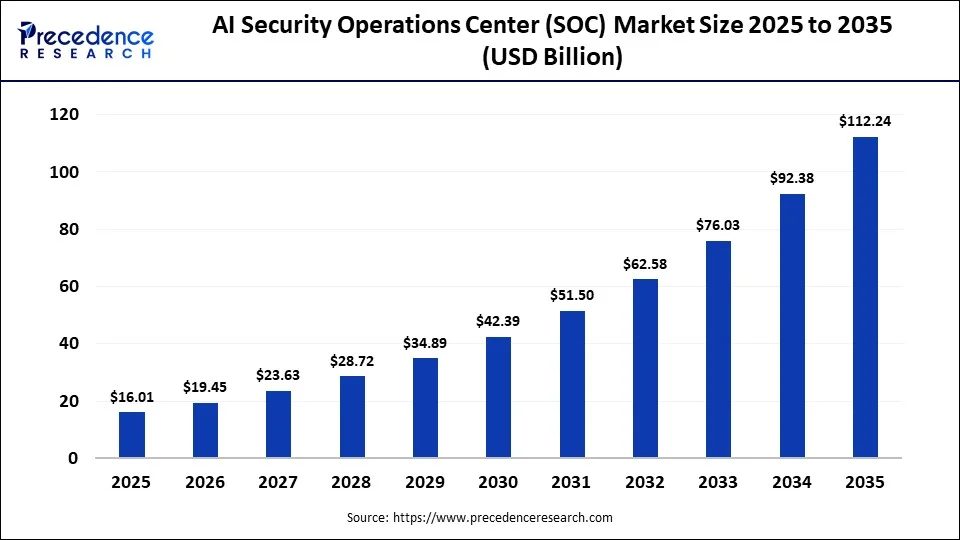
With more than five years of experience in the market, Gautam Mahajan says SOC operations are moving from handling alerts to the ability of the system to categorize alerts, explore all the details, make recommendations, and automate selected response actions. The AI-powered SOC platforms help correlate security telemetry, detect behavioral patterns, summarize incidents, and escalate higher-priority incidents to analysts. The global AI security operations center (SOC) market is valued at USD 19.45 billion of market share in 2026. That will grow to USD 112.24 billion by 2035 at a compound annual growth rate of 21.50%. He also believes the evolving SOC analyst job role is driving changes in the market.
Key Takeaways
- By software, the AI-enabled threat detection platforms segment led the market with a share of 30.9% in 2026.
- By service, the managed detection & response segment dominated the market in 2026.
- By deployment mode, the cloud-based segment captured major revenue in 2026.
- By application, the incident response & remediation segment is expected to grow at the fastest CAGR of 23.9% during the forecast period.
- By technology, the agentic AI segment is expected to grow at the highest CAGR of 30.4% from 2026 to 2035.
- By industry vertical, the healthcare & life sciences segment is expected to expand rapidly with a CAGR of 23.2% over the studied period.
- Palo Alto Networks is distinguished by its AI-powered detection and response capabilities, its subscription business model, and the industry's largest security telemetry dataset, which amounts to USD 5.25 billion in annual runs.
- SentinelOne and Darktrace are known cybersecurity giants that specialise in AI, but Palo Alto Networks offers much more platform scale and market presence, with USD 1 billion at SentinelOne and USD 616.5 million at Darktrace.
- Google's USD 32 billion Wiz cloud acquisition signals the increasing strategic value of cloud security, as more applications and workflows move to the cloud, and enterprises demand more security transparency and observability.
- The USD 25 billion purchase of CyberArk fortifies Palo Alto Networks' identity security solutions, fully supporting identity security as an integral part of today's security platforms.
Market Overview
AI is Shifting SOC Economics from Analyst-Centric Operations Toward Autonomous Detection, Investigation, and Response
The global AI security operations center (SOC) market is estimated at USD 19.45 billion in 2026, projected to reach USD 112.24 billion in 2035 at 21.50% CAGR (2026-2035). An estimated USD 96.23 billion in revenue represents a contribution to the market. That is expected to exceed USD 42.39 billion by about 2030.
The market is moving towards AI-native SOC platforms and security operations as agents instead of AI-assisted security analytics. Three-quarters of market revenues in 2026 came from software, while services comprised 31.3%. The distribution of the cloud will account for 57.6% of the market in 2026 and is projected to climb to 67.1% by 2035 as a result of an expanding trend of organizations shifting workloads. That includes SIEM, XDR, threat intelligence, security automation, and AI inference into the cloud.
The North American region is anticipated to account for the largest share at 40.7% during 2026, and the Asia-Pacific region is projected to hold the fastest growth rate among the major regions at 25.0% CAGR. Its market share is projected to rise from 22.6% to 27.1% by 2035. AI SOC agent platforms are expected to grow at a rate of 28.8% CAGR, while agentic AI will grow at the fastest rate at 30.4% CAGR.
Key Insight: Cloud-based platforms based on artificial intelligence (AI) and agent information and assistance are gaining traction in the area of AI spending in SOCs to handle investigation and response tasks traditionally performed by security analysts.
Source: Precedence Research Database
Market Size & Forecast
A USD 100+ Billion Security Operations Opportunity Emerges by 2035
By 2035, the projected value of the AI SOC market is around USD 112.24 billion with a CAGR of 21.50% during the forecast period. This growth is driven not by increased cybersecurity budgets, but by companies spending on technologies that reduce manual tasks for SOC teams and automate additional aspects of D&R (detection and response).
Large enterprises comprise 69.2% of market revenue in 2026. That will decrease to 63.6% by 2035. SMEs' revenue is projected to increase by 24.7%, while large ones are projected to increase by 19.5%. AI-powered SOC solutions are thus enabling companies to manage complex security scenarios without the need for larger teams or resources.
Key Insight: SME adoption is progressing at a faster rate than that of large enterprises, reflecting the reduction in SME costs and staff requirements for advanced SOC capabilities driven by AI.
Source: Precedence Research Database
Segmentation Analysis
AI-Native Platforms and Agentic Workflows Are Capturing the Fastest-Growing Revenue Pools
Aman interprets that AI SOC agent platforms have a 28.8% CAGR and held a 9.3% market share in 2026. Agent-based security operations are on the rise as companies seek more than just an analyst assistant. Companies want AI to interpret the alerts, make decisions, and handle response workflows. The industry's native architecture for AI-powered security operations drives AI-native SOC platforms to record a CAGR of 24.5%.
The orchestrated response platforms segment is predicted to grow at a consistent rate of 23.0% CAGR and command a market share of 17.2% in 2026, due to the value of organizations placing manual response activities being increasingly minimized and repetitive response activities being automated. AI-enabled threat detection platforms held the largest market share of 30.9% in 2026, enabling SOCs to ingest massive data streams, filter out noise, and detect advanced attacks in seconds.
Key Insight: AI SOC agent platforms are key drivers at 28.8% CAGR, reflecting the market transitioning towards autonomous investigation and response from analysts only.
Managed detection & response (MDR) is still the biggest service category, accounting for 41.8%. The percentage of SOC-as-a-service grows to 32.2% from 29.7% because organizations aim to have H24 security operations without the heavy burden of a large in-house SOC team. Aditi believes that the deployment side indicates an even more striking structural transition. The cloud-based deployment increases from 57.6% to 67.1% due to the growing share of companies moving security infrastructure and workloads to cloud environments. Thus, security operations require scaling accordingly.
Key Insight: The cloud segment is estimated to be 67.1% by 2035 due to organizations requiring flexible, scalable security operations to ensure their cloud environments are protected.
Source: Precedence Research Database
Application and Technology Segmentation
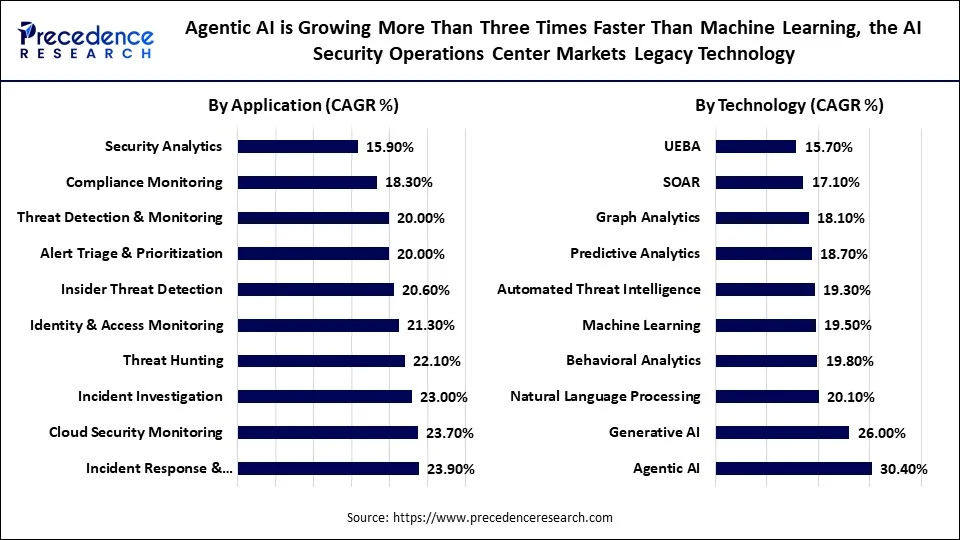
In applications, incident response & remediation is growing at 23.9% CAGR as security teams increasingly require technology that can help them from detecting an incident to controlling and remediating an incident. Cloud security monitoring is in the lead with 23.7%, as more cloud infrastructure is deployed in the coming years.
The technology side is of even greater importance. Agentic AI is the top performer among the technology group at 30.4% CAGR. It assists with multi-step investigation and response tasks, rather than just generating recommendations. Generative AI grows at 26.0%, supported by its ability to summarize incidents and make large volumes of security information easier to understand. The use of NLP is increasing at an annual rate of 20.1%, since security teams have an increasing need to work with complex security information in an intuitive manner.
Key Insight: This agentic AI one's the growth at 30.4% CAGR as security buyers are moving toward using AI that investigates and acts, rather than analyzing.
Source: Precedence Research Database
Security Environment, Industry Vertical, Organization Size, and Region
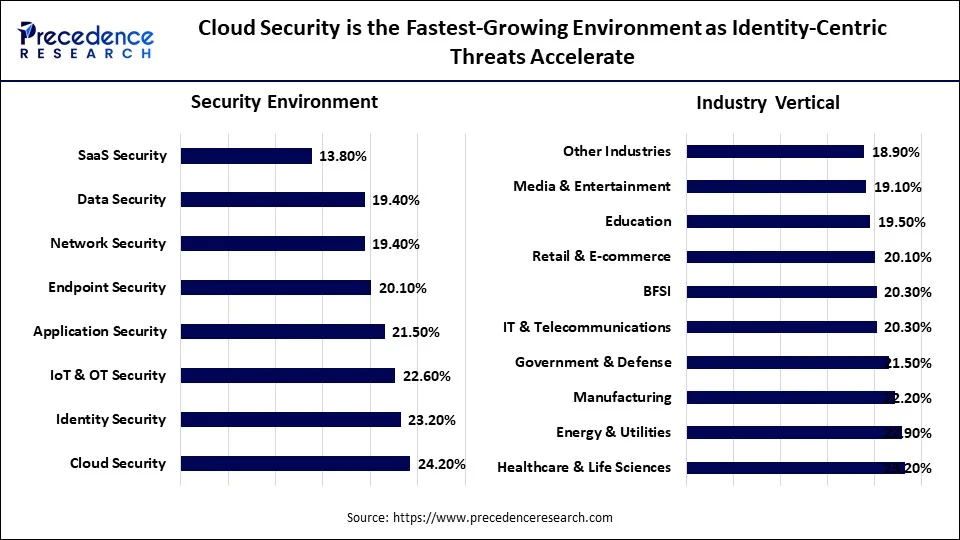
Cloud security is a leader at 24.2% CAGR, due to the fact that organizations are migrating more workloads and data to the cloud and thus require constant security visibility across clouds. Its market share is expected to grow from 18.1% to 22.9% as cloud security is growing. SaaS security has a growth rate of 13.8%, reflecting the slower growth within the group, while the rest of the market is growing at a higher rate by gaining traction in the cloud.
The industry-vertical side displays significant growth in the sectors where disruptions of operations and sensitive information are a big concern for security. BFSI leads the market at 20.3% CAGR, with this sector being extremely data-driven and having to handle lots of sensitive data.
Key Insight: Cloud security is expected to expand at a 24.2% CAGR, as the growing extent of cloud infrastructure use has correspondingly raised the necessity for constant and scalable monitoring of security.
In 2026, approximately 69% of the market existed in large enterprises, while 31% of the market was in SMEs, as Aman interpreted. Large enterprises, driven by big enterprises, have bigger technology environments and are subject to much more complex compliance. On the other hand, at the same time, the share of SMEs is gaining significant weight, as it would increase from 30.8% to 36.4%, as AI-driven SOC services enable smaller enterprises to utilize security measures.
In 2026, North America accounted for 40.7% of total sales, but is forecast to drop to 38.1% in 2035, despite being a significant market due to the growth rate of other areas. Europe's significance is declining, however, from 26.1% to 24.8%. Asia-Pacific will grow by 27.1%, one of the strongest growth regions, as digital transformation, cloud, and cybersecurity investments are booming across the region.
Key Insight: Lower-cost AI services and digital adoption in Asia-Pacific (APAC) are creating new pools of demand as SME share rises to 36.4% and APAC share jumps to 27.1%.
Source: Precedence Research Database
Market Dynamics
Alert Volumes, Talent Constraints, Cloud Complexity, and Autonomous Response Are Reshaping SOC Economics
As the amount of data gathered by security appliances continues to increase, the number of analysts available is not growing in parallel. The most obvious demand pressure is that as more data is gathered by security appliances, more analysts are not being added. AI can assist security teams in correlating events, summarizing incidents, identifying suspicious activity, augmenting alerts, and even automating repetitive action steps. AI-powered technologies for SOCs have a robust spending foundation in 2025 as global cybersecurity expenditures are forecast to reach USD 213 billion, rising to USD 248 billion sometime in 2026.
While the early stages of alert triage and prioritization represent 13.1% of app revenue, ramping up to the next phase of alert investigation and remediation. This is a stage that was previously considered to be manual. Respondents are seeing an increased number of vendors pushing into this as the next logical step in the journey of automation. Hallucinations in the models, the quality of available data in security dashboards, integrations with more complicated security systems, governance hurdles, false positives, and the need for subject matter experts to set up artificial intelligence tools. Also, the fear of giving AI systems authority to make important security decisions still affects adoption.
Key Insight: The commercial opportunity is advancing from quicker sorting of alerts to a commercial AI investigation that can also manage remedial action.
Source: Precedence Research Database
Pricing and Commercial Model Analysis
AI SOC Pricing Is Moving Toward Consumption, Subscription, and Outcome-Based Economics
AI SOC platforms rely on commercial models, which are distinct from traditional security systems. Often, vendors tend to charge based on annual recurring revenue, annual contract value, protected endpoints, telemetry volume, data ingestion, users, assets, cloud workloads, seats, or the level of managed services.
Cloud-native SOC solutions are typically based on monthly subscription fees, and MDR and SOC-as-a-service work on a subscription for both software and detection and response types of services. With AI agents, repetitive analyst tasks can be automated, presenting an additional pricing option. To ensure that there remains enough incentive for vendors, pricing will increasingly be tied to measurable activities like incidents investigated, alerts processed, assets protected, or automated activities completed.
Key Insight: AI automation creates scope for SOC vendors to move beyond seat-based pricing toward usage and outcome-linked commercial models.
| Commercial Model | How It Works | Typical Fit |
| Subscription / ARR-Based License | Recurring fee tied to platform access and scale of deployment | Cloud-native SIEM, XDR, and AI SOC platforms |
| Per-Endpoint / Per-Asset Pricing | Fee scales with the number of protected endpoints, users, or workloads | Endpoint security and XDR platforms |
| Data-Ingestion / Telemetry-Based Pricing | Fee scales with volume of security data ingested and retained | SIEM and security data platforms |
| Managed-Service / MDR Fee | Bundled fee covering technology plus 24/7 managed analyst coverage | MDR and SOC-as-a-Service providers |
| Outcome-Based Pricing | Payment tied to incidents investigated, alerts processed, or automated workflows executed | Agentic AI and autonomous investigation platforms |
Source: Precedence Research Database
Demand-Supply and Value Chain
Data, Detection, Intelligence, Reasoning, and Response Form a New Security Operations Stack
| Stage | Description |
| Telemetry Ingestion | Network, endpoint, identity, app, cloud & OT data |
| Normalization & Enrichment | Data cleansing and threat-intelligence enrichment |
| Detection & Analytics | ML, behavioral and predictive models flag anomalies |
| Reasoning & Investigation | GenAI/agentic systems correlate evidence and form hypotheses |
| Response & Remediation | Automated or human-approved containment and remediation |
| Validation & Reporting | Outcome verification, audit trail, and compliance reporting |
The AI SOC value chain begins at the endpoint, network, identity, application, cloud infrastructure, SaaS platforms, and operational technology. Those events are then normalized and enriched and then fed into detection engines, analysis platforms, threat intelligence, generative AI, and agentic systems. A bigger portion is shifting to the reasoning and action layer, where the systems can investigate incidents, infer what is likely to occur, suggest remediation, and then carry out the approved response procedure. While the most basic capabilities of SIEM, XDR, SOAR, and MDR are present, autonomous investigation, orchestrating agents, security reasoning, and integrated response remain immature.
Key Insight: AI SOC's thin supply of technical skills is evolving from gathering security data to definitively thinking about security data and making calculated decisions.
Source: Precedence Research Database
Technology and Innovation
Agentic AI Is Becoming the Next Major Architecture Layer
While machine learning itself came out on top in 2026 as the biggest technology category. It is expected to lose 4% of market share by 2035 to 20.4%. Agentic AI, on the other hand, is expected to be 18.4%. The process of just detecting and recommending to one that can detect, investigate, reason, act, and validate results.
Support for multi-step investigations, cross-connect evidence between security environments, generate investigation hypotheses, query security data, and trigger pre-defined response workflows by AI agents. This also highlights the need for governance and explainability, audit trails, permissions given and accepted, and reliable execution. The vendors need to demonstrate the ability of their AI to run security operations without fail, rather than just engaging users in conversation or summarizing their content.
Key Insight: Agentic AI has become an integral part of the SOC architecture to handle specific investigation and response tasks.
Regulation, Governance and Risk
Autonomous Security Requires Stronger Controls Around AI Decision-Making
Incident reporting, industry security needs, data residency and security requirements, compliance with privacy rules, security regulations, and AI governance have become key considerations in the deployment of AI SOC. Enterprises should also be aware of the location of the data that is processed at telemetry, how models utilize security data, and what privileges must be granted to AI systems when controlling infrastructure.
Governance is therefore shifting from the traditional security-control testing business to accountability for AI decisions. Organizations seek out audit trails, thresholds for human intervention, monitoring of the model, and customizable data environments, as well as records of what actions an AI system took.
Key Insight: Governance needs to monitor decisions and actions from AI that SOC systems are becoming capable of delivering in an autonomous way.
Customer and Application Analysis
Incident Response Is Becoming the Highest-Value AI Automation Layer
Threat detection & monitoring remains a major application in 2026, accounting for 26.3% of the market share, but this will shrink to 24.1% as AI features permeate into broader use across the SOC workflow. Incident response & remediation is increasing at 23.9%, with cloud security monitoring at 23.7%.
The vertical share for the BFSI category was the highest at 20.1%, followed by government & defense at 14.7% and IT & telecommunications at 16.8%. Energy & utilities' share will go up from 7.1% to 7.9%, while healthcare & life sciences' share will grow from 11.4% to 12.8%.
Key Insight: Incident response is becoming a major AI automation opportunity as enterprises move from identifying threats to shortening the time required to contain them.
Competitive Intelligence
Competitive Landscape-Platform Scale Is Converging With AI-Native SOC Automation
| Category | Companies |
| Global Platform Leaders |
|
| AI-Native Security Leaders |
|
| MDR & Managed SOC Specialists |
|
| Security Analytics & SIEM Specialists |
|
| AI-Native SOC Agent Challengers |
|
In this competitive market, it is categorized into four main groups: large cybersecurity platforms, cloud and technology ecosystems, managed SOC/MDR providers, and AI-native SOC challengers. Large vendors have more comprehensive telemetry, pre-existing enterprise sales, threat intelligence, integrated security offerings, and distribution. AI-powered companies are competing by deploying faster, investigating autonomously, using agent-based workflows, and with targeted SOC automation.
The competition is getting more than just AI-powered detection. Now vendors are being judged on their ability to investigate and respond to cases autonomously, in addition to accuracy, interoperability, governance, and providing measurable gains in analyst productivity. There's also a chance for acquisitions and partnerships that occur at the lower levels of fragmented platforms.
Key Insight: Competitive advantage is shifting from simply having AI features to proving that AI can automate meaningful SOC work safely and consistently.
Source: Precedence Research Database
Tentative Leading Company Universe
| Company | HQ | Market Position | Core Strength | Major Applications/Segments |
| Microsoft | US | Global platform leader | Cloud, SIEM, XDR, AI | Enterprise SOC |
| Cisco | US | Global security platform | Network, SIEM, XDR | Enterprise/network SOC |
| CrowdStrike | US | AI-native security leader | Endpoint, XDR, AI | Detection/response |
| Palo Alto Networks | US | Integrated security leader | XSIAM, XDR, automation | Enterprise SOC |
| Google Cloud | US | Cloud-security leader | Security operations, AI | Cloud SOC |
| IBM | US | Enterprise security leader | SIEM, AI, consulting | Large enterprises |
| Fortinet | US | Integrated security provider | Network/security fabric | Enterprise/SME |
| SentinelOne | US | AI security challenger | Autonomous endpoint/XDR | SOC automation |
| Sophos | UK | Security platform/MDR provider | MDR, endpoint | SME/mid-market |
| Arctic Wolf | US | MDR specialist | Managed SOC | Mid-market/enterprise |
| Elastic | Netherlands | Security analytics challenger | Search, analytics, AI | SIEM/SOC |
| Rapid7 | US | Security operations provider | SIEM, exposure, MDR | Enterprise |
| ReliaQuest | US | SOC modernization specialist | MDR, orchestration | Enterprise |
| Exabeam | US | Security analytics specialist | SIEM, UEBA | Enterprise SOC |
| eSentire | Canada | MDR specialist | Managed detection | Enterprise/SME |
| Expel | US | MDR specialist | Managed investigation | Mid-market |
| Huntress | US | SME-focused security provider | MDR, managed security | SMB |
| Torq | US | Hyperautomation/agentic challenger | AI workflows | SOC automation |
| Dropzone AI | US | AI-native challenger | Autonomous investigation | SOC analyst automation |
| Radiant Security | US | AI-native specialist | Agentic triage | SOC automation |
| Simbian | US | Autonomous SOC challenger | AI SOC agents | Investigation/response |
| Prophet Security | US | AI-native SOC specialist | Investigation/hunting | Enterprise SOC |
| D3 Security | Canada | Security orchestration specialist | AI orchestration | Incident response |
| Securonix | US | SIEM/UEBA specialist | Analytics, threat detection | Enterprise |
| Darktrace | UK | AI security specialist | Behavioral AI | Network/enterprise SOC |
Source: Precedence Research Database
Market Share & Competitive Ranking
Scale and Installed Telemetry Create a Structural Advantage
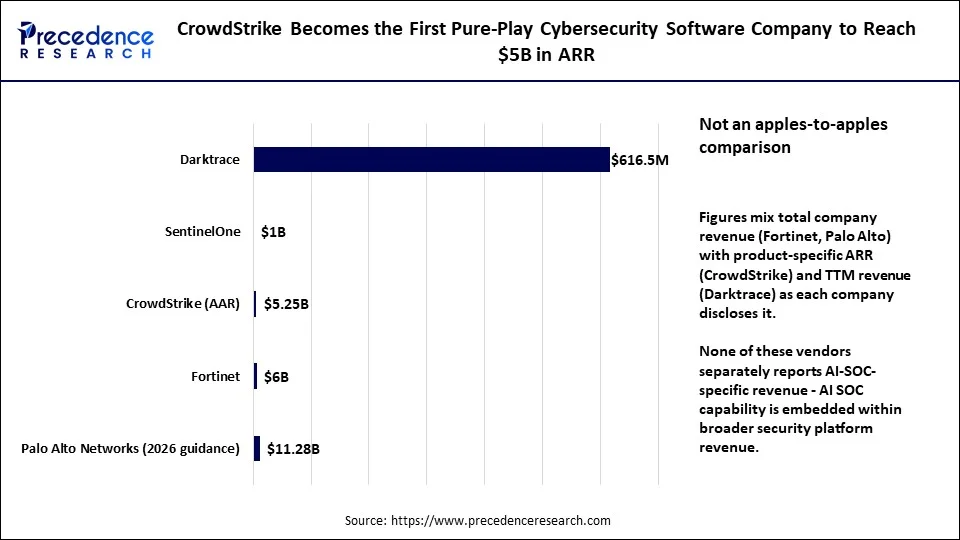
Palo Alto Networks is valued at roughly USD 11.28 billion. Fortinet is valued at around USD 6 billion, representing another large installed base and broad enterprise distribution. That could help drive its way into AI-driven security operations. The company's AI-powered detection and response capabilities are well founded. It generates USD 5.25 billion in ARR and operates on a subscription-based model and a vast security telemetry surface. The platform scale of SentinelOne is demonstrated at about one billion dollars, while Darktrace's demonstration is cybersecurity-centric and less robust at USD 616.5 million.
Key Insight: CrowdStrike reaches USD 5.25 billion ARR, showing how recurring revenue and large telemetry footprints can create a strong platform base for AI SOC expansion.
Source: Precedence Research Database
Competitive Benchmarking - The Winning Formula Combines Telemetry Scale With Autonomous Execution
| Category | Global Platform Leaders | AI-Native Challengers |
| Telemetry & Data Scale | Exceptional | Limited |
| Enterprise Distribution | Exceptional | Emerging |
| Autonomous Investigation Depth | Developing | Core Differentiator |
| Agentic Workflow Maturity | Integrating via Partners/M&A | Native Design |
| Enterprise Trust & Track Record | Established | Building |
| Deployment Speed | Slower (broad platform) | Fast (focused scope) |
The most competitive vendors stand out for their platform breadth, AI maturity, threat intelligence, data scale, response automation, customer retention, cloud integration, geographic reach, and managed-service capabilities. Platform leaders tend to make strong Enterprise Distribution and Product Breadth scores. AI-native challengers have levers to work more acutely on investigating and navigating their work autonomously. To better adapt to agentic and workflow-level operations, whereas they currently lag more on the dynamics of scale, trust, integration, and enterprise procurement.
Key Insight: Traditional platform leaders have the advantage of scale and trust, while newer AI-native vendors are pushing the boundaries of automation and efficiency.
Source: Precedence Research Database
Product Portfolio Benchmarking - Broad Platforms Are Expanding While Specialists Attack High-Value Workflow Gaps
It is no surprise that prominent security platforms are increasing in scope throughout SIEM, XDR, endpoint, cloud, identity, threat intelligence, SOAR, MDR, and AI assistant functions. The goal is becoming more important to influence several parts of the SOC process beyond just security.
Broad integrations and cross-sell potential are the benefits of large platforms, which specialist vendors are targeting at specific spots. Content in the space of alert triage/monitoring, threat hunting, investigation, and incident response is still a space where narrowband automation can also hold its own.
Key Insight: Broad platforms are gaining end-to-end SOC coverage. Specialists are seeing opportunities that automating workflows can provide clear operational benefits.
Technology & Innovation Benchmarking - Agentic Workflows Are the Main Competitive Differentiator
The technology comparison features AI assistants, autonomous agents, detection engineering, investigation automation, response automation, threat intelligence, natural-language security operations, model governance, and multi-agent orchestration. These capabilities offer a more useful indicator of the strength of competition than just the number of AI capabilities.
Key Insight: The importance of key insights is the volume and complexity of SOC activities that can be reliably automated by AI in a defined manner.
Source: Precedence Research Database
Application Competitive Benchmarking & Geographic Competitive Landscape
Cloud security monitoring is expected to grow by 23.7% CAGR, identity & access monitoring at 21.3%, and incident response & remediation at 23.9%. This shows vendors can now serve a wider variety of enterprise security functions, operations, and technologies, and claim more of the incremental technology dollars.
In 2026, North America accounts for 40.7% of the global market, reflecting well-established cybersecurity infrastructure and a high density of technology vendors. Europe was the leading region, accounting for 26.1% of the market, while Asia-Pacific was at 22.6% and is projected to expand the most (27.1%) by 2035. A competitive positioning across regions will depend on localization, sovereign deployment options, managed-services partnerships, cloud ecosystems, and local cybersecurity maturity.
Key Insight: Cloud, identity, and response integration is growing in strategic value as regional growth is driven by increased usage of cloud and investment in cybersecurity.
Source: Precedence Research Database
Manufacturing & Capacity Benchmarking/Customer & Channel Benchmarking
Unlike hardware markets, AI SOC platforms do not involve manufacturing anything. They have an ability that relies on cloud infrastructure, telemetry-processing capability, AI inference resources, software engineering experience, and managed security analysts.
Most enterprise customers want to use a platform that integrates seamlessly with their baseline assets instead of replacing their existing security controls. This makes APIs, interoperability, implementation partners, technical support, and managed-service channels a direct part of the vendor-selection process. The providers of MDR services can leverage AI and 24x7 human oversight. The vendors who are pitching their AI solutions offer a competitive advantage because they're minimizing the analytical tasks that are less exciting to analysts.
Key Insight: Integration capability and service delivery networks are becoming as important as AI performance when enterprises select an AI SOC platform.
Source: Precedence Research Database
Strategic Developments & M&A Landscape
Security Platform Consolidation Is Expanding Into AI, Cloud, Data, and Autonomous Operations
| Date | Deal & Key Details |
| Mar-24 | Cisco completes $28 billion acquisition of Splunk - Combines Cisco's network telemetry and Talos threat intelligence with Splunk's SIEM/SOAR platform to build the “SOC of the Future.” |
| Mar-25 | Google Cloud completes $32 billion acquisition of Wiz - Adds cloud-native security posture management to Google Cloud's security operations suite; the largest cybersecurity acquisition on record at announcement. |
| Jul 2025-Feb 2026 | Palo Alto Networks acquires CyberArk for $25 billion - Establishes Identity Security as a core platform pillar for securing human, machine, and agentic AI identities. |
Cisco made the USD 28 billion Splunk deal in March 2024. The rationale behind the transaction was Cisco's network telemetry and threat intelligence with Splunk's SIEM/SOAR systems. Google Cloud acquired Wiz in March 2025 for USD 32 billion. The addition provided Google with a cloud security posture management service as part of its security suite. The USD 32 billion value underscores just how crucial cloud security has become as businesses grow more reliant on moving more workloads to cloud environments and require visibility into security.
Palo Alto Networks made a series of acquisitions and paid USD 25 billion for CyberArk from July 2025 through February 2026. This acquisition will bolster its identity security, a central platform offering that is becoming vital. The need for controlled identities and permissions grows with the proliferation of human users, machines, and AI agents.
Key Insight: With over USD 85 billion invested in three sizable deals, cybersecurity leaders forecast that buying data, cloud, and identity will be a way to build more robust platforms for future AI SOCs.
Source: Precedence Research Database
Company Profiles - Detailed Intelligence Across the Most Relevant Participants
Microsoft
- HQ: Redmond, Washington, US Founded: 1975 Ownership: Public (NASDAQ: MSFT)
- The core of its SOC platform is its cloud-native SIEM product, Microsoft Sentinel, as well as Microsoft Defender and Security Copilot-Microsoft's generative-AI security analyst assistant. Microsoft's total revenue for FY2025 is projected to be $281.7 billion, and its Intelligent Cloud revenue, which comprises security, is expected to grow by 21% to $106.3 billion.
- Key Strengths: Industry-leading enterprise deployments, seamless embed capability with Microsoft 365 and Azure telemetry, and one of the widest rollouts of AI-enhanced security support with Security Copilot.
- Key Vulnerabilities: Security is just a component of Microsoft's overall, substantial technology portfolio, and Microsoft doesn't report standalone security revenue figures.
Cisco
- HQ: San Jose, California, US Founded: 1984 Ownership: Public (NASDAQ: CSCO)
- Cisco acquired Splunk for $28 billion, uniting Talos threat intelligence with Cisco's network telemetry and Splunk's SIEM and SOAR. The partnership is bringing Cisco's vision of the “SOC of the Future”.'
- Key Strengths: Cisco's core networking business with its strong network-layer telemetry and Splunk's prowess with data platform and security analytics.
- Key Vulnerabilities: Consolidating Splunk's Data Platform with Cisco's cybersecurity ecosystem is a top priority for execution. It's also a network-centric company, whereas its cloud-native, AI-first rivals are not.
CrowdStrike
- HQ: Austin, Texas, US Founded: 2011 Ownership: Public (NASDAQ: CRWD)
- At the heart of CrowdStrike's SOC offering are its Falcon platform, alongside the CrowdStrike AI agentic assistant. CrowdStrike ended 2026 with the highest-ever ending ARR of $5.25 billion (+24% YoY), becoming a pure-play cybersecurity software provider. The company also delivered a record amount of $1.01 billion in net-new ARR for the year.
- Key Strengths: Cloud-native architecture built for AI from inception, strong endpoint/XDR installed base, and the fastest ARR growth to $5B+ scale of any pure-play cybersecurity software vendor.
- Key Vulnerabilities: It is the premium valuation that already reflects its expectations for continued strong growth. Microsoft's security suite and SentinelOne's cheaper alternative, based on artificial intelligence, are also rising competitors for CrowdStrike.
Palo Alto Networks
- HQ: Santa Clara, California, US Founded: 2005 Ownership: Public (NASDAQ: PANW)
- Cortex XSIAM is Palo Alto Networks' artificial intelligence-driven security operations center (SOC) platform. On February 11, 2026, the company finalized the acquisition of CyberArk for $25 billion, with Identity Security becoming an integral component of a new platform strategy to safeguard identities of humans, machines, and agentic AI. Palo Alto Networks also raised its FY2026 revenue guidance to $11.28-11.31 billion.
- Key Strengths: There is broad coverage of platforms addressing network, cloud, and identity security, and enterprise distribution is healthy, as is a desire to make significant acquisitions to fill capability voids.
- Key Vulnerabilities: The CyberArk transaction is more than 20X bigger than Palo Alto Networks' past biggest acquisition, and with significant integration and execution risk. The firm's share value tumbled on announcement of the deal, due to investor sentiment about the size, execution and terms of the purchase.
Google Cloud
- HQ: Mountain View, California, US Founded: 2008 (Google Cloud Platform) Ownership: Public (Alphabet Inc., NASDAQ: GOOGL)
- Google Cloud Security Operations, formerly Chronicle, is a combination of security operations capabilities and Gemini AI for investigation and analysis. With Wiz's acquisition announced in March 2025, Google's total investment amounts to $32 billion, making it its largest cybersecurity purchase to date.
- Key Strengths: Robust cloud infrastructure and data-processing scale, and the Wiz acquisition bringing top-notch security posture management tools and covering a major security posture management gap from AWS and Azure.
- Key Vulnerabilities: Google Cloud's security business is smaller than Microsoft's and AWS's cloud businesses. How Wiz integration and cross-selling go will dictate how much, if any, Google will turn its $2 billion-plus acquisition into a bigger commerce business.
SentinelOne
- HQ: Mountain View, California, US Founded: 2013 Ownership: Public (NYSE: S)
- By making SentinelOne's Singularity platform and Purple AI assistant available directly to customers on a single device, SentinelOne is squarely competing with CrowdStrike in the AI-powered endpoint and XDR security market. SentinelOne just hit its first year of full-year operating profits and just crossed the $1 billion in annual revenue mark, and in the last quarter, nearly 100 large enterprise customers were added to the SentinelOne solution.
- Key Strengths: AI-native architecture, robust performance in MITRE ATT&CK tests, and the revenue multiple that beats and outperforms CrowdStrike among enterprise-level customers due to its initial low price point.
- Key Vulnerabilities: SentinelOne is much smaller than CrowdStrike, with about $1 billion in ARR compared to its $5.25 billion ARR figure. This company also recorded 3 quarters of a net income margin of approximately -41%, with more investment before profitability.
Darktrace
- HQ: Cambridge, UK Founded: 2013 Ownership: Private (Thoma Bravo-backed)
- The features are classified into four sections of Darktrace's Cyber AI Platform: PREVENT (attack surface management), DETECT (anomaly detection), RESPOND (autonomous defence), and HEAL (post-breach recovery). By mid-2025, the trailing-twelve-month revenue stood at $616.5 million, up 36% from the previous year. Management aims for $1 billion in revenue by 2027 and a US expansion of $200m in 2026.
- Key Strengths: Self-learning, unsupervised AI approach to anomaly detection differentiates it from signature- and rules-based competitors; strong revenue growth rate relative to its scale.
- Key Vulnerabilities: Although CrowdStrike's key vulnerabilities are smaller than Palo Alto Networks' and Fortinet's, it's still not the largest of them. It is a competitor with larger vendors that have a wider portfolio of platforms and far greater security R&D assets.
Company Strategic Positioning - Platform Leaders and AI-Native Challengers Are Following Different Paths to SOC Automation
These market/platform leaders have extensive security portfolios, enterprise relationships, a great deal of telemetry, and distribution networks.
- Cloud-native tech leaders are CrowdStrike, SentinelOne, and Darktrace, battling with their customer-first architectures, AI-driven detection, and fast development of automated security tools.
- The MDR / Managed SOC Leaders are Arctic Wolf, Sophos, eSentire, Expel, Huntress, and ReliaQuest, who fuse technology with managed security operations and regular human review.
- Security Analytics / SIEM Specialists: Elastic, Rapid7, Exabeam, Securonix, and D3 Security are dedicated to security analytics, detection, investigation, and SOC workflow capabilities.
- Agentic Challengers Torq, Dropzone AI, Radiant Security, Simbian, and Prophet Security appear to be targeting the challenge of agent-based investigation, automating workflow, and diminishing repetitive work in the SOC.
It's an advantage for large players in monetising existing security relationships and telemetry, or for AI-native businesses to threaten the status quo with specialised automation. Additionally, organisations with outsourced expertise will find relevance in MDR providers, and orchestration specialists in need of more automation for hybrid security setups will find upside in this space.
Key Insight: The market is developing in two paths, such as established platforms are adding AI to broad security ecosystems, while challengers are rebuilding specific SOC workflows around autonomous agents.
Opportunity & White-Space Analysis - The Largest Untapped Pools Sit in Autonomous Response, SMEs, Cloud Security, and Regulated Environments
Agentic AI is the best growth and white space signal, at 30.4% CAGR and 9.2% share in 2026. As a small percentage of sales, yet a very high growth rate, there is great interest in it, as there is enough opportunity to grow the category. This growth is being propelled by the industry's move to auto-investigating and auto-responding to incidents with AI, beyond the use of AI as an analyst assist tool.
AI SOC agent platforms' growth rate is 28.8% CAGR, expected to reach 9.3% in 2026, hinting that agent-based SOC architectures are starting to make a category. Generative AI is the reason the market is seeing a 26.0% CAGR and a 15.8% market share. Due to its advantages in investigating, summarising, and providing assistance for analysts.
Key insight: Although autonomous investigation and response are the biggest possible underdeveloped market opportunity, agentic AI is leading the way at 30.4% CAGR.
Source: Precedence Research Database
Major White Spaces
- Autonomous SOC for SMEs
- Agentic incident response
- Cross-platform security orchestration
- AI SOC for regulated industries
- Sovereign and private AI SOC deployments
- Cloud-native threat investigation
- Identity-centric autonomous detection
- AI-enabled OT security
- Outcome-based MDR pricing
Industry Structure - Competitive Rivalry Is High as Platform Vendors and AI-Native Specialists Converge
| Porter's Five Forces | Key Insight |
| Supplier Power Medium | Cloud infrastructure, AI models and cybersecurity talent influence vendor economics. |
| Buyer Power Medium-High | Large enterprises have substantial procurement leverage and can demand integration and outcome-based terms. |
| Threat of New Entrants Medium | AI lowers development barriers, but enterprise trust and telemetry scale remain difficult to replicate. |
| Threat of Substitutes Medium | Traditional SIEM, MDR and human SOC teams remain relevant substitutes for AI-native platforms. |
| Competitive Rivalry High | Major platforms, MDR providers and AI-native challengers increasingly overlap and compete for the same budgets. |
Supplier power is set at medium, as cloud infrastructure, AI models, and cybersecurity talent all have an impact on the economic power of the vendor. Buyer power is medium-high due to the integration capability and the buyers' commercial terms (outcome) requirements by large enterprises.
AI has dropped the barrier for security development, and it is easier to develop a security product; the threat of new entrants is medium. The threat of substitutes is also considered medium, due to the fact that there are still alternatives to AI-native platforms, such as traditional SIEM and MDR teams as well as SOC. Competitive rivalry is high, as several platforms and expert AI firms compete for the same security budget.
Key Insight: The competitive picture is getting High as more of these budgets are being attacked by platform vendors, MDR vendors, and AI-native challengers.
Source: Precedence Research Database
PESTLE Analysis - Regulation, AI Governance, Cyber Threat Evolution, and Cloud Economics Shape Market Development
| PESTLE Factor | Assessment/Key Insight |
| Political | Critical infrastructure protection and national cybersecurity strategies increase investment. |
| Economic | SOC staffing shortages encourage automation and managed-service adoption. |
| Social | Cybersecurity talent shortages increase demand for AI-assisted analyst productivity. |
| Technological | GenAI and agentic AI shift SOC architecture toward autonomous investigation. |
| Legal | Privacy, incident reporting, AI governance and data-sovereignty requirements influence deployment. |
| Environmental | Cloud and AI workloads increase scrutiny of computing efficiency and infrastructure consumption. |
Political factors are also pro-investment, as critical infrastructure protection and national cybersecurity strategies are driving more investment in security.
Staffing shortages are driving both automation and the adoption of managed services in organizations. Therefore, companies are moving towards automation due to economic factors. The shortage of cybersecurity talent is a growing driver behind AI's role in boosting analyst productivity.
Legal considerations have an impact on deployment since privacy laws, incident reporting, data sovereignty, and AI governance requirements impact the implementation of security systems. These needs are significant for organizations that are multi-site or possess sensitive information. Cloud and AI workloads are pushing environmental factors higher on the agenda, as the efficiency and infrastructure consumption of workloads become a priority.
Key Insight: Trust, privacy, and deployment needs are elements of AI governance, and talent shortage is structural, since companies require automation for these and many more.
Source: Precedence Research Database
Market Attractiveness - High-Growth Technology With Strong Structural Demand and Increasing Competitive Intensity
The market is classified as highly attractive status with a solid CAGR of 21.50%, growing cloud adoption, increasing cyber threats, severe cybersecurity manpower scarcity, increasing maturity of AI, and enhanced ease of access for SMEs. AI-native platforms, autonomous investigation, automated response, cloud and identity security, MDR/SOCaaS, and solutions for highly regulated environments are the most promising offerings.
Future Outlook - The SOC Evolves From AI-Assisted Analysis Toward Autonomous Security Operations
I interpret this graph as a comparison of five major structural indicators between 2026 and 2035. It examines how the AI SOC market is projected to evolve over the next ten years. Cloud-based deployment increases from 57.6% to 67.1% due to the growing demand to secure cloud-based infrastructure and applications.
As the value of AI SOC is gradually moving toward software-driven analytics, automation, reasoning, and response, the software share rises significantly from 68.7% to 72.1%. Fewer than half of the SME community (30.8%) have upgraded their security software to ensure backdooring is no longer possible. Agentic AI has grown by a whopping 10.3%, going from 9.2% to 18.4%, showcasing the most pronounced structural change. Cybersecurity investment, adoption of cloud, and digital transformation are growing fast across the Asia-Pacific region. This results in an increase in the region's share from 22.6% to 27.1%.
Key Insight: AI SOC is progressing toward more cloud-based, software-led, and more autonomous security operations, with agent AI doubling from 9.2% to 18.4% and cloud and software climbing to 67.1% and 72.1%, respectively.
Source: Precedence Research Database
Expert Insights
The market for the AI security operations center is transitioning from traditional alert monitoring to security operations. Therefore, AI has the potential to dig into events, link signals together, and assist in making responses. At the convergence of security analytics, generative AI copilots, and agent-driven automation, there are great opportunities, including across SIEM, XDR, endpoint, identity, cloud, and network telemetry. Over the coming decade, the need to speed up the investigation process, a lack of security analysts with experience, and a growing number of security alerts will continue to be key factors influencing SOC technology adoption.
Our Experts
The analytical part of the report was the core of primary market research, methodology building, technology, market positioning and forecasting, and segment and regional trends analysis conducted by Gautam Mahajan.
Aman handled regulatory filings, company financial data, cybersecurity product data, and other independently sourced quantitative data, which bolstered the evidence base behind market estimations.
Aditi carried out a thorough review of the entire research document, conducted a quality assessment of the document, checked its findings, finalised its content or material, overcame inconsistencies, and completed the report for accuracy and clarity.
AI Security Operations Center (SOC) Market Segmentation
By Software Type
- AI-Enabled Threat Detection Platforms
- AI-Powered Security Analytics
- AI-Orchestrated Response Platforms
- AI-Native SOC Platforms
- AI SOC Agent Platforms
- Security Data Platforms
- Threat Intelligence Platforms
By Service
- Managed Detection & Response
- SOC-as-a-Service
- Incident Response & Forensics
- Threat Intelligence Services
- Security Consulting & Advisory
By Deployment Mode
- Cloud-Based
- On-Premises
- Hybrid
By Organization Size
- Small & Medium Enterprises
- Large Enterprises
By Application
- Threat Detection & Monitoring
- Alert Triage & Prioritization
- Incident Investigation
- Threat Hunting
- Incident Response & Remediation
- Insider Threat Detection
- Cloud Security Monitoring
- Identity & Access Monitoring
- Compliance Monitoring
- Security Analytics
By Technology
- Machine Learning
- Generative AI
- Agentic AI
- Natural Language Processing
- Behavioral Analytics
- Predictive Analytics
- Automated Threat Intelligence
- Security Orchestration, Automation & Response
- User & Entity Behavior Analytics
- Graph Analytics
By Security Environment
- Network Security
- Endpoint Security
- Cloud Security
- Application Security
- Identity Security
- Data Security
- IoT & OT Security
- SaaS Security
By Industry Vertical
- BFSI
- Government & Defense
- Healthcare & Life Sciences
- IT & Telecommunications
- Manufacturing
- Retail & E-commerce
- Energy & Utilities
- Media & Entertainment
- Education
- Other Industries
By Region
- North America (U.S., Canada, Mexico)
- Europe (Germany, U.K., France, Italy, Spain, Netherlands, Switzerland, Rest of Europe)
- Asia-Pacific (China, Japan, India, South Korea, Australia, Singapore, Rest of Asia-Pacific)
- Latin America (Brazil, Argentina, Mexico, Rest of Latin America)
- Middle East & Africa (UAE, Saudi Arabia, Israel, South Africa, Rest of Middle East & Africa)
Questions This Report Deliberately Leaves Open
- What will be the size of the world's AI Security Operations Center market in 2035 and 2030?
- What will be the factors that will contribute to the market growth at 21.50% CAGR?
- What will be the most significant percentage of incremental revenue winners when it comes to AI SOC software?
- How is AI SOC Agent Platforms becoming so much larger than traditional security analytics?
- At what rate will on-premises systems be supplanted by cloud-based SOCs?
- What are the most lucrative applications to come through until 2035?
- What will GenAI and Agentic AI mean for the future of SOC operating models?
- What pricing models do you think will thrive in the cloud native AI SOC economy, and in MDR and SOC-as-a-Service?
- Which industries will increase AI SOC spending most rapidly?
- What will the impact be on the market's competitiveness as a result of the uptake by SMEs?
- Who are the current platforms that have the best balance of platform size, AI features, and security telemetry?
- What are the biggest threats posed by the AI-native competition to traditional SOCs?
- What are the greatest geographic gaps - especially in the Asia Pacific region?
- What are the key themes for M&A that startups might focus on to redefine the AI SOC competition?
- What technologies, applications, and business models will be the likely next generation of AI SOC profit pools?
References
- Precedence Research Database
"AI Security Operations Center Market - Market Size, Segmentation, and Company Universe Data"
https://www.precedenceresearch.com
Data used: Market size, CAGR, all segment share/CAGR tables, and the 25-company tentative universe - Palo Alto Networks
"Palo Alto Networks Completes Acquisition of CyberArk to Secure the AI Era" - February 11, 2026
https://www.paloaltonetworks.com/company/press/2026/palo-alto-networks-completes-acquisition-of-cyberark-to-secure-the-ai-era
Data used: Palo Alto-CyberArk M&A deal terms and completion date - Palo Alto Networks Inc.
"SEC Form 10-Q, FY2025" - 2025
https://www.sec.gov/Archives/edgar/data/1327567/000132756725000035/panw-20251031.htm
Data used: CyberArk acquisition financial terms - Networkworld / Cisco
"Cisco Completes $28 Billion Splunk Acquisition" - March 18-19, 2024
https://www.networkworld.com/article/2066444/cisco-completes-28-billion-splunk-acquisition.html
Data used: Cisco-Splunk M&A deal terms and completion date - CNBC
"Palo Alto Networks Stock Falls After Announcing $25 Billion CyberArk Deal" - July 30, 2025
https://www.cnbc.com/2025/07/30/palo-alto-networks-cyberark-deal.html
Data used: Google-Wiz $32B deal context and market reaction - CrowdStrike Holdings, Inc.
"CrowdStrike Reports Fourth Quarter and Fiscal Year 2026 Financial Results" - March 3, 2026
https://seekingalpha.com/pr/20422812
Data used: CrowdStrike FY2026 ARR and revenue figures - TechDogs
"Top 10 Cybersecurity Companies in 2026" - April 2026
https://www.techdogs.com/top-10-technology-rankings/top-10-cybersecurity-companies
Data used: Fortinet revenue figure; competitive tiering context - Finimize
"Darktrace Aims For $1 Billion With Its AI Cybersecurity Push" - August 5, 2025
https://finimize.com/content/drktf-asset-snapshot
Data used: Darktrace TTM revenue and growth rate - TECHi
"Best Cybersecurity Stocks to Buy in 2026" - March 31, 2026
https://www.techi.com/best-cybersecurity-stocks/
Data used: SentinelOne revenue milestone; global cybersecurity spending estimates
For inquiries regarding discounts, bulk purchases, or customization requests, please contact us at sales@precedenceresearch.com
Frequently Asked Questions





Ask For Sample
No cookie-cutter, only authentic analysis – take the 1st step to become a Precedence Research client
 Get a Sample




 sales@precedenceresearch.com
 Schedule a Meeting
