



Air Freight Market Trends, Companies, Revenue / Sales Performance, Transportation Volume, Warehouse Capacity, Delivery Performance, Pricing Metrics, Competitive Landscape, and Industry Outlook
Air Freight Market (By Service Type: Express Freight, Standard Air Freight, Deferred Freight, Charter Services; By Cargo Type: General Cargo, Perishable Goods, Pharmaceuticals & Healthcare Products, Hazardous Goods, High-value Goods, E-commerce Shipments; By End-use Industry: Retail & E-commerce, Healthcare & Pharmaceuticals, Automotive, Aerospace & Defense, Electronics & Semiconductors, Food & Beverages, Manufacturing, Others; By Destination: Domestic, International; By Aircraft Type: Dedicated Freighters, Belly Cargo; By Delivery Speed: Same-day Delivery, Next-day Delivery, Economy Delivery) - Global Industry Analysis, Size, Trends, Leading Companies, Regional Outlook, and Forecast 2026 to 2035
Source: https://www.precedenceresearch.com/air-freight-market
 Get a Sample
 Table Of Content


What is the Air Freight Market Size in 2026?
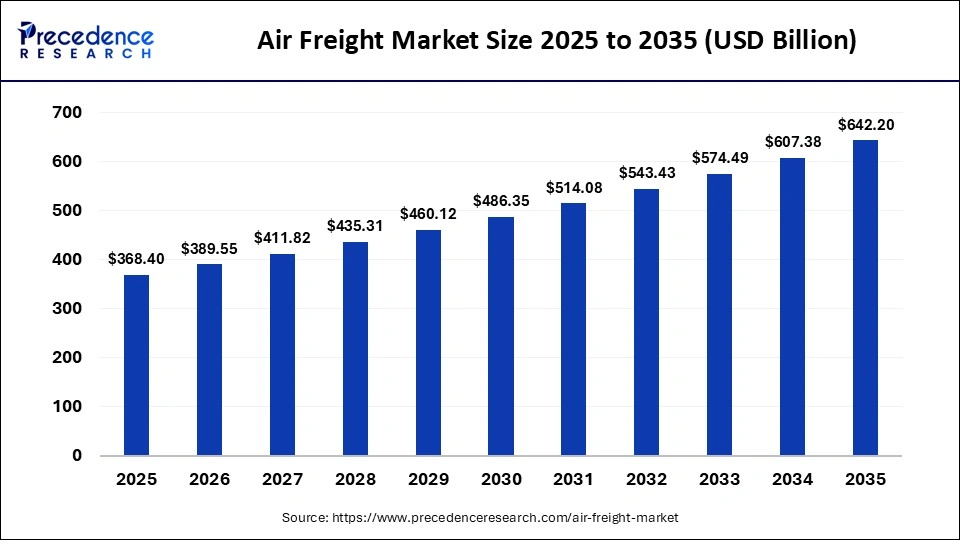
The global air freight market size is expected to grow from USD 389.55 billion in 2026 to approximately USD 642.20 billion by 2035, expanding at a CAGR of 5.80% from 2026 to 2035. The market growth is attributed to rising cross-border e-commerce activity and increasing investments in high-speed global cargo transportation infrastructure.
Key Takeaways
- Asia-Pacific dominated the market with 39% of the air freight market share in 2025.
- North America held the second-largest market share of 28% in 2025 and is expected to register a significant growth of 4.8% CAGR during 2026 and 2035.
- By service type, the express freight segment contributed the highest market share of 38% in 2025.
- By service type, the standard air freight segment held a 34% share of the market in 2025 and is expected to grow at a significant CAGR of 4.2% in between 2026 and 2035.
- By cargo type, the general cargo segment held a major market share of 36% in 2025.
- By cargo type, the pharmaceutical and healthcare products segment held a 18% share in 2025 and is expected to register a significant growth of 8.5% CAGR during 2026 and 2035.
- By end-use industry, the retail and e-commerce segment contributed the highest air freight market share of 26% in 2025.
- By end-use industry, the healthcare and pharmaceuticals segment contributed 18% of the market share in 2025 and is expected to grow at a CAGR of 8.2% over the projected period.
- By aircraft type, the dedicated freighters segment contributed the highest market share of 58% in 2025.
- By aircraft type, the belly cargo segment held a 42% share of the market in 2025 and is expected to grow at a significant CAGR of 4.8% in between 2026 and 2035.
- By delivery speed, the next-day delivery segment contributed the highest market share of 46% in 2025.
- By delivery speed, the economy delivery facilities segment held a 36% share of the market in 2025 and is expected to grow at a significant CAGR of 3.8% in between 2026 and 2035.
Market Overview
Rising cross-border e-commerce activity and pharmaceutical logistics demand continue driving strong expansion across the global market. Air freight transportation involves specifically designed aircraft for the fast transportation of goods internationally. These are used for the movement of goods for the whole main body of the aircraft, or for part of the aircraft, depending on their availability.
The International Air Transport Association (IATA) states that air cargo demand grew by around 11.3% in 2024 to the highest amount of cargo tonne-kilometre volumes ever recorded. The increased demand was driven largely by strong e-commerce shipments and disruption in the maritime transportation supply chain. This has significantly boosted demand for international air cargo on key trade routes.
Impact of Artificial Intelligence on the Air Freight Market
Artificial intelligence significantly transforms the air freight industry by improving cargo visibility and real-time logistics coordination across global supply chains. AI-driven tools are increasingly being leveraged by airlines and freight companies to make predictions about cargo demand and minimise shipment delays in global trade. Weather forecasts, fuel prices, and traffic flow are analyzed by advanced machine learning platforms to optimize cargo companies' scheduling processes and transportation efficiency.
Growth Factors
- Increasing Adoption of Digital Cargo Platforms: Growing implementation of AI-enabled booking and tracking systems is improving shipment visibility and operational efficiency across freight networks.
- Propelling Growth of Cross-border SME Trade Activity: Increasing participation of small exporters in global commerce is expanding international air shipment volumes.
Market Trends
Expansion of Sustainable Aviation Fuel (SAF) Usage
Air cargo companies made accelerated investments in and use of sustainable aviation fuel (SAF) to improve carbon emissions performance and achieve global sustainability goals. To further improve air cargo carbon emissions performance and meet global sustainability goals, cargo companies accelerated investments and the use of SAFs. Higher environmental regulations helped to press the upgrade of fleets by cargo operators, with newly available freighter aircraft technologies being more efficient at burning fuel.
Sky Corridors in Transition as Asia Powers Global Air Freight While E-commerce Disruptions Reshape Cargo Demand
- In 2025, air cargo volume, in terms of tonne-kilometers (CTKs), was also led by Asia-Pacific, which accounted for around 35.9% of global air cargo volume, fueled by exports of e-commerce goods, semiconductors, and manufacturing-related goods from China, South Korea, and Southeast Asia.
- In 2025, air cargo shipments in North America accounted for almost 24.5% of all global air cargo volumes. The region is among the world's biggest cargo markets, but was measured with a drop in cargo demand by 1.3% annually through less robust demand from Asia's trans-Pacific carriers and a change in the Asia-Europe trade route.
- In 2025, U.S.-bound low-value e-commerce air shipments from China and Hong Kong decreased by almost 43%, month-over-month, reflecting a severe hit to trans-Pacific air cargo volumes following the discontinuation of tax-free de minimis exemptions on packages worth less than USD 800.
Market Scope
| Report Coverage | Details |
| Market Size in 2025 | USD 368.40 Billion |
| Market Size in 2026 | USD 389.55 Billion |
| Market Size by 2035 | USD 642.20 Billion |
| Market Growth Rate from 2026 to 2035 | CAGR of 5.80% |
| Dominating Region | Asia Pacific |
| Fastest Growing Region | North America |
| Base Year | 2025 |
| Forecast Period | 2026 to 2035 |
| Segments Covered | Service Type, Cargo Type, End-use Industry, Destination, Aircraft Type, Delivery Speed, and Region |
| Regions Covered | North America, Europe, Asia-Pacific, Latin America, and Middle East & Africa |
Market Dynamics
Drivers
Rising Cross-Border E-Commerce Shipments
Rising cross-border e-commerce demand across Asia-Pacific, Europe, and North America is expected to drive the air freight market. E-commerce companies are relying increasingly on swift, global logistics to move fast-moving goods such as electronics, fashion items, and top-dollar packages.
According to DHL's 2025 reports, approximately 41% of social commerce shoppers purchase products from international sellers at least once every month. Additionally, the growing pharmaceutical exports are anticipated to strengthen temperature-controlled cargo operations across major international trade corridors.
Restraint
Hamper Growth Through Volatile Fuel Prices
Operational profitability through fluctuating aviation fuel prices is expected to hamper the market in the coming years. Unpredictable aviation fuel costs will continue to be a major irritant for the profitability of operations in the international cargo transportation industry. Furthermore, the long-term profitability through rising aircraft maintenance expenses and cargo infrastructure investments is likely to affect industry expansion strategies globally.
Opportunity
Surging Demand for Time-Sensitive Industrial Shipments
Surging transportation requirements for semiconductors, aerospace components, and high-value industrial equipment are projected to create immense opportunities for the market. Manufacturing regions in China, South Korea, and Southeast Asia are responsible for heavy daily parcel production volumes on high-frequency traffic routes between countries. Furthermore, the high expansion in international trade volumes and manufacturing exports is estimated to strengthen cargo transportation demand across major commercial economies.
Segmental Insights
Service Type Insights
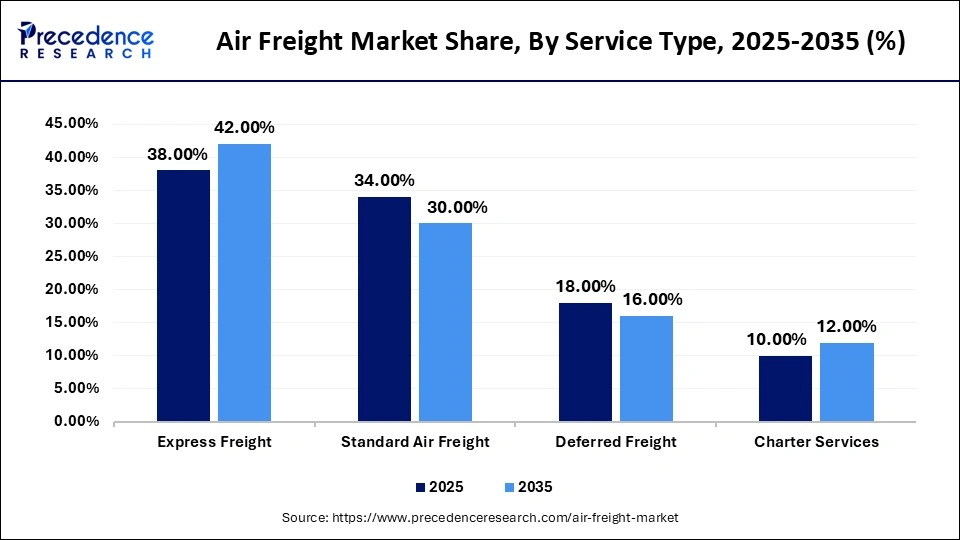
Air Freight Market Share, By Service Type, 2025-2035 (%)
| Service Type | 2025 | 2035 | CAGR (%) |
| Express Freight | 38.00% | 42.00% | 7.50% |
| Standard Air Freight | 34.00% | 30.00% | 4.20% |
| Deferred Freight | 18.00% | 16.00% | 3.80% |
| Charter Services | 10.00% | 12.00% | 8.50% |
The Express Freight Segment Dominated the Market with 38% of Market Share in 2025
The express freight segment generated approximately USD 139.99 billion in 2025 and is projected to reach nearly USD 269.72 billion by 2035, growing at a CAGR of 7.5% during the forecast period. The express freight segment dominated the air freight market with a share of 38% in 2025, due to rising cross-border online shopping activity. There was a strong trend for ultra-fast cargo delivery services to support e-commerce shipments, medical products, luxury, and semiconductors that do not have many transit time constraints.
The standard air freight segment accounted for approximately USD 125.26 billion in 2025 and is projected to reach nearly USD 192.66 billion by 2035, growing at a CAGR of 4.2% during the forecast period. The standard air freight segment held a 34% share of the market in 2025, as it is increasingly demanded to provide dependable and cost-effective cargo transportation services. There was also further acceleration in routine freight transportation activities, which was fed by the growth of industrial production in emerging manufacturing economies.
The deferred freight segment generated approximately USD 66.31 billion in 2025 and is projected to reach nearly USD 102.75 billion by 2035, growing at a CAGR of 3.8% during the forecast period. The deferred freight segment held 18% of the market share in 2025, owing to the rising adoption of a more cost-effective shipping solution with regard to non-urgent cargo. Deferred shipment activity expanded significantly on the Asia-Pacific and Europe trade lanes as there was a huge demand for economical transportation alternatives.
The charter services segment accounted for approximately USD 36.84 billion in 2025 and is expected to reach nearly USD 77.06 billion by 2035, expanding at a CAGR of 8.5% during the forecast period. The charter services segment contributed 10% to the market in 2025, driven by strong demand for energy components, turbines, and defense equipment. Cargo airlines built up heavy-lift capabilities with their widebody freighter power fleet and customized route coordination in remote and hitherto underserved areas.
Cargo Type Insights
The General Cargo Segment Dominated the Market with 36% of Market Share in 2025
The general cargo segment generated approximately USD 132.62 billion in 2025 and is projected to reach nearly USD 205.50 billion by 2035, growing at a CAGR of 4.5% during the forecast period. The general cargo segment dominated the air freight market with a share of 36% in 2025, due to the large-scale industrial trade operations worldwide. Global merchandise trade volume also picked up by around 2.7% in 2025. This further facilitates the recovery of manufacturing exports, boosting the general cargo segment in the coming years.
The perishable goods segment accounted for approximately USD 51.58 billion in 2025 and is projected to reach nearly USD 96.33 billion by 2035, growing at a CAGR of 6.8% during the forecast period. The perishable goods segment held a 14% share of the market in 2025, supported by the robust expansion of specialized refrigerated transportation. In 2025, the fresh produce trade volume has increased globally with Emirates SkyCargo's weekly deliveries of around 2 million kg of fresh produce via African-EU and Asian-ME trade routes. A surge in global consumption of fresh products brought in from abroad and premium products is expected to fuel the demand for perishable goods air freight.
Air Freight Market Share, By Cargo Type, 2025-2035 (%)
| Cargo Type | 2025 | 2035 | CAGR (%) |
| General Cargo | 36.00% | 32.00% | 4.50% |
| Perishable Goods | 14.00% | 15.00% | 6.80% |
| Pharmaceuticals & Healthcare Products | 18.00% | 20.00% | 8.50% |
| Hazardous Goods | 8.00% | 7.00% | 4.00% |
| High-value Goods | 12.00% | 13.00% | 6.50% |
| E-commerce Shipments | 12.00% | 13.00% | 10.50% |
The pharmaceuticals and healthcare products segment generated approximately USD 66.31 billion in 2025 and is projected to reach nearly USD 128.44 billion by 2035, growing at a CAGR of 8.5% during the forecast period. The pharmaceuticals and healthcare products segment held 18% of the market share in 2025. The increase in clinical trial logistics and the advanced transportation of goods in the biologic market substantially boosted activity in healthcare-related regulated freight transport.
The hazardous goods segment accounted for approximately USD 29.47 billion in 2025 and is projected to reach nearly USD 44.95 billion by 2035, growing at a CAGR of 4% during the forecast period. The hazardous goods segment contributed 8% to the market in 2025, driven by increased demand for shipping industrial chemicals, aerospace materials, and high-tech battery products. With the growing demand for battery and industrial equipment exports, Atlas Air invested in hazardous material handling equipment and infrastructure in selected North American cargo centers, growing by almost 14% in 2026.
The e-commerce shipments segment generated approximately USD 44.21 billion in 2025 and is projected to reach nearly USD 83.49 billion by 2035 at the fastest CAGR of 10.5% during the forecast period. The e-commerce shipments segment held 12% of the market share in 2025. The rapid expansion of international online retail trade across diverse geographical locations, with the increasing adoption of smartphones and internet connectivity boosts the segment's growth. The increasing consumer demand for fast delivery services and the growing cross-border parcel shipping activities drive the segment's growth.
End-use Industry Insights
The Retail and E-commerce Segment Dominated the Market with 26% of Market Share in 2025
The retail and e-commerce segment generated approximately USD 95.78 billion in 2025 and is projected to reach nearly USD 192.66 billion by 2035 at the fastest CAGR of 8.5% during the forecast period. The retail and e-commerce segment dominated the air freight market with a share of 26% in 2025, as a result of the growing adoption of omnichannel retail strategies and the rising share of customers choosing express delivery. Additionally, Alibaba's logistics effort around SEA-2026 saw an upward trend in the e-commerce air parcel transportation volume, rising by almost 7.95%, across all manner of electronic and fashion exports.
The healthcare and pharmaceuticals segment accounted for approximately USD 66.31 billion in 2025 and is projected to reach nearly USD 128.44 billion by 2035, growing at a CAGR of 8.2% during the forecast period. The healthcare and pharmaceuticals segment held a 18% share of the market in 2025, due to increasing demand for transportation of biologics, plasma therapies, precision medicines, and temperature-sensitive pharmaceutical products. Healthcare freight transportation volumes have surged, in particular within intercontinental transport networks for vaccine exports and the growing volume of production of personalized medicine products.
Air Freight Market Share, By End-use Industry, 2025-2035 (%)
| End-use Industry | 2025 | 2035 | CAGR (%) |
| Retail & E-commerce | 26.00% | 30.00% | 8.50% |
| Healthcare & Pharmaceuticals | 18.00% | 20.00% | 8.20% |
| Automotive | 12.00% | 11.00% | 4.50% |
| Aerospace & Defense | 10.00% | 9.00% | 5.00% |
| Electronics & Semiconductors | 16.00% | 17.00% | 7.80% |
| Food & Beverages | 8.00% | 7.00% | 5.20% |
| Manufacturing | 10.00% | 6.00% | 3.80% |
The automotive segment generated approximately USD 44.21 billion in 2025 and is projected to reach nearly USD 70.64 billion by 2035, growing at a CAGR of 4.5% during the forecast period. The automotive segment held a 12% of the market share in 2025, supported by shipment activities of high-value components, semiconductors, and precision-engineered vehicle parts, resulting in strong cargo demand. Car manufacturers placed greater emphasis on the ability to get freight to and from ports quickly, enabling them to produce just-in-time at various car manufacturing plants around the world.
The aerospace and defense segment accounted for approximately USD 36.84 billion in 2025 and is projected to reach nearly USD 57.80 billion by 2035, growing at a CAGR of 5% during the forecast period. The aerospace and defense segment contributed 10% to the market in 2025, driven by increasing movement involving aircraft systems, military equipment, satellite components, and emergency logistics operations. Rising aircraft production and geopolitical security investments led to a significant jump in the aerospace supply chains for specialized cargo transportation.
Aircraft Type Insights
Air Freight Market Share, By Aircraft Type, 2025-2035 (%)
| Aircraft Type | 2025 | 2035 | CAGR (%) |
| Dedicated Freighters | 58.00% | 61.00% | 6.50% |
| Belly Cargo | 42.00% | 39.00% | 4.80% |
The Dedicated Freighters Segment Dominated the Market with 58% of Market Share in 2025
The dedicated freighters segment generated approximately USD 213.67 billion in 2025 and is projected to reach nearly USD 391.74 billion by 2035, growing at a CAGR of 6.5% during the forecast period. The dedicated freighters segment dominated the air freight market with a share of 58% in 2025, as a result of growing industrial exports and the growing premium freight industry. Boeing forecast there would be more than 3900 active freighters in service globally by 2025, as demand for fast-growing, high-volume logistics transportation and an expanding global express delivery system fuel growth.
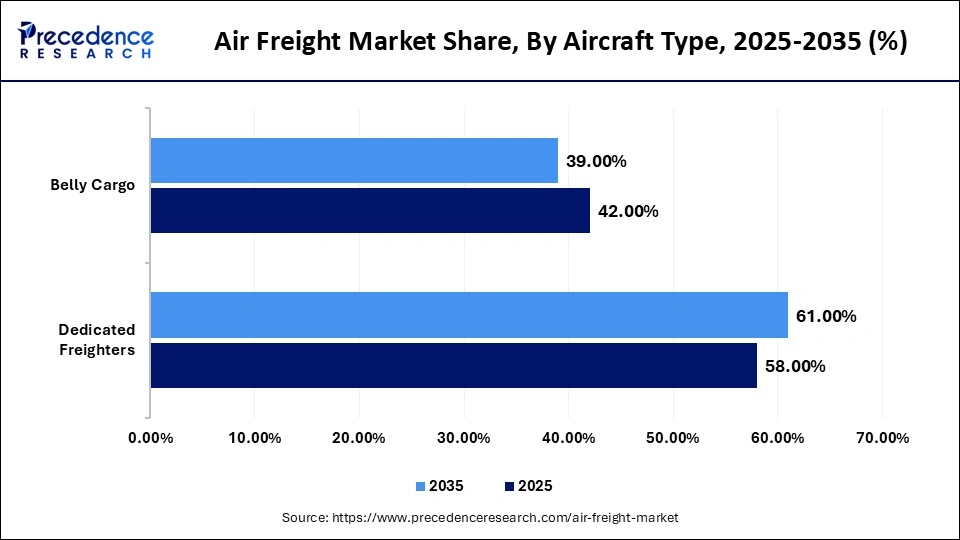
The belly cargo segment accounted for approximately USD 154.73 billion in 2025 and is projected to reach nearly USD 250.46 billion by 2035, growing at a CAGR of 4.8% during the forecast period. The belly cargo segment held a 42% share of the market in 2025, boosted by a general increase in activity of the international tourism recovery and by an increase in connectivity between continents. Growing investments in fuel-efficient passenger aircraft and digital load-planning technologies continue supporting stable expansion across lower-deck cargo logistics operations.
Delivery Speed Insights
Air Freight Market Share, By Delivery Speed, 2025-2035 (%)
| Delivery Speed | 2025 | 2035 | CAGR (%) |
| Same-day Delivery | 18.00% | 22.00% | 9.80% |
| Next-day Delivery | 46.00% | 48.00% | 6.50% |
| Economy Delivery | 36.00% | 30.00% | 3.80% |
The Next-day Delivery Segment Dominated the Market with 46% of Market Share in 2025
The next-day delivery segment generated approximately USD 169.46 billion in 2025 and is projected to reach nearly USD 308.26 billion by 2035, growing at a CAGR of 6.5% during the forecast period. The next-day delivery segment dominated the air freight market with a share of 46% in 2025, as consumer expectations for much quicker delivery times gave the next-day freight transportation. E-commerce sites, healthcare distributors, semiconductor providers, and industrial manufacturers were increasingly looking at fast overnight delivery options to minimize stock lag and enhance customer delivery productivity.
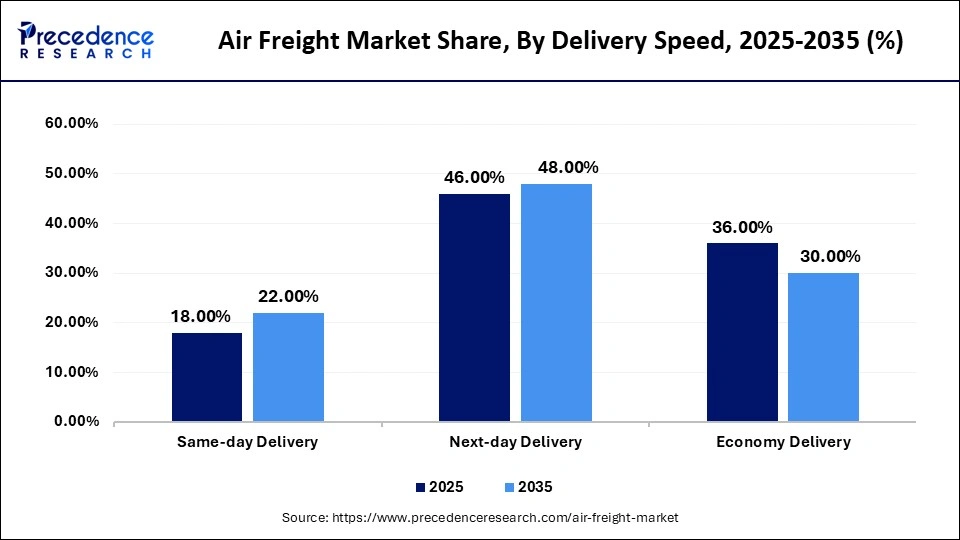
The economy delivery segment accounted for approximately USD 132.62 billion in 2025 and is projected to reach nearly USD 192.66 billion by 2035, growing at a CAGR of 3.8% during the forecast period. The economy delivery segment held a 36% share of the market in 2025. The adoption of economy-focused cargo transportation services increased rapidly, as the diversification and complexity of international trade increased. Both the manufacturers, wholesalers, and industrial distributors chose economy freight services for moving bulk quantities of their inventory, for routine commercial transport.
The same-day delivery segment generated approximately USD 66.31 billion in 2025 and is projected to reach nearly USD 141.28 billion by 2035, growing at a CAGR of 9.8% during the forecast period. The same-day delivery segment contributed 18% to the market in 2025, driven by the increasing trend of last-minute medicine and electronics orders, which demand the absolute quickest delivery times. Amazon Prime Air increased its same-day fulfillment by air services in the major logistics hubs of major metropolitan areas in 2026, accelerating ultra-fast parcel movement of consumer electronics and healthcare products.
Regional Insights
Asia Pacific Air Freight Market Size and Growth 2026 to 2035
The Asia Pacific air freight market size is estimated at USD 143.68 billion in 2025 and is projected to reach approximately USD 287.56 billion by 2035, with a 7.20% CAGR from 2026 to 2035.
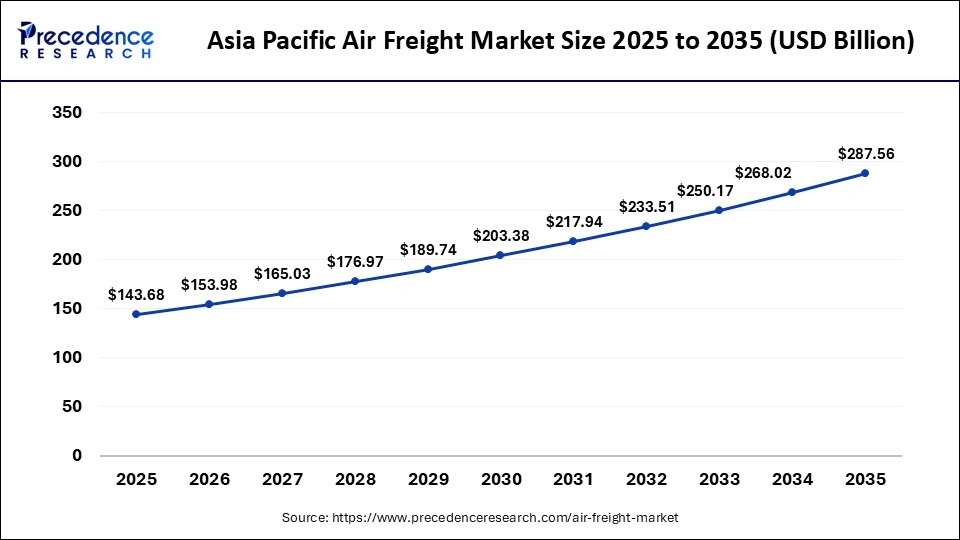
Asia Pacific dominated the Market with 39% of the Air Freight Market Share in 2025
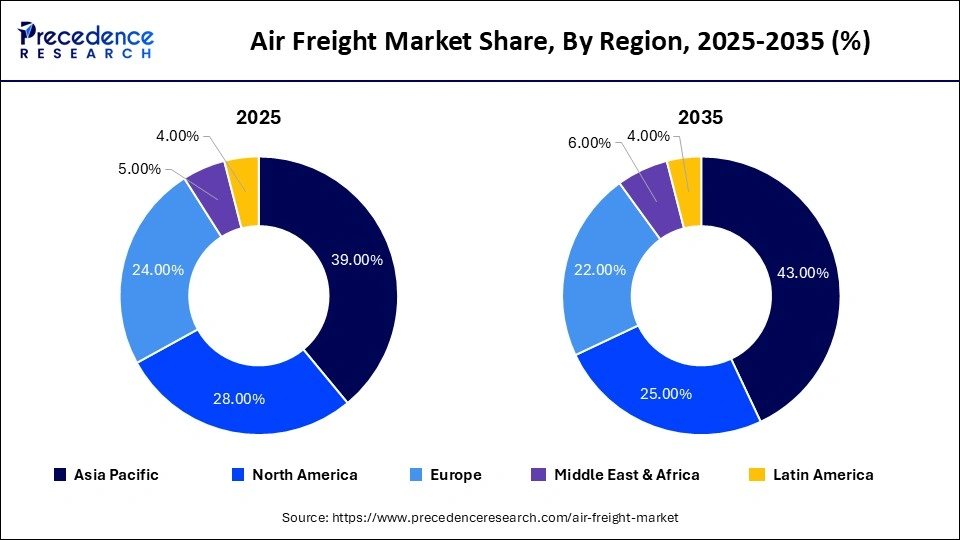
Asia Pacific held a major market share of 39% in 2025, due to its position in terms of large-scale manufacturing, export-oriented industrial activities, and integration of the advanced electronics supply chain. China, South Korea, Vietnam, and Singapore have created a significant amount of cargo demand for semiconductor products, consumer electronics products, and industrial machinery transport.
In 2025, Asia-Pacific airlines posted cargo demand growth of 8.5%, the strongest for the region worldwide, according to the IATA report. Additionally, governments in Southeast Asia are also increasing investments in smart airport infrastructure, which further boosts the market in this region.
China Accelerating Asia-Pacific Air Freight Expansion
China leads the market due to its large-scale industrial manufacturing and e-commerce across borders. China further bolstered the regional connections of trade with the AI-powered cargo visibility systems and broadened pharmaceutical cold-chain logistics facilities.
Which Factors Drive the Air Freight Market in North America?
North America held the second-largest market share of 28% in 2025 and is expected to grow at a notable CAGR of 4.8% over the projected period, supported by its large-scale express delivery services and well-developed logistics infrastructure. The increased need for same-day delivery and time-sensitive freight surge transportation exercises boosted growth in e-commerce fulfillment & time sensitive transportation activities.
U.S. Leads North American Cargo Transportation GrowthThe U.S. is a major contributor to the market due to the region's strong demand for shipments of pharmaceuticals, aerospace parts, semiconductors, and advanced manufacturing products. Memphis, Louisville, Chicago O'Hare, and Miami International Airport, among other major cargo hubs, enhanced automated cargo processing and the cold-chain logistics infrastructure.
How is Europe Growing in the Air Freight Market?
Europe held a 24% share of the market in 2025 and is expected to grow at a 4.5% CAGR between 2026 and 2035, driven by strong international trade connectivity and sophisticated logistics infrastructure. Frankfurt, Amsterdam Schiphol, Paris Charles de Gaulle, and Leipzig airports were among those with substantial volumes of cargo, including pharmaceuticals, industrial equipment, luxury goods, and automotive parts.
Germany Strengthening Europe's Air Freight Leadership
In Germany, the market plays its role as the leader of European supply chains. Germany's involvement in pharmaceutical logistics and its highly integrated international trade system remains strong. Germany's integrated transportation connectivity with road, rail, and maritime transport across Europe, combined with air freight, also provided it with competitive advantages.
Will the Middle East and Africa Grow in the Air Freight Market?
The Middle East and Africa region held 5% of the market share in 2025 and is expected to grow at the fastest CAGR of 7.8% during the forecast period, driven by the rapid expansion of cargo operations by Gulf carriers. The MEA region is a strategic location that connects Asia, Europe, and Africa trade routes. The increasing investments in airport logistics infrastructure and growing international re-export activities contribute to market growth.
UAE's Booming Air Freight Transport
The presence of key players and constant government efforts to develop a robust air logistics infrastructure drive the market. Emirates SkyCargo, Aero Freight & Logistics, and Azury Cargo are leading players in the UAE.
Air Freight Market Value Chain Analysis
- Cargo Generation & Shipment Booking
The value chain begins with manufacturers, retailers, healthcare companies, and exporters generating shipment demand for domestic and international transportation. Freight forwarders and digital booking platforms coordinate cargo reservations, documentation, and route planning.
Key Players: DHL Global Forwarding, Kuehne+Nagel, DSV, Expeditors International, Flexport.
- Cargo Handling & Consolidation
Shipments are consolidated, screened, labeled, and prepared at cargo terminals and warehouse facilities before air transportation. Logistics providers manage customs documentation, palletization, and temperature-controlled handling for specialized cargo.
Key Players: Swissport, dnata, SATS Ltd, Worldwide Flight Services (WFS), Menzies Aviation.
- Air Cargo Transportation
Cargo airlines and integrated carriers transport goods through dedicated freighters and passenger aircraft belly cargo networks across international trade routes.
Key Players: FedEx Express, UPS Airlines, Emirates SkyCargo, Qatar Airways Cargo, Lufthansa Cargo, Cathay Cargo.
- Last-mile Distribution & Delivery
After arrival, cargo moves through regional distribution centers and final-mile logistics networks for delivery to retailers, industrial facilities, healthcare providers, and consumers. Logistics companies use digital tracking and route optimization systems to improve delivery speed and visibility.
Key Players: Amazon Air, DHL Express, CEVA Logistics, DB Schenker, GEODIS, Maersk Air Cargo.
Air Freight Market Companies
- DHL Group
- FedEx Corporation
- United Parcel Service (UPS)
- Kuehne+Nagel
- DB Schenker
- DSV A/S
- Expeditors International
- Nippon Express Holdings
- CEVA Logistics
- C.H. Robinson Worldwide
- Qatar Airways Cargo
- Emirates SkyCargo
- Cathay Cargo
- Singapore Airlines Cargo
- Lufthansa Cargo
Recent Developments
- In May 2026, DHL Express introduced Heavy Weight Express (HWX) under its Time Definite International portfolio, expanding global express cargo capabilities for heavyweight shipments up to 1,000 kilograms per piece and 3,000 kilograms per shipment. The service targets industries requiring rapid international transportation of high-volume and time-sensitive cargo across major global trade corridors.(Source: https://www.stattimes.com)
- In May 2026, DP World announced that its Panama freight forwarding operations secured International Air Transport Association (IATA) certification, strengthening regulatory compliance and operational efficiency across regional air cargo logistics. The certification supports faster cargo processing, secure shipment handling, and improved international freight connectivity through Panama's strategic logistics gateway.(Source: https://finance.yahoo.com)
Segments Covered in the Report
By Service Type
- Express Freight
- Standard Air Freight
- Deferred Freight
- Charter Services
By Cargo Type
- General Cargo
- Perishable Goods
- Pharmaceuticals & Healthcare Products
- Hazardous Goods
- High-value Goods
- E-commerce Shipments
By End-use Industry
- Retail & E-commerce
- Healthcare & Pharmaceuticals
- Automotive
- Aerospace & Defense
- Electronics & Semiconductors
- Food & Beverages
- Manufacturing
- Others
By Destination
- Domestic
- International
By Aircraft Type
- Dedicated Freighters
- Belly Cargo
By Delivery Speed
- Same-day Delivery
- Next-day Delivery
- Economy Delivery
By Region
- North America
- Latin America
- Europe
- Asia-pacific
- Middle and East Africa
For inquiries regarding discounts, bulk purchases, or customization requests, please contact us at sales@precedenceresearch.com
Frequently Asked Questions
Tags





Ask For Sample
No cookie-cutter, only authentic analysis – take the 1st step to become a Precedence Research client
 Get a Sample




 sales@precedenceresearch.com
 Schedule a Meeting
