



Automotive Hypervisor Market Size, Companies, Share, Vehicle Production Volume, Sales Performance, Export & Import Analysis, Technology Adoption, Competitive Positioning, and Demand Trends
Automotive Hypervisor Market (By Product Type: Type 1 Automotive Hypervisor, Type 2 Automotive Hypervisor; By Vehicle Type: Passenger Cars, Light Commercial Vehicles, Heavy Commercial Vehicles; By End User: Economy, Mid-Priced, Luxury; By Mode of Operation: Autonomous Vehicle, Semi-autonomous Vehicle) - Global Industry Analysis, Size, Trends, Leading Companies, Regional Outlook, and Forecast 2026 to 2035
Source: https://www.precedenceresearch.com/automotive-hypervisor-market
 Get a Sample
 Table Of Content


What is the Automotive Hypervisor Market Size?
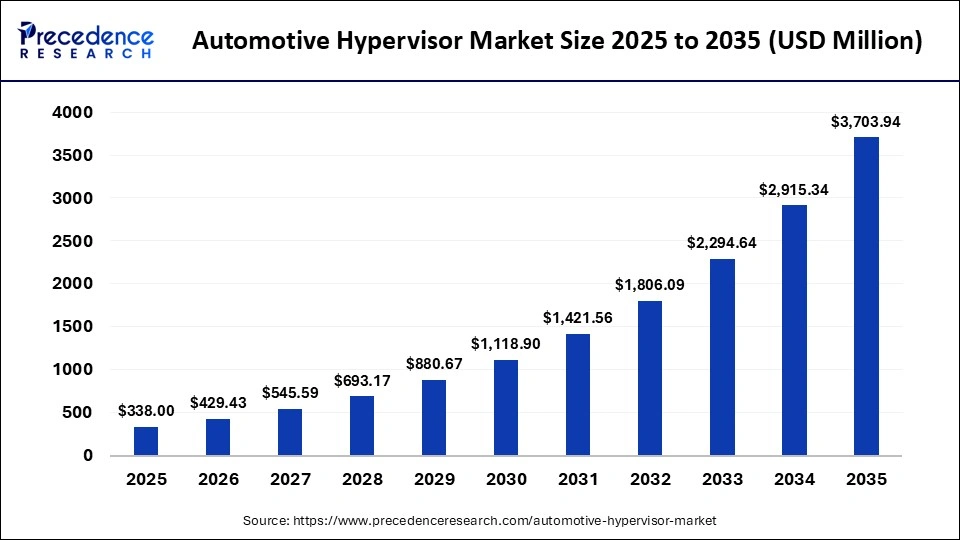
The global automotive hypervisor market size was calculated at USD 338.00 million in 2025 and is predicted to increase from USD 429.43 million in 2026 to approximately USD 3,703.94 million by 2035, expanding at a CAGR of 27.05% from 2026 to 2035. The market is growing as automakers adopt virtual cockpit and in-vehicle virtualization technologies to accelerate development, enhance safety, and enable secure infotainment and autonomous systems.
Key Takeaways
- By region, Asia Pacific led the global automotive hypervisor market in 2025.
- By region, North America is observed to be the fastest-growing region in the upcoming period.
- By product type, the Type 1 automotive hypervisor segment led the market in 2025.
- By product type, the Type 2 automotive hypervisor segment is observed to grow at the fastest rate in the foreseen period.
- By vehicle type, the passenger vehicles segment dominated the global market in 2025.
- By vehicle type, the heavy commercial vehicles segment is expected to grow at the fastest rate in the coming years.
- By end user, the luxury segment led the global market in 2025.
- By end user, the economy segment is observed to be the fastest growing in the foreseeable period.
- By mode of operation, the semi-autonomous segment led the market in 2025.
- By mode of operation, the autonomous segment is expected to expand at the fastest rate in the foreseen period.
Market Overview
An automotive hypervisor is a specialized software that runs directly on vehicle hardware, creating isolated environments for different applications. It is a virtualization platform that enables multiple applications and operating systems to run concurrently on a single hardware device. By allowing multiple operating systems to operate on the same hardware platform, hypervisors reduce the need for additional hardware components, thereby lowering overall system costs.
Automakers are increasingly introducing software-driven features such as advanced infotainment, ADAS, and vehicle to everything (V2X) communication, which is increasing system complexity. In this scenario, hypervisors enable manufacturers to consolidate ECUs by running multiple virtualized environments on a single hardware platform. This consolidation helps reduce vehicle weight, power consumption, and manufacturing costs, while also supporting more efficient system management, although it can increase system complexity and make maintenance and troubleshooting more challenging.
Impact of Artificial Intelligence on the Automotive Hypervisor Market
The incorporation of AI and ML (machine learning) algorithms into hypervisor platforms is opening new avenues for predictive analytics, adaptive systems management, and enhanced cybersecurity measures. AI integration enables advanced in-vehicle virtualization, allowing hypervisors to manage multiple critical applications, such as infotainment, driver-assistance, and autonomous driving, on a single hardware platform securely. Hardware-assisted virtualization features like Intel VT-x and ARM TrustZone, combined with AI algorithms, improve isolation, real-time decision-making, predictive maintenance, and cybersecurity, while accelerating development of virtual cockpit platforms and autonomous systems.
Automotive Hypervisor Market Trends
- The rapid development of autonomous vehicles, which require real-time sensor processing, AI-driven decision-making, and robust system isolation, is increasing the demand for automotive hypervisors.
- The increasing focus on vehicle security is driving the adoption of automotive hypervisors, as they isolate critical systems and prevent unauthorized access to vehicle networks.
- Growing integration of ADAS and advanced infotainment systems is boosting the implementation of automotive hypervisors in modern vehicles.
- OEMs are leveraging cloud-based hypervisor platforms for virtual testing, simulation, and over-the-air updates, accelerating innovation.
- Increasing EV and AV adoption boosts demand for hypervisors to manage complex, software-defined vehicle architectures efficiently.
Market Scope
| Report Coverage | Details |
| Market Size in 2025 | USD 338.00 Million |
| Market Size in 2026 | USD 429.43 Million |
| Market Size by 2035 | USD 3,703.94 Million |
| Market Growth Rate from 2026 to 2035 | CAGR of 27.05% |
| Dominating Region | Asia Pacific |
| Fastest Growing Region | North America |
| Base Year | 2025 |
| Forecast Period | 2026 to 2035 |
| Segments Covered | Product Type, Vehicle Type, End User, Mode of Operation, and region |
| Regions Covered | North America, Europe, Asia-Pacific, Latin America, and Middle East & Africa |
Segment Insights
Product Type Insights
How Did the Type 1 Automotive Hypervisor Segment Dominate the Market?
The Type 1 automotive hypervisor segment dominated the automotive hypervisor market with a major revenue share in 2025. This is mainly due to its ability to run directly on vehicle hardware, providing superior performance, security, and isolation for critical in-vehicle applications. This bare-metal architecture allows automakers to consolidate multiple safety-critical and infotainment systems on a single platform, ensuring real-time operation and compliance with stringent functional safety standards like ISO 26262.
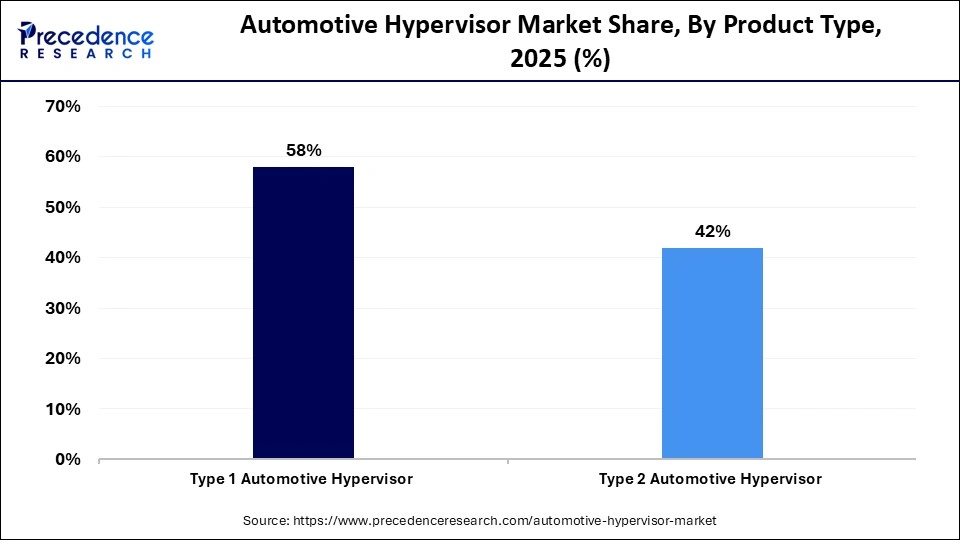
The adoption of lightweight hypervisor architecture, i.e., Type 1 hypervisors, enables faster boot times and reduced latency, which are essential for real-time automotive systems. Moreover, Type 1 hypervisors function without an underlying operating system, as they work directly on the vehicle hardware. They deliver superior performance, security, and dependability, positioning them as the preferred option for safety-critical and mission-critical applications within the automotive sector. Additionally, the rising adoption of advanced driver-assistance systems (ADAS), autonomous driving features, and virtual cockpit platforms has further strengthened demand for Type 1 hypervisors in modern vehicles.
The Type 2 automotive hypervisor segment is projected to grow at the fastest CAGR during the forecast period, driven by factors such as simplified installation on existing operating systems, familiar management interfaces that leverage host OS tools, and hardware flexibility that supports diverse configurations. Furthermore, type 2 hypervisors run on a pre existing operating system, which acts as the host. Car manufacturers often equip vehicles with advanced third-party software components such as navigation systems, voice assistants, and entertainment applications, making Type 2 hypervisors particularly suitable for integrating these software environments.
Vehicle Type Insights
What Made Passenger Vehicles the Dominant Segment in the Automotive Hypervisor Market?
The passenger vehicles segment dominated the market in 2025, driven by rising demand for connected and autonomous vehicles and the growing adoption of hypervisors that provide independence and flexibility in mobility systems. Increasing urbanization has led many people to rely on taxis, car sharing, and on-demand mobility services, which are contributing to the rising demand for passenger cars. According to the Ministry of Heavy Industries in India, in 2025, around 53.8 lakh passenger vehicles were produced, 44.9 lakh were sold, and 8.6 lakh were exported, highlighting the strong demand for passenger vehicles.
Increasing demand for connected, software-defined vehicles and enhanced in-car experiences has driven automakers to adopt hypervisors that can securely manage multiple applications on a single hardware platform. Additionally, the rapid adoption of electric and autonomous passenger vehicles has further fueled the need for hypervisors to ensure real-time performance, safety, and cybersecurity across critical vehicle functions.
The heavy commercial vehicle segment is projected to witness the fastest growth during the forecast period, driven by its ability to withstand heavy loads and rigorous operating conditions, making these vehicles suitable for hauling freight on highways and navigating rough terrains. Automotive hypervisors play a crucial role in ensuring the safety and security of heavy commercial vehicles by enabling the isolation of critical functions within the vehicle system. According to the Ministry of Heavy Industries, in India in 2025, around 11.1 lakh heavy commercial vehicles were produced, 10.3 lakh were sold, and 0.9 lakh were exported, indicating strong demand for heavy-duty vehicles.
End User Insights
What Made Luxury the Dominant Segment in the Market?
The luxury segment dominated the automotive hypervisor market in 2025, driven by rising disposable incomes, growing demand for electric vehicles, and a shift in customer preference from sedans to SUVs. Luxury car manufacturers emphasize delivering a high-quality user experience by integrating advanced technologies and premium features. Luxury vehicles utilize hypervisors to support sophisticated autonomous driving capabilities and high-end infotainment systems, ensuring seamless performance and enhanced system management. These factors have fueled global demand for passenger cars with premium features, supporting the growth of the luxury vehicle segment.
The economy segment is projected to witness the fastest growth during the forecast period, driven by cost efficiency, which is a key factor encouraging the implementation of automotive hypervisors in these vehicles. Hypervisors enhance safety and infotainment features while optimizing resource usage across vehicle systems. As the number of connected devices and systems in modern vehicles continues to grow, cybersecurity has become a major concern for automotive manufacturers. Automotive hypervisors help improve system security by separating critical and non critical functions and enabling secure communication channels between them.
Mode of Operation Insights
How Did the Semi-Autonomous Vehicle Segment Lead the Market?
The semi-autonomous vehicle segment dominated the automotive hypervisor market in 2025 due to the increasing integration of advanced driver-assistance systems (ADAS) that require real-time, secure management of multiple vehicle functions. Hypervisors in semi-autonomous vehicles enable safe consolidation of critical and non-critical applications on a single hardware platform, ensuring isolation and reliability for both control and infotainment systems. Additionally, the rising adoption of semi-autonomous technologies in passenger cars and commercial fleets has driven demand for hypervisors that support enhanced safety, cybersecurity, and scalable software-defined vehicle architectures.
The autonomous vehicle segment is projected to grow at the fastest rate during the forecast period, driven by increasing demand for vehicles capable of operating with minimal or no human intervention. In autonomous vehicles, an automotive hypervisor acts as a specialized software layer that runs directly on vehicle hardware, creating isolated environments for different applications. As demand for autonomous vehicles increases, the need to ensure system safety, reliability, and efficient resource management is also growing, boosting the demand for hypervisors in this segment.
Regional Insights
What is the Asia Pacific Automotive Hypervisor Market Size?
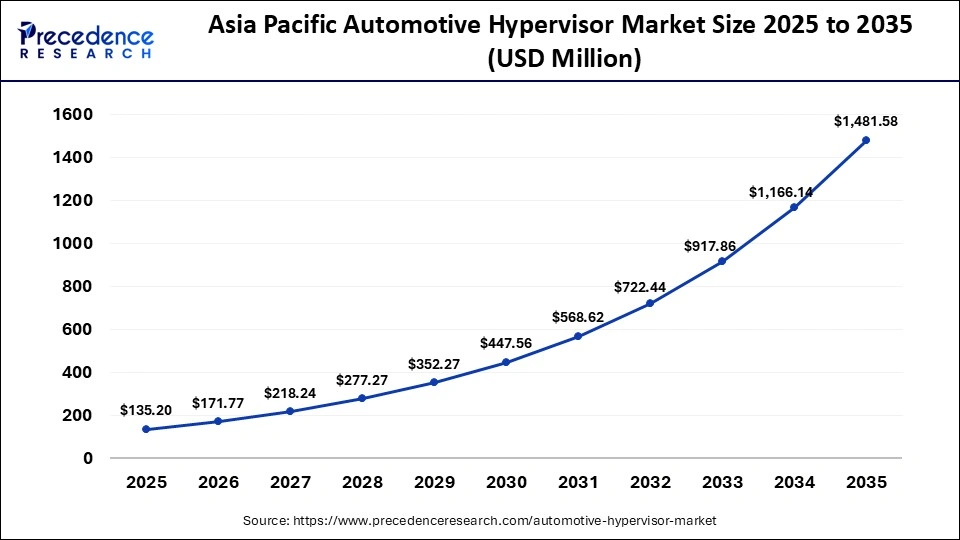
The Asia Pacific automotive hypervisor market size is expected to be worth USD 1,481.58 million by 2035, increasing from USD 135.20 million by 2025, growing at a CAGR of 40.00% from 2026 to 2035.
What Made Asia Pacific the Leading Region in the Automotive Hypervisor Market?
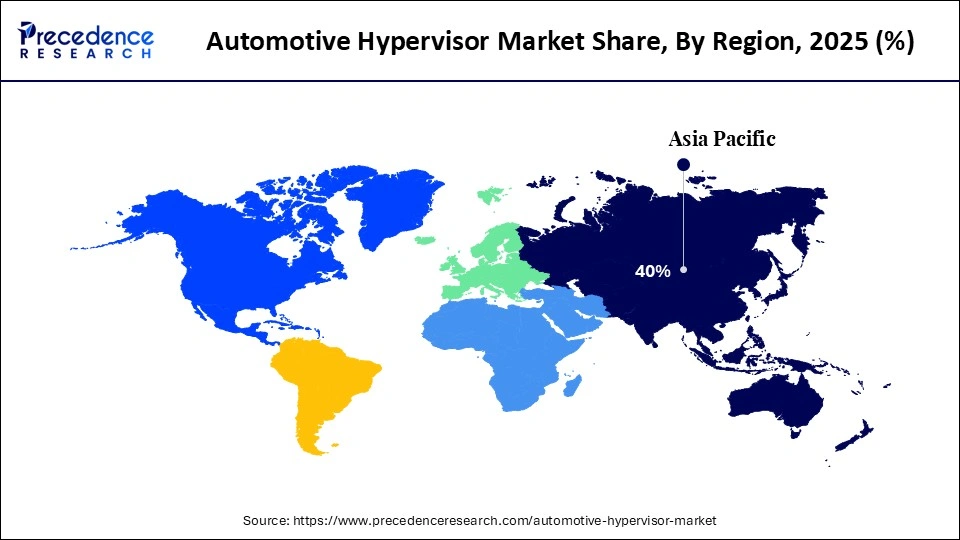
Asia Pacific led the automotive hypervisor market by holding a major share in 2025 due to the rapid growth of automotive manufacturing and strong adoption of advanced in-vehicle technologies in countries like China, Japan, and South Korea. The region's robust electric vehicle (EV) production, coupled with increasing investments in autonomous driving and connected car technologies, has fueled demand for hypervisors to manage multiple vehicle systems securely and efficiently. Additionally, supportive government policies, strong R&D capabilities, and a well-established automotive supply chain have further reinforced the region's leadership in the market.
China represents a key market for automotive hypervisors due to its large automotive production capacity and the increasing adoption of electric vehicles (EVs). Japan and South Korea also contribute significantly to market growth, given their strong focus on innovation and advanced automotive technologies. In addition, rising consumer preference in Japan for smart and connected vehicles is encouraging automakers to integrate hypervisor technology into their vehicle platforms. The increasing number of automakers in India and growing consumer demand for vehicles with advanced features are supporting market expansion in the country.
How is the Opportunistic Rise of North America in the Market?
North America is expected to witness significant growth in the automotive hypervisor market, driven primarily by a strong focus on vehicle safety and cybersecurity. Automakers are increasingly deploying hypervisors to isolate critical vehicle functions and prevent unauthorized access to sensitive systems. Rising adoption of advanced technologies and improvements in system integration are enabling seamless compatibility with existing automotive infrastructures.
Across the region, industries are embracing automotive hypervisor solutions to enhance operational efficiency, streamline workflows, and improve overall system productivity. Sustainability has also emerged as a key trend shaping the market, as environmental considerations gain importance across sectors. In North America, particularly in the U.S. and Canada, market growth is further supported by the presence of major automotive manufacturers and robust demand for advanced driver-assistance systems (ADAS), which is accelerating the adoption of automotive hypervisors.
What are the Advancements in the Automotive Hypervisor Market in Europe?
Europe is expected to have significant growth in the market. This growth and development are driven by stringent regulations on vehicle safety and emissions, which necessitate the integration of advanced technologies. Countries like Germany and France are leading players, as they are quick to adopt hypervisor solutions, driven by their strong automotive manufacturing base and commitment to sustainability.
Germany Market Trends
The country's growth is characterized by a mix of established firms and innovative startups, all competing to meet the evolving demands of the automotive sector. The region is also witnessing increased collaboration between automotive manufacturers and technology providers to enhance vehicle connectivity and automation.
What are the Key Trends in the Automotive Hypervisor Market in Latin America?
Latin America is expected to witness substantial growth in the market, driven by rising vehicle production, increasing consumer demand for smart vehicles, and government initiatives promoting electric mobility. Countries like Brazil and Mexico are leading players, with significant investments being made in automotive technology and infrastructure development.
Brazil Market Trends
The region is home to numerous local and international companies competing to capture the highest market share. The region also has a high focus on enhancing vehicle safety and connectivity, which is driving the adoption of hypervisor solutions.
How is the Middle East and Africa Region Growing in the Automotive Hypervisor Market?
The Middle East and Africa region is expected to grow at a notable CAGR in the foreseeable future, driven by various factors, such as increasing vehicle ownership, urbanization, and government initiatives aimed at improving transportation infrastructure. Countries like South Africa and the UAE are leading players, with high levels of investments being made in smart city projects that integrate advanced automotive technologies.
Saudi Arabia Market Trends
The region has a strong presence of global companies, which is helping in fostering innovation and technology transfer, essential for the region's automotive sector. As the demand for connected and autonomous vehicles rises, the country is poised for significant growth, presenting opportunities for new entrants and established firms alike.
Automotive Hypervisor Market Companies
- BlackBerry Ltd. (QNX)
- Green Hills Software
- Wind River Systems
- Panasonic Holdings Corp.
- Renesas Electronics Corp.
- NXP Semiconductors N.V.
- Continental AG (including Elektrobit)
- Siemens AG (including Mentor Graphics)
- Visteon Corporation
- Qualcomm Inc.
- Robert Bosch GmbH (including ETAS)
- Vector Informatik GmbH
- SYSGO GmbH
- Aptiv PLC
- Sasken Technologies Ltd.
Recent Developments
- In March 2026, Soracom opened pre-orders for its Connectivity Hypervisor, an SGP.32-compatible solution enabling dynamic remote management and switching of multiple operator profiles on a single IoT eSIM. Validated through automotive field tests since mid-2025, the platform allows IoT devices to activate on a Soracom profile and switch dynamically to local or use-case-specific carriers based on region, regulations, or application needs. Pre-orders target long-lifecycle deployments in automotive, utilities, asset tracking, and healthcare. (Source: https://www.automotiveworld.com)
- In 2025, QNX launched QNX Hypervisor 8.0, an advanced embedded virtualization platform that streamlines and speeds up software development by allowing multiple operating systems to run securely and efficiently on a single system-on-chip.(Source: https://www.automotivetestingtechnologyinternational.com)
- In January 2024, Stellantis N.V. launched the world's first virtual cockpit platform through its Virtual Engineering Workbench (VEW), enabling infotainment development up to 100 times faster. Using BlackBerry's QNX Hypervisor in the cloud, now available via AWS Marketplace, Stellantis can create realistic virtual versions of car controls and systems without modifying the main software, reducing development timelines from months to as little as 24 hours.(Source: https://www.stellantis.com)
Segments Covered in the Report
By Product Type
- Type 1 Automotive Hypervisor
- Type 2 Automotive Hypervisor
By Vehicle Type
- Passenger Cars
- Light Commercial Vehicles
- Heavy Commercial Vehicles
By End User
- Economy
- Mid-Priced
- Luxury
By Mode of Operation
- Autonomous Vehicle
- Semi-autonomous Vehicle
By Region
- North America
- Asia Pacific
- Europe
- Latin America
- Middle East & Africa
For inquiries regarding discounts, bulk purchases, or customization requests, please contact us at sales@precedenceresearch.com
Frequently Asked Questions





Ask For Sample
No cookie-cutter, only authentic analysis – take the 1st step to become a Precedence Research client
 Get a Sample




 sales@precedenceresearch.com
 Schedule a Meeting
