



Autonomous AI in Smart Homes Market Trends, Companies, Revenue / Sales Performance, Subscriber Growth, Pricing Strategies, Cloud Adoption, Infrastructure Expansion, Competitive Landscape, and Industry Outlook
Autonomous AI in Smart Homes Market (By Component: Hardware, Software, Services; By Technology: Machine learning, NLP, Computer vision, Predictive analytics, Others; By Application: Voice assistance and command recognition, Security and surveillance, Energy management, Healthcare and assisted living, Others; By Connectivity: Wireless protocols, Wired protocols) - Global Industry Analysis, Size, Trends, Leading Companies, Regional Outlook, and Forecast 2026 to 2035
Source: https://www.precedenceresearch.com/autonomous-ai-in-smart-homes-market
 Get a Sample
 Table Of Content


What is Autonomous AI in Smart Homes Market Size in 2026?
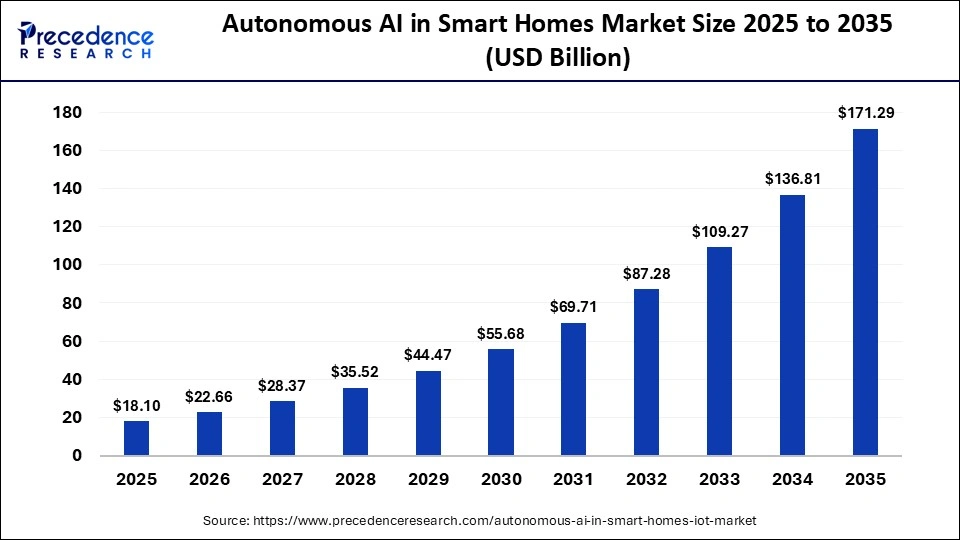
The global autonomous AI in smart homes market size was calculated at USD 18.10 billion in 2025 and is predicted to increase from USD 22.66 billion in 2026 to approximately USD 171.29 billion by 2035, expanding at a CAGR of 25.20% from 2026 to 2035. The rising energy costs and environmental concerns, and the emerging need for proactive home security, energy efficiency, and elderly care are driving the adoption of autonomous AI in smart homes.
Key Takeaways
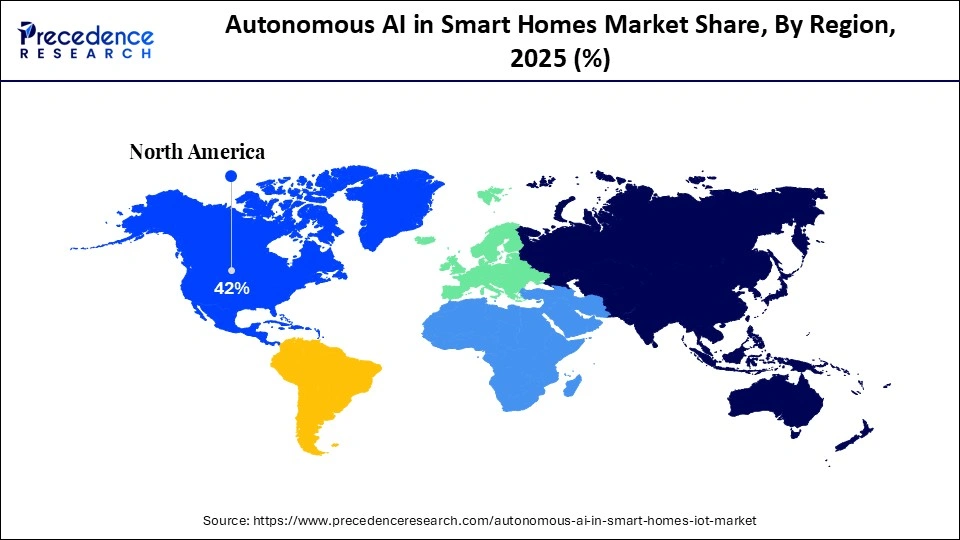
- North America dominated the autonomous AI in smart homes market share in 42% in 2025.
- Asia Pacific is expected to grow at the fastest CAGR in the market during the forecast period.
- By component, the software segment dominated the market in 2025.
- By component, the services segment is expected to grow at the fastest CAGR in the market during the forecast period.
- By technology, the machine learning segment dominated the market in 2025.
- By technology, the predictive analytics segment is expected to grow at the fastest rate in the market in 2025.
- By application, the voice assistance and command recognition segment dominated the market in 2025.
- By application, the security and surveillance segment is expected to grow at the fastest CAGR in the market during the forecast period.
- By connectivity, the wireless protocols segment dominated the autonomous AI in smart homes market in 2025.
- By connectivity, the wired protocols segment is expected to grow steadily in the market during the forecast period.
Autonomous AI in Smart Homes: Intelligent Security and Predictive Energy Management
The autonomous Artificial Intelligence in smart homes market is driven by the major industrial applications, including hyper-personalized wellness, smart kitchens, robotics, and the increased use of computer vision by advanced systems. The urgent need to resolve the potential industrial challenges, such as high initial costs, complexity, and data privacy are raising the importance of AI advancements for smart home management. The major market players are Apple HomeKit, Google Home/Nest, Amazon Alexa, and Samsung SmartThings. Moreover, the prominent industries in specialized hardware offerings are Honeywell, Ecobee, Schneider Electric, ABB Ltd., and Siemens.
Autonomous AI in Smart Homes Market Trends
- IoT-based Smart Home Automation: IoT-based systems benefit smart home users by monitoring and controlling home appliances. IoT automation has brought enhanced security and convenience, and also reduced energy wastage.
- Energy Optimization in Smart Home Systems: Researchers prioritize advanced intelligent energy optimization strategies. The management of energy is an integral part of smart home automation. It is possible to reduce the electricity expenses of households by meeting the real-time needs for energy.
- Interoperability and Scalability in Smart Home Systems: A unified framework and compatibility with other devices are crucial factors for smart home automation. Researchers introduced an IoT framework for interoperability, due to which devices with varying communication interfaces, such as Wi-Fi, Zigbee, and Bluetooth, could interact with each other.
- Security and Remote Access: The rising trends include the integration of IoT devices into the home to meet the security goals in smart home automation. The security protocols include the local network restriction, VPN integration, and authentication mechanisms. VPN integration allows remote access through a virtual private network securely.
- Innovations in AI-Integrated Smart Homes: The applications of machine learning algorithms and IoT sensors offer affordable solutions for automated home control. These solutions reduce power consumption and create comfort for the users.
Market Scope
| Report Coverage | Details |
| Market Size in 2025 | USD 18.10 Billion |
| Market Size in 2026 | USD 22.66 Billion |
| Market Size by 2035 | USD 171.29 Billion |
| Market Growth Rate from 2026 to 2035 | CAGR of 25.20% |
| Dominating Region | North America |
| Fastest Growing Region | Asia Pacific |
| Base Year | 2025 |
| Forecast Period | 2026 to 2035 |
| Segments Covered | Component, Technology, Application, Connectivity, and region |
| Regions Covered | North America, Europe, Asia-Pacific, Latin America, and Middle East & Africa |
Segmental Insights
Component Insights
How did the Software Segment Dominate the Market in 2025?
The software segment dominated the autonomous AI in smart homes market in 2025, owing to an industrial transition towards context-aware decision-making and predictive operations through the integration of software. A strong focus on the production and adoption of various software components and technologies, such as machine learning algorithms, natural language processing, edge computing integration, and unified platforms drive the expansion of software. The major application areas are energy management, proactive security, and health and wellness monitoring.
The services segment is expected to grow at the fastest CAGR in the autonomous AI in smart homes market during the forecast period due to managed proactive services, such as predictive maintenance and behavioral threat detection. The growing need for professional services supports the integration of AI home automation. There is a rising expansion of subscription-based models, cloud-based AI, and SaaS, which offer real-time data processing for health monitoring and energy optimization.
Technology Insights
What made Machine Learning the Dominant Segment in the Autonomous AI in Smart Homes Market in 2025?
The machine learning segment dominated the market in 2025, owing to the major roles of machine learning in hyper-personalized automation, predictive maintenance, behavioral security, and vision. The multimodal sensor fusion systems combine data from various sources, such as radar, Wi-Fi signals, and acoustic monitoring. The wide adoption of unified interoperability enabled machine learning models to unite devices across many brands like Google, Samsung, and Amazon.
The predictive analytics segment is estimated to grow at the fastest rate in the autonomous AI in smart homes market during the predicted timeframe due to the integral function of predictive modelling to enable data-driven decision-making for more resilient and efficient urban development. AI-powered predictive models support infrastructure development, environmental monitoring, energy management, and climate adaptation. Predictive analytics helps to mitigate future risks and address the needs of the urban population.
Application Insights
How did the Voice Assistance and Command Recognition Segment Dominate the Autonomous AI in Smart Homes Market in 2025?
The voice assistance and command recognition segment dominated the market in 2025, owing to the importance of voice as the simplest method to manage a fragmented IoT environment. Smart home assistants are leading as a single point of interaction for security, lighting, and climate systems. AI voice systems offer real-time insights into energy waste, which help people to reduce utility bills through automated scheduling.
The security and surveillance segment is anticipated to grow at a notable rate in the autonomous AI in smart homes market during the upcoming period due to advancements in smart home security through the integration of home automation technologies. The home security is enhanced by the effectiveness of various security systems, like smart locks, surveillance cameras, and motion sensors. These advanced systems enable users to control and monitor their homes in real-time, which provides an additional layer of security.
Connectivity Insights
Why did the Wireless Protocols Segment dominate the Autonomous AI in Smart Homes Market in 2025?
The wireless protocols segment dominated the market in 2025, owing to the transition from simple connectors to the foundational intelligent layer of the smart home, which offers autonomous ambient computing. Thread 1.4 protocol offers a self-healing network that enables battery-operated sensors to last for years. The enhanced capabilities like Wi-Fi 7 and 5G integration are becoming essential for real-time AI processing, security tasks, and high-bandwidth tasks.
The wired protocols segment is predicted to grow at a steady rate in the autonomous AI in smart homes market during the studied period due to the growing need for local edge AI processing, reliability for autonomous security, and infrastructure for predictive energy management. There is a rising need for access to sensitive personal data like health metrics, routines, and biometrics for autonomous AI. Long-term scalability and interoperability are essential for autonomous homes, which allow users to insert next-generation AI modules.
Regional Insights
North America Autonomous AI in Smart Homes Market Size and Growth 2026 to 2035
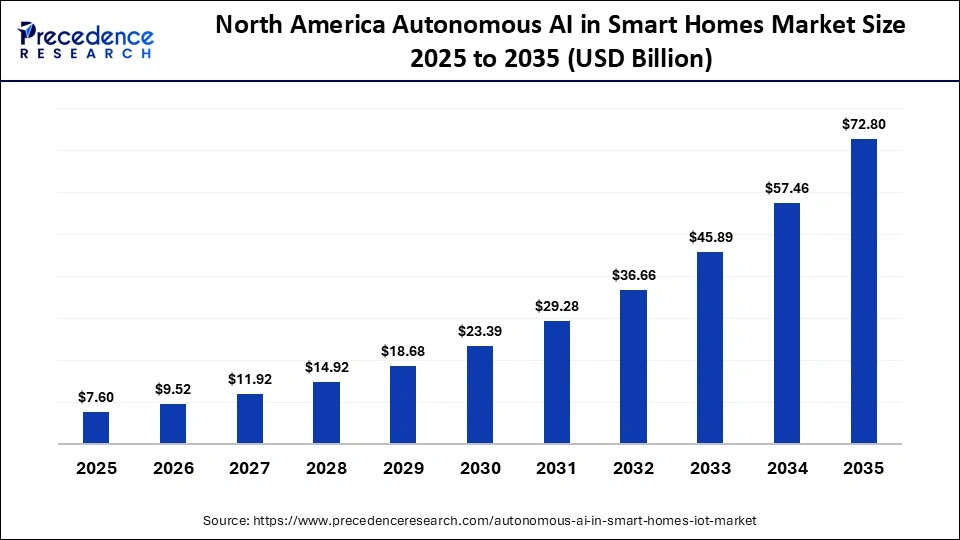
The North America autonomous AI in smart homes market size is estimated at USD 7.60 billion in 2025 and is projected to reach approximately USD 72.80 billion by 2035, with a 25.35% CAGR from 2026 to 2035.
How does North America dominate the Autonomous AI in Smart Homes Market in 2025?
North America dominated the market share of 42% in 2025, owing to the widespread adoption of interoperability standards, advanced AI security solutions, and robust digital infrastructure. The U.S. Department of State is dedicated to tackling the most pressing challenges, mitigating risks, establishing digital unity, and ensuring responsible AI innovation. The U.S. government announced a new global AI research mission and an AI in global development initiative to advance future research in AI and global progress, and meet sustainable development goals.
U.S. Autonomous AI in Smart Homes Market Size and Growth 2026 to 2035
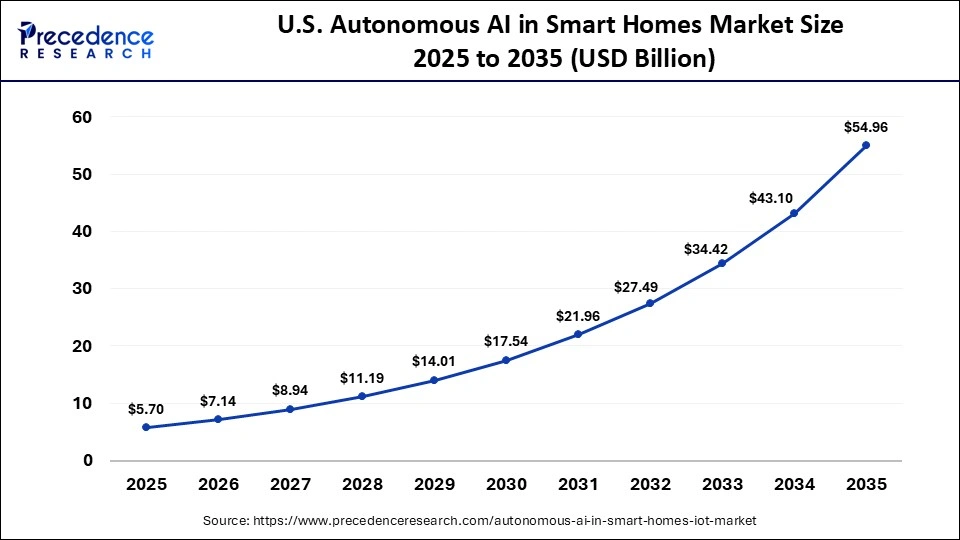
The U.S. autonomous AI in smart homes market size is calculated at USD 5.70 billion in 2025 and is expected to reach nearly USD 54.96 billion in 2035, accelerating at a strong CAGR of 25.43% between 2026 to 2035.
U.S. Autonomous AI in Smart Homes Market Analysis
The U.S. industry witnesses the integration of Generative AI, the expansion of 5G and edge computing, smart security, and proactive monitoring by autonomous systems, which are the primary growth drivers of the market in the U.S. The U.S. Department of State reported that the U.S. is committed to ensuring the adoption of AI technologies to make Americans and people around the world safer, prosperous, and more secure.
What is the Potential of the Autonomous AI in Smart Homes Market in the Asia Pacific?
Asia Pacific is expected to grow at the fastest CAGR in the market during the forecast period due to rapid urbanization, smart city projects, improved infrastructure, 5G deployment, and an aging population. The leading companies, like Samsung, announced major investments to establish a testing campus and smart home innovation in India, which aims to scale up production of AI-powered appliances. There is a rapid shift towards proactive solutions, like automatic energy optimization and predictive security. The IndiaAI mission aims to provide the foundational infrastructure for AI applications across various sectors.
India Autonomous AI in Smart Homes Market Trends
The Government of India supports renewable energy, and the Digital India initiatives have expanded high-speed internet to semi-urban and rural areas, which further transforms the market in India. In February 2026, the Ministry of Electronics and IT reported that in less than 24 months, the India AI mission has set up a foundation for the development of the AI ecosystem in the country.
How does Europe advance Notably in the Autonomous AI in Smart Homes Market?
Europe is expected to grow at a notable rate in the market, owing to advanced local data processing, energy-efficiency mandates, and the growing need for home healthcare solutions. The European Commission and EU member states launched the European Union (EU) Coordinated Plan on Artificial Intelligence (AI) to promote the development, investment, and co-operation in AI. The Organisation for Economic Co-operation and Development (OECD) conducted a survey to assess the implementation progress made by the EU member states.
Germany Autonomous AI in Smart Homes Market Analysis
The expansion of 5G and fiber infrastructure, robust investments in connectivity, and funding for smart-grid integration and AI-controlled residential applications are accelerating the growth of the market in Germany. Germany is harnessing AI for smarter production, including robot fleets, virtual factories, and its newly launched industrial AI cloud.
Top Companies in the Market and Their Offerings
- Amazon: Alexa+ (Advanced AI Assistant), Next-Gen Echo Lineup, Ring & Kidde Smart Alarms, agentic capabilities, Omnisense sensor fusion, AZ3 & AZ3 Pro Silicon, echo hub, miniaturized echo studio, echo show 8 and 11.
- Google: Gemini for Home, Ask Home, Nest Learning Thermostat, enhanced Nest security, Google TV streamer, Google Home app redesign, home APIs for developers, Wear OS, and pixel integration.
- Samsung: AI Vision Inside, Samsung Vision AI, Bixby Voice ID, Knox matrix, AI energy mode, autonomous maintenance.
- Apple: iPhone 16 Series, Mac mini, enhanced Siri, Matter and Thread support, AI smart home display, Next-Gen HomePod with Display, second-generation AirTag, home security cameras, robotic tabletop device, humanoid robotics.
- Honeywell International: Autonomous building control, AI-enhanced indoor air quality, connected solutions platform, Qualcomm Multi-Modal AI, smart energy management.
Other Companies in the Autonomous AI in Smart Homes Market
- Schneider Electric
- ABB Ltd.
- Xiaomi
- Ecobee
- Johnson Controls
- Deep Sentinel
- Josh.ai
- Arlo Technologies
Recent Developments in the Autonomous AI in Smart Homes Market
- In October 2025, Google announced the launch of its AI-powered echo devices and Gemini-powered smart home lineup, introducing its AI strategy, Google Home and Nest devices, which are designed to present its AI assistant, Gemini AI. The company aims to compete on hardware, aiming to make Gemini accessible to other businesses and manufacturers. (Source: https://techcrunch.com)
- In February 2025, Amazon launched its Alexa+ AI-powered smart home assistant, which is a new premium version of its popular voice assistant. It offers exciting features such as deeper smart home integration and promising enhanced AI capabilities.
Segments Covered in the Report
By Component
- Hardware
- Software
- Services
By Technology
- Machine learning
- NLP
- Computer vision
- Predictive analytics
- Others
By Application
- Voice assistance and command recognition
- Security and surveillance
- Energy management
- Healthcare and assisted living
- Others
By Connectivity
- Wireless protocols
- Wired protocols
By Region
- North America
- Europe
- Asia-Pacific
- Latin America
- Middle East & Africa
For inquiries regarding discounts, bulk purchases, or customization requests, please contact us at sales@precedenceresearch.com
Frequently Asked Questions





Ask For Sample
No cookie-cutter, only authentic analysis – take the 1st step to become a Precedence Research client
 Get a Sample




 sales@precedenceresearch.com
 Schedule a Meeting
