



Composite Microbial Fertilizer Market Size, Companies, Share, Crop Production Volume, Yield Analysis, Export & Import Trends, Pricing Metrics, Competitive Positioning, and Demand Forecast
Composite Microbial Fertilizer Market (By Type: Bacterial-based Composite Fertilizers, Fungal-based Composite Fertilizers, Algal/Actinobacteria Composite, Others; By Product Form: Liquid, Granular, Powder; By Application Method: Soil Application, Seed Application, Foliar Application; By Crop Type: Cereals and Grains, Fruits and Vegetables, Oilseeds and Pulses, Others) - Global Industry Analysis, Size, Trends, Leading Companies, Regional Outlook, and Forecast 2026 to 2035
Source: https://www.precedenceresearch.com/composite-microbial-fertilizer-market
 Get a Sample
 Table Of Content


What is Composite Microbial Fertilizer Market Size in 2026?
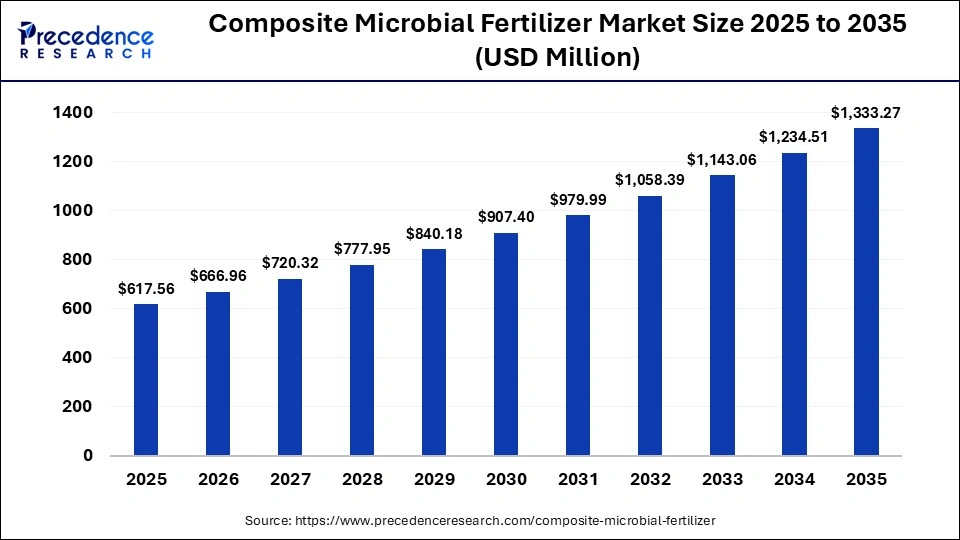
The global composite microbial fertilizer market size was calculated at USD 617.56 million in 2025 and is predicted to increase from USD 666.96 million in 2026 to approximately USD 1,333.27 million by 2035, expanding at a CAGR of 8.00% from 2026 to 2035. The composite microbial fertilizer market is growing rapidly due to a surge in demand for sustainable agriculture, stringent environmental regulations on artificial chemicals, and the need to enhance soil health and crop production.
Key Takeaways
- Asia-Pacific dominated the composite microbial fertilizer market with a share of approximately 40% in 2025 and is expected to expand with the highest CAGR of 8.4% during the forecast period.
- By type, the bacterial-based composite fertilizers segment held the largest market share of approximately 45% in 2025.
- By type, the fungal-based composite fertilizers segment is expected to grow at the fastest CAGR of 6.8% between 2026 and 2035.
- By product form, the granular segment dominated the market with a share of approximately 40% in 2025.
- By product form, the liquid segment is expected to rise with the highest CAGR of 6.6% during the forecast period.
- By application method, the soil application segment held the largest revenue share of approximately 45% in the market in 2025.
- By application method, the foliar application segment is expected to grow rapidly with a CAGR of 7% between 2026 and 2035.
- By crop type, the cereals and grains segment held the largest revenue share of approximately 45% in the market in 2025.
- By crop type, the fruits and vegetables segment is expected to grow with the highest CAGR of 7.2% between 2026 and 2035.
What is the Landscape of the Composite Microbial Fertilizer Market?
The market is centered on the combination of beneficial microorganisms paired with traditional nutrient sources to enhance soil health, improve nutrient absorption, and promote organic farming. The pivot towards sustainable agriculture and demand for natural food, coupled with government initiatives, are key drivers of this market. The market growth is propelled by the need for sustainable agriculture, soil health enhancement, and reduced dependency on chemical fertilizers.
Composite microbial fertilizers enhance soil nutrients, improve crop resistance to environmental stress, and boost overall yield, which further expands market growth. Technological advancements in fertilizer formulations are enhancing product consistency and effectiveness. The market growth is supported by increased funding and demand for agricultural solutions that align with high productivity and sustainable practice.
What is the Role of AI in the Composite Microbial Fertilizer Market?
AI is revolutionizing this market by enabling targeted applications and improving efficiency and sustainability. It improves soil health by boosting microbial product efficiency and selecting the ideal probiotic strain. It integrates with various applications to ensure that the fertilizer is applied to specific locations and times of need. AI is transforming the business model from selling commodities to providing superior, sustainable digital service, improving competitive advantages and ROI. AI and machine learning (ML) algorithms focus on precision agricultural solutions, enhancing productivity while addressing ecological sustainability.
Composite Microbial Fertilizer Market Trends
- Sustainability and Organic Demand: The shift towards natural food consumption has enhanced the adoption of eco-friendly biofertilizer so as to reverse soil degradation, reduce dependency on synthetic chemicals, and provide safe organic food to the consumers.
- Technological Advancements: Innovations in formulation and precision agriculture integration allow targeted nutrient uptake, improving crop yields while reducing environmental impact.
- Microbial Diversity: The agricultural sector is pivoting towards composite microbial fertilizers to achieve holistic soil and crop benefits rather than utilizing single-strain products.
- Impact on Yield and Stress Resistance: These fertilizers are increasingly utilized to improve crop productivity and enhance resistance against environmental stress.
Market Scope
| Report Coverage | Details |
| Market Size in 2025 | USD 617.56 Million |
| Market Size in 2026 | USD 666.96 Million |
| Market Size by 2035 | USD 1,333.27 Million |
| Market Growth Rate from 2026 to 2035 | CAGR of 8.00% |
| Dominating Region | Asia Pacific |
| Fastest Growing Region | North America |
| Base Year | 2025 |
| Forecast Period | 2026 to 2035 |
| Segments Covered | Type, Product Form, Application Method, Crop Type, and Region |
| Regions Covered | North America, Europe, Asia-Pacific, Latin America, and Middle East & Africa |
Segmental Inaights
Type Insights
Which Type Segment Dominated the Composite Microbial Fertilizer Market?
The bacterial-based composite fertilizers segment dominated the market with a share of approximately 45% in 2025, due to its superior efficiency in nitrogen fixation, rapid colonization, and ability to solubilize phosphate/potassium to improve soil health. These fertilizers contain plant growth-promoting bacteria, which enhance nutrient absorption and strengthen the soil ecosystem. It is expanding in this market due to its ability to improve soil health, enhance crop yield, and promote organic farming. The availability of this fertilizer in various formulations is driving its widespread adoption.
Composite Microbial Fertilizer Market Share, By Crop Type, 2025 (%)
| Crop Type | Market Share (%) |
| Cereals and Grains | 45% |
| Fruits and Vegetables | 30% |
| Oilseeds and Pulses | 15% |
| Others | 10% |
The fungal-based composite fertilizers segment is expected to rise at a remarkable CAGR of 6.8% between 2026 and 2035. It is witnessing tremendous growth as this fertilizer provides a highly effective, renewable, and regenerative solution that reverses soil degradation and improves nutrient availability. The growth is driven by a surge in environmental regulation and demand for sustainable agriculture and restored soil health. Fungal-based biofertilizers can increase micro diversity in soils, enhance physicochemical properties, and provide a more nutrient-rich environment for plants.
Product Form Insights
What Made the Granular Segment Lead the Composite Microbial Fertilizer Market?
The granular segment led the market with a share of approximately 40% 2025, due to its superior handling, extended shelf life, and ease of application compared to other formulations. This formulation protects the microorganism from abiotic stress and improves the soil condition. It is cost-efficient and compatible with fertilizer habits, which boosts the segment's growth. Granular formulation is highly preferred due to its demand for raw crops and large-scale farming.
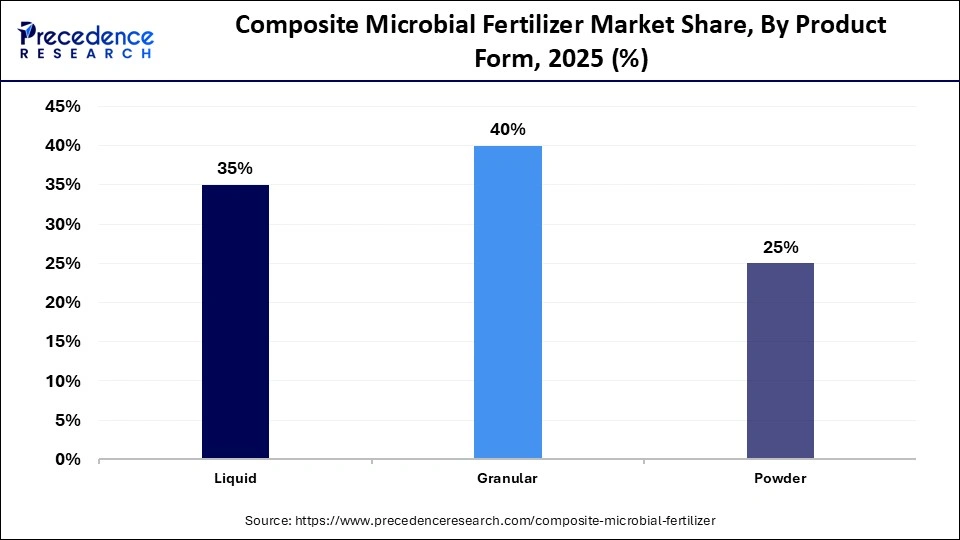
The liquid segment is expected to show the fastest growth with a CAGR of 6.6% over the forecast period. The tremendous growth of this segment in the market is due to its superior performance, enhanced microbial viability, streamlined application in modern irrigation systems, and increased shelf life. The growth is driven by a surge in demand for organic and precision farming. Liquid formulation enables better integration with modern automated farming and enhances soil fertility, augmenting the segment's growth.
Application Method Insights
Which Application Segment Dominated the Composite Microbial Fertilizer Market?
The soil application segment contributed the biggest revenue share of approximately 45% in 2025 because it is the most effective method to enhance soil health, restore microbial diversity, and promote long-term soil fertility. The dominance of soil application is due to several factors, like rapid colonization that enhances nutrient uptake, restoration of soil health and structure, long-lasting nutrient benefits, suppression of soil-borne pathogens, and ease of application. Soil application is the preferred choice, as it is a comprehensive soil treatment that goes beyond a simple plant nutrient boost.
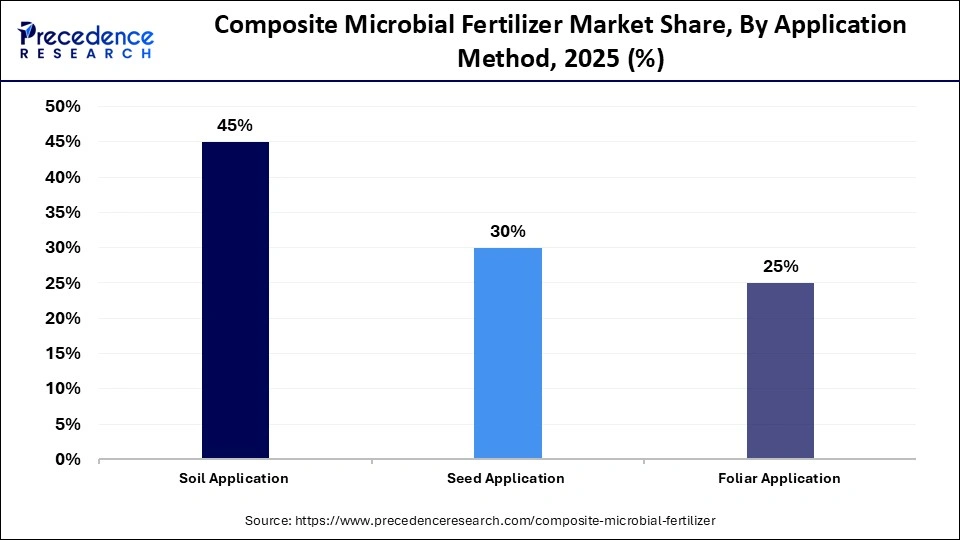
The foliar application segment is expected to gain the highest market share with a CAGR of 7% between 2026 and 2035. It is expanding exponentially in the market due to its high efficiency, fast pace, and ecologically sustainable alternative to traditional fertilizer. The growth is propelled by the need to improve crop yield, enhance nutrient efficiency, and combat soil degradation and climate instability. It is particularly useful for field crops, such as wheat, barley, and rice, to enhance grain yield.
Crop Type Insights
What Made the Cereals and Grains Segment Lead the Composite Microbial Fertilizer Market?
The cereals and grains segment accounted for the highest revenue share of approximately 45% in 2025, as these crops represent the biggest share of agricultural production and have a high nutritional value. Farmers are increasingly required to adopt organic, bio-based solutions. These fertilizers enhance nutrient absorption while reducing reliance on expensive synthetic fertilizers, which drives this segment. Advanced microbial formulation provides easy, large-scale application for cereals and grains.
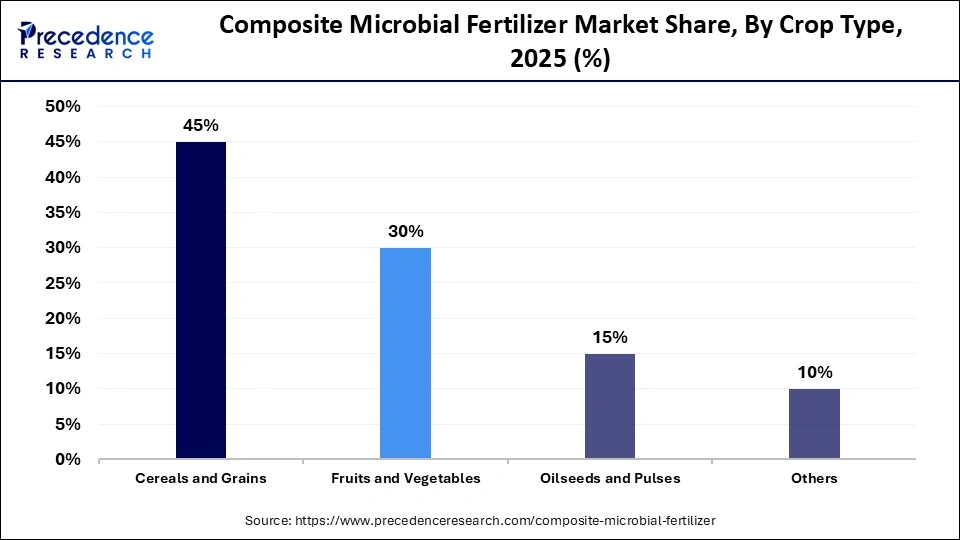
The fruits and vegetables segment is expected to rise with the highest CAGR of 7.2% between 2026 and 2035. It is expanding rapidly in this market, as these high-value crops are vulnerable to soil degradation and spoilage, creating an immediate need for a solution to improve quality, yield, and shelf life. Consumer preference for organic, residue-free, healthy crops is expanding this market. This sector is further driven by the need to manage abiotic stresses, which are common in high-value greenhouse and open-field cultivation.
Regional Analysis
Asia-Pacific Composite Microbial Fertilizer Market Size and Growth 2026 to 2035
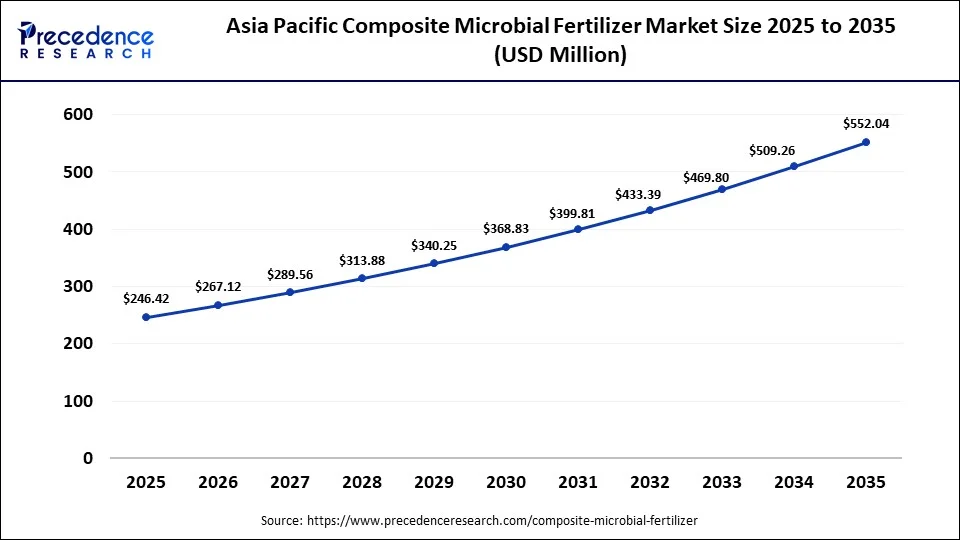
Asia-Pacific composite microbial fertilizer market size is expected to be worth USD 552.04 million by 2035, increasing from USD 246.42 million by 2025, growing at a CAGR of 8.40% from 2026 to 2035
Why Did Asia-Pacific Dominate the Composite Microbial Fertilizer Market?
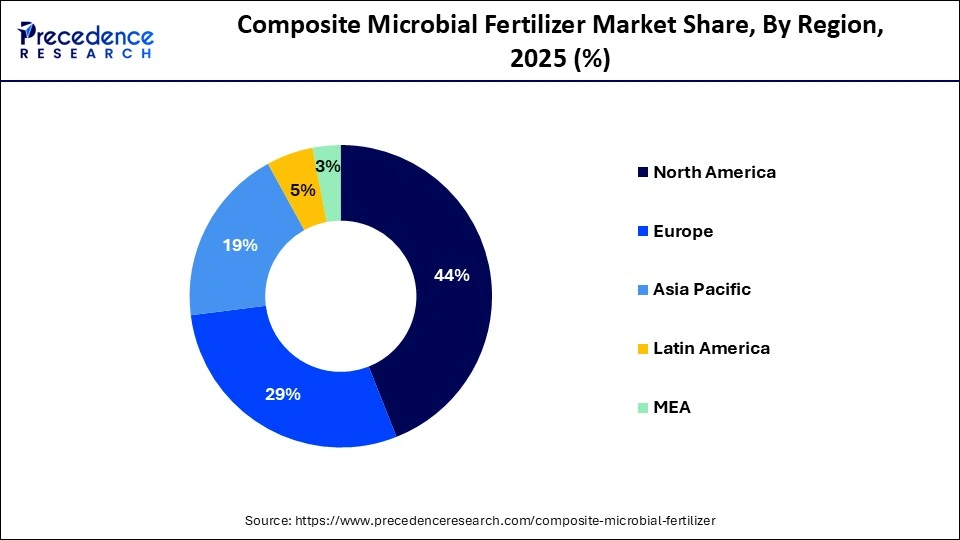
Asia-Pacific held a major revenue share of approximately 40% in the market in 2025 and is expected to host the fastest-growing market with a CAGR of 8.4% in the coming years. It dominates the market due to massive agricultural activity, surging population-driven food demand, and robust government support for eco-friendly organic farming to improve soil. This market is propelled by massive, rapid adoption of biologicals along with initiatives promoting sustainable farming and reducing the usage of chemical fertilizers. Increased consumer health awareness has boosted demand for natural products, further driving the market.
China Market Trends
China dominates this market due to its robust government-backed policies for soil restoration and its vast area of organic farmland. This market is further expanded due to tax exemption on biofertilizers, rapid innovation, and a shift towards organic fertilizer over chemical fertilizers. Growing consumer preference for safer, premium-quality food has further boosted the market.
China is promoting "green agricultural development," which aims to address environmental issues, minimizing chemical fertilizer utilization in favor of biofertilizers. China invests heavily in RandD to improve microbial innovations to enhance crop nutrient uptake and soil health, which boosts the market. China's market leadership is driven by a surge in demand for organic farming and reduced chemical usage.
According to the Food and Agriculture Organization of the United Nations, China is the world's largest producer of cereals, cotton, fruits, vegetables, meat, poultry, eggs, and fishery products. It produces one-fourth of the world's grain and feeds one-fifth of the world's population.
How is Europe Growing in the Composite Microbial Fertilizer Market?
Europe is expected to grow at a notable CAGR in the foreseeable future. Its expansion is driven by stringent regulations like the European Green Deal and the Farm to Fork Strategy, which reduce chemical fertilizer use, and a surge in demand for sustainable, high-yield crops that enhance soil health. Innovation in precision agriculture has increased efficiency and adoption rates.
The focus on soil health, high adoption of organic farming, and robust RandD in biotechnology infrastructure drive this growth. Major companies in this region are focused on developing new formulations to improve soil fertility. This market is further propelled by advanced agricultural practices and robust support of organic, eco-friendly farming solutions.
France Market Trends
France is leading in the European market due to vast agricultural land, a surge in demand for organic farming, and supportive government policies. This market is reinforced by advanced RandD infrastructure, widespread adoption of precision farming, and a remarkable organic farming sector. The French government has allocated €600 million for fertilizer subsidies aimed at adopting organic, eco-friendly, and bio-based products. Government initiatives like "Ecophyto II+" and CAP eco-scheme payments further boost this market in this region. The market is supported by specialized industry organizations that facilitate the adoption of new technologies.
France accounts for 18% of the total agricultural production of the 27 member countries of Europe. The agri-food industry is the country's leading industrial sector. In 2023, France generated a revenue of approximately €198 billion with the presence of over 416,436 active farms.
Composite Microbial Fertilizer Market Value Chain Analysis
- Harvesting and Post-Harvest Handling: It hinges on maintaining the viability of living organisms, prolonging the storage life, and ensuring the product quality.
Key Players: Lifeasible, Futureco Bioscience S.A. (Sumitomo Corporation), Ecotone Industries - Storage and Cold Chain Logistics: It focuses on maintaining dark, temperature-regulated storage for these products.
Key Players: Snowman Logistics Ltd., Lineage Logistics, Americold Realty Trust, Inc. - Processing and Packaging: It focuses on transforming raw, nutrient-rich material into long-lasting, marketable products.
Key Players: Novonesis (formerly Novozymes A/S), IPL Biologicals Limited, Lallemand Inc.
Top Companies in the Composite Microbial Fertilizer Market
- Novozymes A/S
- BASF SE
- Symborg
- Agri Life
- Ajay BioTech
- Camson Bio Technologies
- CBF China Biofertilizers
- Gujarat State Fertilizers and Chemicals Ltd
- Lallemand
- Madras Fertilizers
- National Fertilizers
- Nutramax Laboratories
- Rashtriya Chemicals and Fertilizers
- Rizobacter Argentina
- Sresta Natural Bioproducts
Recent Developments in the Composite Microbial Fertilizer Market
- In February 2025, Grupa Azoty announced the production of its new multi-component fertilizer, POLIFOSKA Multi S. The product balances nutrient composition, promotes proper plant growth and development, and enhances crop yield quality with notable economic benefits. (Source: https://www.indianchemicalnews.com)
- In January 2025, Super Crop Safe Ltd. launched Super Gold WP+, an innovative solution of inoculant mycorrhiza and other essential nutrients to enhance crop productivity, enhance root growth and nutrient absorption, improve soil health, and support eco-friendly and sustainable agriculture. (Source: https://www.aninews.in)
- In January 2025, Nutrien Ag Solutions introduced N-FINITY, a new nitrogen-management solution designed to enhance the soil's ability to fix, recruit, and liberate nitrogen in the root zone. N-FINITY can help make every unit of nitrogen go farther.
Segments Covered in the Report
By Type
- Bacterial-based Composite Fertilizers
- Fungal-based Composite Fertilizers
- Algal/Actinobacteria Composite
- Others
By Product Form
- Liquid
- Granular
- Powder
By Application Method
- Soil Application
- Seed Application
- Foliar Application
By Crop Type
- Cereals and Grains
- Fruits and Vegetables
- Oilseeds and Pulses
- Others
By Region
- North America
- Europe
- Asia-Pacific
- Latin America
- Middle East & Africa
For inquiries regarding discounts, bulk purchases, or customization requests, please contact us at sales@precedenceresearch.com
Frequently Asked Questions





Ask For Sample
No cookie-cutter, only authentic analysis – take the 1st step to become a Precedence Research client
 Get a Sample



 sales@precedenceresearch.com
 Schedule a Meeting
