



Desalting Buffer Exchange Market Size, Companies, Share, Patient Volume, Treatment Adoption Rates, Pricing Analysis, Regulatory Landscape, Competitive Positioning, and Demand Forecast
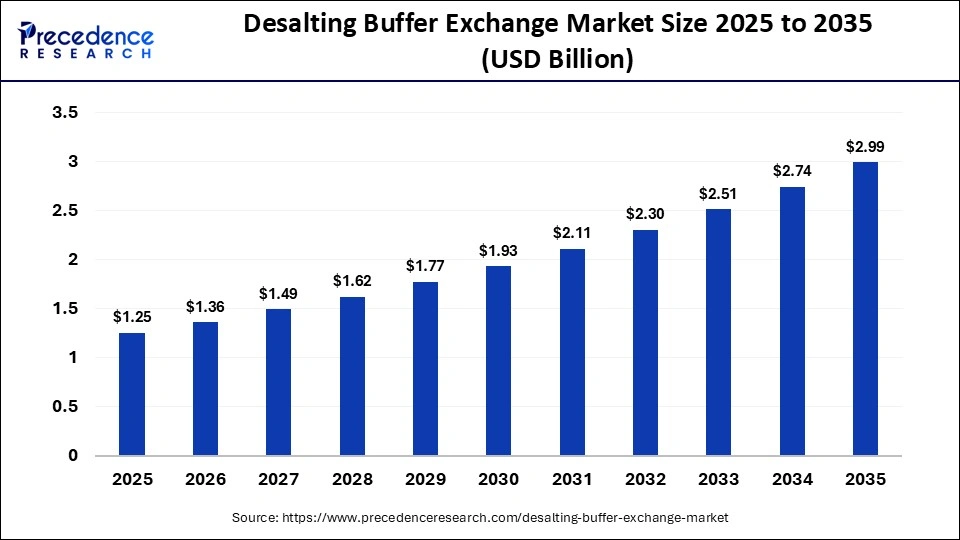
Rohan Patil, a Healthcare Industry Expert, highlights that the desalting buffer exchange market has reached USD 1.36 billion in 2026 and is on track to reach USD 2.99 billion by 2035, advancing at a CAGR of 9.10%. Key desalting buffer exchange market companies shaping the market include Agilent Technologies, Inc., Avantor, Inc., Bio-Rad Laboratories, Inc., Cytiva (Danaher Corporation), GE Healthcare (Cytiva), while major growth segments span By Product, By Technique, By Application, By End User.
Source: https://www.precedenceresearch.com/desalting-buffer-exchange-market
 Get a Sample
 Table Of Content


What is the Desalting Buffer Exchange Market Size in 2026?
The global desalting buffer exchange market size accounted for USD 1.25 billion in 2025 and is predicted to increase from USD 1.36 billion in 2026 to approximately USD 2.99 billion by 2035, expanding at a CAGR of 9.10% from 2026 to 2035. The market growth is attributed to the rising demand for efficient downstream purification and advancements in filtration and chromatography technologies.
Key Takeaways
- North America dominated the market with 39% of the market share in 2025.
- Asia Pacific is expected to grow at the fastest CAGR between 2026 and 2035.
- By product, the columns segment contributed the highest market share of 48% in 2025.
- By product, the membrane filters segment is the second-largest shareholder in 2025 and is expected to grow at a significant rate between 2026 and 2035.
- By technique, the size exclusion chromatography (SEC) segment held a major market share of 46% in 2025.
- By technique, the dialysis segment is the second-largest shareholder in 2025 and is expected to grow at a significant rate between 2026 and 2035.
- By application, the protein purification segment captured the highest market share of 50% in 2025.
- By application, the nucleic acid purification segment is the second-largest shareholder in 2025 and is expected to grow at a significant rate between 2026 and 2035.
- By end user, the pharmaceutical & biotechnology companies segment dominated the market in 2025.
- By end user, the CROs segment is expected to grow at the fastest rate in the coming years.
Market Overview
Desalting and buffer exchange technologies are critical downstream processes that remove salt. These two processes help the removal of salt from proteins as they are transferred into appropriate buffers through the use of chromatography and filtration technologies. Rising global demand for biologics and advanced therapeutics is a primary driver accelerating the desalting buffer exchange market growth.
According to the U.S. FDA, the annual average share of new biologics that are permitted for human consumption is steadily increasing. Increasing biologics approvals and rising manufacturing complexity collectively continue to drive sustained demand for desalting and buffer exchange solutions.
Impact of Artificial Intelligence on the Desalting Buffer Exchange Market
Desalting and buffer exchange processes are being developed with artificial intelligence (AI) to optimize processes by monitoring conductivity, pH levels, and membrane performance. This allows real-time optimization of buffer exchange efficiency and protein stability. Machine learning has become an essential component for most manufacturers. They are integrating machine learning with tangential flow filtration and chromatography platforms to minimize buffer use and to achieve uniform yield. Additionally, AI also helps with predictive maintenance of filtration membranes and columns, minimizing downtime and operational risk across facilities.
Market Trends
- Buffer Recycling and Circular Processing Models: Sustainability-driven buffer reuse is emerging as a key trend in desalting and buffer exchange operations. This approach enables manufacturers to adopt closed-loop purification processes, significantly reducing water consumption and operating costs while supporting environmentally sustainable practices.
- Shift Toward Fully Integrated, Continuous Downstream Platforms: The transition to fully integrated, continuous bioprocessing platforms is accelerating. These platforms are reshaping how buffer exchange processes are executed in real-time. Continuous systems allow the integration of both filtration and chromatography, which reduces the amount of time.
- Increasing Demand for High-Purity Protein Therapeutics: The growing need for stable and high-quality biologics is propelling the adoption of advanced desalting and purification technology.
- Growth in Cell and Gene Therapy Production: Expanding advanced therapy pipelines are fueling demand for precise buffer exchange solutions in complex biologics processing.
Market Scope
| Report Coverage | Details |
| Market Size in 2025 | USD 1.25 Billion |
| Market Size in 2026 | USD 1.36 Billion |
| Market Size by 2035 | USD 2.99 Billion |
| Market Growth Rate from 2026 to 2035 | CAGR of 9.10% |
| Dominating Region | North America |
| Fastest Growing Region | Asia-Pacific |
| Base Year | 2025 |
| Forecast Period | 2026 to 2035 |
| Segments Covered | Product, Technique, Application, End User, and Region |
| Regions Covered | North America, Europe, Asia-Pacific, Latin America, and Middle East & Africa |
Market Dynamics
Drivers
Expansion of Biosimilars Manufacturing Pipelines
Increasing biosimilars manufacturing pipelines is expected to drive the growth of the desalting buffer exchange market in the coming years. Regulatory agencies are continuing to approve biosimilars across oncology, immunology, and endocrinology. The cumulative effect has been putting pressure on the purification infrastructure employed in these areas. The most critical functions provided by buffer exchange are the continued maintenance of formulation stability during the process of biosimilar replication. Furthermore, the growing pipeline complexity strengthens reliance on precise buffer management strategies in commercial-scale manufacturing.
Restraint
High Capital Investment and Operational Costs
High capital investment requirements are expected to limit the adoption of advanced desalting technologies and further hinder the market growth. Significant operating costs associated with buffer preparation, consumables, and system maintenance increase the overall expense of establishing purification infrastructure. Smaller biotech companies often face challenges in scaling processes to high-throughput levels. Additionally, ongoing financial pressures restrict the broader deployment of buffer exchange technologies at emerging manufacturing sites worldwide.
Opportunity
Advancements in Membrane Filtration Technologies
Advancements in membrane filtration technologies are estimated to create immense opportunities for the desalting buffer exchange market. Continuous innovations in the design of filtration technologies have helped to improve operational efficiencies and reduce processing times. Additionally, the rising investments in biomanufacturing infrastructure are expected to expand the deployment of desalting and buffer exchange technologies across new and upgraded facilities.
Segment Insights
Product Insights
Desalting Buffer Exchange Market Share, By Product, 2025-2035 (%)
| Product | 2025 | 2035 |
| Columns | 48.00% | 44.00% |
| Membrane Filters | 28.00% | 26.00% |
| Kits & Reagents | 24.00% | 30.00% |
The Columns Segment Held a 48% Market Share in 2025
The columns segment dominated the desalting buffer exchange market with the largest share of 48% in 2025. This is mainly due to their widespread use in rapid desalting and buffer exchange workflows across research and production environments. Column-based systems are preferred in laboratories, as these systems provide consistent levels of performance. They have minimal set-up times and provide high levels of reproducibility in the various protein purification steps involved. Furthermore, the increasing need for fast and reliable protein purification is boosting the adoption of columns across laboratory-scale and pilot-scale applications.
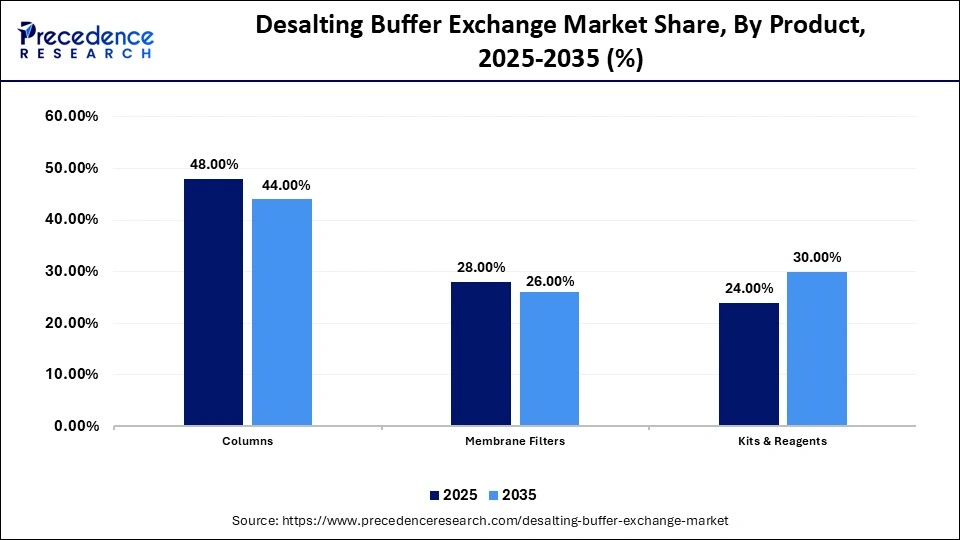
The membrane filters segment held a 28% share of the market in 2025 and is expected to grow at a significant rate in the coming years, supported by their efficiency in ultrafiltration and dialysis applications. Biologics manufacturers are using membrane filtration systems for their scalability and cost-effectiveness. These systems guarantee a consistent and reproducible separation of proteins from salts and any other contaminants, thus ensuring a superior product quality.
The kits & reagents segment held a 24% share of the market in 2025 and is expected to grow at the fastest rate in the upcoming period. This is mainly due to increasing preference for ready-to-use purification solutions in research environments. Moreover, academic research and early-stage drug development activities contribute significantly to increased demand for kits and reagents.
Technique Insights
Desalting Buffer Exchange Market Share, By Technique, 2025-2035 (%)
| Technique | 2025 | 2035 |
| Size Exclusion Chromatography (SEC) | 46.00% | 42.00% |
| Dialysis | 22.00% | 20.00% |
| Ultrafiltration | 20.00% | 26.00% |
| Precipitation Methods | 12.00% | 12.00% |
The SEC Segment Dominated the Market with a 46% Share in 2025
The size exclusion chromatography (SEC) segment dominated the desalting and buffer exchange market with a major share of 46% in 2025. This is due to its precision in separating proteins from salts without altering molecular structure. Laboratories rely on SEC for maintaining protein integrity during buffer exchange, especially in sensitive biologics applications. The use of SEC-based desalting columns continues to increase in the coming years. According to the Cytiva 2025 report, SEC-based desalting columns have been and remain the most widely used purification methods within early-stage biologics workflows.
The dialysis segment was the second-largest shareholder in 2025, holding a 22% share, and is expected to grow at a significant rate during the projection period. This is due to its simplicity and cost efficiency in laboratory-scale buffer exchange applications. The use of dialysis is also continuing to grow, thus reinforcing its position as a popularly used method for cost-effective protein purification.
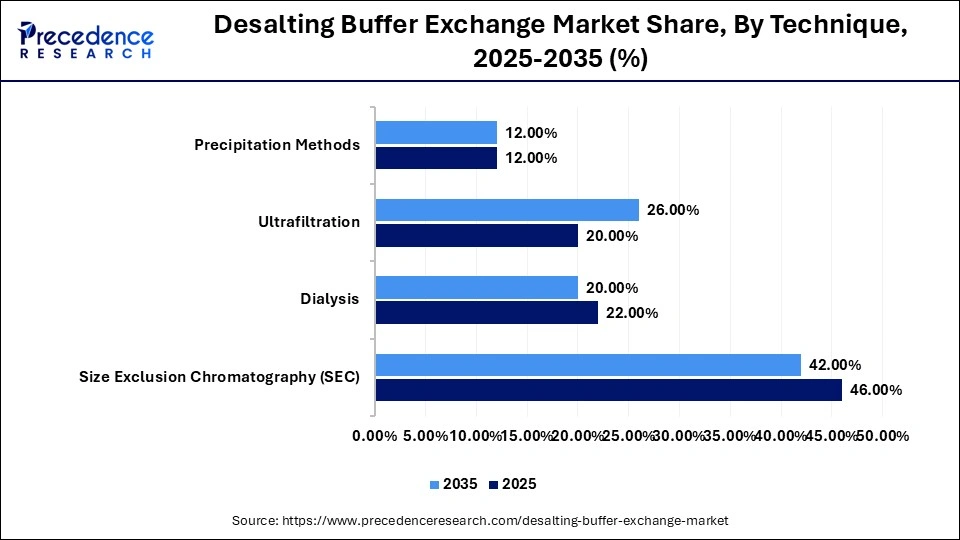
The ultrafiltration segment held a 20% market share in 2025 and is expected to grow at the fastest rate between 2026 and 2035, driven by increasing biologics manufacturing, in which ultrafiltration is critical. Growing preference for scalable and automated purification technologies continues to accelerate their adoption. Moreover, faster processing, scalability, high efficiency, and suitability of ultrafiltration for large sample volumes drive the rapid growth of the segment.
The precipitation methods segment held a 12% share of the market in 2025, owing to their applicability in specialized purification processes. This process is very simple to carry out and has low operational costs compared to other methods. They allow the use of solubility-based selective protein isolation methods in many specialized research laboratories.
Application Insights
The Protein Purification Segment Dominated the Market with a 50% Share in 2025
The protein purification segment dominated the desalting buffer exchange market with a share of 50% in 2025, driven by strong demand from biologics manufacturing and proteomics research in laboratories worldwide. Biopharmaceutical manufacturers rely on effective buffer exchange methods to maintain protein stability during the production of monoclonal antibodies and recombinant proteins. The multi-step purification processes required for high-value biologics reinforce the continued use of desalting technologies to ensure consistent product quality.
Desalting Buffer Exchange Market Share, By Application, 2025-2035 (%)
| Application | 2025 | 2035 |
| Protein Purification | 50.00% | 46.00% |
| Nucleic Acid Purification | 20.00% | 19.00% |
| Drug Development | 18.00% | 24.00% |
| Others | 12.00% | 11.00% |
The nucleic acid purification segment was the second-largest shareholder, holding a 20% share in 2025, due to growing use in genomics, molecular biology, and research activities. In 2025, QIAGEN(NV) reported a growing demand for nucleic acid purification kits in research and diagnostic laboratories throughout the world. Additionally, the rising importance of research omics and nucleic acid purification sustains consistent demand across global laboratories.
The drug development segment held a 18% share of the market in 2025 and is expected to grow at the fastest rate in the coming years, driven by expanding therapeutic pipelines and increasing complexity of biologic drugs. Emerging biotech companies also contribute to the increasing demand for flexible and effective methods of exchanging buffers in the development of drugs.
End User Insights
The Pharmaceutical and Biotechnology Segment Lead the Market in 2025
The pharmaceutical and biotechnology companies segment dominated the desalting buffer exchange market in 2025 due to the high demand for consistent and high-quality biologics production. These companies rely heavily on buffer exchange processes to maintain protein stability during the manufacturing of monoclonal antibodies, recombinant proteins, and other complex biologics. Additionally, ongoing investments in biopharmaceutical R&D and large-scale production facilities drive the widespread adoption of advanced desalting technologies in this segment.
The contract research organizations (CROs) segment is expected to grow at the fastest rate during the forecast period due to increasing outsourcing of protein purification and biologics development by pharmaceutical and biotechnology companies. CROs leverage advanced desalting technologies to provide efficient, high-quality services without requiring clients to invest in their own infrastructure. Additionally, the expansion of global clinical trials and biologics research programs is driving higher demand for outsourced buffer exchange and purification solutions.
Regional Insights
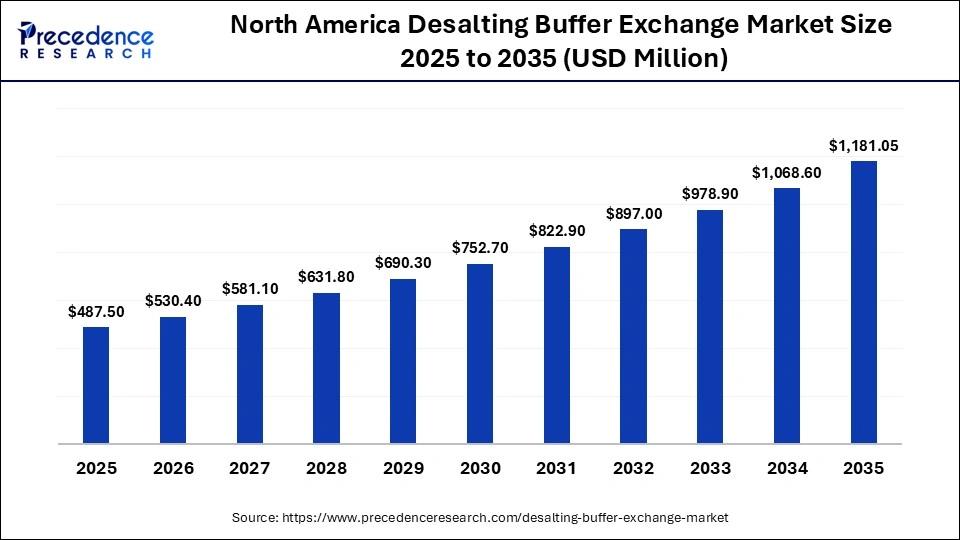
North America desalting buffer exchange Market Size and Growth 2026 to 2035
The North America desalting buffer exchange market size is estimated at USD 487.50 million in 2025 and is projected to reach approximately USD 1,181.05 million by 2035, with a 9.25% CAGR from 2026 to 2035.
What Made North America the Dominant Region in the Market?
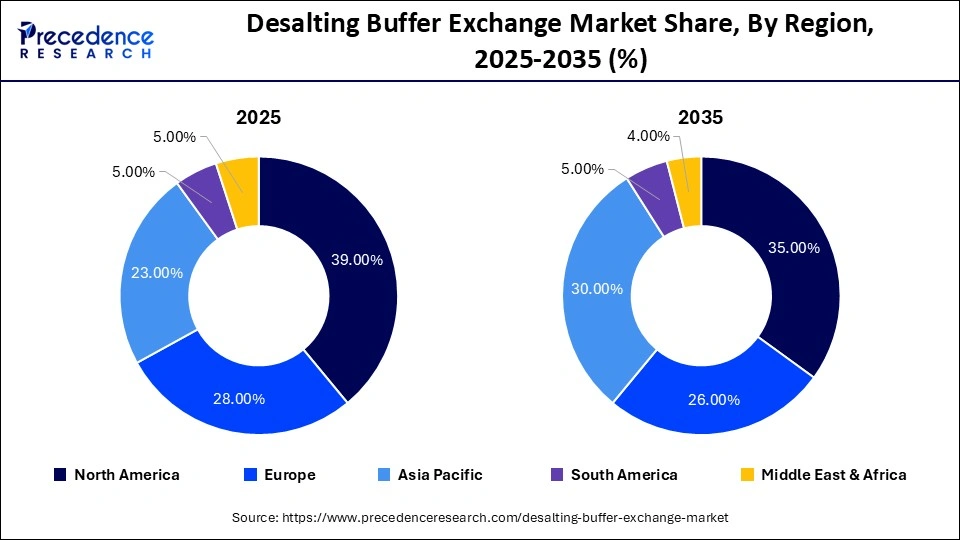
North America dominated the desalting buffer exchange market, capturing the largest share of 39% in 2025. This is mainly due to its robust biopharmaceutical industry. The region benefits from the concentration of leading biopharmaceutical manufacturers and research institutes. The region also hosts a dense network of CDMOs and biotech firms that demand highly controlled desalting and buffer exchange workflows. With the growing investments in R&D, there is an increasing demand for desalting buffer exchange, reinforcing the region's leading position in the market.
U.S. desalting buffer exchange Market Size and Growth 2026 to 2035
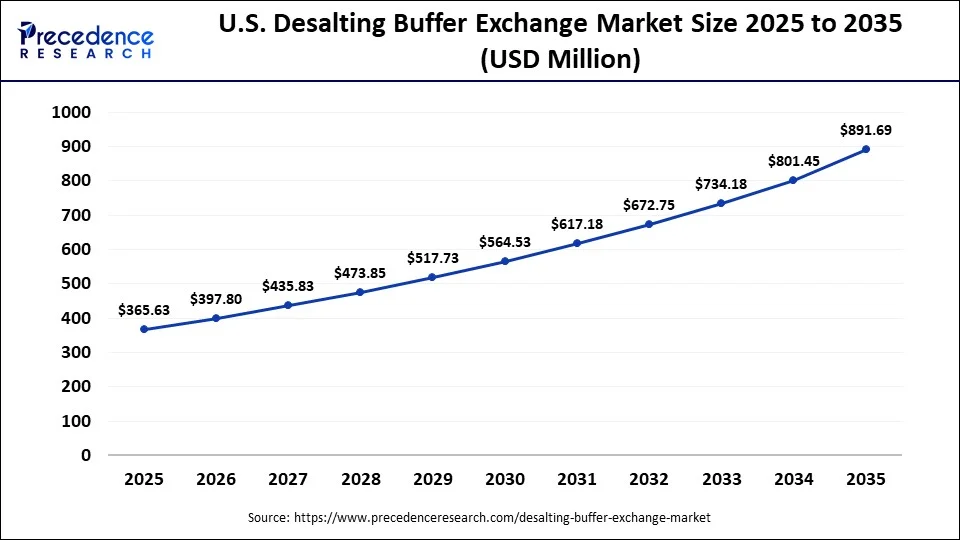
The U.S. desalting buffer exchange market size is calculated at USD 365.63 million in 2025 and is expected to reach nearly USD 891.69 million in 2035, accelerating at a strong CAGR of 9.32% between 2026 and 2035.
U.S. Market Analysis
The U.S. leads the North American desalting buffer exchange market, supported by major biopharma hubs in Massachusetts and California and the ongoing expansion of advanced downstream processing infrastructure. According to the Biotechnology Innovation Organization, the U.S. accounted for over 40% of biologics in development worldwide in 2025. This strong biologics pipeline drives significant demand for purification technologies, including desalting systems and buffer exchange solutions.
Europe: The Second-Largest Shareholder in the Market
Europe held a 28% share of the market in 2025 and is expected to grow at a significant rate during the forecast period, driven by a structured regulatory environment and the continuous expansion of biologics manufacturing capabilities. Standardized processes are essential to ensure reproducibility and consistent quality. As a result, the region is recognized for producing reliable and standardized systems for both desalting and buffer exchange operations.
Germany Anchor Bioprocessing Innovation in Europe
Germany is a major contributor to the desalting buffer exchange market in Europe, due to its strong pharmaceutical manufacturing base and advanced engineering capabilities. In 2025, the European Federation of Pharmaceutical Industry Associations indicated that Germany is one of the largest areas of pharmaceutical manufacturing companies. This is expected to continue to support the significant demand for efficient desalting and buffer systems at manufacturing facilities.
Asia Pacific: The Fastest-Growing Region
Asia Pacific is expected to grow at the fastest rate during the projection period, driven by the rapid expansion of biologics manufacturing capacity in emerging economies. In 2025, Samsung Biologics reported a total production capacity exceeding 600,000 liters, ranking it among the five largest global biologics producers. The accelerating construction of bioprocessing facilities in the region is further increasing the demand for efficient desalting and buffer exchange technologies.
China Market Analysis
In China, the market is driven by aggressive scaling of biologics manufacturing infrastructure and strong government support. Numerous domestic biopharma companies are rapidly increasing production capacity to fulfill both domestic and international demand. Additionally, the significant investment being made in facilities capable of large-scale manufacturing further creates a high demand for efficient downstream processing technologies, such as desalting and buffer exchange.
Desalting Buffer Exchange Market Companies
- Agilent Technologies, Inc.
- Avantor, Inc.
- Bio-Rad Laboratories, Inc.
- Cytiva (Danaher Corporation)
- GE Healthcare (Cytiva)
- Merck KGaA
- Pall Corporation
- PerkinElmer, Inc.
- Promega Corporation
- Qiagen N.V.
- Repligen Corporation
- Sartorius AG
- Shimadzu Corporation
- Takara Bio Inc.
- Thermo Fisher Scientific Inc.
Recent Developments
- In March 2026, DuPont expanded its WAVE PRO platform by integrating reverse osmosis and nanofiltration capabilities, creating a unified system that combines ultrafiltration, ion exchange, RO, and NF for advanced water treatment modeling across industrial and desalination applications.(Source: https://www.prnewswire.com)
- In March 2026, Energy Recovery Inc. launched the PX Q650 Pressure Exchanger, a next-generation energy recovery device engineered to deliver higher flow capacity, improved efficiency, and reduced mixing for large-scale desalination operations. (Source: https://energyrecovery.com)
- In October 2026, QUA, part of Aquatech International, unveiled EDR-Q, an advanced electrodialysis reversal technology developed for high-recovery desalination, water reuse, and specialized process applications, further strengthening its membrane technology portfolio.(Source: https://quagroup.com)
Segments Covered in the Report
By Product
- Columns
- Spin Columns
- Gravity Columns
- Prepacked Columns
- Membrane Filters
- Ultrafiltration Membranes
- Dialysis Membranes
- Kits & Reagent
- Buffer Exchange Kits
- Desalting Reagents
By Technique
- Size Exclusion Chromatography (SEC)
- Dialysis
- Ultrafiltration
- Precipitation Methods
By Application
- Protein Purification
- Recombinant Proteins
- Antibody Purification
- Nucleic Acid Purification
- DNA/RNA Cleanup
- Drug Development
- Biologics Development
- Vaccine Development
- Others
- Diagnostics
- Proteomics Research
By End User
- Pharmaceutical & Biotechnology Companies
- Biopharma Manufacturers
- Vaccine Producers
- Academic & Research Institutes
- Universities
- Research Labs
- Contract Research Organizations (CROs)
By Region
- North America
- Latin America
- Europe
- Asia-pacific
- Middle and East Africa
For inquiries regarding discounts, bulk purchases, or customization requests, please contact us at sales@precedenceresearch.com
Frequently Asked Questions





Ask For Sample
No cookie-cutter, only authentic analysis – take the 1st step to become a Precedence Research client
 Get a Sample




 sales@precedenceresearch.com
 Schedule a Meeting
