


Europe Gene Synthesis Research Use Market Size, Key Companies, Company Market Share, Patient Volume, Treatment Adoption Rates, Pricing Analysis, Regulatory Landscape, Competitive Positioning, and Demand Forecast
Deepa Pandey a Healthcare Industry Expert, highlights that the Europe gene synthesis research market has reached USD 631.99 million in 2026 and is on track to reach USD 2,258.29 million by 2035, advancing at a CAGR of 15.20%. Key XXX market companies shaping the market include Twist Bioscience Corporation, Thermo Fisher Scientific Inc. (GeneArt), GenScript Biotech Corporation Azenta Life Sciences (GENEWIZ), while major growth segments span end user, service type, synthesis method, application.
Source: https://www.precedenceresearch.com/europe-gene-synthesis-research-market
 Get a Sample
 Table Of Content


Europe Gene Synthesis Research Use Market Size, Share and Forecast 2026-2035
The Europe gene synthesis research use market is estimated at USD 631.99 million in 2026 and is projected to reach USD 2,258.29 million by 2035, expanding at a CAGR of 15.20% from 2026 to 2035.
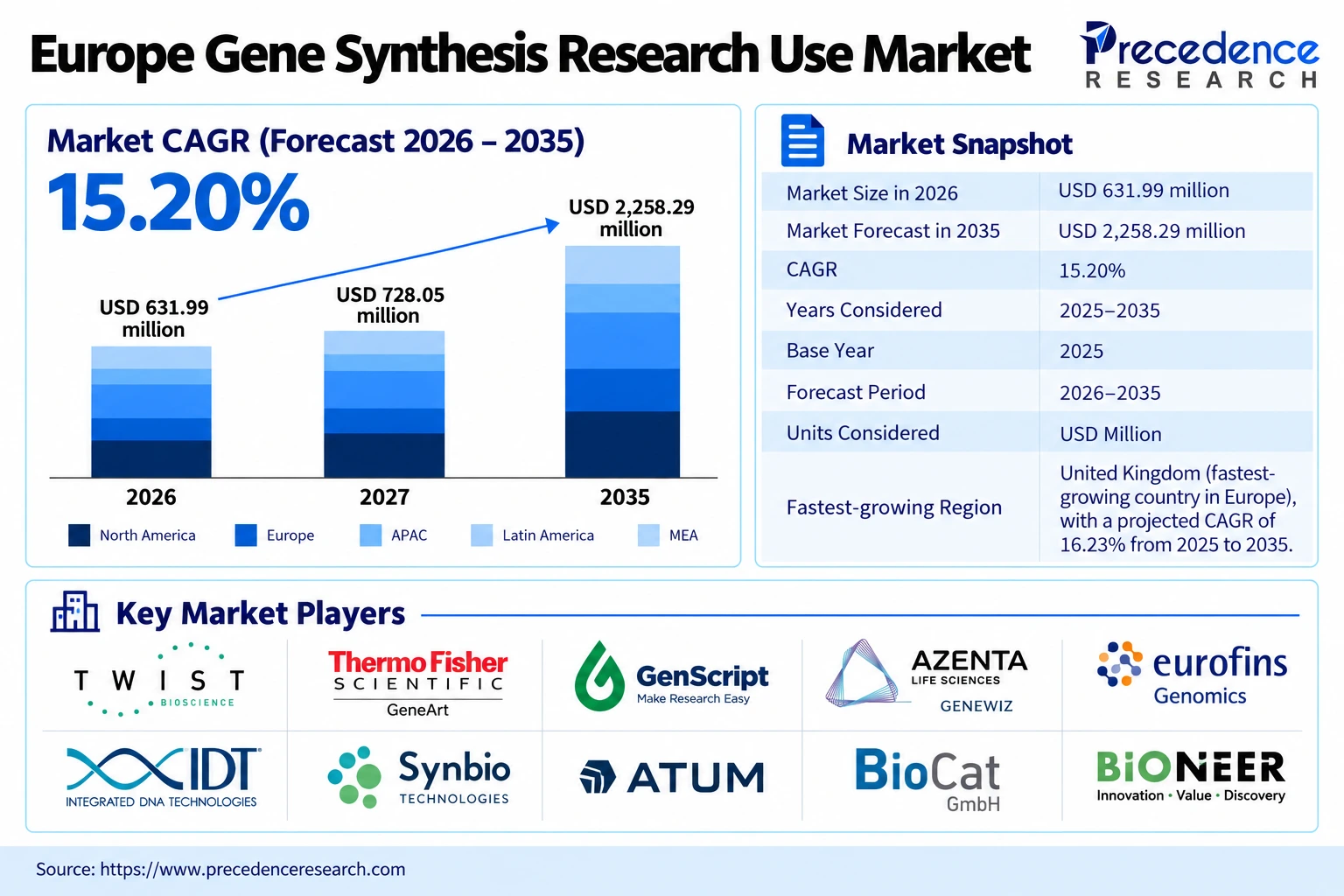
Key Takeaways
Market Size & Growth Outlook
- Market size in 2026: USD 631.99 million
- Estimated market size in 2027: USD 728.05 million
- Projected market size by 2036: USD 2,258.29 million
- CAGR (2026-2035): 15.20%
Regional Market Spotlight
- Germany led the market with a 22.40% (USD 122.89 million) share in 2025.
- United Kingdom accounted for 20.60% (USD 113.01 million) of the market in 2025 and is projected to be the fastest-growing country, at a CAGR of 16.23% from 2025 to 2035.
- France accounted for 13.30% (USD 72.96 million) of the market in 2025.
Segmental Spotlight
- By end user, Biopharmaceutical & Biotechnology Companies accounted for 47.20% (USD 258.94 million) in 2025.
- By service type, Standard Genes accounted for 44.30% (USD 243.03 million) in 2025.
- By synthesis method, Solid-Phase Chemical Synthesis accounted for 71.60% (USD 392.80 million) in 2025.
- By application, Antibody & Protein Engineering accounted for 31.40% (USD 172.26 million) in 2025.
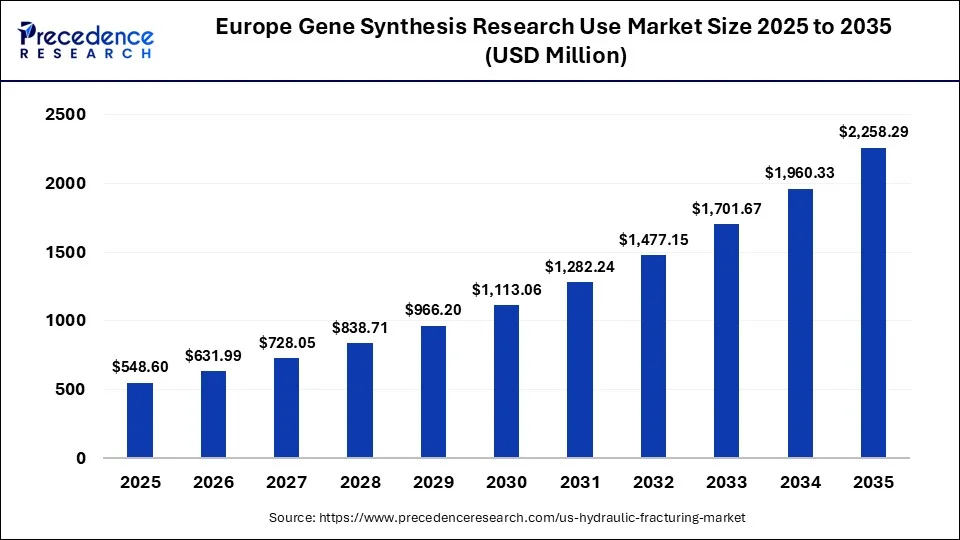
Europe Gene Synthesis Research Use Market Size and Forecast, 2025-2035 (USD Million)
The market was valued at USD 548.60 million in 2025. It covers custom synthetic genes, gene fragments, variant libraries, and complex DNA constructs supplied to academic, biopharmaceutical and contract research laboratories for research purposes. Biopharmaceutical and biotechnology companies accounted for the largest end-user share in 2025, at 47.20%, because antibody, vaccine and cell and gene therapy programs order large volumes of custom DNA. Germany accounted for 22.4% of revenue in 2026, supported by its large life science research base and gene synthesis production sites. Demand is driven by antibody and protein engineering, synthetic biology, AI-guided protein design and falling prices per base pair. Gene synthesis screening guidance, faster turnaround services and enzymatic synthesis technologies are reshaping how European researchers source DNA.
Sources: Expert interviews, secondary sources, Precedence Research database and Precedence Research analysts.
The Europe gene synthesis research use market is projected to grow from USD 631.99 million in 2026 to USD 2,258.29 million by 2035. European laboratories order synthetic genes and libraries instead of cloning DNA in-house because antibody engineering, synthetic biology, and AI-designed proteins require many custom sequences. Falling prices per base pair widen use, while longer and more complex constructs raise value per order, lifting the market to USD 1,113.06 million by 2030 and sustaining a CAGR of 15.20% from 2026 to 2035.
- Analyst View: We built the estimate from the volume of synthetic DNA ordered by European research customers, measured in base pairs by product type, multiplied by average prices for standard genes, fragments, libraries, and complex constructs. Volume assumptions draw on the number of active research groups, biopharma R&D programs, and synthetic biology companies in each country. The total was cross-checked against the European revenues of leading suppliers and against published global estimates with Europe's typical share. The growth rate reflects strong volume growth from protein engineering and AI-driven design, partly offset by continued declines in price per base pair.
Market Trends
- AI-guided protein design increases the number of sequences ordered per project.
- Gene fragments and variant libraries are gaining share over cloned genes.
- Enzymatic DNA synthesis enables longer and more accurate constructs.
- Biosecurity screening of synthetic DNA orders is becoming standard practice.
- Faster turnaround services are becoming a key competitive factor.
- Benchtop DNA synthesizers are emerging for in-lab production of short sequences.
Drivers, Restraints and Opportunities
Driver: Antibody engineering, vaccine research, and synthetic biology all depend on large numbers of custom DNA sequencing. AI-guided protein design multiplies the number of variants researchers want to test. Falling prices per base pair make synthetic DNA cheaper than cloning, so labs outsource more of their DNA work.
Restraint: Price per base pair keeps falling, which limits revenue growth even as volumes rise. Long, repetitive or GC-rich sequences remain hard and slow to synthesize. Research budgets in some European countries are under pressure, and biosecurity screening adds compliance cost for providers.
Opportunity: Enzymatic synthesis and long-DNA technologies open premium services for complex constructs. Synthetic biology companies in food, chemicals, and materials create new commercial demand. Providers with local European production can offer faster delivery and stronger data security to biopharma customers.
Market Segmentation: 2025 Share and Value
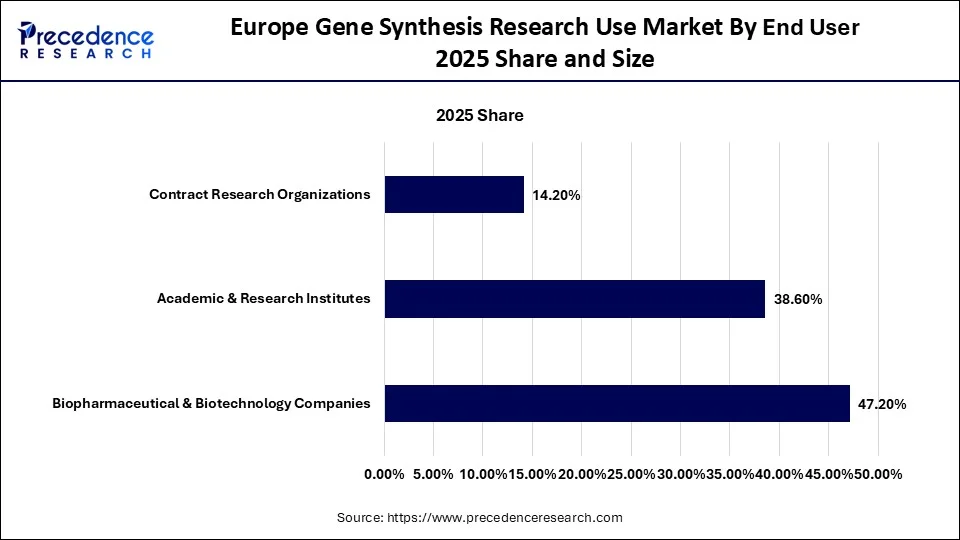
Europe Gene Synthesis Research Use Market by End User 2025 Share & Size
Sources: Expert interviews, secondary sources, Precedence Research database and Precedence Research analysts.
Biopharmaceutical and biotechnology companies accounted for 47.20% (USD 258.94 million) in 2025. Antibody discovery, vaccine design, and cell and gene therapy programs order large volumes of custom genes and libraries. Academic and research institutes, at 38.60% (USD 211.76 million), remain a broad base of demand from university labs and research centers, while contract research organizations, at 14.20% (USD 77.90 million), grow as biopharma outsources discovery work. Biopharma demand is gaining share as AI-guided design increases the number of sequences tested per program.
Europe Gene Synthesis Research Use Market By Service Type 2025 Share & Size
| Segments | 2025 Share | 2025 Market Value |
| Standard Genes | 44.30% | USD 243.03 million |
| Gene Fragments | 22.60% | USD 123.98 million |
| Variant & Mutant Libraries | 15.40% | USD 84.48 million |
| Complex & Long Genes | 10.90% | USD 59.80 million |
| Antibody & Viral DNA Constructs | 6.80% | USD 37.30 million |
Note: 2025 is the base year.
Sources: Expert interviews, secondary sources, Precedence Research database and Precedence Research analysts.
Standard genes accounted for 44.30% (USD 243.03 million) in 2025because cloned, sequence-verified genes remain the most common order. Gene fragments, at 22.60% (USD 123.98 million), are gaining share as researchers assemble constructs themselves for speed and cost, while variant and mutant libraries, at 15.40% (USD 84.48 million), grow with protein engineering and AI design. Complex and long genes account for 10.90% (USD 59.80 million) and antibody and viral DNA constructs for 6.80% (USD 37.30 million), where difficult sequences command higher prices.
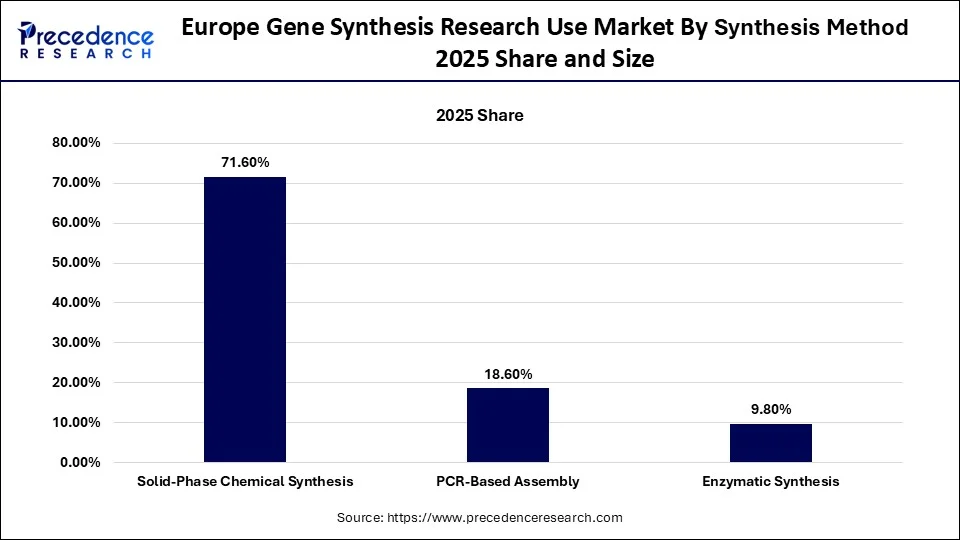
Europe Gene Synthesis Research Use Market by Synthesis Method 2025 Share & Size
Sources: Expert interviews, secondary sources, Precedence Research database and Precedence Research analysts.
Solid-phase chemical synthesis accounted for 71.60% (USD 392.80 million) in 2025 because phosphoramidite chemistry remains the industrial standard for oligonucleotide production. PCR-based assembly, at 18.60% (USD 102.04 million), is used to build longer genes from shorter oligos, while enzymatic synthesis, at 9.80% (USD 53.76 million), is gaining share as new methods promise longer, more accurate DNA with fewer hazardous chemicals.
Europe Gene Synthesis Research Use Market by Application 2025 Share & Size
| Segments | 2025 Share | 2025 Market Value |
| Antibody & Protein Engineering | 31.40% | USD 172.26 million |
| Vaccine & Gene Therapy Research | 22.60% | USD 123.98 million |
| Synthetic Biology & Metabolic Engineering | 19.80% | USD 108.62 million |
| Genetic & Genomic Research | 14.80% | USD 81.19 million |
| Molecular Diagnostics Development | 11.40% | USD 62.54 million |
Note: 2025 is the base year.
Sources: Expert interviews, secondary sources, Precedence Research database and Precedence Research analysts.
Antibody and protein engineering accounted for 31.40% (USD 172.26 million) in 2025, supported by therapeutic antibody discovery and enzyme optimization. Vaccine and gene therapy research, at 22.60% (USD 123.98 million), grows with mRNA and viral vector development, while synthetic biology and metabolic engineering, at 19.80% (USD 108.62 million), expand with bio-based chemicals and food ingredients. Genetic and genomic research accounts for 14.80% (USD 81.19 million) and molecular diagnostics development for 11.40% (USD 62.54 million).
- Analyst View: Segment values were allocated by mapping research activities to the DNA products they use and weighting by base-pair volume and price. Biopharma leads because therapeutic programs order more and longer sequences than academic labs, and standard genes lead because most users still prefer cloned, verified constructs. We expect gene fragments, variant libraries and enzymatic synthesis to gain share as AI-driven protein design increases sequence counts and researchers prioritize speed.
Country Analysis
Europe Gene Synthesis Research Use Market by Country 2025 Share & Size
| Country | 2025 Share | 2025 Market Value |
| Germany | 22.40% | USD 122.89 million |
| United Kingdom | 20.60% | USD 113.01 million |
| France | 13.30% | USD 72.96 million |
| Switzerland | 8.40% | USD 46.08 million |
| Nordics | 7.10% | USD 38.95 million |
| Italy | 6.20% | USD 34.01 million |
| Netherlands | 6.10% | USD 33.46 million |
| Spain | 5.40% | USD 29.62 million |
| Rest of Europe | 10.50% | USD 57.60 million |
Note: 2025 is the base year.
Sources: Expert interviews, secondary sources, Precedence Research database and Precedence Research analysts.
Germany accounted for 22.40% (USD 122.89 million) in 2025, growing on its large academic research base, biopharma industry and gene synthesis production sites. The United Kingdom, at 20.60% (USD 113.01 million), grows fastest on biofoundries, AI protein design start-ups and strong research funding, while France, at 13.30% (USD 72.96 million), expands on vaccine and biotech research. Switzerland, at 8.40% (USD 46.08 million), and the Nordics, at 7.10% (USD 38.95 million), are high-spend biopharma hubs, while Italy, the Netherlands and Spain each account for between 5% and 7% of demand.
Germany accounted for 22.40% (USD 122.89 million) in 2026. Major research institutes, biopharma companies and gene synthesis sites in Regensburg, Ebersberg and Leipzig support demand.
The United Kingdom accounted for 20.60% (USD 113.01 million) in 2026 and is the fastest-growing country. Biofoundries, AI protein design companies and national screening guidance for synthetic DNA support demand.
France accounted for 13.30% (USD 72.96 million) in 2025. Vaccine research, biotech clusters and enzymatic DNA synthesis developers drive demand.
Switzerland accounted for 8.40% (USD 46.08 million) in 2025. Large pharmaceutical R&D centers in Basel and research universities drive high-value orders.
The Nordics accounted for 7.10% (USD 38.95 million) in 2025. Industrial biotechnology and enzyme companies in Denmark and life science research in Sweden support demand.
Italy accounted for 6.20% (USD 34.01 million) in 2025. Academic research and gene therapy development support demand.
The Netherlands accounted for 6.10% (USD 33.46 million) in 2025. Biotech clusters and synthetic biology companies drive orders.
Spain accounted for 5.40% (USD 29.62 million) in 2025. Growing research funding and biotech start-ups support demand.
The Rest of Europe accounted for 10.50% (USD 57.60 million) in 2025. Belgium, Austria, Ireland and Central and Eastern European research centers add steady demand.
- Analyst View: Country shares were built from research spending, the number of life science research groups and biopharma R&D activity in each country, adjusted for the location of supplier sites. Germany and the UK lead because they combine large research bases with strong biopharma sectors. We assign the UK the highest growth premium because its bio foundries, AI protein design companies and clear screening guidance support rapid growth in synthetic DNA orders.
Top 10 Companies in the Europe Gene Synthesis Research Use Market
| Rank | Company Name | Market-Specific Revenue (USD Million) | 2025 Share | Key Products / Business | Headquarters |
| 1 | Twist Bioscience Corporation | 61.5 | 11.21% | Gene fragments, clonal genes and variant libraries | United States |
| 2 | Thermo Fisher Scientific Inc. (GeneArt) | 58 | 10.57% | GeneArt gene synthesis and strings DNA fragments | United States |
| 3 | GenScript Biotech Corporation | 52.4 | 9.55% | Gene synthesis, mutagenesis and library services | China |
| 4 | Azenta Life Sciences (GENEWIZ) | 46.4 | 8.46% | GENEWIZ gene synthesis services | United States |
| 5 | Eurofins Genomics | 42.3 | 7.71% | Gene synthesis and oligonucleotide services | Germany |
| 6 | Integrated DNA Technologies | 39.4 | 7.18% | gBlocks gene fragments and custom genes | United States |
| 7 | Synbio Technologies | 10.5 | 1.91% | Gene synthesis and molecular biology services | United States |
| 8 | ATUM | 8.3 | 1.51% | Gene synthesis and expression vector services | United States |
| 9 | BioCat GmbH | 7 | 1.28% | Gene synthesis services for European customers | Germany |
| 10 | Bioneer Corporation | 5.2 | 0.95% | Gene synthesis and oligonucleotides | South Korea |
Note: Company revenues and shares are 2025 estimates.
Sources: Company press releases, expert interviews, secondary sources, Precedence Research database and Precedence Research analysts.
Twist Bioscience led the Europe gene synthesis research use market with an estimated 11.21% (USD 61.50 million) of 2025 revenue, followed by Thermo Fisher Scientific at 10.57% (USD 58.00 million) and GenScript at 9.55% (USD 52.40 million). Twist Bioscience leads through low-cost silicon-based synthesis of gene fragments and libraries, Thermo Fisher through its GeneArt gene synthesis operations in Germany, and GenScript through broad gene synthesis and mutagenesis services. The top 10 companies accounted for an estimated 60.34% (USD 331.00 million) of 2025 revenue, while the remaining 39.66% (USD 217.60 million) was shared among regional gene synthesis providers, academic core facilities and smaller service companies. Competition centers on turnaround time, price per base pair and the ability to deliver long or complex sequences, while enzymatic synthesis developers and benchtop DNA printers are emerging as new competitors.
Recent Developments
- October 2025: Ansa Biotechnologies raised USD 54.4 million in Series B financing to expand its enzymatic DNA synthesis service, including a guaranteed on-time delivery offering.
- November 2025: Twist Bioscience reported fiscal 2025 revenue of USD 376.6 million and noted the launch of CE-marked, IVDR-compliant products for European customers.
Market Segments
By End User
- Biopharmaceutical & Biotechnology Companies
- Academic & Research Institutes
- Contract Research Organizations
By Service Type
- Standard Genes
- Gene Fragments
- Variant & Mutant Libraries
- Complex & Long Genes
- Antibody & Viral DNA Constructs
By Synthesis Method
- Solid-Phase Chemical Synthesis
- PCR-Based Assembly
- Enzymatic Synthesis
By Application
- Antibody & Protein Engineering
- Vaccine & Gene Therapy Research
- Synthetic Biology & Metabolic Engineering
- Genetic & Genomic Research
- Molecular Diagnostics Development
By Country
- Germany
- United Kingdom
- France
- Switzerland
- Nordics
- Italy
- Netherland
- Spain
- Rest of Europe
Research Methodology
The Europe gene synthesis research use market was defined as custom synthetic genes, gene fragments, variant libraries, and complex DNA constructs supplied for research use in Europe, excluding GMP-grade DNA for clinical manufacturing, counted at supplier level. The 2025 base year was built bottom-up from synthetic DNA volumes in base pairs by product type and average prices and checked top-down against the European revenues of leading gene synthesis suppliers. Segment, country, and company values were allocated from research activity by application, national research spending, and supplier portfolios. Key estimates were verified by cross-checking company disclosures, regulatory and industry data, and published third-party estimates, and inputs that could not be reconciled were excluded. All segment, regional and company figures were integrated to the same 2025 base year, and the 2026-2035 forecast, which applies a constant CAGR from the 2025 base, was recalculated and validated.
Analyst View: Overall Market
Gene synthesis in Europe is shifting from a specialist service to everyday research infrastructure, as labs replace in-house cloning with ordered DNA. Our estimate links demand to base-pair volumes and prices by product type, so the forecast captures both rising volumes and falling unit prices. The strongest growth comes from protein engineering, AI-guided design, and synthetic biology. The main risks are price erosion, research funding pressure, and tighter biosecurity rules that raise compliance costs.
Sources and References
- UK Government (gov.uk). "UK screening guidance on synthetic nucleic acids". 2024-10. Screening expectations for synthetic DNA users and providers. https://www.gov.uk/government/publications/uk-screening-guidance-on-synthetic-nucleic-acids
- Council on Strategic Risks. "New gene synthesis screening guidance in the UK". 2024-10-10. Context on UK screening guidance. https://councilonstrategicrisks.org/2024/10/10/new-gene-synthesis-screening-guidance-in-the-uk-a-positive-step-towards-responsible-innovation/
- Ansa Biotechnologies (Business Wire). "Ansa Biotechnologies secures USD 54.4 million in Series B financing". 2025-10-01. Enzymatic DNA synthesis financing and service launch. https://www.businesswire.com/news/home/20251001701666/en/Ansa-Biotechnologies-Secures-54.4-Million-in-Series-B-Financing-to-Redefine-How-Scientists-Access-Synthetic-DNA-with-Industry%E2%80%99s-First-Guaranteed-On-Time-Service
- Twist Bioscience (SEC EDGAR). "Form 10-K, fiscal year 2025". 2025-11. Fiscal 2025 revenue and European product launches. https://www.sec.gov/Archives/edgar/data/1581280/000158128025000025/twst-20250930.htm
For inquiries regarding discounts, bulk purchases, or customization requests, please contact us at sales@precedenceresearch.com
Frequently Asked Questions





Ask For Sample
No cookie-cutter, only authentic analysis – take the 1st step to become a Precedence Research client
 Get a Sample
.webp)



 sales@precedenceresearch.com
 Schedule a Meeting