



Fluorescence Resonance Energy Transfer (FRET) Market Size, Share and Trends 2026 to 2035
Fluorescence Resonance Energy Transfer (FRET) Market (By Type: Instruments (Microscopes/Readers/Detectors), Consumables (Dyes/Probes/Kits), Software & Services; By Technique/Technology: FRET (Standard) Technology, Time-Resolved FRET (TR-FRET), Single-Molecule FRET, Other FRET Variants; By Application: Drug Discovery & Screening, Protein-Protein/Biomolecular Interaction Analysis, Cell Biology & Signaling Studies, Diagnostics & Biosensors; By End-User: Pharmaceutical & Biotech Companies, Academic & Research Institutes, Contract Research Organizations, Clinical & Diagnostic Labs) - Global Industry Analysis, Size, Trends, Leading Companies, Regional Outlook, and Forecast 2026 to 2035
Source: https://www.precedenceresearch.com/fluorescence-resonance-energy-transfer-market
 Get a Sample
 Table Of Content
What is the Fluorescence Resonance Energy Transfer (FRET) Market Size?
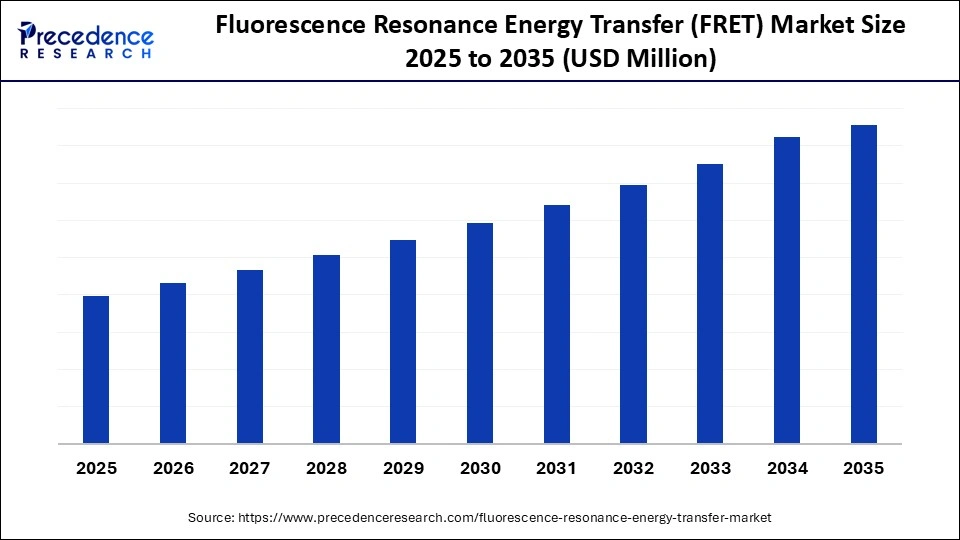
The global fluorescence resonance energy transfer (FRET) market enables precise analysis of protein interactions and cellular processes. It enhances accuracy in life sciences research The FRET is renowned as a reliable method to visualize the molecular interactions of proteins and nucleic acids, and is extensively applied in molecular biology research and development.
Market Highlights
- North America dominated the fluorescence resonance energy transfer (FRET) market in 2025, with a market share of 45%.
- Asia Pacific is expected to grow at the fastest CAGR of 9.0% in the market during the forecast period.
- By type, the instruments segment dominated the market in 2025, with a revenue share of approximately 55%.
- By type, the consumables segment in the market is expected to grow at the fastest CAGR of 7.5% in the market during the forecast period.
- By technique/technology, the FRET technology segment dominated the market in 2025, with a revenue share of approximately 50%.
- By technique/technology, the time-resolved FRET segment is expected to grow at the fastest rate of 7.6% in the market in 2025.
- By application, the drug discovery & screening segment dominated the fluorescence resonance energy transfer (FRET) market in 2025, with a revenue share of approximately 45%.
- By application, the cell biology & signaling studies segment is expected to grow at the fastest rate of 7.8% in the market in 2025.
- By end-user, the pharmaceutical & biotech companies segment dominated the market in 2025, with a revenue share of approximately 50%.
- By end-user, the contract research organizations (CROs) segment is expected to grow at the fastest CAGR of 8.0% in the market during the forecast period.
Market Overview
Fluorescence Resonance Energy Transfer (FRET) is a biophysical mechanism where energy transfers non-radiatively from an excited donor fluorophore to a nearby acceptor fluorophore, highly sensitive to nanometer-scale proximity (1-10 nm). It serves as a molecular “spectroscopic ruler” to detect molecular interactions, protein conformational changes, and biosensor responses in real time, making it indispensable in life sciences research, drug discovery assays, and biomedical diagnostics for quantifying biomolecular interactions and dynamic cellular processes.
The FRET technology is widely utilized in light-emitting devices, spanning biosensors and organic photovoltaics. The fluorescence resonance energy transfer (FRET) market is shifting towards nanotechnology, integration of nanomaterials, automation, AI, and renewable energy sectors. The FRET remains an excellent standard for research studies across biotechnology, pharmaceuticals, medical diagnostics, environmental monitoring, and next-generation displays.
How does AI Revolutionize the Market?
Artificial intelligence is contributing to overcoming technical barriers in FRET, and it enhances the sensitivity and specificity of FRET-based biosensing platforms. AI plays a vital role in FRET biosensor design and optimization, and the expansion of the fluorescence resonance energy transfer (FRET) market. It helps to predict performance, detect patterns of interference, and optimize FRET composition and linker design. AI is also crucial in drug discovery and therapeutics, including high-throughput screening, mechanism characterization, and interaction visualization. Deep learning algorithms are trained for image reconstruction, which recreates high-quality images.
What are the Market Trends?
- FRET-based Biosensors: These are powerful diagnostic tools that are used to explore various biological pathways and processes at the molecular level. Fluorophores present in FRET biosensors enable the energy transfer, which gives the ability to act as a probe to detect biomolecules. It also gives valuable information about the biological processes that boost the importance of the fluorescence resonance energy transfer (FRET) market.
- Neurodegenerative Disease Monitoring: Nanobiosensors have been proven to be promising solutions for the early diagnosis of neurodegenerative diseases such as Alzheimer's and Parkinson's. They offer a non-invasive and cost-effective approach to detect disease biomarkers at ultra-low concentrations. They utilize the high specificity and sensitivity of nanotechnology to resolve the challenges in the early diagnosis of neurodegenerative disorders.
Market Scope
| Report Coverage | Details |
| Dominating Region | North America |
| Fastest Growing Region | Asia Pacific |
| Base Year | 2025 |
| Forecast Period | 2026 to 2035 |
| Segments Covered | Type, Technique/Technology, Application, End-User, and Region |
| Regions Covered | North America, Europe, Asia-Pacific, Latin America, and Middle East & Africa |
Segmental Insights
Type Insights
How does the Instruments Segment Dominate the Market in 2025?
The instruments segment dominated the fluorescence resonance energy transfer (FRET) market in 2025 with a revenue share of approximately 55%, owing to their critical role in high-throughput screening, single-molecule resolution, enhanced quantitation, and time-resolved FRET. The industries focus on technical instrument requirements to meet specific optical and sensitivity criteria for effective FRET measurements. Some of the leading instruments in the broad portfolio include filter-based systems, advanced detectors, two emission filters, and FRET with FLIM instrumentation.
The consumables segment is expected to grow at the fastest CAGR of 7.5% in the fluorescence resonance energy transfer (FRET) market during the forecast period due to a rising demand for assay kits, high-specificity fluorophores, and specialized laboratory supplies. Reagents and kits serve as the critical consumables for FRET applications. The major areas of research on consumables are sustainability, eco-friendly products, smart and connected consumables, point-of-care integration, and supply chain resilience.
Technique/Technology Insights
What made FRET Technology the Dominant Segment in the Market in 2025?
The FRET technology segment dominated the fluorescence resonance energy transfer (FRET) market in 2025 with a revenue share of approximately 50%, owing to potential advancements in technology, including nanomaterial integration, enhanced precision, photostability, and hyperbolic metamaterials. The FRET technology plays a leading role in research and medicine, contributing to drug discovery, pathogen detection, disease diagnostics, and cellular imaging. The emerging innovations like CRISPR integrated sensors, multiplexed imaging, single-molecule FRET, and point-of-care diagnostics are gaining traction in the market.
The time-resolved FRET segment is estimated to grow at the fastest rate of 7.6% in the fluorescence resonance energy transfer (FRET) market during the predicted timeframe due to its key role in protein interaction analysis, drug discovery, clinical diagnostics, and pathogen and cancer detection. The technological innovations include AI-driven analytics, multiplexed labelling, ultra-miniaturization, and new probes. There is a rapid shift of laboratories towards recyclable microplates and lower-volume kits to meet the industrial goals of reducing single-use plastic waste by 20-30% by 2030.
Application Insights
How did the Drug Discovery & Screening Segment Dominate the Market in 2025?
The drug discovery & screening segment dominated the fluorescence resonance energy transfer (FRET) market in 2025 with a revenue share of approximately 45%, owing to the primary role of FRET in high-throughput screening, time-resolved FRET, live-cell two-hybrid screening, single-molecule FRET, and next-gen probes and materials. FRET impacts various phases of drug discovery, such as target validation, primary screening, mechanistic study, and in-vivo evaluation. This technology focuses on crucial research areas such as cancer therapy, personalized medicine, and neurodegeneration.
The cell biology & signaling studies segment is anticipated to grow at the fastest rate of 7.8% in the fluorescence resonance energy transfer (FRET) market during the upcoming period due to advancements in cell biology studies, which include nanometer-precision mapping, multicolor and cascade FRET, and AI-driven analysis. FRET plays a vital role in signaling pathways and metabolism, including mechanotransduction and metabolic monitoring. FRET has wide applications in drug discovery and diagnostics, which bring real-time drug efficacy, enable pathogen detection, and allow automated screening.
End-User Insights
Why did the Pharmaceutical & Biotech Companies Segment dominate the Market in 2025?
The pharmaceutical & biotech companies segment dominated the fluorescence resonance energy transfer (FRET) market in 2025 with a revenue share of approximately 50%, owing to the integration of FRET for drug discovery, target validation, nanomedicine, pharmacokinetics, and more. FRET-based PCR is a standard approach in R&D for rapid and high-sensitivity detection of pathogens and toxicity diagnostics. One-step FRET assays are performed for real-time monitoring of therapeutic monoclonal antibodies (mAbs).
The contract research organizations (CROs) segment is predicted to grow at a rapid rate of 8.0% in the fluorescence resonance energy transfer (FRET) market during the studied period due to a rapid shift of pharmaceutical companies towards high-throughput and no-wash assays. The adoption of these assays reduces experimental failure rates and cycle times. The regulatory and industrial pressure is enabling the adoption of lower-volume reagent kits and recyclable microplates, which further drives sustainability.
Regional Insights
How does North America dominate the Market in 2025?
North America dominated the fluorescence resonance energy transfer (FRET) market in 2025 with a revenue share of approximately 45%, owing to increased investments in R&D and advancements in imaging infrastructure, biotechnology, and drug discovery. In August 2025, the U.S. Department of Energy (DOE) announced over $35 million for 42 research projects to advance emerging energy technologies through DOE's Technology Commercialization Fund. These emerging technologies are related to AI, nuclear energy, grid security, and advanced manufacturing from plants, sites, and national laboratories of the DOE.
U.S. Fluorescence Resonance Energy Transfer (FRET) Market Analysis
The rise of personalized medicine, oncology research, domestic manufacturing, and improved supply chain drives the market in the U.S. In September 2025, the U.S. Department of Energy (DOE) announced $134 million in funding for two research and development programs that are specifically designed to advance the U.S. leadership in emerging fusion technologies through targeted research and innovation.
What is the Potential of the Fluorescence Resonance Energy Transfer (FRET) Market in the Asia Pacific?
Asia Pacific is expected to grow at the fastest CAGR of 9.0% in the market during the forecast period due to the expansion of the biopharmaceutical and biotechnology sector, growth in drug discovery and screening, and a surge in research funding. This regional government has launched many biotechnology and research initiatives that fund and integrate FRET technology for biosensors, clinical diagnostics, and pharmaceutical research. The national synthetic biology initiative of South Korea targets bio-manufacturing innovation with the aim of boosting domestic biotechnology.
India Fluorescence Resonance Energy Transfer (FRET) Market Trends
The supportive government policies for precision biotherapeutics, growth of startups, and the rising biotechnology bio-economy are expanding the market in India. India has implemented many high-budget frameworks that boost the development of advanced sensing and biotechnology.
How does Europe advance with a Notable Position in the Market?
Europe is expected to grow at a notable rate in the fluorescence resonance energy transfer (FRET) market, owing to a supportive research ecosystem and European initiatives promoting sustainability. In December 2025, the European Commission announced €1.8 billion of modernisation fund for new clean energy investments, which will bring the 5-year total to over €20 billion. The European Commission aims to establish a predictable and innovation-friendly regulatory framework for the nuclear fusion power industry.
Germany Market Analysis
The rising demand for live cell imaging, incentives for local research, and legislative reforms targeting medical innovation expand the Fluorescence Resonance Energy Transfer (FRET) market in Germany. In September 2024, the European Commission provided financing support for research on single-molecule detection and super-resolution imaging with an adaptable and portable 3D-printed microscopy platform.
Who are the Major Players in the Global Fluorescence Resonance Energy Transfer (FRET) Market?
The major players in the fluorescence resonance energy transfer (FRET) market include Thermo Fisher Scientific, Danaher Corporation/Molecular Devices, PerkinElmer Inc., Agilent Technologies, Bio-Rad Laboratories, GE Healthcare/Cytiva, Merck KGaA (MilliporeSigma), Olympus Corporation, Nikon Corporation, Leica Microsystems (Danaher), Tecan Group, Horiba Scientific, Beckman Coulter (Danaher), Bruker Corp., and Becton, Dickinson & Company.
Recent Developments
- In June 2025, Agilent Technologies Inc. announced its plans to introduce its new products and innovations, including the latest hybrid multisampler and the new LC single quadrupole mass spectrometers, at the HPLC 2025 conference in Belgium. These innovations are made to deliver superior results and boost laboratory efficiency. These products are expected to streamline operations and enhance analytical outcomes.(Source: https://www.investor.agilent.com)
- In December 2025, GE Healthcare introduced advanced imaging solutions powered by NVIDIA technology, including Pristina Recon DL, Photonova Spectra, SIGNA Bolt, SIGNA Sprint with Freelium, and Vivid Pioneer. These systems are launched to support timely diagnoses and streamlined clinical workflows.
(Source: https://investor.gehealthcare.com)
Segments Covered in the Report
By Type
- Instruments (Microscopes/Readers/Detectors)
- Consumables (Dyes/Probes/Kits)
- Software & Services
By Technique/Technology
- FRET (Standard) Technology
- Time-Resolved FRET (TR-FRET)
- Single-Molecule FRET
- Other FRET Variants
By Application
- Drug Discovery & Screening
- Protein-Protein/Biomolecular Interaction Analysis
- Cell Biology & Signaling Studies
- Diagnostics & Biosensors
By End-User
- Pharmaceutical & Biotech Companies
- Academic & Research Institutes
- Contract Research Organizations (CROs)
- Clinical & Diagnostic Labs
By Region
- North America
- Europe
- Asia-Pacific
- Latin America
- Middle East & Africa
For inquiries regarding discounts, bulk purchases, or customization requests, please contact us at sales@precedenceresearch.com
Frequently Asked Questions





Ask For Sample
No cookie-cutter, only authentic analysis – take the 1st step to become a Precedence Research client
 Get a Sample




 sales@precedenceresearch.com
 Schedule a Meeting
