



Grid Enhancing Technologies Market Trends, Companies, Revenue / Sales Performance, Subscriber Growth, Pricing Strategies, Cloud Adoption, Infrastructure Expansion, Competitive Landscape, and Industry Outlook
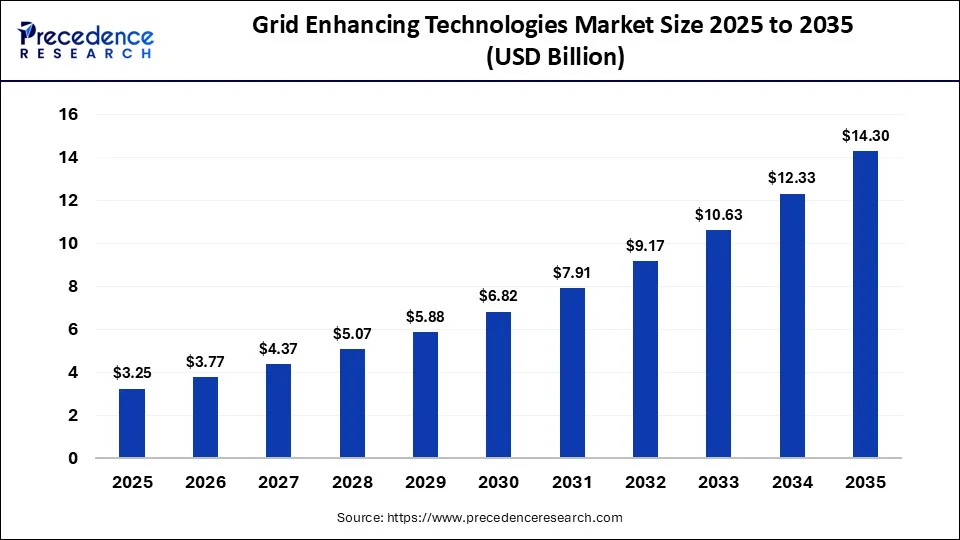
ICT industry specialist Gautam Mahajan estimates the grid enhancing technologies market at USD 3.77 billion in 2026, with continued technology adoption expected to take the market to USD 14.30 billion by 2035 at a CAGR of 15.97%. Leading grid enhancing technologies market providers such as Ampacimon, DNV GL, General Electric (GE) Grid Solutions are expanding their capabilities across segments including technology, component, grid application, deployment model, grid type, voltage level, end user, region.
Source: https://www.precedenceresearch.com/grid-enhancing-technologies-market
 Get a Sample
 Table Of Content


Grid Enhancing Technologies Market Size and Forecast 2026 to 2035
The global grid enhancing technologies market size accounted for USD 3.77 billion in 2026 and is predicted to increase from USD 3.77 billion in 2026 to approximately USD 14.30 billion by 2035, expanding at a CAGR of 15.97% from 2026 to 2035.
Key Takeaways
- By technology, the dynamic line rating (DLR) segment held 24% of market share in 2025.
- By technology, the topology optimization segment held 13% of market share and is expected to grow at the highest CAGR of 18.1% between 2026 and 2035.
- By grid application, the transmission grid segment held a major market share of 32% in 2025.
- By grid application, the congestion management segment held 12% of market share in 2025 and is expected to register the fastest growth of 17.3% CAGR during 2026 and 2035.
- FERC's Order 881 mandates weather-based line ratings, directly forcing utilities toward the grid enhancing technologies market.
- Transmission congestion cost customers over $12 billion in 2024, strengthening the economic case for this optimization sector.
- PJM's interconnection backlog hit roughly 2,600 gigawatts in 2026, fueling urgent demand across the GETs industry.
- DOE committed $1.9 billion in March 2026 toward reconductoring, directly funding growth across the grid modernization space.
- Reconductoring could save consumers $85 billion over a decade, reinforcing long-term value across the grid enhancement market.
Market Size Description
Smart hardware is preferred over the years-long transmission line project in today's world of grid operators. Dynamic line rating systems use real-time weather data along power corridors, as these sensors enable utilities to safely push more power through wires without the danger of overload. Now that operators have cast aside old line ratings that are static, congestion falls off precipitously. Old grid rules require years for interconnection approval of renewable projects. This is a trend toward smarter infrastructure and will pave the way for far-reaching regulation.
The Federal Energy Regulatory Commission took the next step with Order 881, a rulemaking that mandates that transmission owners change line capacities to reflect future weather predictions. FERC Chairman Laura Swett announced in July 2026 that utilities have proactively begun implementing GETs. Such as dynamic line ratings, advanced power flow controllers, and high-performance conductors. She told senators that cost-saving data from such deployments is now available, bolstering the reasons for expanding deployment.
The FERC January 2026 agenda included the use of advanced demand response. The use of dynamic line ratings and emerging cybersecurity technologies was a critical operational priority. Wildfire risk also came into the mix, as FERC asked NERC to consider both predictive AI and dynamic line rating sensors as mitigation measures. PJM Interconnection, the nation's largest grid operator, had previously been asking utilities to prioritize lines that most needed to be upgraded. This facilitates procurement in key U.S. transmission areas. More operators and vendors are waking up to this regulatory signal and are showing greater interest.
Many vendors, including Smart Wires, LineVision and AMPACIMON, are rolling out sensors in utility corridors around the world in North America and Europe. Power Flow Control portfolios for grid operators keep growing for GE Vernova, Siemens Energy, Hitachi Energy and ABB. Dedicated GETs forums for Europe's own transmission operators are held regularly, where they share deployment lessons and technical information. The combination of regulatory, corporate and legislative forces suggests a structurally altered grid by 2035.
Market Snapshot
The valuation of the Grid Enhancing Technologies market stood at USD 3.25 billion in 2025. The compound annual growth rate (CAGR) for the forecast period is estimated to be around 15.97% by analysts. Dynamic line rating is the number one technology segment. The majority of the applications in 2025 were for congestion relief, and this is the primary driver for deployment priorities through 2026. Power flow control is now the fastest growing technology category among the operators
Hardware components like sensors and conductors still command the largest deployment footprint. But software platforms are rapidly closing that gap with faster uptake. Grid enhancing technologies are enabling utilities to meet higher demand for transmission capacity and increased resilience to extreme weather conditions. Federal mandates and aging infrastructure needs continue to propel growth in North America, which is still the region with the fastest growth. The top two end user groups are transmission utilities and independent system operators, which represent an emerging industry-wide strategic evolution.
Strategic Market Insights
While hardware was the primary focus of the grid modernization discussion, that is quickly changing. Utilities are on the hunt for integrated software that combines sensors with predictive analytics. The GET SET initiative enables transmission owners to take a stumbling block-free path to scale advanced power flow control, topology optimization, and dynamic line ratings in concert. Real-time automation enables the operator to respond to changes in loads in seconds instead of days. This is a strategic shift for the sector, with hardware and intelligent software coming together in a significant way.
Analytical tools like sensors and smart meters gather real-time data and enable operators to make informed decisions in a timely fashion. Colorado took a step forward, passing a bill in April 2026 that mandates utilities to evaluate advanced transmission technology, such as topology optimization software. Energy vendors such as Camus Energy and PXiSE Energy Solutions are developing analytics layers on top of the existing grid infrastructure. These software-led approaches create new business avenues for a number of emerging high-growth technology areas.
Commercial Opportunity Highlights
One of the most promising near-term opportunities for vendors is topology optimization. This technology's ability to divert bulk power away from regularly congested regional transmission corridors. Advanced power flow control is next, and it's the power lines that the utilities control and redirect electricity around overloaded lines. Power-flow control devices increase or decrease overall power delivery to achieve overall balance of overloaded lines and underutilized corridors. There is a lot of interest in integrated management platforms that combine these tools into common dashboards.
The promising long-term driver is renewable energy interconnection, as stakeholders are increasingly looking to increase transmission lines on the existing grid instead of constructing new lines. Organizations such as GE Vernova, Hitachi Energy, and Smart Wires are already taking products to market in these overlapping opportunity segments. These all commercial pockets together suggest a new grid that is based on more intelligent software and not on extra steel and copper.
Market Overview
What Are Grid Enhancing Technologies?
Hardware or software devices that squeeze more capacity from existing power lines. They monitor real-time conditions and then instantly adjust the line ratings, power routing, and voltage control. Operators have more visibility of congestion, thermal limits, and equipment health on their networks. These factors provide flexibility and reliability without disturbing any of the newly built transmission towers.
Why Grid Enhancing Technologies Are Becoming Strategically Important
Once in the permitting and land dispute process, it takes years to build new transmission lines, often more than a decade. Utilities are proposing new rights-of-way through communities or protected land, as they face strong local opposition. Capital expenditures are being pushed to their limits by the combination of steel and concrete prices and labor costs associated with traditional growth. Grid enhancing technologies avoid these constraints altogether, bringing capacity improvements in months.
Role of Grid Enhancing Technologies in the Energy Transition
Wind and solar installations tend to be located away from load centers. They are placing additional strain on transmission corridors designed to support older, centralized power generation. These grid technologies help to mitigate that mismatch by rerouting flows and help relieve curtailment when renewables are more plentiful.
Market Scope and Coverage
This study covers the new technologies and advanced conductor technologies, dynamic line rating, and topology optimization throughout the value chain.
This covers hardware, software, and services resources and deployment models, including transmission and distribution networks. Multiple voltage levels from low voltage distribution feeders through high voltage interstate corridors. End users include investor-owned utilities, public power authorities, independent system operators, and industrial grid users in all key regions.
Market Trends
Growing Preference for Optimizing Existing Grid Infrastructure
Instead of constructing new transmission corridors, utilities increasingly enhanced existing lines and substations. Resulting in a decrease in delays and permitting issues. Hitachi Energy focused on increasing the utilization of networks through digital grid solutions in 2025. The operational emphasis naturally helped to increase the rollout of real-time monitoring technology throughout transmission systems.
Rising Deployment of Dynamic Line Rating and Real-Time Grid Monitoring
Dynamic line rating systems became increasingly popular with grid operators. Leveraging weather data, conductor temperature, and sensor data to safely unlock greater transmission capacity. In 2025, LineVision continued to grow its Dynamic Line Rating deployments with prominent North American utilities. These developments also bolstered software-based grid intelligence and optimization solutions.
Increasing Adoption of Software-Defined Grid Management
AI, digital twins, forecasting, and advanced analytics were extended to utilities. Further enhancing the visibility of the grid, operational planning, and automated decision-making. The smartest platforms enhanced the performance of high-end power-flow management systems.
Rising Demand for Advanced Power Flow Control
As congestion grew, the number of transmission operators rolling out more sophisticated power-flow controllers rose to ease network congestion. This enhances stability and maximizes the use of existing network capacity. In 2025, Hitachi Energy further developed its flexible AC transmission (FACT) technologies for the transfer of renewable electricity. There were also gains in rolling out renewable energy integration, which was sped up by these enhancements.
Increasing Need for Faster Renewable Energy Interconnection
Renewable project queues were growing, and utilities were investing in technologies to enhance the grid. Also reducing timelines for connection until new transmission projects were built. PJM Interconnection continued progress on the queue modernization project to ensure projects are incorporated into the system quickly. This factor propelled interest in predictive digital models for long-term grid planning and operations to grow.
Growing Role of Digital Twins and AI in Grid Operations
Digital Twins and predictive AI are becoming common tools for utilities to optimize asset management, maintenance planning, and resilience. These innovations are continuing to enable increasingly adaptive, efficient, and data-driven electricity grid operations.
Market Report Coverage and Key Metrics
| Report Coverage | Details |
| Market Size in 2025 | USD 3.25 Billion |
| Market Size in 2026 | USD 3.77 Billion |
| Market Size by 2035 | USD 14.30 Billion |
| Market Growth Rate from 2026 to 2035 | CAGR of 15.97% |
| Dominating Region | North America |
| Fastest Growing Region | Asia Paicfic |
| Base Year | 2025 |
| Forecast Period | 2026 to 2035 |
| Segments Covered | Technology, Component, Grid Application, Deployment Model, Grid Type, Voltage Level, End User, and Region |
| Regions Covered | North America, Europe, Asia-Pacific, Latin America, and Middle East & Africa |
Market Segmentation Analysis
Technology Insights
Why Did Dynamic Line Rating Dominate the Global Grid Enhancing Technologies Market by Technology?
The dynamic line rating (DLR) segment dominated the market with a share of 24% in 2025, due to increasing renewable electricity connections and grid congestion, operators prioritized technologies that immediately unlocked unused transmission capacity from existing assets.
Grid Enhancing Technologies Market Share, By Technology, 2025 (%)
| Technology | 2025 Share (%) | 2035 Share (%) | CAGR (2025–2035) |
| Dynamic Line Rating (DLR) | 24 | 25 | 16.40% |
| Advanced Power Flow Control (APFC) | 21 | 23 | 17.00% |
| Topology Optimization | 13 | 15 | 18.10% |
| Smart Wires | 12 | 11 | 15.10% |
| Grid-Enhancing Software & Analytics | 18 | 20 | 17.10% |
| Advanced Conductors | 9 | 5 | 9.80% |
| Other Grid Enhancing Technologies | 3 | 1 | 10.50% |
The topology optimization segment held 13% of the market share in 2025 and is expected to grow at the fastest CAGR of 18.1% between 2026 and 2035, driven by utilities increasingly requiring software-driven methods for maximizing network flexibility during changing operating conditions.
Component Insights
Why Did Hardware Dominate the Global Grid Enhancing Technologies Market by Component?
The hardware segment dominated the market with a share of 57% in 2025, due to utilities first investing in physical equipment required for real-time grid monitoring and transmission optimization.
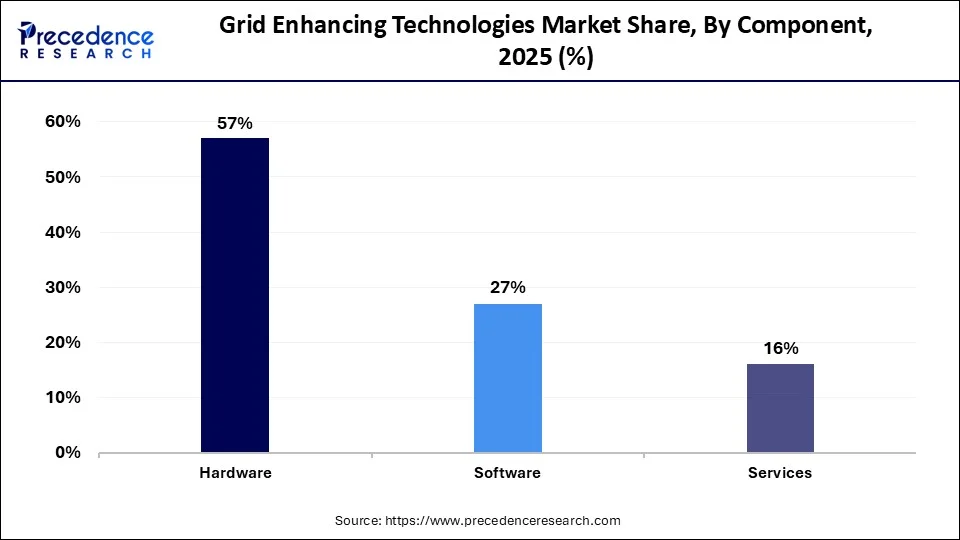
The software segment held a 27% share of the market in 2025 and is expected to grow at the fastest CAGR of 19.1% between 2026 and 2035, driven by an increasing dependence on intelligent platforms for grid visibility, forecasting, and operational optimization.
Grid Application Insights
Why Did Transmission Grid Dominate the Global Grid Enhancing Technologies Market by Grid Application?
The transmission grid segment dominated the market with a share of 32% in 2025, due to its increasing pressure on aging transmission infrastructure, system operators accelerated upgrades that delivered immediate operational improvements with lower implementation timelines.
Grid Enhancing Technologies Market Share, By Grid Application, 2025 (%)
| Grid Application | 2025 Share (%) | 2035 Share (%) | CAGR (2025-2035) |
| Transmission Grid | 32 | 31 | 15.60% |
| Distribution Grid | 22 | 24 | 17.00% |
| Interconnection & Grid Expansion | 16 | 17 | 16.70% |
| Congestion Management | 12 | 13 | 17.30% |
| Renewable Energy Integration | 10 | 10 | 16.00% |
| Grid Resilience & Reliability | 5 | 4 | 13.70% |
| Demand Flexibility & Optimization | 3 | 1 | 10.70% |
The congestion management segment held 12% of market share and is expected to grow at the highest CAGR of 17.3% between 2026 and 2035, owing to the accelerating integration of renewable energy resources, transmission operators increasingly adopted digital optimization platforms that minimized network congestion without major infrastructure expansion.
Deployment Model Insights
Why Did Standalone Deployment Dominate the Global Grid Enhancing Technologies Market by Deployment Model?
The standalone deployment segment dominated the market with a share of 42% in 2025, as utilities widely selected standalone solutions that integrated into existing transmission operations with limited disruption.
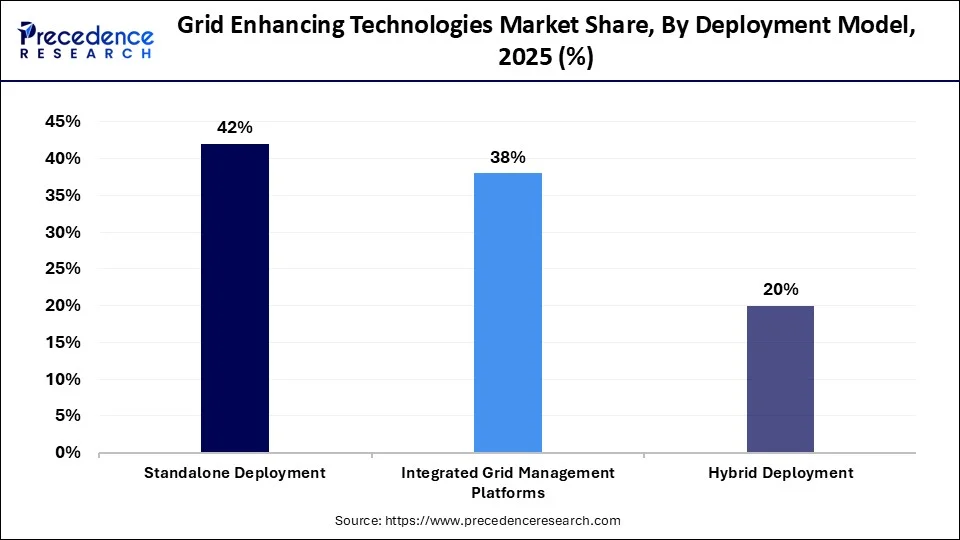
The integrated grid management platforms segment held a 38% share of the market in 2025 and is expected to grow at the fastest CAGR of 18.1% between 2026 and 2035, driven by rapid expansion of utility digitalization strategies, with operators increasingly investing in integrated software ecosystems supporting renewable integration and real-time grid optimization.
Grid Type Insights
Why Did AC Grid Dominate the Global Grid Enhancing Technologies Market by Grid Type?
The AC grid segment dominated the market with a share of 78% in 2025, owing to the widespread presence of high-voltage AC transmission assets.
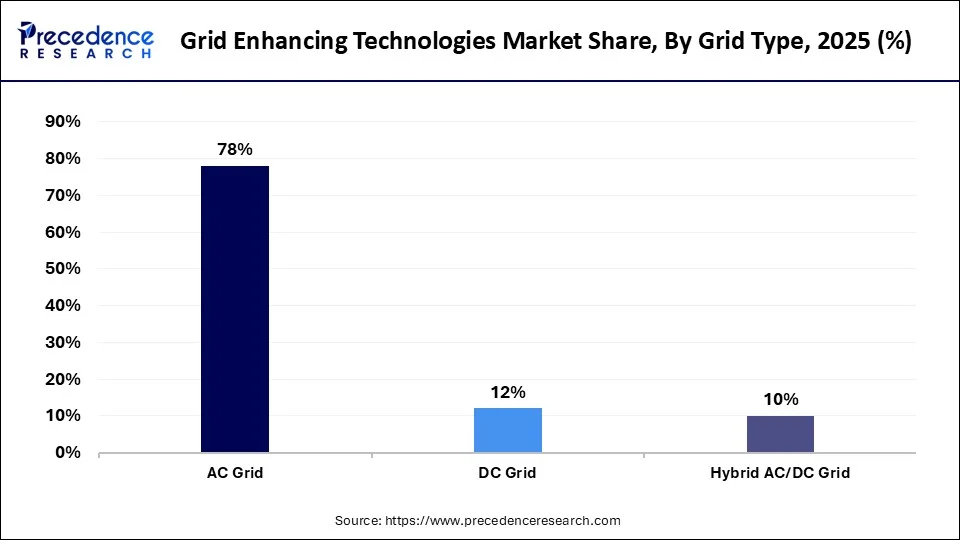
The DC grid segment held a 12% share of the market in 2025 and is expected to grow at the fastest CAGR of 19.3% between 2026 and 2035, driven by the growing investment in advanced DC grid technologies and intelligent control platforms.
Voltage Level Insights
Why Did High Voltage Dominate the Global Grid Enhancing Technologies Market by Voltage Level?
The high voltage segment dominated the market with a share of 36% in 2025, due to expanding modernization of high-capacity transmission infrastructure.
Grid Enhancing Technologies Market Share, By Voltage Level, 2025 (%)
| Voltage Level | 2025 Share (%) | 2035 Share (%) | CAGR (2025-2035) |
| Low Voltage | 8 | 7 | 14.50% |
| Medium Voltage | 22 | 23 | 16.70% |
| High Voltage | 36 | 35 | 15.50% |
| Extra-High Voltage | 34 | 35 | 16.30% |
The medium voltage segment held a 22% share of the market in 2025 and is expected to grow at the fastest CAGR of 16.7% between 2026 and 2035, driven by operators increasingly upgrading medium-voltage infrastructure using digital grid solutions.
End User Insights
Why Did Transmission System Operators (TSOs) Dominate the Global Grid Enhancing Technologies Market by End User?
The transmission system operators (TSOs) segment dominated the market with a share of 32% in 2025, due to the increasing demand for transmission modernization.
Grid Enhancing Technologies Market Share, By End User, 2025 (%)
| End User | 2025 Share (%) | 2035 Share (%) | CAGR (2025-2035) |
| Transmission System Operators (TSOs) | 31 | 30 | 15.40% |
| Distribution System Operators (DSOs) | 22 | 25 | 17.50% |
| Utilities | 20 | 19 | 15.20% |
| Renewable Energy Developers | 10 | 12 | 18.20% |
| Independent Power Producers (IPPs) | 7 | 6 | 13.90% |
| Industrial & Commercial Energy Consumers | 6 | 5 | 13.80% |
| Government & Regulatory Authorities | 4 | 3 | 12.50% |
The renewable energy developers segment held 10% of market share in 2025 and is expected to grow at the fastest CAGR of 18.2% between 2026 and 2035, driven by the expanding wind and solar projects that increasingly depend on efficient transmission access and faster grid connections.
Market Dynamics
Market Drivers
Accelerating Renewable Energy Deployment
Coal or gas-fired unit output is constant, whereas wind and solar vary from hour to hour. To absorb these swings without reducing the amount of clean power, grid operators must have real-time visibility. Rather than new lines, grid enhancing technologies increase the capacity and reliability of current lines at a faster and lower cost. The amount of renewable energy that a region can connect and utilize is now dependent on flexible network management.
Rapid Electrification of Transport, Industry, and Buildings
US electricity demand will rise from 4,097 billion kWh in 2024 to 4,283 billion kWh in 2026. The Lawrence Berkeley National Laboratory (LBNL) estimates that electricity usage in data centers will increase by 13% to 27% per year until 2028. For heat pumps, EV charging, and reshored manufacturing, circuits are getting increasingly overloaded. By 2034, national electricity demand is projected to increase by 16%, and by 2040 by 31%.
Aging Transmission and Distribution Infrastructure
There are more than 600,000 miles of US transmission lines, with more than two-thirds over 25 years old. These aged assets are over-burdened with loads and weather events beyond their original design. The deployment of sensors and monitoring tools to understand the health of assets and thermal limits in real time is becoming common practice in utilities.
Delays and High Costs Associated with Conventional Grid Expansion
In 2026, the US interconnection backlog reached approximately 2,600 GW. The median transmission project time on queue grew to over five years. Majority of queued projects end up being withdrawn due to unanticipated delays and high grid upgrade costs. Grid enhancing technologies provide an alternative route for developers and utilities to navigate these permitting and construction challenges, one that is quicker and less expensive.
Market Restraints
Complex Integration with Legacy Grid Infrastructure
The lack of interoperability is a challenge in many places on the grid where mixed-vendor equipment and legacy substations are installed. In 2025, Siemens Energy and GE Vernova further developed retrofit solutions. But tackling decades-old assets was still challenging. The barriers to compatibility also revealed that the industry lacked specialized engineering skills.
Limited Awareness and Technical Expertise
Talent was also limited for utilities in the areas of AI, digital twins, advanced protection systems, and grid optimization software. Bigger workforce constraints also complicated investment decisions in the changing regulatory environment.
Unclear Regulatory and Cost-Recovery Frameworks
Projects were delayed by many utilities as regulators set different rules for investment recovery of grid-enhancing technologies and digital platforms. These uncertainties also raised concerns about cybersecurity and protecting digital infrastructure.
Cybersecurity and Data Protection Risks
Modern electricity networks and operational technology (OT) have increased the attack surface caused by cloud platforms and intelligent sensors. In 2025, Schneider Electric beefed up its industrial cybersecurity capabilities, and Palo Alto Networks added additional defenses for critical infrastructure. As utilities continue to increase the amount of digital and AI-enabled grid operations, stronger cyber resiliency will continue to be a necessity.
Market Opportunities
Grid Optimization as an Alternative to Conventional Transmission Expansion
This is a trend towards more sensor and software solutions than years-long transmission construction projects, particularly in the utility sector. Planners are now considering whether HVDC, FACTS, HTS, and multi-terminal DC can fit the actual system constraints. This mixed fleet can provide operators with the flexibility of selecting the appropriate technology for the specific bottleneck, instead of relying on new lines.
Expansion of Integrated Grid Management Platforms
Individual sensors and individual controllers are being replaced by a single platform with all sensors and controllers consolidated on one. Operators desire dashboards that bring together dynamic line rating information with power-flow control and automated dispatching decisions. The platform consolidation trend that is giving vendors the real opportunity to create end-to-end, interoperable grid management systems.
Growth in Renewable Energy Interconnection Solutions
Regional ISO market structure and utility planning practices now become a key factor in interconnection outcomes, rather than queue position. Developers waiting for lots of queues to be processed have become another customer base for vendors claiming to provide quicker grid access for GETs. Companies assisting renewable projects to avoid years of study delays reap disproportionately high commercial value in this context.
Increasing Demand for Software and Analytics
Utilities are moving away from one-off hardware purchases, and towards recurring software subscriptions. Managed-service models enable operators to leave optimization tasks to experts in the analytics arena rather than establishing their own teams. These are the fastest-growing commercial opportunities in the industry, as the industry evolves toward software and managed analytics services.
Emerging Opportunities in Hybrid AC/DC Networks
VSC-HVDC with MMC topology is able to control active and reactive power, even in weak AC networks. Currently, the most common application for HVDC and hybrid AC/DC grid interconnection is offshore wind integration. Invenergy has teamed with contractors Quanta and Kiewit to install 5,000MW of controllable HVDC capacity in four states as part of the Grain Belt Express project. As distributed energy resources continue to increase in number, a key challenge is coordinating these hybrid architectures.
Market Challenges
Demonstrating Measurable Grid Performance Improvements
It's difficult for utilities to demonstrate measurable improvements in transmission capacity and congestion under alternate operating conditions. There is still little standardisation of performance evaluation, which complicates investment choices and technology comparison.
Long Procurement Cycles in the Utility Sector
The prolonged technical reviews and regulatory clearance process slow down the technology procurement process in electricity transmission projects. Public tendering procedures are also used to further extend deployment timelines prior to commercial use.
Interoperability Across Multiple Grid Technologies
High degree of engineering coordination and system validation is required to integrate old machines with new software and communication systems. There are still differences in protocols and vendor technologies that are limiting seamless grid modernization efforts.
Grid Enhancing Technologies Market Ecosystem Analysis
Grid Technology Value Chain
The physical layer of the ecosystem is composed of sensors, conductors, and power flow controllers. They are manufactured by the component suppliers. On top of that hardware comes software that adds analytics, forecasting, and automation. The technology integrators then bring utilities, transmission system operators, distribution system operators, renewable developers, and regulators together as one working system.
Role of Grid Operators and Utilities
Transmission and distribution operators make the decision on which technologies to test and validate. Then ultimately scale across their networks. In 2026, utilities should incorporate multi-year Multi-vendor supply contracts and incorporate technologies that improve the grid into the core reliability planning. Dynamic line rating serves as a quick, short-term solution in addition to the USD 4 billion in transmission upgrades National Grid is pursuing in New York. Procurement teams are asking for independent performance data more and more before investing in new vendor platforms.
Role of Renewable Energy Developers and IPPs
Interconnection requests are the lifeline of independent power producers, and how quickly utilities can process these requests and release spare generation capacity. The new cycle-based process at PJM will call for developers to demonstrate site control and financial readiness much sooner. The faster a network can be accessed, the more rapidly the project is likely to be economical. This will help to speed up the time it takes to go from financial close to revenue generation. Developers are increasingly putting their trust in corridors with GETs, as these projects are not dependent on years-long waiting periods associated with the traditional network upgrade.
Role of Regulators and Government Agencies
About a dozen states are relying on regulatory sandbox programs to speed up their review process. This is typically a year, but has been reduced to months for these modular technologies. In 2026, the Department of Energy (DOE) announced that it will invest approximately USD 1.9 billion in infrastructure investment through its SPARK program. Cost recovery is still lagging in many states, with utilities remaining uncertain about full cost recovery. The need to establish clear standards and predictable incentives is still very relevant before the wider regulatory landscape fully embraces the procurement of GETs.
Partnerships and Ecosystem Collaboration
Great River Energy, Minnesota Power, and Xcel Energy created GridReady with Grid Catalyst to match emerging technology startups with real-world utility pilot opportunities. The programme is designed for companies with TRL 7+, and applications will be accepted until 26th June 2026. Co-development of a platform between engineering companies and software firms, instead of selling prefabricated products, has become more common with utility partners.
Grid Capacity and Congestion Analysis
Transmission Congestion Drivers
Wind and solar projects are frequently located at remote sites from their end-users. The realization of today's power networks' full potential relies more on cutting-edge grid-enhancing technologies, which ease binding operational constraints. EPRI estimates total electric power demand will increase by 30% to 46% from 2020 to 2035. This geographic misalignment of supply and demand continues to steadily raise congestion costs in each of the key interconnection regions.
Distribution Network Capacity Constraints
Industry surveys show that grid capacity is currently the top constraint to charging network growth in 2026. A 2026 model study showed that the grid limits they maintain saw a potential coverage loss of 19% when compared to a grid with no limit. Rooftop solar, home batteries, and uncoordinated EV charging add loads to local feeders and transformers. They were not designed to handle two-way power flow. These areas of congestion are becoming as critical as anything else on the bulk transmission system, particularly for utilities.
Grid Enhancement Versus Conventional Expansion
Even traditional transmission construction can take years to get permission, site, and construct over contested land corridors. EV charging infrastructure can be installed in one to two years. On the other hand, new transmission projects may take several years to plan, permit, and build. Grid enhancing technologies close that timeline gap dramatically, often reaching operational status within months instead of years.
Capacity Utilization Improvement Potential
A single managed charging alone has been proven to boost existing PD hosting capability by 1.3 to 2.3 times. It's comparable, both on the transmission side of the grid, in terms of utilization gains. These are achievable through dynamic line rating, advanced power flow control, and topology optimization. Smart Wires devices take this concept a step further. They also allow operators to reroute power around congestion points without the costly curtailment that used to be a reality.
Technology and Innovation Landscape
Dynamic Line Rating Technology
Improved simulations of the thermal capacity of the transmission corridors. This includes wind and temperature data, as well as solar data, which are updated in real-time from weather sensors located along the transmission corridor. Then, software is used to continuously recalculate safe line ratings and replace the conservative static limits that were set decades ago. Smart Wires' network-wide dynamic line rating solution does not require hardware on each circuit. They detect spare capacity beyond static thermal ratings and meets FERC Order 881 requirements.
Advanced Power Flow Control
Smart Wires' SmartValve technology applies controlled voltage to the device to divert electric power from overloaded lines to spare capacity. The San Jose deployment provided PG&E with 100 MW of immediate transfer capability relief and reduced thermal overloads by up to 34% on PG&E's limiting facility.
Topology Optimization
Automated software reroutes bulk power flows away from chronically congested corridors by changing the connections between substations and breakers. This configuration reconfiguration occurs in real-time without having to touch a single physical wire or structure. Dynamic line rating is part of the process of a line getting modernized, but not a standalone solution.
Smart Wires and Network Optimization Technologies
Arvind Krishna was appointed Chief of Engineering at Smart Wires in July 2026 as the demand for data centres and electrification increases. The company seeks to expand its SmartValve deployments. Prior to the deployment of 48 SmartValves, the estimated capacity of the north-south capacity was an additional 2 gigawatts. They are used with analytics platforms to optimize power flow through a combined hardware or software solution, which is becoming more common.
Grid-Enhancing Software and Analytics
One hyperscaler has integrated PJM grid telemetry into its own scheduling systems. Further, working with two utilities to help save on AI usage during grid stress. OATI would like to see that GETs are not deployed on a line-by-line basis but throughout regional networks. Complementing these platforms are digital twins and forecasting tools, which help to inform dispatch decisions.
Advanced Conductors
TS Conductor's manufacturing facility in South Carolina launched a USD 134 million investment in May 2026. Further ramping up the supply of Aluminum-Encapsulated Carbon Core conductor. California and Massachusetts are just two states that currently mandate that utilities conduct a formal evaluation of advanced conductors prior to the construction of new lines.
Component and Business Model Analysis
Hardware Market Structure
Smart Wires puts SmartValve as the main hardware product, providing for firm capacity control with a capacity of 12-18 months after deployment. The physical infrastructure of sensors and monitoring equipment continues to be the backbone in most utility buying budgets. Despite the growing focus on the software that is running on top of the hardware layer it is still very important.
Software Market Structure
EPRI's Open Power AI Consortium includes utilities including Southern California Edison. This is addressing issues with data sharing that will help to speed up the digitalization of the grid. Forecasting engines, digital twins, and optimization platforms are now becoming more prevalent, complementing, and not replacing, hardware. Additionally, the grid management platforms are vying with one another on interoperability because utilities do not want to become dependent on a single-vendor's hardware.
Services Market Structure
Consulting, implementation, integration, and management services are also becoming a big investment in utilities to realize the full value of new software solutions. More engineering companies are grouping together interconnection studies, planning support, and system integration into one package of services. These service layers can enable utilities to close the gap between acquiring new technology and predictable operation on a large scale.
Shift Toward Recurring Software and Service Revenue
By 2027, the majority of utilities will upgrade their asset management infrastructure to deliver continuous power service, according to ISG. Subscription and managed-service pricing is growing in popularity with vendors for more than just equipment sales. That dependency on data, in turn, is a strong incentive toward a recurring revenue model. It is driving the whole Gets system slowly toward platform-based, subscription-driven business models.
Grid Modernization Investment Analysis
Utility Capital Expenditure Priorities
As utilities continue to allocate capital in ways that balance the traditional approach of building poles and wires with the quicker-deploying digitalization tools, costs are rising. Renewables interconnection projects vie for the same limited engineering and construction budget as optimization software. The technologies being chosen are increasingly ones that can free up capacity within months. They maintain flexibility with capital to be used for larger, longer-term transmission projects.
Public and Government Infrastructure Investment
In early 2026, the Department of Energy secured its largest loan ever to provide customers of Georgia Power and Alabama Power with more than $7 billion in savings. On March 12, 2026, DOE announced a $1.9 billion funding opportunity for transmission reconductoring and advanced technology deployment separately. These multiple federal and state programs are layered and demonstrate a long-term public-sector approach. They are not one-time initiatives.
Private Investment and Strategic Capital
In July 2026, National Grid Ventures made a groundbreaking strategic investment in Joulent, a Houston-based energy infrastructure firm. This is valued at a staggering $1.75 billion. Ten-year grid optimization wait times have come up as a major concern for many investors. Making it a leading venture category. Rather, grid technology has become the fundamental industrial capacity rather than a side bet for infrastructure and strategic corporate investors.
Investment Attractiveness by Technology
The highest recurring-revenue value lies with software and analytics platforms. Utilities pay on an ongoing basis. By 2026, dynamic line rating has reached well beyond the early pilot phase, and topology optimization is also in a fairly high commercialization stage. On the other hand, the investment appeal of the advanced conductors and hybrid AC/DC architectures is mitigated by the heavier investments needed for initial engineering and deployment time. They also provide larger scalability.
Regulatory and Policy Landscape
Grid Modernization Regulations
SB 1006 was passed in California, which mandates utilities to consider all transmission lines that may be reconducted using advanced conductors. Massachusetts was next with S.2967, which requires new transmission projects to seriously evaluate ATTs. This wave of state and federal bills is continuing to turn grid digitization from a voluntary pilot project into a mandated planning process.
Renewable Interconnection Policies
FERC Order 2023 was aimed at moving away from a first-come, first-served approach to serial studies and toward a cluster-based, first-ready, first-served approach. In November 2025, Grid Strategies published a forecast for the United States. This will require over 150 GW of new capacity in 2030 to meet demand. These reforms have direct impacts on the demand for GETs. Because the quicker the cycle, the quicker the reward for proof of spare capacity to the utilities.
Utility Cost-Recovery Mechanisms
In July 2026, FERC's Chairman, Laura Swett, announced the Commission's formation of a task force to examine incentives for the adoption of grid-enhancing technology. Many state commissions continue to have unclear cost-recovery frameworks, and it is unclear if GET spending will be fully recovered. Predictable recovery rules rather than funding availability are driving up adoption speed, as regulators realize this.
Standards and Interoperability Requirements
Because utilities won't allow single-vendor solutions for multi-decade infrastructure. Vendors are creating hardware and software based on interoperability standards. Adequate technical standards continue to be a key element for the successful, scalable expansion of GETs into neighbouring utility areas and regional transmission operators.
Cybersecurity and Critical Infrastructure Requirements
In January 2026, NERC released a CIP Roadmap that reflects new cyber and physical threats that are related to increased grid digitalization. As the cybersecurity requirements become more stringent, Connected sensors and software that power GETs need. That meet these demands before being fully deployed for use by utilities.
Pricing and Commercial Economics Analysis
Technology Cost Structure
The aluminium-encapsulated carbon core conductors only incur a slight premium relative to the standard conductors in total project costs. Significant portion of total GETs spending is going toward software licensing, system integration, and continuous support. Most GETs solutions utilize existing towers, rights-of-way, and substations to keep maintenance costs low.
Total Cost of Ownership
In a recent MDU reconductoring project, the team opted to not modify any structures, thus avoiding an estimated 40% of the construction costs compared with traditional methods. Initial capital investment remains low compared to building new transmission, and life-cycle operating costs are low. This incremental upfront premium for advanced conductors is more than made up for, and then some, at the full project level. Twenty years of total cost of ownership (TCO) is increasingly being used by utilities as a metric instead of just sticker price.
Return on Investment Analysis
Using Grid Strategies' calculations, $12 billion+ or more in 2024 was lost by US customers to transmission congestion. The application of new conductors to existing U.S. transmission lines could yield cost savings of up to $85 billion to consumers over the next 10 years and quadruple the level of capacity increases. These are not only efficiency gains, but also the real savings GETs are bringing through avoided congestion costs and quicker renewable interconnection.
Technology Adoption Economics by End User
Transmission system operators justify GETs spending through congestion relief across their highest-value interstate corridors. Active load management is an increasing preference for distribution system operators. This can delay distribution system upgrades by up to a decade by managing load away from thermal limits. Renewable developers have the biggest economic advantage, as years long interconnection queues can be reduced significantly with the help of GETs.
Customer Buying Behavior and Procurement Analysis
Key Technology Purchasing Criteria
Utility decision makers are often left with little more than trust of the vendor to address concerns about cost and real-world economic benefits. The majority of utility purchasing teams rate capacity improvement and implementation speed as their top priorities when it comes to purchasing.
Utility Procurement Process
The engineering side of the technical evaluation usually begins with engineering staff. They creating models of how much capacity they expect to increase at a utility's congestion points. These programs can include startups at TRL 7, where technology has been demonstrated in a relevant environment and above. Those pilots that have succeeded then progress through the regulatory process before the utility embarks on a wide-scale rollout in their wider transmission or distribution network.
Renewable Developer Purchase Drivers
The interconnection outcome is increasingly based on ISO market structure and planning practices of utilities rather than queue position on interconnection. Developers are attracted to GETs-enabled corridors in particular because the faster connectivity means that the project financing is quicker and better. This change has led renewable developers to increasingly prefer utilities that already track. They have experience with GETs adoption over those that are only using traditional queue processing.
Importance of Demonstration Projects
The Department of Energy outlined a six to 12 GETs template project that can be rolled out in three to six months. While VELCO's SmartValve project is fast, by the standards of utilities, the project is not expected to be up and running until the end of 2026 or the beginning of 2027. These are early demonstrations that provide credible, practical data from the utility sector and not just vendors. Those who succeed with their pilots are increasingly the key to getting a technology from perpetual trial into real commercialization.
Market Regional Analysis: North America, Europe, Asia-Pacific
Why Did North America Dominate the Global Grid Enhancing Technologies Market?
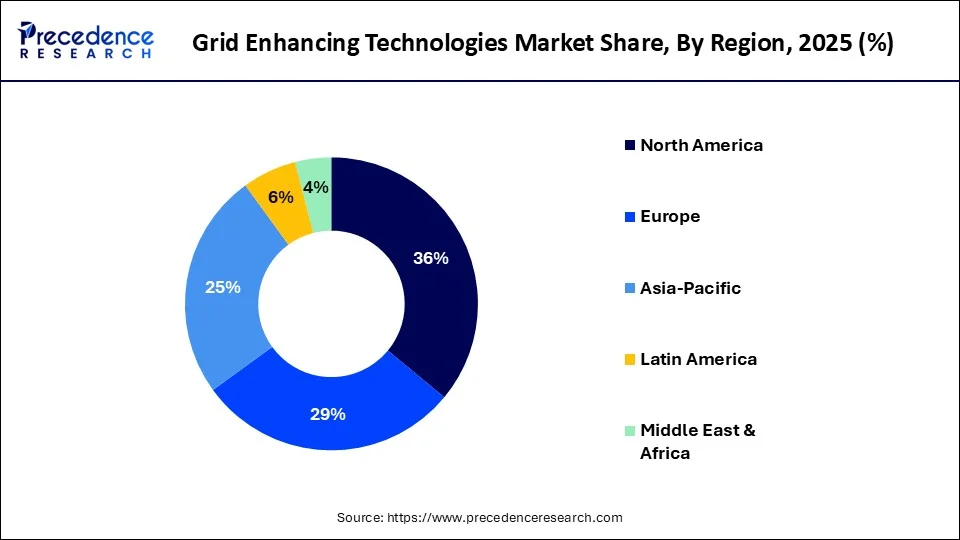
North America led the market, capturing the largest revenue share in 2025, accounting for an estimated 36%, due to the rising electricity demand from data centers.
U.S. Grid Enhancing Technologies Market Size and Growth 2026 to 2035
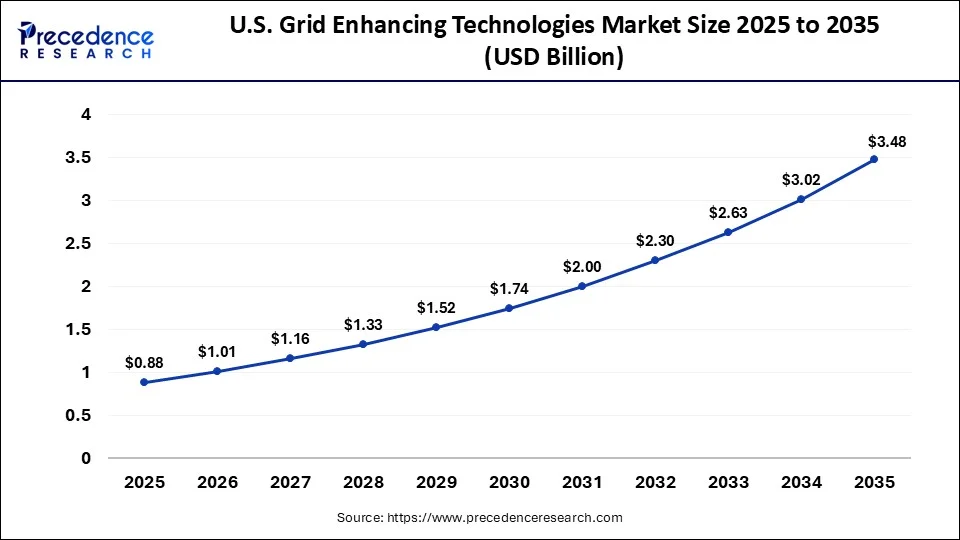
The U.S. grid enhancing technologies market size was evaluated at USD 0.88 billion in 2025 and is projected to reach around USD 3.48 billion by 2035, growing at a CAGR of 14.74% from 2026 to 2035.
The United States (Domination and fastest growth)
The U.S. is the regional leader in adoption, with substantial upgrades in transmission infrastructure, a growing number of renewables being inter-connected, and ongoing deployment of advanced technologies for grid optimization.
Asia Pacific Region Growing with Fastest CAGR of 19.3%
Asia Pacific held a 25% share of the market in 2025 and is expected to grow at a 19.3% CAGR between 2026 and 2035, driven by rapid construction of renewable power plants and ultra-high-voltage transmission projects.
China (Dominant)
The region is dominated by the deployment of ultra-high-voltage transmission, investments in the digital grid, and large renewable integration programs in China.
India (Fastest-Growing)
India sees the highest rate of regional growth with additions of renewable capacity and a significant amount of transmission corridor development to enable the national electrification effort.
Europe Expected to Held Market Share of 29% in 2025
Europe is expected to hold 29% of the market in 2025 and is estimated to grow at a considerable CAGR of 15.2% over the projected period, supported by cross-border electricity trading requiring higher transmission efficiency and greater operational flexibility across interconnected networks.
Germany (Dominant)
Extensive transmission expansion, industrial electricity demand, and large renewable generation facilities requiring advanced grid optimization technologies are the main drivers of Germany's dominance.
U.K. (Fastest-Growing)
The growth of offshore wind is driving higher and higher demand for intelligent transmission, flexible power-flow management, and dynamic line rating.
Latin America Held Notable Market Share with 6% in 2025
The Latin America region is expected to grow at a notable CAGR of 14.2% between 2026 and 2035, due to greater demand for efficient transmission infrastructure and improved grid reliability.
Brazil (Dominant and Fastest Growing)
Brazil's high penetration level in the region is due to its long transmission lines, high penetration of renewables, and huge interconnected electricity system.
Middle East & Africa Held a Considerable Market Share of 4% in 2025
The Middle East & Africa region is expected to grow at a strong CAGR of 13.8% between 2026 and 2035, driven by governments investing in stronger transmission networks supporting renewable energy diversification and grid resilience.
GCC (Dominant)
Major transmission projects, smart grid projects, and large renewable energy diversification programs drive the dominance of the GCC countries.
South Africa (Fastest-Growing)
South Africa has the highest rate of growth for renewable integration, transmission reinforcement, and national grid modernization projects.
Competitive Landscape
Market Structure and Competitive Intensity
Siemens Energy is GE Vernova's main competitor in all three business areas of the grid, electrification, and gas turbines. Also, Hitachi Energy and ABB compete more directly in the grid hardware and controls business. These large equipment manufacturers face competition from engineering companies and software firms who specialize in the design and manufacture of utility equipment. Smaller companies such as Smart Wires and LineVision develop niche applications for power flow control and dynamic line rating.
Competitive Positioning Matrix
The global high-voltage switchgear market is dominated by the following companies. Including Hitachi Energy, Siemens Energy, GE Vernova, China XD Electric, and Henan Pinggao. It's a very important relationship with utilities, as the time lag in the procurement process favors trusted, long-standing utilities who've already performed well in the field. Vendors targeting both North American and European utilities are getting more deployment experience and are now increasingly aligned in geographic presence with leaders.
Technology Portfolio Benchmarking
Full-line companies such as GE Vernova and Siemens Energy integrate advanced conductors, power electronics and grid software into a single portfolio. Specialist suppliers, such as Smart Wires and TS Conductor, focus on a more specialised power flow control or the development of next generation conductor materials. This new division between the wide platform and the very deep specialists is a key part of today's competitive yardstick.
Business Model Benchmarking
Traditional hardware OEMs continue to make most of their sales using hardware contracts. Although software licensing sales have been growing steadily. Managed-service contracts instead of one-off fees are the standard way of competing with consulting and integration firms. The business model shift is driving a change in utilities' vendor assessment. Moving beyond the conventional capital equipment economics towards recurring platform value.
Strategic Developments
In early 2026, GE Vernova acquired the remaining 50 percent of Prolec GE, marking a 30-year partnership in the manufacture of transformers. In late July 2026, Arvind Krishna joined Smart Wires as Chief of Engineering to speed up the development of the SmartValve product. The mergers, promotions, and significant contracts with utilities show a maturing industry as it turns to a proven and successful technology and as specialists compete to commercialize its deployment at scale.
Grid Enhancing Technologies Market Companies
- Ampacimon
- DNV GL
- General Electric (GE) Grid Solutions
- Hitachi Energy
- LatticeGrid
- Linxon
- Mitsubishi Electric Corporation
- NewGrid
- Nexans
- Reactive Technologies
- Schneider Electric
- Siemens Energy
- Smart Wires
- Varentec
Future Market Outlook (2025-2035)
Short-Term Outlook: 2025-2028
DOE plans to finish six to 12 GET projects based on the template that can be replicated by future utilities in three to six months. The regulatory process moves forward with FERC's pending dynamic line rating rulemaking and NERC's growing cybersecurity roadmap. As utilities slowly working their way past isolated pilot projects. Expect steady improvement in DLR adoption and initial software deployment.
Medium-Term Outlook: 2028-2032
Integrated platforms that integrate sensors, power flow control, and automated dispatch should be considered a utility standard purchase and not a novelty. Renewable developers will more likely consider GETs-enabled corridors as a minimum standard than a competitive edge. The overall commercialisation should follow as demonstration projects mature and become fully operational in several regions to begin in the early 2020s.
Long-Term Outlook: 2032–2035
Solutions that consider the full HVDC, FACTS, and multi-terminal DC system will best be able to accommodate the large new loads without loss of reliability. The potential of power networks will rely more on the use of so-called advanced power network technology, complemented by selective regulation. By 2035, the grid will be truly automated and flexible, with hardware and AI working in a single system, not stacked on top of each other.
Strategic Opportunity Analysis
Highest-Growth Technology Opportunities
Other factors are also scoring well for their speed-to-deployment and near-term utility appetite, with topology optimization and advanced power flow control outscoring the rest. The second business segment is software analytics platforms. They have the longest growth curve as they cover an operator's entire network and not just one corridor. The three categories combined are the most obvious pathway from pilot project to full commercialization in the near future.
Highest-Growth Geographic Opportunities
Asia Pacific's total grid investment will reach around $2.6 trillion in the decade ahead, with over two-thirds of this investment in China. Asia's fast pace of investment, manufacturing depth and policy activity could make it the fastest region. This achieves the objective of outpacing the West in achieving large-scale electrification. It is anchored by the massive coordinated grid expansion programs of China, India, Japan and Australia.
Most Attractive End-User Opportunities
Renewable energy developers are the fastest-growing end user segment. GETs shorten years-long interconnection delays that threaten financing for projects. Industrial consumers, especially data center operators, are increasingly looking for GETs-enabled power delivery from their utility partner. Instead of waiting through normal queues.
Recurring Revenue Opportunities
The estimated $5.8 trillion in worldwide grid upgrades through 2035, about $700 billion is allocated to digital grid technology upgrades. That digital transition is more conducive to the subscription sales of software and long-term support contracts as opposed to equipment sales. This is a trend that's already underway. The managed-service and platform-subscription aspects of the sector are the most likely revenue stream for success in the coming years.
Strategic Recommendations
Recommendations for Grid Technology Providers
Vendors need to align hardware sales with software analytics, and they should not be separate and distinct products. ACORE's technical report, in collaboration with Electric Power Engineers, provides a comprehensive explanation of how to incorporate DLR, PFC, and topology optimization into utility planning. Providers should seek opportunities to establish pilot partnerships with utility decision makers similar to Minnesota's GridReady program.
Recommendations for Software and Analytics Companies
Companies need to focus on interoperability, as utilities have long-term infrastructure investments and do not want to be locked in by a single vendor. Subscription-based analytics platforms should form the basis of a go-to-market strategy. Because a recurring revenue stream is much more sustainable than software licensing.
Recommendations for Utilities and Grid Operators
Utilities can also implement evaluation systems of this nature before settling for the conventional line construction. Grid Strategies estimated the additional amount of capacity required in the United States would be over 150 gigawatts within five years. Delaying the installation will become more expensive. Utility planners should consider the total lifecycle cost of GETs as compared to traditional expansion, not just capital costs.
Recommendations for Renewable Energy Developers
Developers need to focus on projects in territories where utilities have shown they have used GETs and achieved quicker study cycles. Interconnection status is now considered a key financing diligence factor with site control and permitting readiness. Early familiarity in building GETs can significantly reduce the long timeline of financial close and revenue generation, which can span multiple years.
Recommendations for Investors
The best near-term performing categories are advanced power flow control and software analytics. They are implemented quickly and have recurring revenue opportunities. Platform business models are more preferable than pure hardware businesses. Revenue from subscriptions is more lasting than revenue from hardware. The biggest concern for investors is regulatory uncertainty concerning cost recovery, and investors should keep an eye on GETs legislation at the state level prior to any substantial investments.
Complete Market Segmentation
By Technology
- Dynamic Line Rating (DLR)
- Advanced Power Flow Control (APFC)
- Topology Optimization
- Smart Wires
- Grid-Enhancing Software & Analytics
- Advanced Conductors
- Other Grid Enhancing Technologies
By Component
- Hardware
- Software
- Services
By Grid Application
- Transmission Grid
- Distribution Grid
- Interconnection & Grid Expansion
- Congestion Management
- Renewable Energy Integration
- Grid Resilience & Reliability
- Demand Flexibility & Optimization
By Deployment Model
- Standalone Deployment
- Integrated Grid Management Platforms
- Hybrid Deployment
By Grid Type
- AC Grid
- DC Grid
- Hybrid AC/DC Grid
By Voltage Level
- Low Voltage
- Medium Voltage
- High Voltage
- Extra-High Voltage
By End User
- Transmission System Operators (TSOs)
- Distribution System Operators (DSOs)
- Utilities
- Renewable Energy Developers
- Independent Power Producers (IPPs)
- Industrial & Commercial Energy Consumers
- Government & Regulatory Authorities
By Region
- North America
- Latin America
- Europe
- Asia-pacific
- Middle and East Africa
For inquiries regarding discounts, bulk purchases, or customization requests, please contact us at sales@precedenceresearch.com
Frequently Asked Questions





Ask For Sample
No cookie-cutter, only authentic analysis – take the 1st step to become a Precedence Research client
 Get a Sample




 sales@precedenceresearch.com
 Schedule a Meeting
