



AI in Power Grid Management Market Trends, Companies, Revenue / Sales Performance, Subscriber Growth, Pricing Strategies, Cloud Adoption, Infrastructure Expansion, Competitive Landscape, and Industry Outlook
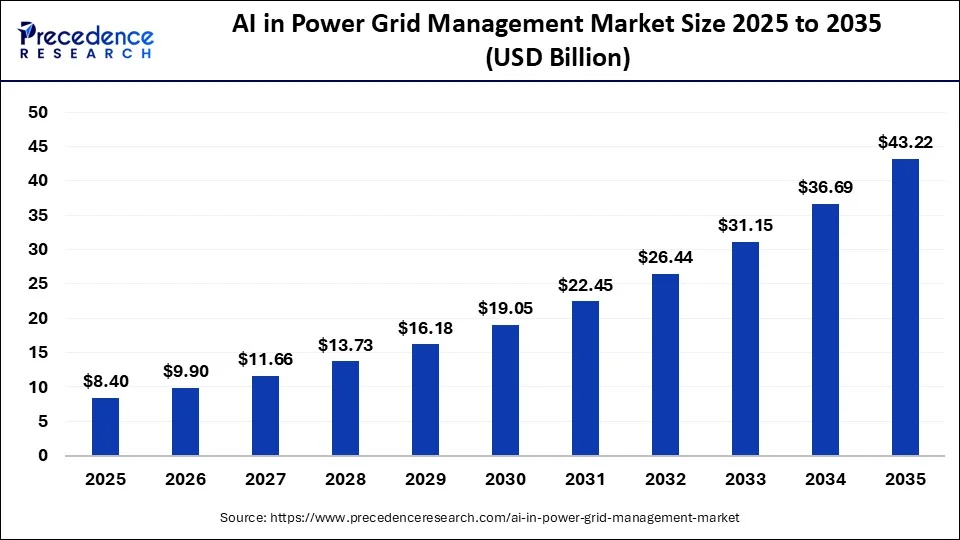
ICT industry specialist Shivani Zoting estimates the AI in power grid management market at USD 9.90 billion in 2026, with continued technology adoption expected to take the market to USD 43.22 billion by 2035 at a CAGR of 17.80%. Leading AI in power grid management market providers such as ABB, Alpiq, AppOrchid Inc are expanding their capabilities across segments including component, deployment mode, technology, application, grid type, utility type, end user, organization size, region.
Source: https://www.precedenceresearch.com/ai-in-power-grid-management-market
 Get a Sample
 Table Of Content


AI in Power Grid Management Market Size and Forecast 2026 to 2035
The global AI in power grid management market size accounted for USD 8.40 billion in 2025 and is predicted to increase from USD 9.90 billion in 2026 to approximately USD 43.22 billion by 2035, expanding at a CAGR of 17.80% from 2026 to 2035. The market growth is attributed to increasing investments in grid modernization, expanding renewable energy integration, and rising adoption of AI-powered predictive analytics across electricity transmission and distribution networks.
Key Takeaways
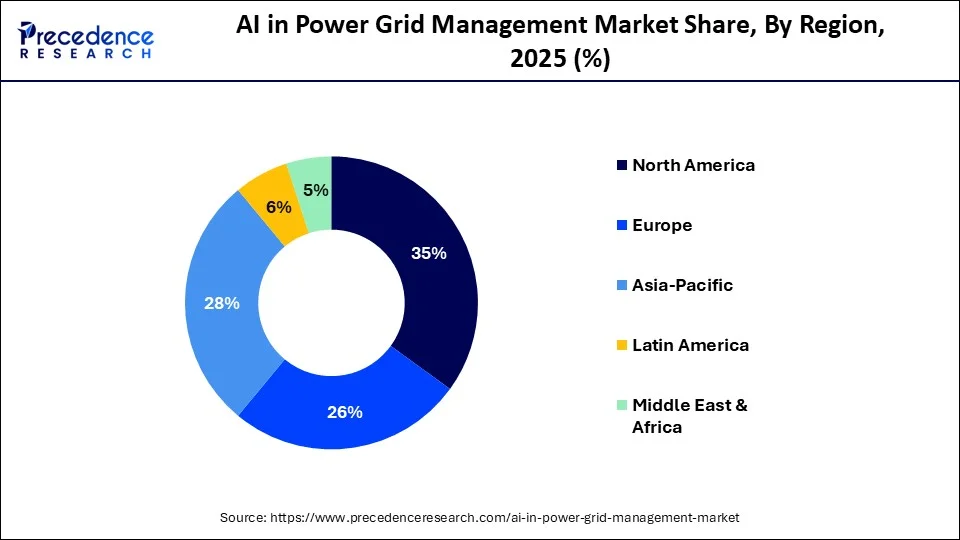
- North America dominated the AI in power grid management market with 35% of the market share in 2025.
- Asia-Pacific is expected to register a rapid growth of 20.6% CAGR during 2026 and 2035.
- By component, the software segment contributed the highest market share of 48% in 2025 and is expected to grow at the highest CAGR of 19.3% between 2026 and 2035.
- By component, the hardware segment held the second-largest market share of 27% in 2025.
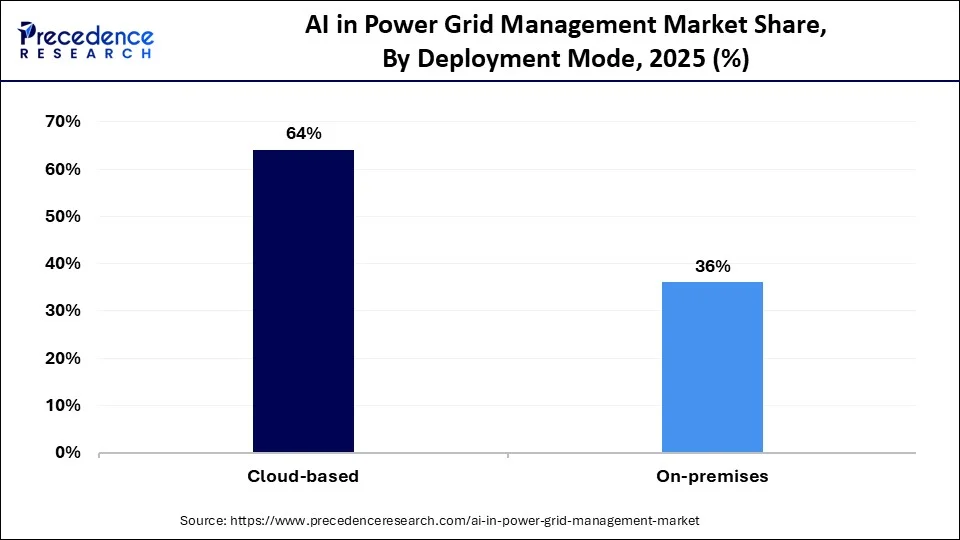
- By deployment mode, the cloud-based segment held a major market share of 64% in 2025 and is expected to register robust growth of 20.1% CAGR during 2026 and 2035.
- By deployment mode, the on-premises segment held the second-largest market share of 36% in 2025.
- By technology, the machine learning segment contributed the highest AI in power grid management market share of 31% in 2025.
- By technology, the reinforcement learning segment is expected to grow at a strong CAGR of 21.5% over the projected period.
- By application, the grid asset management segment contributed the highest market share of 21% in 2025.
- By application, the renewable energy integration segment is expected to grow at a rapid CAGR of 22.4% between 2026 and 2035.
- By end user, the utilities segment contributed the highest market share of 46% in 2025.
- By end user, the renewable energy developers segment is expected to grow the fastest CAGR of 20.4% between 2026 and 2035.
Market Overview
The growing need to modernize aging electricity infrastructure is accelerating the adoption of AI in power grid management worldwide. AI collects operators real-time data from the grid to predict demand, identify faults, optimize power flow, and make operational decisions automatically. The technology also enhances the integration of renewable energy sources, ensuring a more stable and efficient energy supply using predictive analytics and intelligent grid controls.
The International Energy Agency (IEA) also gave a 17% annual growth estimate for data center electricity demand in April 2025, primarily due to surging workloads on AI. As electricity use increases, utilities are being incentivized to install sophisticated grid management systems to increase grid reliability and achieve better operational efficiencies in real time. Furthermore, the growth of these developments fuels investments in AI-powered grid modernization, with infrastructure transformation being a key growth strategy for AI in the power grid management market.
AI in Power Grid Management Market Growth Factors
- Expanding Digital Twin Deployment: Growing adoption of AI-powered digital twins is enhancing real-time grid simulation, operational planning, and infrastructure resilience.
- Growing Adoption of Edge AI Computing: Expanding implementation of edge-based artificial intelligence is improving low-latency grid analytics and faster operational responses.
AI in Power Grid Management Market Trends
- Grid-Interactive Virtual Power Plants Expanding Through AI Coordination: AI's infusion into VPPs became more prevalent to better manage battery storage, rooftop solar, EVs, and flexible end-user loads. Advanced optimization platforms optimize thousands of distributed assets constantly while supplying frequency regulation and peak demand management services. AI-powered virtual power plants (VPPs) are gradually changing the way the electricity system is operated in a decentralized manner.
- Quantum-Inspired AI Optimizing Complex Grid Dispatch: Technologies emerged in 2026 that utilised quantum-inspired optimisation algorithms to enable the solution of very complicated transmission scheduling and balancing renewable energy applications. Increasing commercialization of quantum-inspired intelligence continues to expand next-generation capabilities across modern electricity networks.
Market Report Coverage and Key Metrics
| Report Coverage | Details |
| Market Size in 2025 | USD 8.40 Billion |
| Market Size in 2026 | USD 9.90 Billion |
| Market Size by 2035 | USD 43.22 Billion |
| Market Growth Rate from 2026 to 2035 | CAGR of 17.80% |
| Dominating Region | North America |
| Fastest Growing Region | Asia Paicfic |
| Base Year | 2025 |
| Forecast Period | 2026 to 2035 |
| Segments Covered | Component, Deployment Mode, Technology, Application, Grid Type, Utility Type, End User, Organization Size, and Region |
| Regions Covered | North America, Europe, Asia-Pacific, Latin America, and Middle East & Africa |
Market Dynamics
Drivers
Increasing Grid Modernization Investments
Increasing investments in electricity grid modernization are expected to drive market growth. AI-based platforms are used by utilities to manage power flow, forecast equipment failures, and to gain operational visibility with real-time analysis of grid data.
According to the International Energy Agency (IEA), over 2,500 GW of renewable, storage, and large-load projects remain in global grid connection queues, highlighting the urgent need for smarter grid operation. Furthermore, the growing deployment of renewable energy resources is anticipated to increase demand for AI-enabled grid management technologies across modern electricity networks.
Restraint
Cybersecurity Risks and Critical Infrastructure Vulnerabilities
Rising cybersecurity threats are expected to increase operational and financial risks for electricity utilities, hindering market growth. The processing of OT and IT data at AI platforms provides lucrative targets for ransomware, malware, and strategic cyberattacks. Furthermore, these challenges hinder widespread AI deployment because high implementation costs are anticipated to limit investment across utilities operating aging electricity infrastructure.
Opportunity
Surging Electricity Demand from AI Data Centers Driving Intelligent Grid Operations
Surging electricity demand from AI-powered data centers is projected to increase the deployment of intelligent grid management platforms worldwide, further creating immense opportunities for players competing in the market. By leveraging the benefits of AI, grid operators can make more accurate predictions of surges in electricity demand and optimize the use of load balancing capabilities.
This further enhances system reliability when demand fluctuates in unpredictable and unexpected ways. Furthermore, the International Energy Agency (IEA) reported in April 2026 that electricity demand from data centers increased 17% during 2025, primarily driven by expanding artificial intelligence workloads.
Market Segmentation Analysis
Component Insights
The Software Segment Dominated the Market with 48% of Market Share in 2025
The software segment dominated the AI in power grid management market with a share of 48% in 2025 and is expected to grow at the fastest CAGR of 19.3% between 2026 and 2035, due to rapid adoption of AI-driven grid intelligence platforms across utilities and transmission operators. AI-driven software for grid intelligence was quickly adopted by both utilities and power transmission companies, making it a significant portion of the revenue stream.
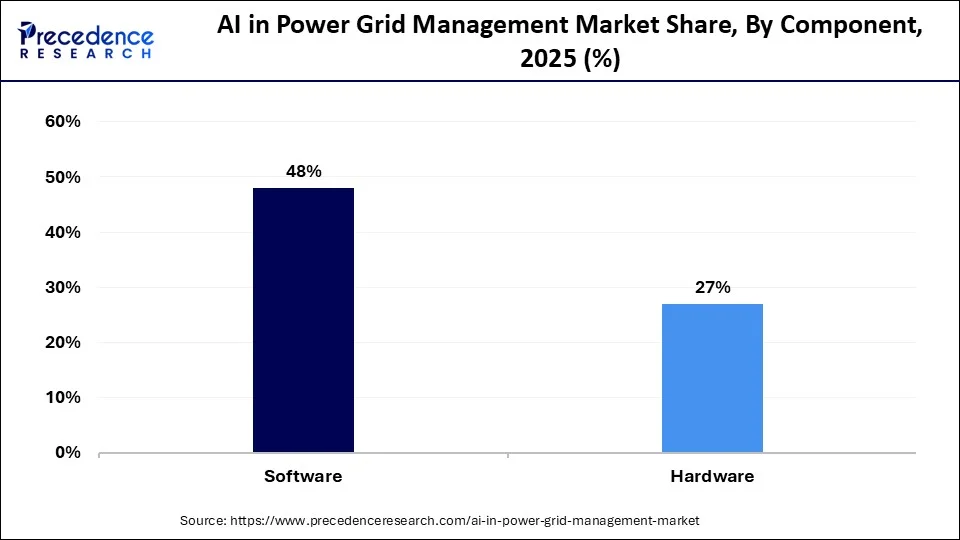
The hardware segment held a 27% share in 2025, owing to growing demand for sophisticated physical devices with the ability to collect solid operational data for AI applications to build intelligent grid infrastructure. Growing demand for RE and DE projects led to growth in the number of intelligent hardware solutions needed in the power grid for T&D operations. These investments were successful in securing strong hardware demand in the face of rapid innovations in software.
The services segment contributed 25% to the market in 2025, as utilities increasingly use it to deploy, integrate, and optimize AI solutions for complex electricity infrastructure. Throughout digital transformation projects, there continued to be a strong need for consulting, system integration, cybersecurity evaluations, workforce training, and managed services.
Deployment Mode Insights
The Cloud-based Segment Dominated the Market with 64% of Market Share in 2025
The cloud-based segment dominated the AI in power grid management market with a share of 64% in 2025 and is expected to grow at the highest CAGR of 20.1% between 2026 and 2035, due to increasing demand for scalable AI platforms that process massive volumes of grid data across distributed electricity networks.
Cloud platforms further make it easier to integrate distributed energy resources, advanced metering infrastructure, and energy management systems. Furthermore, cloud adoption is continuing to broaden in advanced electricity systems, particularly for the use of generative AI, digital twins, and edge-cloud architecture.
The on-premises segment held a 36% share in 2025, owing to the importance of having direct control over operational data, cybersecurity policies, and mission-critical applications. On-site AI systems for grid protection and energy management, and real-time control of energy operations, remained top priorities for large transmission operators and national utilities as they continued to invest.
Technology Insights
The Machine Learning Segment Led the Market with 31% of Market Share in 2025
The machine learning segment led the AI in power grid management market with a share of 31% in 2025, due to increasing deployment of predictive intelligence across modern electricity transmission and distribution networks. This trend towards machine learning models to predict demand and continuously learn from grid data to enhance operating efficiency for utilities is ubiquitous.
AI in Power Grid Management Market Share, By Technology, 2025-2035 (%)
| Technology | 2025 | CAGR (%) |
| Machine Learning | 31.00% | 17.9% |
| Deep Learning | 18.00% | 19.2% |
| Natural Language Processing | 8.00% | 15.6% |
| Computer Vision | 9.00% | 18.4% |
| Reinforcement Learning | 10.00% | 21.5% |
| Digital Twin | 16.00% | 20.3% |
| Generative AI | 8.00% | 20.8% |
The reinforcement learning segment is expected to grow at a rapid CAGR of 21.5% between 2026 and 2035, owing to the rise in the need for autonomous control of operations in very dynamic electricity networks. Companies have been testing reinforcement learning algorithms that optimize based on predefined suboptimal rules. This continually fine-tunes control strategies by interacting with the changing operating conditions.
The deep learning segment held an 18% share in 2025, driven by increasing demand from utilities for advanced NN solutions that could derive knowledge from complex operational data repertoires. Fault diagnosis, renewable electricity generation forecasting, and cybersecurity monitoring in electricity infrastructure were all boosted by deep learning models for critical electricity infrastructure.
Application Insights
The Grid Asset Management Segment Dominated the Market with 21% of Market Share in 2025
The grid asset management segment held the largest AI in power grid management market share of 21% in 2025, due to increasing investments in predictive maintenance, digital inspections, and intelligent infrastructure monitoring across power grid companies. Additionally, Siemens Energy, Hitachi Energy, ABB, and Schneider Electric also pushed for AI-powered asset-based solution platforms for transformer diagnostics, digital substations, and condition-based maintenance, among other capabilities.
AI in Power Grid Management Market Share, By Application, 2025-2035 (%)
| Application | 2025 | CAGR (%) |
| Grid Asset Management | 21.00% | 17.6% |
| Load Forecasting | 16.00% | 18.5% |
| Demand Response Management | 11.00% | 18.8% |
| Renewable Energy Integration | 15.00% | 22.4% |
| Grid Optimization | 13.00% | 17.9% |
| Energy Trading & Market Forecasting | 8.00% | 18.2% |
| Outage Detection & Restoration | 7.00% | 17.3% |
| Fault Detection & Diagnosis | 5.00% | 18% |
| Voltage & Frequency Control | 2.00% | 17.1% |
| Cybersecurity & Threat Detection | 2.00% | 20.9% |
The renewable energy integration segment is expected to grow at the highest CAGR of 22.4% between 2026 and 2035, owing to the increasing deployment of distributed energy resources, battery storage, wind energy, and solar energy in electricity power systems.
AI also enhances renewable integration capabilities by providing high-quality weather intelligence and variable planning and scheduling of reserves. The U.S. Energy Information Administration (EIA) anticipates that 81% of planned additions are for solar or battery storage, which drives increased demand for predicting and balancing AI for renewables.
The load forecasting segment held a 16% share in 2025, fueled by companies that are reliant on accurate electricity demand forecasting for optimizing generation scheduling and transmission planning. Historical demand patterns, weather conditions, distributed generation, electric vehicle charging habits, and industrial consumption are all used to assess how to improve the accuracy of AI models.
End User Insights
The Utilities Segment Dominated the Market with 46% of Market Share in 2025
The utilities segment dominated the AI in power grid management market with a share of 46% in 2025, due to increasing investments in intelligent grid modernization, operational automation, and infrastructure resilience. AI is becoming a more common tool for electric utilities, and it's essential to provide better outage management and electricity demand forecasting in transmission and distribution networks.
AI in Power Grid Management Market Share, By End User, 2025-2035 (%)
| End User | 2025 | CAGR (%) |
| Utilities | 46.00% | 17.9 |
| Energy & Power Companies | 20.00% | 18.1 |
| Government & Public Utilities | 11.00% | 16.8 |
| Industrial Power Consumers | 10.00% | 18.7 |
| Commercial Power Consumers | 6.00% | 17.3 |
| Renewable Energy Developers | 7.00% | 20.4% |
The renewable energy developers segment held 7% of the market share in 2025 and is expected to grow at the highest CAGR of 7% between 2026 and 2035, owing to the increasing aspiration of implementing utility-scale solar, wind, battery storage, and hybrid energy projects around the world. Developers are using AI to predict renewable energy production, maximize storage capabilities, enhance project efficiency, and advance grid interconnection planning.
The energy and power companies segment held a 20% share in 2025, driven by large electricity producers increasingly adopting AI to improve operational efficiency across generation, transmission, and integrated energy portfolios. Enterprises adopted intelligent analytics, combined with optimization and generation and consumption matching and grid coordination optimization for various pieces of power equipment.
Market Regional Analysis: North America, Europe, Asia-Pacific
Which Factors Drive the AI in Power Grid Management Market in North America?
North America held a major market share of 35% in 2025, due to the accelerating investments in digital grid modernization, AI, and resilient electricity infrastructure. The U.S. Department of Energy's (DOE) Grid Resilience and Innovation Partnerships (GRIP) Program is continuing to back more than 105 grid modernization projects across the nation.
This improves transmission systems' reliability, wildfire resilience, and intelligent operation of the grid. The North American Electric Reliability Corporation (NERC) also identified new reliability challenges in the face of North American population growth and increased electrification in different regions. AI is becoming a key tool in utilities' efforts to better predict demand, maximize transmission capacity, fully restore outages, and bolster cybersecurity in critical infrastructure.
U.S. AI in Power Grid Management Market Size and Growth 2026 to 2035
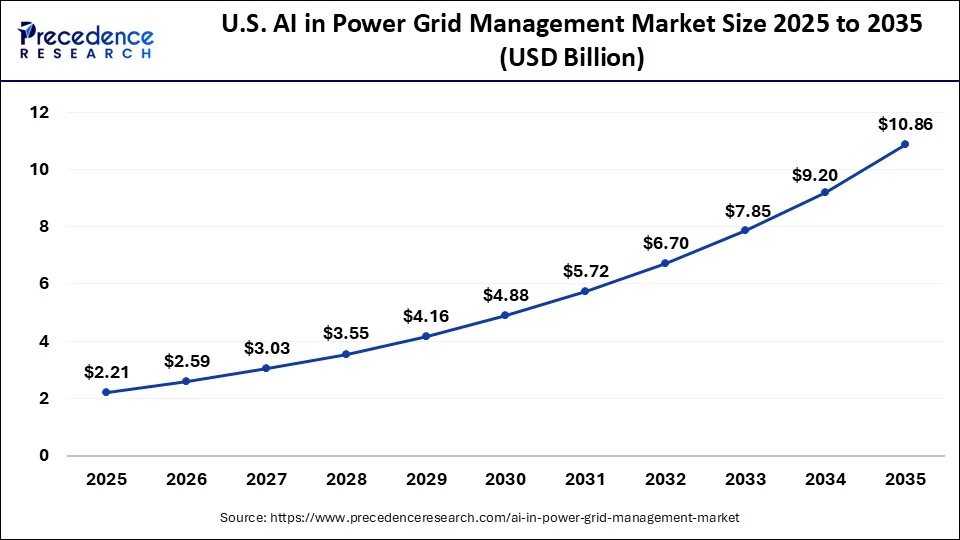
The U.S. ai in power grid management market size was evaluated at USD 2.21 billion in 2025 and is projected to reach around USD 10.86 billion by 2035, growing at a CAGR of 17.26% from 2026 to 2035.
U.S. Driving North America's AI in Power Grid Management Leadership in 2025
U.S. leads the market due to its investment in grid modernization and transmission infrastructure are driving regional growth as U.S. companies remain leading investors. The U.S. Energy Information Administration (EIA) is projecting that around 63 GW of new utility-scale electricity generation will be added by 2025. This further drives the demand for AI-based forecasting, outage management, and grid optimization.
How is Asia-Pacific Growing in the AI in Power Grid Management Market?
Asia-Pacific held the second-largest market share of 28% in 2025 and is expected to grow at the fastest CAGR of 20.6% over the projected period, supported by proactive deployment of electricity infrastructure and renewable generation by regional governments. The International Energy Agency (IEA) forecasts Asia will drive the greatest gains in global electricity demand, fueling the motivation for utilities in the region to optimize their operational efficiency using AI.
China Leads Asia-Pacific's AI in Power Grid Management Expansion
China is a major contributor to the market due to the expanding need for operational intelligence across the country, which will require AI-based tools to operate across the National Grid. Five major electricity equipment manufacturers, such as Huawei Digital Power, Mitsubishi Electric, Hitachi Energy, Siemens Energy, and Schneider Electric, are further beefing up their intelligent electricity solutions. Furthermore, ongoing investments in infrastructure have put China as the most powerful growth engine within the regional market.
Europe Holding Significant Market Share of 26% in 2025
The Europe region held a 26% share of the AI in power grid management market in 2025 and is expected to grow at a 17.8% CAGR between 2026 and 2035. This is driven by ambitious grid modernization plans, growing renewable energy supplies, and cross-border transmission links, which continue to drive the intelligentization technology.
Demand for smart operation technologies continues to rise with the growing capacity of offshore wind, DERs, and battery storage. These initiatives are further driving the use of AI across the electricity infrastructure in Europe.
Germany Powering Europe's Rapid AI in Power Grid Management Growth
In Germany, the market is growing due to the scope of its AI applications that are helping to manage congestion, forecast renewables, maintain assets, and improve intelligent transmission planning. As the country increases its offshore wind power, utility-scale battery storage, and industrial electrification, the complexity of interconnected electricity networks continues to grow, and demand for AI power grid management solutions increases.
Latin America Holding Notable Market Share with 6% in 2025
Latin America held 6% of the AI in power grid management market share in 2025 and is expected to grow at a notable CAGR of 16.4% between 2026 and 2035, due to its digital substations and the modernization of outdated transmission infrastructure to further strengthen AI deployment. Brazil, Chile, Mexico, and Colombia are still backing smart grid deployment, which enhances the integration of renewables and the reliability of electricity use.
Brazil Expanding AI in Power Grid Management Opportunities Across Latin America
Brazil is a major player in the market, fuelled by the growth of wind, hydropower, solar, and battery storage projects, which continue to drive up the demand for AI-driven forecasting. Machine learning and advanced analytics are increasingly being used by utilities for optimising their operations and minimizing electricity loss in long-distance power transmission networks.
Will the Middle East and Africa Grow in the AI in Power Grid Management Market?
The Middle East and Africa region held 5% of the market share in 2025 and is expected to show lucrative growth with a CAGR of 17.1% between 2026 and 2035. National energy transition initiatives, smart city programs, and an expansion of renewable electricity generation continue to fuel the further deployment of intelligent grid systems in the Middle East and Africa. The efforts persist as a major push towards building up an intelligent new power grid in the region that has always been strong on demand for such technology.
Saudi Arabia Accelerating AI in Power Grid Management Production in the Middle East & Africa
In Saudi Arabia, the market is growing due to the region's growing smart grid investments and rapid energy transition plans aimed at a digital electric grid. The deployment of digital energy platforms to strengthen the energy resilience and efficiency of the electricity grid is ongoing as part of National investments under Vision 2030.
AI in Power Grid Management Market Value Chain Analysis
- AI Software & Digital Infrastructure Development
AI platforms, cloud infrastructure, and machine learning models are developed to support intelligent grid monitoring, forecasting, and automation.
Key Players: Microsoft, Google Cloud, Amazon Web Services (AWS), IBM, Oracle Utilities, C3 AI.
- Grid Hardware & System Integration
AI software is integrated with smart meters, sensors, substations, SCADA systems, and communication networks for real-time grid operations.
Key Players: Siemens Energy, Hitachi Energy, Schneider Electric, ABB, GE Vernova, Landis+Gyr, Itron.
- Utility Deployment & Grid Operations
Electric utilities and grid operators deploy AI solutions to optimize asset management, renewable integration, load forecasting, and network reliability.
Key Players: State Grid Corporation of China (SGCC), National Grid plc, PJM Interconnection, CAISO, Hydro One, Power Grid Corporation of India Limited (PGCIL).
Market Competitive Landscape: Leading Companies and Strategies
The AI in power grid management market is moderately consolidated with a mix of global AI and grid solution vendors and specialized AI and grid software vendors. Comprehensive digital grid and automation portfolios are provided by industry leaders, such as GE Vernova, Hitachi Energy, Siemens Energy, Schneider Electric, and ABB. Competition is further enhanced with the capabilities of AI and utility cloud-based platforms from Microsoft, Google Cloud, Amazon Web Services, IBM, and Oracle Utilities.
New startups, including C3 AI, GridBeyond, Utilidata, BluWave-ai, and Camus Energy, center on how to predict, optimize distributed energy resources, and make distributed grids smarter and more intelligent. In 2025, competition continues to evolve in innovative ways with strategic partnerships and product innovation within intelligent electricity infrastructure. GE Vernova acquired Alteia in 2025, introduced by a partnership between GE and UpSmart, to enhance AI-powered visual inspections of electricity grids. Furthermore, the grid modernization investments continue to spark acquisitions, technology partnerships, and other AI-driven innovations across the competitive marketplace.
AI in Power Grid Management Market Companies
- ABB
- Alpiq
- AppOrchid Inc.
- Atos SE
- C3.ai
- Flex Ltd.
- General Electric
- Origami Energy Ltd.
- Siemens AG
- SmartCloud Inc.
- Uptake Technologies
Recent Developments AI in Power Grid Management Market (2025-2026)
- In June 2026, GE Vernova introduced GridOS for Transmission and released new AI whitepapers on grid planning and autonomous edge operations at Orchestrate 2026. CEO Philippe Piron emphasized that a modern grid must coordinate and adapt quickly to rising electricity demand, making software essential for utilities in planning and operations. (Source: https://www.gevernova.com)
- In June 2026, Schneider Electric expanded EcoCare, its AI-powered service plan, to include 3-Phase UPS. This service focuses on condition-based maintenance and 24/7 monitoring to enhance uptime and operational efficiency. With downtime costing up to USD 10 million per hour, the push for improved energy management is critical as U.S. electricity demand rises significantly. (Source: https://www.se.com)
Segments Covered in the Report
By Component
- Software
- AI Platforms
- Analytics Software
- Grid Optimization Software
- Predictive Maintenance Software
- Hardware
- Edge AI Devices
- Smart Sensors
- Intelligent Controllers
- High-Performance Computing Infrastructure
- Services
- Consulting
- System Integration
- Deployment & Implementation
- Support & Maintenance
- Managed Services
By Deployment Mode
- Cloud-based
- Public Cloud
- Private Cloud
- Hybrid Cloud
- On-premises
By Technology
- Machine Learning (ML)
- Deep Learning
- Natural Language Processing (NLP)
- Computer Vision
- Reinforcement Learning
- Digital Twin
- Generative AI
By Application
- Grid Asset Management
- Asset Health Monitoring
- Predictive Maintenance
- Failure Predictio
- Load Forecasting
- Demand Response Management
- Renewable Energy Integration
- Grid Optimization
- Energy Trading and Market Forecasting
- Outage Detection and Restoration
- Fault Detection and Diagnosis
- Voltage and Frequency Control
- Cybersecurity and Threat Detection
By Grid Type
- Transmission Grid
- Distribution Grid
- Smart Grid
- Microgrid
By Utility Type
- Electric Utilities
- Independent System Operators (ISOs)
- Transmission System Operators (TSOs)
- Distribution System Operators (DSOs)
- Renewable Energy Operators
By End User
- Utilities
- Energy and Power Companies
- Government and Public Utilities
- Industrial Power Consumers
- Commercial Power Consumers
- Renewable Energy Developers
By Organization Size
- Large Enterprises
- Small and Medium Enterprises (SMEs)
By Region
- North America
- Latin America
- Europe
- Asia-pacific
- Middle and East Africa
For inquiries regarding discounts, bulk purchases, or customization requests, please contact us at sales@precedenceresearch.com
Frequently Asked Questions





Ask For Sample
No cookie-cutter, only authentic analysis – take the 1st step to become a Precedence Research client
 Get a Sample




 sales@precedenceresearch.com
 Schedule a Meeting
