


India Temperature-Controlled Pharma Products Market Size, Key Companies, Company Production Capacity, Healthcare Infrastructure Growth, Product Utilization, Regulatory Compliance, Company Investment Strategies, and Market Outlook
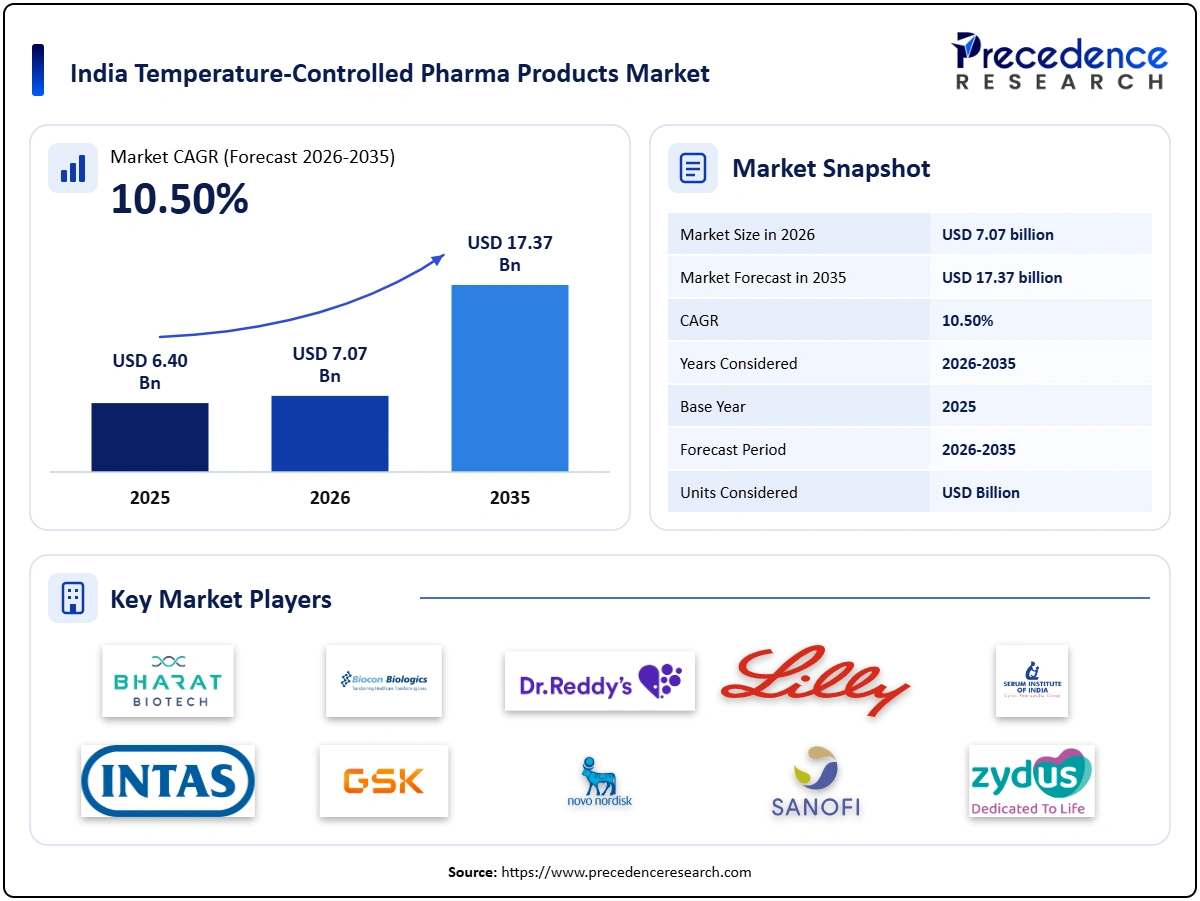
Payal Rabde, a Healthcare Industry Expert, highlights that the India temperature-controlled pharma products market has reached USD 7.07 billion in 2026 and is on track to reach USD 17.37 billion by 2035, advancing at a CAGR of 10.50%. Key India temperature-controlled pharma products market companies shaping the market include Novo Nordisk India, Biocon Biologics, Intas Pharmaceuticals while major growth segments span product, temperature range, distribution channel.
Source: https://www.precedenceresearch.com/india-temperature-controlled-pharma-products-market
 Get a Sample
 Report Description
Key Takeaways
Market Size & Growth Outlook
- Market size in 2025: USD 6.40 billion
- Estimated market size in 2026: USD 7.07 billion
- Projected market size by 2035: USD 17.37 billion
- CAGR (2026-2035): 10.50%
Regional Market Spotlight
- West India led the market with a 32.00% share and reached USD 2.05 billion in 2025.
- South India accounted for a 30.00% share and generated USD 1.92 billion in 2025 and is projected to be the fastest-growing region, at a CAGR of 11.18% from 2026 to 2035.
- North India held 26.00% of the market share and was valued at USD 1.66 billion in 2025.
Segmental Spotlight
- By product, the Vaccines segment accounted for 30.00% share and generated USD 1.92 billion in 2025.
- By temperature range, the Refrigerated (2-8°C) segment accounted for an 84.00% share, reaching USD 5.38 billion in 2025.
- By distribution channel, Hospital Pharmacies capture 38.00% share, with a market valuation of USD 2.43 billion in 2025.
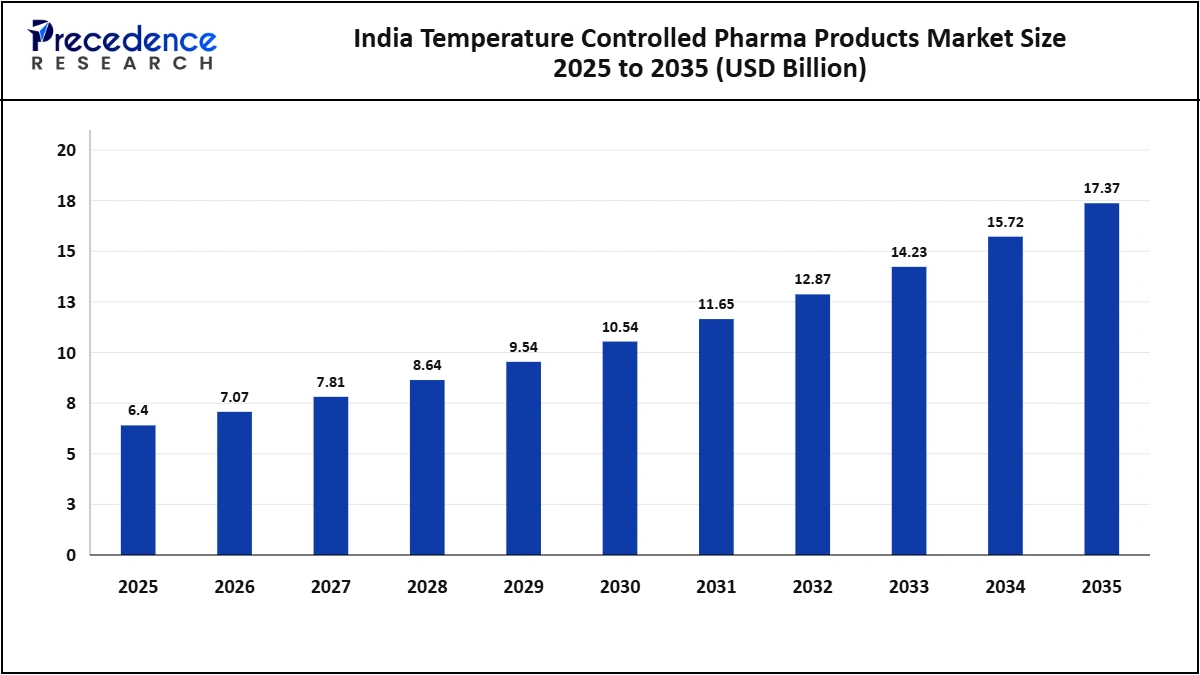
India Temperature Controlled Pharma Products Market Size and Forecast, 2025-2035 (USD Billion)
Note: 2025 is the base year; 2026-2035 values are forecasts.
Sources: Expert interviews, secondary sources, Precedence Research database, and Precedence Research analysts.
The India temperature-controlled pharma products market is projected to grow from USD 6.40 billion in 2025 to USD 17.37 billion by 2035 because India's use of vaccines, insulin, and biologics is rising quickly, and all of these products need refrigerated or frozen storage from manufacture to patient. Rising diabetes and cancer burden, biosimilar launches, wider immunization coverage, adult vaccination, growing hospital and pharmacy networks, and better cold chain infrastructure support strong growth, lifting the market to USD 10.54 billion by 2030 and sustaining a CAGR of 10.50% from 2026 to 2035.
Analyst View: India's temperature-controlled pharma market is set for strong growth, supported by rising demand for vaccines, insulin, and biologics. Increasing chronic disease prevalence, expanding immunization programs, growing healthcare networks, and improvements in cold chain infrastructure are expected to drive market expansion.
Market Trends
- Increasing biosimilar launches by Indian pharmaceutical companies are driving demand for reliable temperature-controlled storage.
- Growing adoption of adult and HPV vaccination is expanding the need for efficient vaccine cold chain networks.
- Rising use of GLP-1 injectables for diabetes and weight management is creating additional demand.
- Expansion of cold chain hubs in tier-two cities is improving access to temperature-sensitive medicines across smaller markets.
- Growing e-pharmacy adoption is encouraging investments in cold chain delivery solutions.
- Increasing use of temperature monitoring and tracking technologies is improving supply chain visibility.
Drivers, Restraints and Opportunities
Driver
High diabetes prevalence is increasing demand for insulin and other biologics. Growing biosimilar availability and immunization coverage are further driving demand for temperature-controlled storage. Meanwhile, expanding hospital networks and stricter distribution requirements are supporting market growth.
Restraint
Limited cold chain infrastructure in rural areas restricts market reach. Price controls put pressure on margins, while power outages and high logistics costs increase operational challenges. Temperature fluctuations also lead to product wastage.
Opportunity
Expanding biosimilar access programs and adult vaccination are creating new growth opportunities. Investments in last-mile cold chain technology and e-pharmacy delivery can improve distribution reach. The introduction of cell and gene therapies is expected to further increase demand for specialized cold chain solutions.
Market Segmentation: 2025 Share and Size
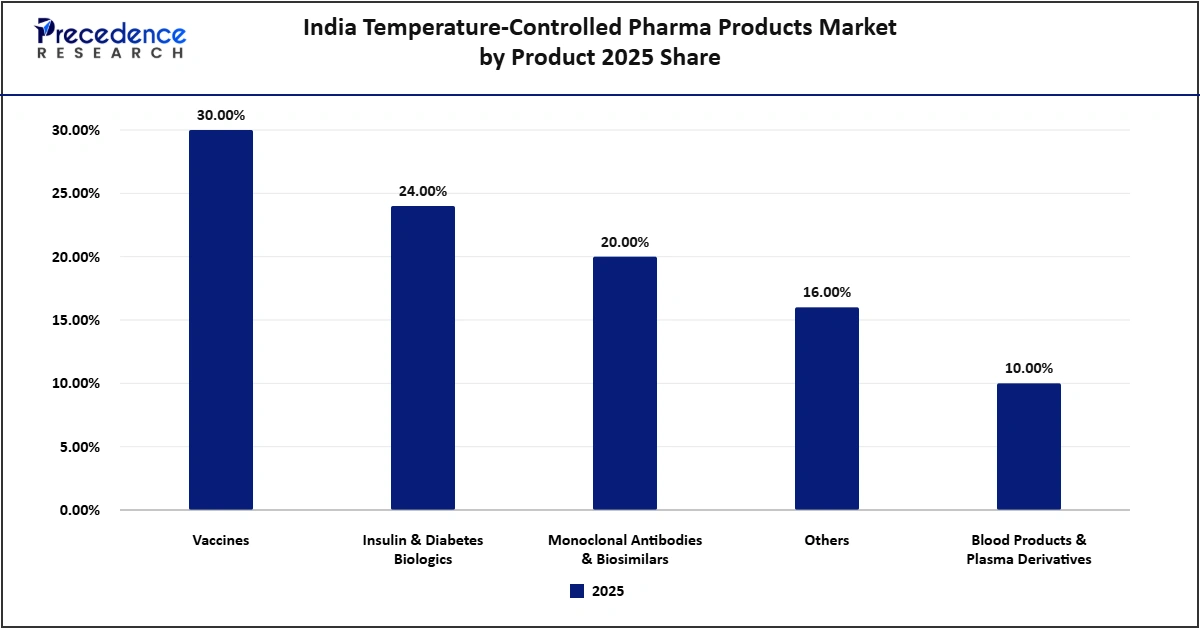
India Temperature-Controlled Pharma Products Market by Product 2025 Share
Note: 2025 is the base year; 2035 values are forecasts.
Sources: Expert interviews, secondary sources, Precedence Research database, and Precedence Research analysts.
Vaccines accounted for 30.00% share in 2025, insulin & diabetes biologics for 24.00%, monoclonal antibodies & biosimilars for 20.00%, others for 16.00%, and blood products & plasma derivatives for 10.00%.
Vaccines: This segment held the largest market share of 30.00%, valued at USD 1.92 billion in 2025, and is expected to reach USD 4.74 billion by 2035, growing at a CAGR of 9.43% during 2026-2035. Vaccines are the largest product group because India's Universal Immunization Programme reaches tens of millions of children and pregnant women each year, and private demand for vaccines such as pneumococcal, HPV, influenza, rotavirus, and adult vaccines is growing. Domestic makers such as Serum Institute of India and Bharat Biotech supply much of this demand.
Insulin & Diabetes Biologics: In 2025, the segment represented 24.00% of the total market, with a valuation of USD 1.54 billion. It is projected to grow to USD 3.92 billion by 2035, registering a CAGR of 9.83% during the forecast period. Insulin & diabetes biologics, including human insulin, insulin analogues, and GLP-1 injectables, are a large group because India has one of the world's largest populations with diabetes, and all these products need refrigerated storage before use.
Monoclonal Antibodies & Biosimilars: The market valuation of this segment was USD 1.28 billion in 2025 and is expected to reach USD 4.47 billion by 2035, at a CAGR of 13.33% from 2026 to 2035. Monoclonal antibodies & biosimilars are the fastest-growing product group because more cancer and autoimmune patients are being treated with biologics, and Indian companies such as Biocon, Intas, Zydus, and Dr. Reddy's are launching affordable biosimilars.
Others: This segment accounted for 16.00% share and reached USD 1.02 billion in 2025 and is projected to reach USD 2.61 billion by 2035, growing at a CAGR of 9.83% from 2026 to 2035. Others include fertility hormones, eye drops, certain antibiotics and injectables, and other products needing controlled temperatures.
Blood Products & Plasma Derivatives: Valued at USD 0.64 billion in 2025, this segment captured 10.00% of the market and is forecast to reach USD 1.63 billion by 2035, at a CAGR of 9.83% over the forecast period. Blood products & plasma derivatives, such as albumin, immunoglobulins, and clotting factors, are used in hospitals for surgery, trauma, and bleeding disorders.
India Temperature-Controlled Pharma Products Market by Temperature Range 2025 Share & Size
| Segments | 2025 Share | 2025 Value (USD Billion) | 2035 Value (USD Billion) | CAGR 2026-2035 |
| Refrigerated (2-8°C) | 84.00% | 5.38 | 14.29 | 10.27% |
| Frozen | 10.00% | 0.64 | 2.02 | 12.17% |
| Ultra-Low Temperature | 6.00% | 0.38 | 1.06 | 10.67% |
Note: 2025 is the base year; 2035 values are forecasts.
Sources: Expert interviews, secondary sources, Precedence Research database, and Precedence Research analysts.
Refrigerated (2-8°C) accounted for 84.00% (USD 5.38 billion) in 2025, frozen for 10.00% (USD 0.64 billion), and ultra-low temperature for 6.00% (USD 0.38 billion).
Refrigerated (2-8°C): The segment contributed 84.00% to the overall market in 2025, equivalent to USD 5.38 billion. It is anticipated to witness steady growth to USD 14.29 billion by 2035, expanding at a CAGR of 10.27% from 2026 to 2035. Refrigerated products stored at 2 to 8 degrees Celsius are the largest group because most vaccines, insulin, and biologics require this range.
Frozen: With a 10.00% market share in 2025, this segment generated USD 0.64 billion in revenue and is expected to expand at a CAGR of 12.17%, reaching USD 2.02 billion by 2035. Frozen products are growing faster, covering some vaccines, plasma products, and specialty therapies that need storage below freezing.
Ultra-Low Temperature: This segment accounted for 6.00% share and generated USD 0.38 billion in 2025 and is estimated to reach USD 1.06 billion by 2035, growing at a CAGR of 10.67% from 2026 to 2035. Ultra-low temperature products include cell and gene therapies and some mRNA products that need storage far below freezing, a small but emerging group in India.
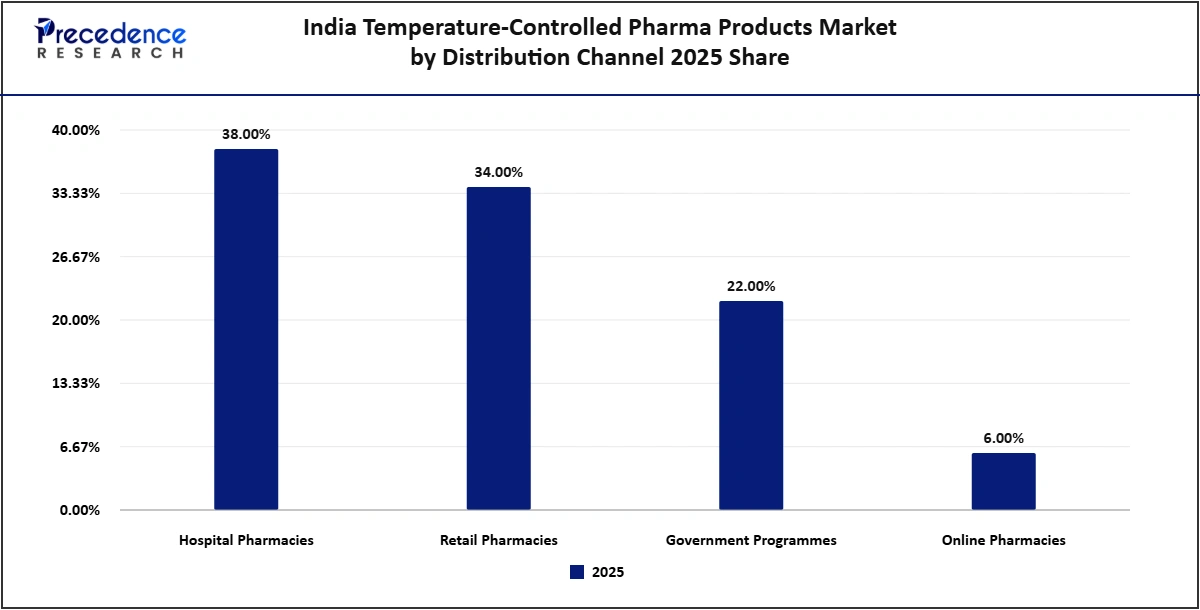
India Temperature-Controlled Pharma Products Market by Distribution Channel 2025 Share
Note: 2025 is the base year; 2035 values are forecasts.
Sources: Expert interviews, secondary sources, Precedence Research database, and Precedence Research analysts.
Hospital pharmacies accounted for 38.00% (USD 2.43 billion) in 2025, retail pharmacies for 34.00% (USD 2.18 billion), government programmes for 22.00% (USD 1.41 billion), and online pharmacies for 6.00% (USD 0.38 billion).
Hospital Pharmacies: The market value of this segment stood at USD 2.43 billion in 2025, accounting for 38.00% of the total market. It is projected to increase to USD 6.24 billion by 2035, expanding at a CAGR of 9.88% from 2026 to 2035. Hospital pharmacies are the largest channel because biologics, blood products, and many injectables are given in hospitals and cancer centers.
Retail Pharmacies: This segment captured 34.00% share and was valued at USD 2.18 billion in 2025 and is expected to grow to USD 5.79 billion by 2035, at a CAGR of 10.28% over the forecast period. Retail pharmacies are a major channel for insulin and private vaccines and must maintain refrigerators and cold chain links.
Government Programmes: Valued at USD 1.41 billion in 2025, this segment captured 22.00% of the market and is forecast to reach USD 3.75 billion by 2035, at a CAGR of 10.28% over the forecast period. Government programmes, mainly the Universal Immunization Programme and state health schemes, buy vaccines and other products in bulk through a national cold chain network.
Online Pharmacies: The market valuation of this segment was USD 0.38 billion in 2025 and is estimated to reach USD 1.59 billion by 2035, expanding at a CAGR of 15.28% from 2026 to 2035. Online pharmacies are the fastest-growing channel, as e-pharmacies add cold chain delivery for insulin and other refrigerated medicines in cities.
Analyst View: Vaccines dominate the product segment, supported by large-scale immunization programs and rising private vaccination demand, while monoclonal antibodies and biosimilars are gaining momentum due to growing cancer and autoimmune treatments. Refrigerated storage remains the backbone of the market, although frozen products are seeing faster adoption. Hospital pharmacies lead distribution, while online pharmacies are emerging as a promising growth channel with expanding cold chain delivery capabilities.
Country Analysis
India Temperature-Controlled Pharma Products Market by Country 2025 Share
| Country | 2025 Share | 2025 Value (USD Billion) | 2035 Value (USD Billion) | CAGR 2026-2035 |
| West India | 32.00% | 2.05 | 5.3 | 9.98% |
| South India | 30.00% | 1.92 | 5.54 | 11.18% |
| North India | 26.00% | 1.66 | 4.47 | 10.38% |
| East & Northeast India | 12.00% | 0.77 | 2.06 | 10.38% |
Note: 2025 is the base year; 2035 values are forecasts.
Sources: Expert interviews, secondary sources, Precedence Research database, and Precedence Research analysts.
West India accounted for 32.00% (USD 2.05 billion) in 2025, South India for 30.00% (USD 1.92 billion), North India for 26.00% (USD 1.66 billion), and East & Northeast India for 12.00% (USD 0.77 billion).
West India: This region held the largest market share of 32.00%, valued at USD 2.05 billion in 2025, and is expected to reach USD 5.30 billion by 2035, growing at a CAGR of 9.98% during 2026-2035. West India is the largest region because Maharashtra and Gujarat host many pharmaceutical and vaccine makers, major distribution hubs in Mumbai, Pune, and Ahmedabad, and large private hospital networks.
South India: The market valuation of this region was USD 1.92 billion in 2025 and is forecast to reach USD 5.54 billion by 2035, at a CAGR of 11.18% from 2026 to 2035. South India is the fastest-growing region, supported by strong healthcare infrastructure, high diabetes prevalence, biologics and vaccine makers in Hyderabad and Bengaluru, and new cold chain hubs.
North India: In 2025, the segment represented 26.00% of the total market, with a valuation of USD 1.66 billion. It is projected to grow to USD 4.47 billion by 2035, registering a CAGR of 10.38% over the forecast period. North India has a large population, major hospitals in Delhi, and growing demand from government immunization programmes in large states.
East & Northeast India: This region captured 12.00% share and was valued at USD 0.77 billion in 2025 and is estimated to reach USD 2.06 billion by 2035, exhibiting a CAGR of 10.38% from 2026 to 2035. East & Northeast India have lower cold chain coverage but rising demand as government programmes and hospital networks expand.
Analyst View: West India leads the market, supported by strong pharmaceutical manufacturing, established distribution hubs, and major hospital networks. South India is emerging as the fastest-growing region, driven by expanding healthcare infrastructure and rising demand for biologics. North India benefits from its large patient base and government immunization programs, while East & Northeast India offer growth potential through improving cold chain infrastructure and healthcare access.
Competitive Landscape
Top Companies in the India Temperature-Controlled Pharma Products Market
| Rank | Company Name | Market-Specific Revenue (USD Billion) | 2025 Share | Key Products / Business | Headquarters |
| 1 | Serum Institute of India | 0.55 | 8.59% | Vaccines | India |
| 2 | Novo Nordisk India | 0.30 | 4.69% | Insulin and GLP-1 products | Denmark |
| 3 | Biocon Biologics | 0.25 | 3.91% | Insulin and biosimilars | India |
| 4 | Intas Pharmaceuticals | 0.20 | 3.12% | Biosimilars and specialty injectables | India |
| 5 | Bharat Biotech | 0.15 | 2.34% | Vaccines | India |
| 6 | Zydus Lifesciences | 0.15 | 2.34% | Biosimilars and vaccines | India |
| 7 | Sanofi India | 0.14 | 2.19% | Insulin and vaccines | France |
| 8 | Dr. Reddy's Laboratories | 0.12 | 1.88% | Biosimilars | India |
| 9 | GSK India | 0.12 | 1.88% | Vaccines | United Kingdom |
| 10 | Eli Lilly India | 0.10 | 1.56% | Insulin and diabetes products | United States |
Note: Company revenues and shares are 2025 estimates.
Sources: Company press releases, expert interviews, secondary sources, Precedence Research database and Precedence Research analysts.
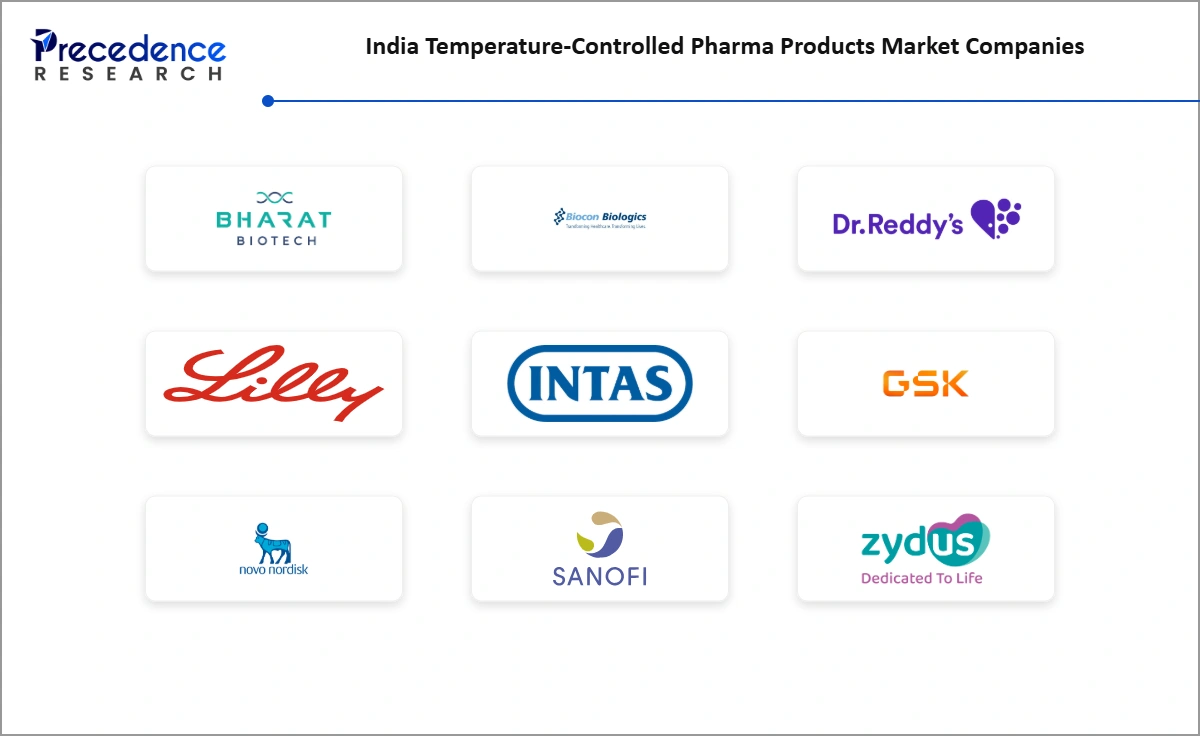
Serum Institute of India led the India temperature-controlled pharma products market with 8.59% (USD 0.55 billion) of 2025 revenue, followed by Novo Nordisk India at 4.69% (USD 0.30 billion) and Biocon Biologics at 3.91% (USD 0.25 billion). Serum Institute of India leads with a wide range of vaccines for government programs and private markets. Novo Nordisk India is a leading supplier of insulin and GLP-1 products, and Biocon Biologics offers insulin and biosimilars for diabetes, cancer and autoimmune diseases. Intas Pharmaceuticals, Bharat Biotech, Zydus Lifesciences, Sanofi India, Dr. Reddy's Laboratories, GSK India, and Eli Lilly India compete through biosimilars, vaccines, insulin, and diabetes products.
The top 10 players accounted for 32.50% (USD 2.08 billion) of 2025 revenue, while the remaining 67.50% (USD 4.32 billion) was shared among many domestic biologics makers, plasma fractionators and distributors. The India temperature-controlled pharma products market is moderately concentrated, and competition centers on product portfolio, price, government tender wins, cold chain distribution reach, doctor relationships, and biosimilar launches. Price controls and government procurement keep prices low for many essential products.
Companies Ecosystem
The India temperature-controlled pharma products ecosystem links manufacturers with cold chain packaging and logistics providers, distributors, hospitals and pharmacies, government programs and patients.
| Ecosystem Stage | Role in the Market | Key Companies |
| Manufacturers | Make vaccines and biologics | Serum Institute, Biocon, Bharat Biotech, Intas, Zydus |
| Cold Chain Logistics | Store and move products | Envirotainer, Snowman Logistics, Kuehne+Nagel |
| Distributors | Supply hospitals and pharmacies | National and regional pharma distributors |
| Dispensing Points | Store and dispense | Hospital, retail and online pharmacies |
| Programs & Patients | Procure and use products | Universal Immunization Programme, patients |
Sources: Company press releases, expert interviews, secondary sources, Precedence Research database and Precedence Research analysts.
Precedence Research Companies Quadrant
The Precedence Research Companies Quadrant positions key participants in the India temperature-controlled pharma products market by market strength, reflecting revenue scale, market share and geographic reach, and by innovation and growth strategy, reflecting product portfolio breadth, R&D intensity and partnerships. Positions reflect each company's estimated 2025 Indian temperature-controlled product sales and our assessment of its portfolio, pipeline and distribution.
Sources: Company press releases, expert interviews, secondary sources, Precedence Research database and Precedence Research analysts.
Leaders: Serum Institute of India, Novo Nordisk India, Biocon Biologics, Intas Pharmaceuticals, Bharat Biotech, Zydus Lifesciences, and Sanofi India combine large Indian sales with broad vaccine, insulin, or biologics portfolios.
Innovators: Dr. Reddy's Laboratories, GSK India, and Eli Lilly India bring new vaccines and biologics to the Indian market.
Recent Development
- July 2026: Envirotainer opened a new station in Navi Mumbai, its sixth in India, roughly doubling capacity over its existing Mumbai operation. The facility adds local preconditioning services for temperature-controlled pharmaceutical shipments, strengthening cold chain capabilities across western India.
India Temperature Controlled Pharma Products Market Segments
By Product
- Vaccines
- Insulin & Diabetes Biologics
- Monoclonal Antibodies & Biosimilars
- Others
- Blood Products & Plasma Derivatives
By Temperature Range
- Refrigerated (2-8°C)
- Frozen
- Ultra-Low Temperature
By Distribution Channel
- Hospital Pharmacies
- Retail Pharmacies
- Government Programmes
- Online Pharmacies
By Country
- North India
- South India
- West India
- East & Northeast India
Research Methodology
The India temperature-controlled pharma products market was defined as pharmaceutical products sold in India that require refrigerated, frozen, or ultra-low temperature storage and distribution. The 2025 base year was built bottom-up from domestic sales volumes of temperature-controlled pharmaceutical products in India by product, temperature range, channel, and region, and average prices, and checked top-down against the domestic sales of leading vaccine, insulin, and biologics makers in India. Segment, regional and company values were allocated from products, temperature ranges, channels and regional consumption. Key estimates were verified by cross-checking company disclosures, regulatory and industry data and published third-party estimates, and inputs that could not be reconciled were excluded. All segment, regional and company figures were reconciled to the same 2025 base year, and the 2026-2035 forecast, which applies a constant CAGR from the 2025 base, was recalculated and validated.
Analyst View: India's temperature-controlled pharma products market is gaining momentum as demand for vaccines, insulin, biologics and biosimilars continues to rise. Expanding immunization programs, increasing chronic disease burden, and growing healthcare infrastructure are strengthening demand for reliable cold chain solutions. While biologics, adult vaccination and e-pharmacy delivery offer strong growth opportunities, high logistics costs, price pressures and limited rural cold chain infrastructure remain key challenges.
Sources and References
- "Envirotainer Opens Station in Navi Mumbai". July 2026. Press release. (Source: www-api.envirotainer.com)
For inquiries regarding discounts, bulk purchases, or customization requests, please contact us at sales@precedenceresearch.com
Frequently Asked Questions





Ask For Sample
No cookie-cutter, only authentic analysis – take the 1st step to become a Precedence Research client
 Get a Sample




 sales@precedenceresearch.com
 Schedule a Meeting