



Lab Consumables Market Size, Companies, Share, Patient Volume, Treatment Adoption Rates, Pricing Analysis, Regulatory Landscape, Competitive Positioning, and Demand Forecast
Lab Consumables Market (By Type: Reusable, Disposable; By Product: Pipettes and Tips, Syringes and Needles, Vials and Containers, Petri Dishes and Plates, Filtration Products and Accessories, Centrifuge Tubes, Test Tubes and Racks, Others; By Material: Plastic, Glass, Others; By Application: Lifescience Research, Clinical Diagnostics, Forensic Testing, Others; By End-user: Hospital and Clinics, Pharmaceutical and Biotechnology Companies, Clinical Laboratories, Academic and Research Institutions, Others (Forensic)) - Global Industry Analysis, Size, Trends, Leading Companies, Regional Outlook, and Forecast 2026 to 2035
Source: https://www.precedenceresearch.com/lab-consumables-market
 Get a Sample
 Table Of Content


What is Lab Consumables Market Size?
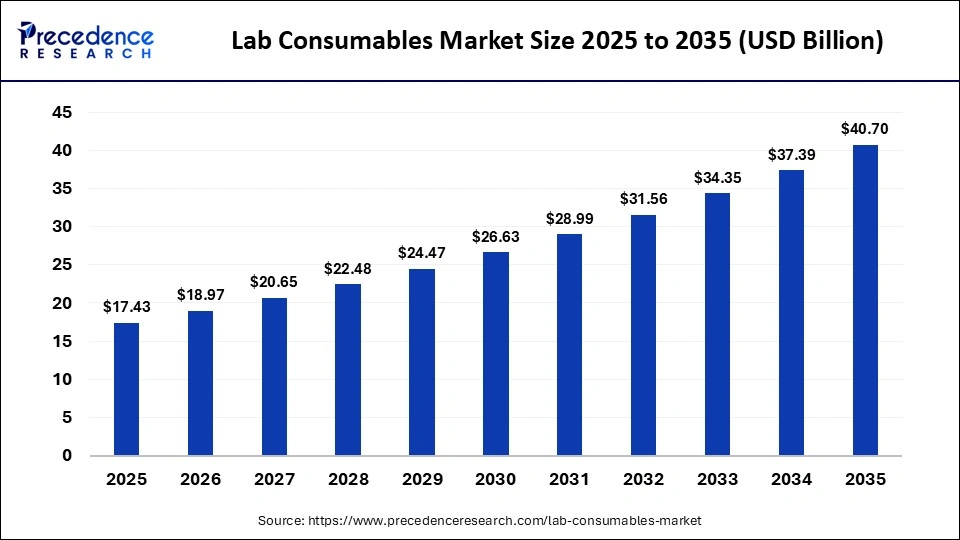
The global lab consumables market size was calculated at USD 17.43 billion in 2025 and is predicted to increase from USD 18.97 billion in 2026 to approximately USD 40.70 billion by 2035, expanding at a CAGR of 8.85% from 2026 to 2035. This market is growing due to the exponential rise in specialized, single-use, automation-compatible pipette tips, microplates, and vials, which are demanded for high-throughput screening in molecular diagnostics and even genomic research.
Key Takeaways
- North America dominated the global lab consumables market in 2025.
- Asia Pacific is expected to grow at the fastest CAGR between 2026 and 2035.
- By type, the disposable segment dominated the global market in 2025.
- By type, the reusable segment is expected to expand at the fastest CAGR between 2026 and 2035.
- By product, the syringes and needles segment dominated the global market in 2025.
- By product, the vials and containers segment is expected to expand at the fastest CAGR between 2026 and 2035.
- By material, the plastic segment dominated the global market in 2025.
- By material, the glass segment is expected to expand at the fastest CAGR between 2026 and 2035.
- By application, the life science research segment dominated the global lab consumables market in 2025.
- By application, the clinical diagnostics segment is expected to expand at the fastest CAGR between 2026 and 2035.
- By end-user, the hospital and clinics segment dominated the global market in 2025.
- By end-user, the pharmaceutical and biotechnology companies segment is expected to expand at the fastest CAGR between 2026 and 2035.
What Drives the Lab Consumables Market?
The market is driven by the increasing need for laboratory testing across various sectors. This expansion is propelled by advancements in research and development activities, mainly in pharmaceuticals and biotechnology. The market covers a wide range of products, including pipettes, petri dishes, test tubes, and lab bottles, which are essential for conducting experiments and analyses.
How is AI Influencing the Lab Consumables Market?
AI is revolutionizing the market by enhancing supply chain management, automating inventory replenishment, and improving product development. Through predictive analytics, AI decreases stockouts and waste, while machine learning streamlines manufacturing quality control and even logistics. It allows automated, just-in-time purchasing and guarantees regulatory compliance. AI improves resource usage, assisting labs in tracking consumption patterns to decrease unnecessary purchases of expensive reagents. AI speeds up the research and development of new, high-performance, and even sustainable materials for lab consumables.
What are the Key Trends Influencing the Lab Consumables Market?
- Automation and High-Throughput Screening: To increase efficiency, labs are changing toward robotic systems, driving the need for specialized consumables such as robotic pipette tips and microplates that demand precise dimensional tolerances.
- Single-Use Consumables and Sterility: The demand to minimize contamination risks and guarantee sterility in pharmaceutical and clinical settings has accelerated the need for disposable, single-use products.
- Sustainability and Eco-Friendly Products: Due to environmental concerns along with ESG mandates, there is a strong trend toward utilizing biodegradable materials, recyclable plastics, and reusable labware.
- Growth in R&D and Diagnostics: Increasing investment in biotech and pharma, combined with an aging population demanding more diagnostic tests for chronic diseases, is heavily boosting the market.
Market Scope
| Report Coverage | Details |
| Market Size in 2025 | USD 17.43 Billion |
| Market Size in 2026 | USD 18.97 Billion |
| Market Size by 2035 | USD 40.70 Billion |
| Market Growth Rate from 2026 to 2035 | CAGR of 8.85% |
| Dominating Region | North America |
| Fastest Growing Region | Asia Pacific |
| Base Year | 2025 |
| Forecast Period | 2026 to 2035 |
| Segments Covered | Product, Type, Application, Material, End-user, and region |
| Regions Covered | North America, Europe, Asia-Pacific, Latin America, and Middle East & Africa |
Segment Insights
Type Insights
What made the Disposable Segment Dominant in the Lab Consumables Market?
The disposable segment led the market in 2025. It is driven by surging clinical diagnostics, growing infectious diseases (COVID-19), along with rapid expansion in pharmaceutical or biotech R&D. Safety, convenience, decreased cross-contamination, and even automation compatibility cemented this expansion. The growth of drug discovery, vaccine development, and genomic research demands high-throughput, sterile, and reliable disposable tools. Disposables provide superior convenience, removing the demand for cleaning and sterilization, which saves time and labor in high-volume and fast-paced laboratory environments.
The reusable segment is expected to grow at the fastest CAGR in the lab consumables market throughout the forecast period. Laboratories are facing increased pressure to decrease the enormous amount of plastic waste generated. Reusable glassware, along with specialized, durable plastics, are being accepted to align with sustainability goals and decrease carbon footprints. The development of sophisticated cleaning, washing, and sterilization systems, like those from Grenova, enables the safe, automated, and thus validated reuse of formerly single-use items such as pipette tips and plates without compromising research quality.
Product Insights
Why did the Syringes and Needles Segment Dominate the Lab Consumables Market?
The syringes and needles segment dominated the market in 2025. This is due to an unprecedented rise in need for chronic disease management, widespread vaccination programs, and even the accelerating shift towards pre-filled together with safety-engineered devices. Pre-filled syringes are favored for decreasing dosage errors and enhancing efficiency in hospitals, mainly with the growth of biologic therapies.
The vials and containers segment is expected to grow at a significant CAGR in the upcoming period, because of the rapid growth in biotechnology and the demand for large-scale vaccine manufacturing, mainly following the COVID-19 pandemic, have created a massive need for specialized vials and containers. The growth of molecular diagnostics, especially in oncology and infectious diseases, demands high-quality, specialized containers for PCR and next-generation sequencing, along with sample collection.
Material Insights
Why did the Plastic Segment Dominate the Lab Consumables Market?
The plastic segment dominated the market in 2025. This is because of its cost-effectiveness, lightweight nature, and superior breakage resistance compared to glass. Plastic is generally less expensive, and even its disposability saves time and resources on cleaning and sterilization. Further, increased investment in pharmaceutical, biotech, and even clinical diagnostic research drives the demand for high-quality, contamination-free plastic consumables.
The glass segment is expected to grow at a significant CAGR in the upcoming period, due to its unmatched chemical inertness, high thermal stability, and superior optical transparency. Borosilicate glass generally does not react with most chemicals, acids, bases, or organic solvents, guaranteeing that experimental results remain accurate and pure. This is vital for maintaining sample integrity.
Application Insights
Why did the Lifescience Research Segment Dominate the Lab Consumables Market?
The life science research segment dominated the market in 2025. This is because of the heavy R&D investment in drug discovery, growing chronic disease prevalence, and the growth of the biotechnology and CRO sectors. High-volume, recurring need for specialized items such as reagents, kits, and sterile plastics is boosted by advanced genomics, proteomics, and automation. The rapid expansion of Contract Research Organizations, together with Contract Development and Manufacturing Organizations, mainly in emerging markets, has accelerated the consumption of lab products.
The clinical diagnostics segment is expected to grow at a significant CAGR in the upcoming period, due to its growing investment in healthcare facilities and rising need for, and accessibility to, preventative care, along with diagnostic services, mainly in emerging markets, which has fueled the demand for consumables. Clinical and diagnostic laboratories, which include hospital-based labs, have seen a remarkable rise in testing volume to fund patient care, which directly increases the need for consumables.
End-user Insights
Why did the Hospital and Clinics Segment Dominate the Lab Consumables Market?
The hospital and clinics segment dominated the market in 2025. This is because of the high-volume diagnostic testing, rising chronic disease prevalence, and growing hospital admissions. The demand for immediate, routine, and even specialized testing in clinical settings boosts continuous, high-volume consumption of diagnostic consumables, tubes, and, even increasingly, disposable, single-use, and specialized plastics. Thus, to prevent hospital-acquired infections, there is a high acceptance rate of single-use and disposable lab materials, boosting consistent, large-volume purchases.
The pharmaceutical and biotechnology companies segment is expected to grow at a significant CAGR in the upcoming period, due to its massive, sustained investment in R&D, drug discovery, and, remarkably, the continuous demand for quality control. This is largely driven by the rising need for new biologics, vaccines, and personalized medicines. The extensive, multi-stage procedure of drug discovery and development, from preclinical testing to clinical trials, demands a consistent, high-volume supply of consumables.
Regional Insights
What made North America the Dominant Region in the Lab Consumables Market?
North America dominated the market in 2025. This is due to the widespread usage of sophisticated diagnostics and genomics, along with precision medicine, which depend on high-precision, single-use, or specialized plasticware and reagents. There is substantial funding and a solid network of academic, clinical, and even private research laboratories that drive a continuous need for consumables.
U.S. Lab Consumables Market Trends
The U.S. leads the market. It is driven by remarkable investment in molecular biology, genomics, and proteomics, mainly through NIH funding, and is accelerating the need for specialized, high-purity consumables. Further, increasing regulatory scrutiny necessitates the usage of sterile, high-quality, and also traceable consumables to guarantee accuracy and reduce contamination risks.
What makes Asia Pacific the Fastest-Growing Region in the Lab Consumables Market?
Asia Pacific is expected to grow at the fastest CAGR throughout the forecast period, due to rapidly developing nations that are investing in healthcare facilities and even diagnostic labs to meet the demands of a growing, aging population. Increased focus on quality control and compliance with regulations such as the FDA and EMA necessitates the usage of high-quality, sterile consumables, like pipettes, vials, and filtration products.
China Lab Consumables Market Trends
The China market is driven by the growing adoption of eco-friendly, biodegradable, and sustainable materials to decrease the environmental impact of single-use plastics. Moreover, the implementation of smart, traceable, secure, and high-quality packaging for diagnostic and clinical products.
What makes Europe a Significant Region in the Lab Consumables Market?
Europe is expected to grow at a significant rate throughout the forecast period. This is due to its advanced, heavily supported pharmaceutical or biotech R&D, strict quality control regulations mainly for diagnostics, and a strong impact on sustainability. High-quality standards for medical devices, along with laboratory hygiene, mainly in sterilization, mandate the consistent usage of high-grade, single-use consumables.
UK Lab Consumables Market Trends
The UK market is driven by the increased investment in drug discovery, genomics, and personalized medicine, which is fueling the need for specialized, high-quality, sterile consumables. A huge shift toward using recyclable plastic labware and even sustainable materials, driven by global and local eco-friendly goals.
What makes Latin America the Notable Region in the Lab Consumables Market?
Latin America is expected to grow at a notable rate throughout the forecast period. This is due to rapid expansion driven by expanding pharmaceutical industries, a high burden of chronic diseases like cancer and diabetes requiring diagnostics, and even increased investment in healthcare infrastructure. The growth of the pharmaceutical sector, mainly in biosimilars and R&D, has increased the demand for lab supplies. Increased government spending, along with foreign investment in healthcare infrastructure are improving the sector, with Brazil emerging as a key hub.
Brazil Lab Consumables Market Trends
Brazil's market is driven by a rising focus on using sustainable or biodegradable plastics in laboratories, boosted by global environmental initiatives. Further, in-vitro diagnostics consumables, mainly those used for molecular diagnostics, together with immunoassay, are driving the need due to increased chronic disease screening. Thus, microplates are also registering significant growth.
What makes MEA the Rapid Region in the Lab Consumables Market?
MEA is expected to grow at a rapid rate throughout the forecast period. This is due to the high prevalence of chronic and infectious disorders necessitates consistent, high-volume testing, that changes directly into the consumption of laboratory materials. To enhance efficiency and accuracy, labs in the Middle East are shifting from manual to automated systems, boosting the need for specialized, automation-compatible, and high-precision consumables. The "smart lab" concept is becoming popular to improve speed and reduce errors, especially in molecular diagnostics.
UAE Lab Consumables Market Trends
The UAE market is driven by rising healthcare, pharmaceutical research, and medical tourism. The need is highest for pipettes & tips and also vials & containers. The market is rapidly shifting toward disposable plasticware to guarantee contamination control.
Lab Consumables Market Companies
- Thermo Fisher Scientific offers a wide range of products, including reagents, labware, and safety consumables. The company's strong focus on innovation and its extensive global distribution network have helped it maintain a dominant position in the market.
- Merck KGaA provides a comprehensive range of lab consumables, including reagents and labware. The company's emphasis on quality and its robust research and development capabilities have contributed to its strong market presence.
- Danaher Corporation is known for its broad portfolio of laboratory products, including pipettes, tubes, and plates, and has a significant presence in the lab consumables market. The company's focus on technological advancements and its strategic acquisitions have strengthened its market position.
- Agilent Technologies, another such key player in the market, offers a wide range of lab consumables, including reagents and labware. The company's emphasis on innovation and its strong global distribution network have helped it maintain a competitive edge in the market.
Other Major Key Players
- Danaher Corporation
- Bio-Rad Laboratories, Inc.
- Eppendorf SE
- Corning Incorporated
- Bruker
- PerkinElmer Inc.
Industry Developments
The market is characterized by a high level of innovation, and this growth and development are driven by advancements such as automation, AI, miniaturization, and smart technologies. Modern instruments now feature user-friendly interfaces, enhanced precision, and automation capabilities, such as touchscreen pipettes and robotic sample processors. These innovations help in improving efficiency, accuracy, and adaptability, thus meeting the evolving needs of scientific research and diagnostics.
Regulations all over the world also significantly impact the market by ensuring product safety, quality, and compliance. Strict standards, especially in healthcare and pharmaceuticals, help to drive innovation and lead to the development of high-quality equipment and disposables. Compliance requirements also influence procurement decisions, encouraging suppliers to provide certified products that meet regulatory benchmarks, thus fostering trust in highly critical research and diagnostic applications.
Global market expansion is further being driven by rising research activities, healthcare advancements, and increased demand for diagnostic tools worldwide. Key players all over the world are strengthening their presence through partnerships, distribution networks, and localized manufacturing.
Recent Developments
- In July 2025, Merck introduced the AAW Automated Assay Workstation, developed with automation leader Opentrons, to automate routine laboratory procedures. This partnership enhancement reduces manual, hands-on time, providing consistent, reliable results across various applications. It reflects a strategic move to boost laboratory productivity and advance research capabilities. (Source: https://www.merckgroup.com)
- In May 2025, Danaher Corporation declared the launch of a collaboration with AstraZeneca to develop and commercialize novel diagnostic tools and tests intended to aid clinicians in better determining which individuals would most benefit from precision medicine treatments. (Source: https://investors.danaher.com)
Segments Covered in the Report
By Type
- Reusable
- Disposable
By Product
- Pipettes and Tips
- Syringes and Needles
- Vials and Containers
- Petri Dishes and Plates
- Filtration Products and Accessories
- Centrifuge Tubes
- Test Tubes and Racks
- Others
By Material
- Plastic
- Glass
- Others
By Application
- Lifescience Research
- Clinical Diagnostics
- Forensic Testing
- Others
By End-user
- Hospital and Clinics
- Pharmaceutical and Biotechnology Companies
- Clinical Laboratories
- Academic and Research Institutions
- Others (Forensic)
By Region
- North America
- Asia Pacific
- Europe
- Latin America
- Middle East & Africa
For inquiries regarding discounts, bulk purchases, or customization requests, please contact us at sales@precedenceresearch.com
Frequently Asked Questions
Tags





Ask For Sample
No cookie-cutter, only authentic analysis – take the 1st step to become a Precedence Research client
 Get a Sample
.webp)



 sales@precedenceresearch.com
 Schedule a Meeting
